The State of Distribution in India in 2026
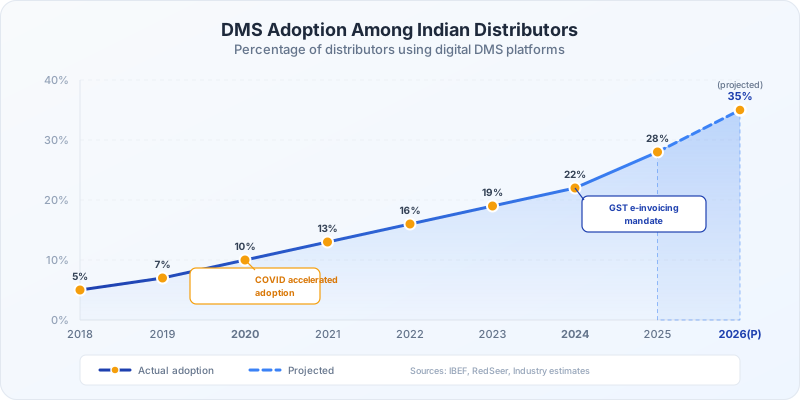
India's distribution economy is massive. Across FMCG, dairy, beverages, and packaged foods, the country moves goods worth over Rs 25 lakh crore annually through a network of 8 lakh distributors and 1.5 crore retail outlets. Yet only about 22% of these distributors use any form of digital distribution management software. The remaining 78% still rely on paper registers, WhatsApp, phone calls, and Excel sheets -- methods that are inefficient, error-prone, and completely opaque to the brands they represent.
Distribution management software changes this. By digitizing every touchpoint from factory to retailer shelf, it gives brands and distributors visibility, control, and scalability they have never had before. This definitive pillar guide explores everything you need to know about distribution management software in India: the unique Indian distribution ecosystem, market landscape, features, pricing, implementation, vendor selection, ROI, and real-world case studies. If you want to see a live demo, schedule one today.
Whether you are a dairy brand, an FMCG manufacturer, a beverage company, or a bakery chain, this guide will help you make an informed decision. For a quick overview of the DMS concept, start with our companion piece: What is DMS? Distributor Management System Explained.
The Indian Distribution Ecosystem Explained
Before evaluating software, you need to understand the distribution channel structure that makes India fundamentally different from Western markets. India's distribution chain is the longest and most fragmented in the world, and no DMS platform can succeed here without being designed around it.
The Multi-Tier Channel Structure
A typical Indian FMCG distribution chain follows this path:
Manufacturer → Carrying and Forwarding Agent (C&FA) → Super Stockist → Distributor → Retailer → Consumer
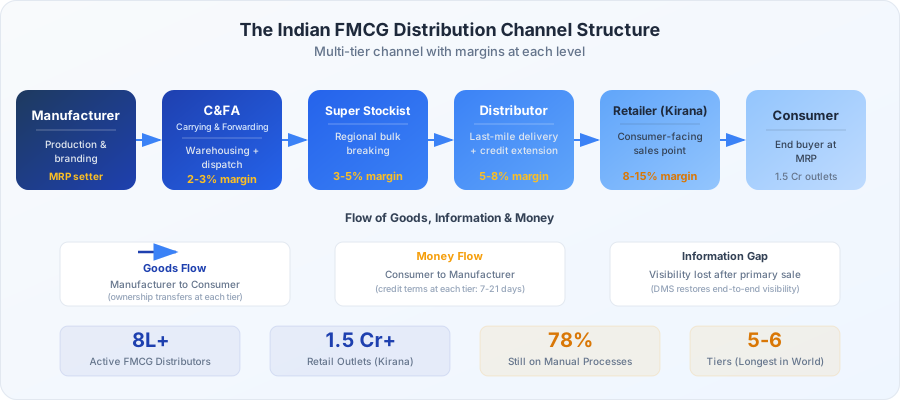
Each tier serves a specific purpose:
- C&FA (Carrying and Forwarding Agent): Operates as a logistics hub. Does not take ownership of goods but manages warehousing and dispatching on behalf of the manufacturer. Typically handles a zone or state. There are approximately 4,000-5,000 CFAs across India.
- Super Stockist: A bulk buyer who purchases from the C&FA and breaks bulk for redistribution to distributors. Common in regions where distributor density is high. Earns 2-4% margin.
- Distributor: The backbone of Indian distribution. Takes ownership of inventory, extends credit to retailers, manages a defined geography (typically a town or part of a city), and employs salesmen to service retail outlets. India has approximately 8 lakh active FMCG distributors. Margins range from 3-8% depending on category and brand power.
- Retailer (Kirana Store): The final touchpoint before the consumer. India has over 1.5 crore kirana stores, making it the largest unorganized retail market on earth. For more on how technology is reaching these stores, read our guide on kirana store distribution technology.
How India Differs From Western Distribution
In the US or Europe, manufacturers sell directly to large retail chains (Walmart, Tesco) or through a single tier of distributors. India's multi-tier structure exists because of three factors:
- Geographic fragmentation: 6 lakh+ villages, 8,000+ towns, 28 states with different languages, tax environments (pre-GST), and consumer preferences.
- Retail fragmentation: 1.5 crore+ small stores, most with less than 200 sq ft of shelf space, each ordering Rs 2,000-10,000 worth of goods per visit.
- Credit dependency: Most kirana stores operate on credit terms of 7-21 days. The distributor absorbs this working capital requirement, which no manufacturer could manage directly at scale.
This is why any distributor management software built for India must handle multi-tier hierarchies, credit management, beat-level operations, and vernacular interfaces. Generic ERP systems designed for Western markets consistently fail in India. Read our comparison: ERP vs CRM vs DMS for Indian distribution.
Distribution Economics: Margins at Each Level
| Channel Partner | Typical Margin | Working Capital Requirement | Key Risk |
|---|---|---|---|
| C&FA | 1-2% (commission) | Low (does not own goods) | Warehousing efficiency |
| Super Stockist | 2-4% | Medium | Bulk inventory holding |
| Distributor | 3-8% | High (owns inventory + extends credit) | Credit risk, expiry, returns |
| Retailer | 10-20% | Low-Medium | Footfall, competition |
Understanding these economics matters because distribution management software must optimize at every tier. A 0.5% margin improvement for a distributor doing Rs 2 crore annual turnover means Rs 1 lakh in additional profit -- and when multiplied across your entire network of 200+ distributors, the aggregate impact runs into crores. For a deeper dive into distributor economics, see our guide on FMCG distributor margins and profitability in India.
What is Distribution Management Software?
Distribution management software (often called DMS or DSM) is a purpose-built platform that manages the flow of goods, information, and money between manufacturers, distributors, and retailers. It covers order placement, inventory tracking, invoicing, payments, trade schemes, returns, reverse logistics, and analytics -- all in a single integrated system.
Unlike generic ERPs, distribution management software is designed for the specific workflows of channel sales: daily order cycles, trade promotions, secondary sales, beat planning, and field force management. For an exhaustive feature list, refer to the DMS features checklist.
DMS Market Landscape in India (2026)
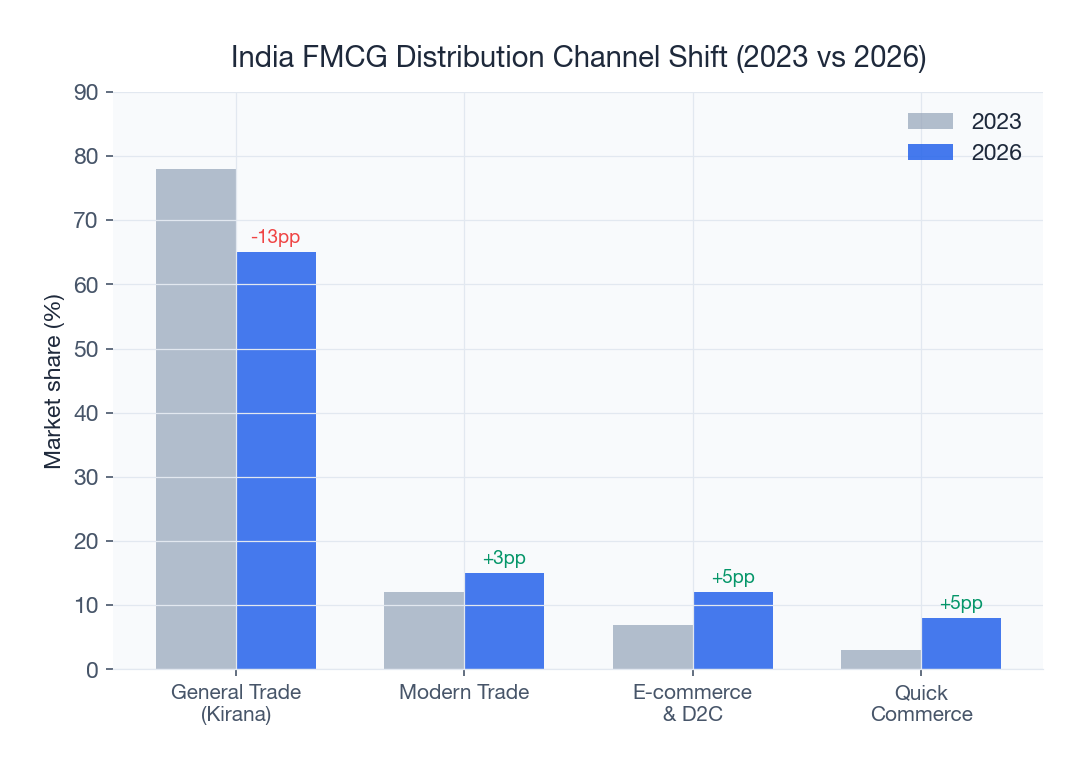
The Indian DMS market has matured significantly over the past five years. According to industry estimates from NASSCOM and RedSeer, the market for distribution technology platforms in India crossed Rs 3,500 crore in 2025 and is projected to grow at 30-35% CAGR through 2028, driven by GST compliance requirements, D2C brand proliferation, and the push for secondary sales visibility.
Major DMS Vendors in India
| Vendor | Strengths | Best For | Pricing Model |
|---|---|---|---|
| Bizom | Enterprise features, analytics, large client base | Large FMCG companies (500+ distributors) | Per-user, enterprise pricing |
| FieldAssist | Field force automation, SFA+DMS combo | Mid-to-large FMCG brands | Per-user, tiered |
| BeatRoute | Channel partner engagement, modern UX | Mid-market brands with GT+MT mix | Per-user, modular |
| Botree (MobiVista) | Deep ERP integration, strong in pharma+FMCG | Enterprises with SAP/Oracle ERP | License + AMC |
| Ivy Mobility | Global presence, CPG-focused | MNCs operating in India | Enterprise licensing |
| SpireStock | Dairy/perishable focus, crate tracking, affordable SaaS | Dairy, FMCG, beverage brands of all sizes | Transparent SaaS tiers |
For a detailed head-to-head comparison, read our analysis: Tally vs Bizom vs FieldAssist: which DMS is right for your business? and the comprehensive Best Distributor Management Software India: Buyer's Guide.
Key Market Trends
- Cloud-first shift: In 2020, roughly 60% of DMS deployments were on-premise. By 2026, the ratio has flipped: over 75% of new deployments are cloud SaaS. For a detailed comparison, see SaaS vs on-premise DMS.
- Mobile-first design: Distributors and salesmen use the DMS primarily on Android phones, not desktops. Any DMS without a robust offline-capable mobile app is a non-starter in India.
- AI/ML integration: Leading platforms are adding demand forecasting, anomaly detection, and route optimization powered by machine learning. See our deep dive on demand forecasting for distribution.
- API ecosystems: DMS platforms are becoming integration hubs, connecting to Tally, GST portals, e-invoicing, payment gateways, and even WhatsApp for retailer ordering.
- Vertical specialization: Generic one-size-fits-all DMS is giving way to platforms specialized for dairy, bakery, beverages, and pharma, each with category-specific workflows.
DMS for Different Business Sizes
One of the biggest mistakes brands make is choosing a DMS designed for a different scale of operation. What works for HUL with 5,000 distributors will not work for a regional snacks brand with 40 distributors, and vice versa. Here is how needs differ by scale:
Startups and Small Brands (10-50 Distributors)
At this stage, founders often handle distribution personally. The priority is getting a basic digital system in place before bad habits (paper-based tracking, WhatsApp ordering, Excel billing) become ingrained. For a comprehensive startup guide, read the dairy startup distribution guide.
- Need: Simple, affordable SaaS with quick onboarding (under 2 weeks)
- Budget: Rs 5,000-20,000/month
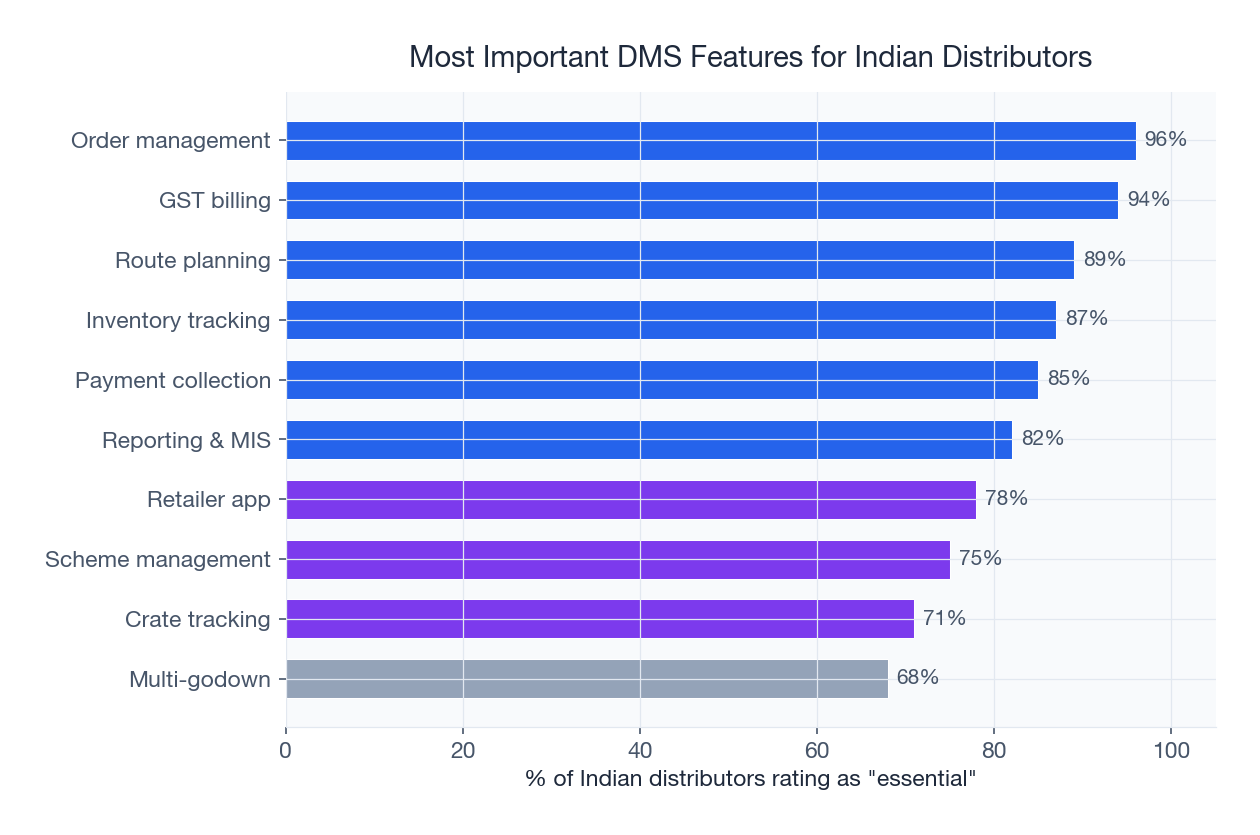
- Must-haves: Order management, GST billing, basic inventory, mobile app
- Nice-to-haves: Route planning, analytics
- Common mistake: Buying an enterprise DMS that takes 3 months to implement and costs 5x the budget
Mid-Market Brands (50-500 Distributors)
This is the scale where distribution management software delivers the highest ROI. Manual processes that worked at 30 distributors break at 100. You need systems that scale.
- Need: Full-featured DMS with scheme engine, analytics, multi-plant support
- Budget: Rs 25,000-1,00,000/month
- Must-haves: Scheme management, secondary sales tracking, field force tracking, credit management, reporting
- Nice-to-haves: API integrations, custom workflows, advanced analytics
- Common mistake: Over-customizing instead of adapting processes to best-practice workflows
Enterprise Brands (500-5,000+ Distributors)
Enterprise brands need DMS platforms that serve as the central nervous system of their distribution. The platform must integrate seamlessly with ERP (SAP, Oracle), handle massive data volumes, and support a complex organizational hierarchy.
- Need: Enterprise-grade customization, ERP integration, API ecosystem, multi-geography support
- Budget: Rs 2-10 lakh/month plus implementation
- Must-haves: Deep ERP/SAP integration, custom approval workflows, territory hierarchy management, BI/analytics suite, multi-plant distribution
- Nice-to-haves: AI-powered demand forecasting, predictive analytics, white-labeled distributor app
- Common mistake: Building in-house instead of buying, resulting in 10x higher TCO and years of tech debt
Feature Matrix by Business Size
| Feature | Small (10-50) | Mid (50-500) | Enterprise (500+) |
|---|---|---|---|
| Order management | Essential | Essential | Essential |
| GST billing | Essential | Essential | Essential |
| Mobile app | Essential | Essential | Essential |
| Inventory tracking | Basic | Advanced (multi-warehouse) | Advanced + ERP sync |
| Scheme engine | Basic | Essential | Advanced (multi-tier) |
| Route optimization | Optional | Essential | AI-powered |
| Beat planning | Optional | Essential | Essential |
| Field force tracking | Optional | Essential | Essential |
| Secondary sales tracking | Optional | Essential | Essential |
| Analytics/BI | Basic dashboards | Advanced | Custom BI + data lake |
| ERP integration | Not needed | Optional | Essential |
| API access | Not needed | Optional | Essential |
| Crate/asset tracking | Category-dependent | Category-dependent | Category-dependent |
| Multi-plant support | Not needed | Optional | Essential |
For more guidance on matching features to your requirements, see the DMS buyer's checklist.
Why Indian Brands Need Distribution Management Software
1. Scale Without Chaos
Growing from 50 to 500 distributors is impossible with manual processes. Distribution software provides the systems backbone that lets you scale revenue 10x without tripling your operations headcount. According to a 2025 McKinsey India study, brands using DMS platforms scaled their distribution networks 2.3x faster than those relying on manual processes, with 40% lower incremental operations cost.
2. Real-Time Visibility
Brands have historically lost sight of their products the moment they left the factory. Distribution software restores visibility -- you can see inventory at every distributor, know exactly what is selling at the retailer level, and identify problems before they become crises. This distribution tracking capability is what transforms reactive firefighting into proactive management.
3. GST and Regulatory Compliance
India's GST framework, e-invoicing mandates (now extended to businesses with Rs 5 crore+ turnover), and e-way bill requirements make manual compliance risky. Distribution software automates it all -- generating compliant invoices, filing returns data, and maintaining audit trails that reduce penalty risk. Learn more in our GST billing guide for distributors.
4. Competitive Pressure
Your competitors are digitizing. If you do not, you will find it increasingly difficult to attract quality distributors, who prefer brands with modern systems that simplify their operations. A FICCI survey found that 67% of distributors in metro cities now factor in "brand technology support" when deciding whether to take on a new brand.
5. Working Capital Optimization
Distribution is a working-capital-intensive business. Every day of delayed collection, every instance of unsold inventory, and every case of unreconciled claims erodes profitability. DMS platforms with payment collection automation and credit limit management typically reduce the cash-to-cash cycle by 20-30%.
6. Secondary Sales Intelligence
Primary sales (manufacturer to distributor) tell you what you shipped. Secondary sales (distributor to retailer) tell you what is actually selling. Without secondary sales tracking, you are flying blind. DMS gives you daily secondary sales data at the SKU-outlet level -- intelligence that was previously available only to the largest FMCG companies with dedicated market research budgets.
Feature Deep Dive: What Each Module Does
Most DMS vendors list features as bullet points. Here, we explain exactly how each module works in practice, what workflows it supports, and what business impact you should expect.
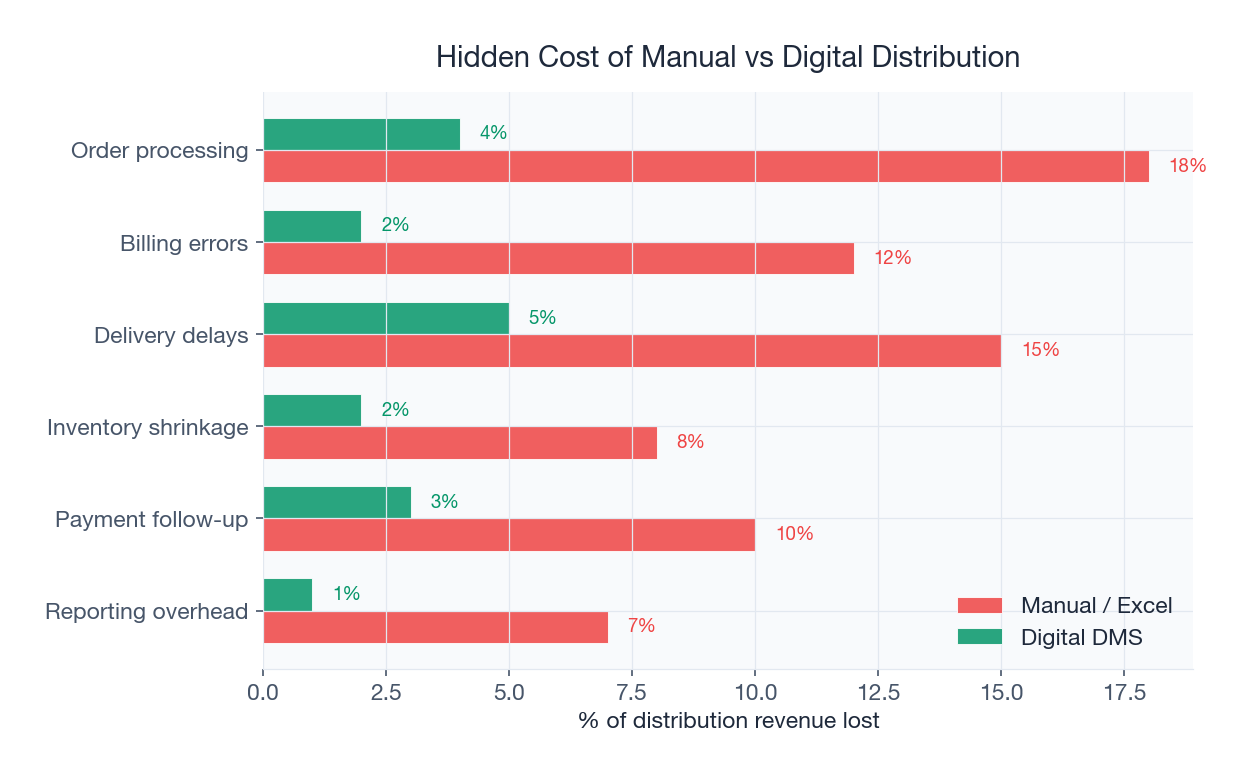
Order Management
Order management is the heart of any DMS. Here is how a typical order cycle works in a well-implemented system:
- Order placement: The distributor or salesman opens the mobile app, selects the retailer, and places an order. The system pre-populates the last order for quick reordering. For retailers using WhatsApp-based ordering, orders can be captured via chat and auto-converted into the DMS.
- Validation: The system checks available stock, credit limit, minimum order quantity, and any order cutoff times. Orders that fail validation are flagged with clear reasons.
- Routing: Validated orders are routed to the appropriate plant or warehouse based on geography, product availability, and delivery schedule.
- Approval: Multi-level approval workflows (if configured) route large or exception orders to the appropriate authority.
- Fulfillment: The warehouse team picks, packs, and dispatches. The system generates a dispatch note and updates inventory in real time.
- Delivery confirmation: The delivery person captures digital proof of delivery with photo, signature, and timestamp.
Business impact: Brands using SpireStock's order management module report 95% reduction in order processing time (from 45 minutes per order to under 2 minutes) and 60% fewer order errors. Read the detailed breakdown in order management for dairy distributors.
Inventory and Warehouse Tracking
Real-time stock visibility across factories, CFAs, super-distributors, and distributors. The system tracks inventory by SKU, batch, manufacturing date, and expiry date. Automated reorder triggers notify when stock falls below configurable thresholds.
For perishable categories like dairy and bakery, the system enforces FIFO/FEFO (First Expiry, First Out) dispatch rules, reducing expiry-related losses. Multi-godown tracking is essential for distributors managing multiple warehouses -- see our guide on multi-godown stock management. For batch tracking and traceability, the DMS maintains a complete chain-of-custody from production to retail shelf.
Business impact: 35-50% reduction in expiry losses, 25% improvement in stock turnover, near-zero stockouts at distributor points.
Invoicing and GST Billing
Automated GST-compliant invoicing handles all the complexity that makes manual billing a nightmare: multi-rate GST (5%, 12%, 18%, 28%), CGST/SGST/IGST split based on transaction type, HSN code mapping, e-invoicing via the NIC portal (mandatory for businesses above Rs 5 crore turnover), and automated credit/debit notes for returns. The system generates GST-compliant invoices in seconds, not hours.
Business impact: 90% reduction in billing time, zero GST filing errors, automatic reconciliation with Tally/accounting software. Read our deep dive on GST billing for dairy distribution.
Scheme and Promotion Management
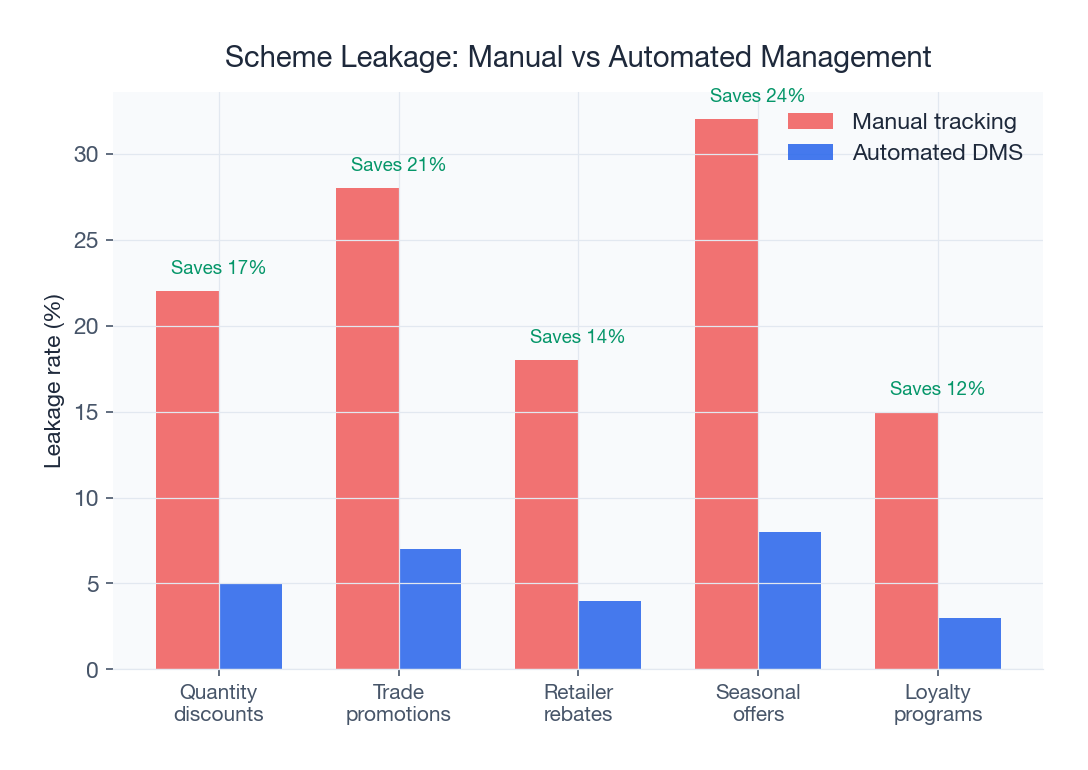
A configurable scheme engine is what separates a real DMS from a glorified billing tool. Trade promotions are the lifeblood of Indian FMCG distribution -- brands spend 15-25% of revenue on trade schemes -- and manual scheme management leaks 8-15% of that spend.
The scheme engine supports multiple promotion types: flat discounts, slab-based rebates, buy-X-get-Y free goods, target-linked bonuses, combination offers, and seasonal promotions. Schemes can be targeted by geography, distributor tier, product category, or individual retailer. For a deep exploration of this problem, read how to prevent scheme leakage in FMCG.
Business impact: Near-zero scheme leakage (down from 8-15%), 40% faster scheme rollout, elimination of manual scheme calculation disputes between brands and distributors.
Route and Beat Planning
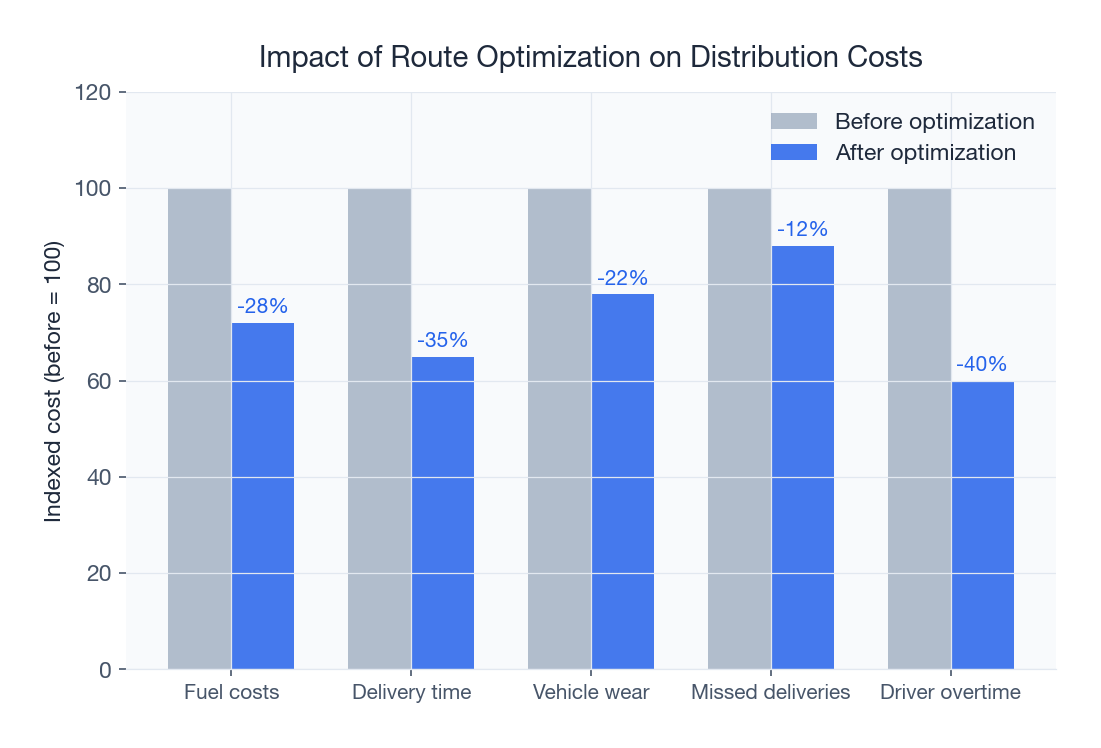
Route optimization minimizes delivery costs by calculating the most efficient sequence of stops. Beat planning assigns retailers to salesmen based on geography, visit frequency, and outlet potential. A well-designed beat plan ensures every retailer gets visited at the right frequency: high-value outlets weekly, medium outlets bi-weekly, tail outlets monthly.
The DMS tracks beat adherence in real time -- if a salesman skips outlets or deviates from the planned route, the system flags it immediately. Learn more in What is Beat Planning in FMCG? and our dedicated guide on dairy delivery route planning.
Business impact: 15-25% reduction in fuel and travel costs, 30% improvement in outlet coverage, 20% increase in productive selling time per salesman.
Field Force Management
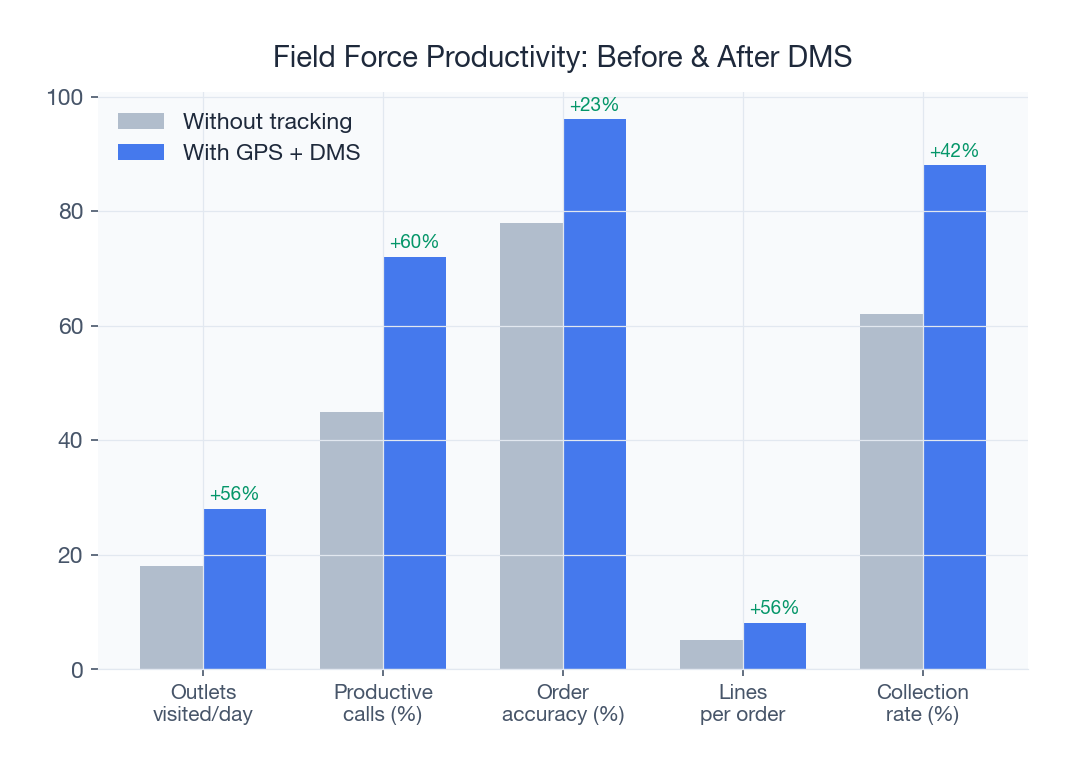
GPS tracking, attendance tracking, and beat adherence reports ensure your field team is actually visiting outlets as planned. The mobile app captures check-in/check-out times with geo-tagged photos, so there is no ambiguity about whether a visit happened.
Beyond attendance, field force tracking measures productivity metrics: orders per visit, lines per order, time per outlet, and coverage percentage. This data lets you identify underperforming salesmen, optimize territory assignments, and link incentives to measurable outcomes. See also: salesman tracking apps for FMCG.
Business impact: 25% increase in productive field time, 35% improvement in outlet coverage adherence, near-elimination of ghost visits.
Collection and Credit Management
Payment collection modules track receivables, age invoices, automate reminders, and reconcile partial payments. The system maintains a real-time outstanding balance for every retailer and distributor, with aging analysis (0-7 days, 7-15, 15-30, 30+) that drives collection priority. For more on this critical function, read payment collection for dairy distributors and distributor claims settlement.
Business impact: 20-30% reduction in average collection period, 50% fewer overdue accounts, automated reconciliation that eliminates month-end chaos.
Analytics and Reporting
Sales analytics dashboards surface KPIs across distributors, products, territories, and time periods. Data replaces gut-feel. Typical reports include: daily/weekly/monthly sales trends, distributor-wise performance ranking, SKU-wise profitability, territory heatmaps, scheme ROI analysis, salesman productivity scorecards, and automated MIS reports.
Business impact: Decisions backed by data instead of intuition. Brands using DMS analytics identify underperforming territories 60% faster and reallocate resources 3x more efficiently than those using manual reporting.
Crate and Returnable Asset Tracking
For dairy, beverages, and bakery brands, crate and returnable asset management is non-negotiable. India's dairy industry alone loses Rs 2,000-3,000 crore annually in crate losses. The DMS tracks every crate by serial number or batch, recording issuance, return, and current location. For a dedicated guide, see crate management systems for dairy and returnable asset tracking for FMCG.
Business impact: 60-80% reduction in crate loss, complete audit trail for asset disputes, recovery of Rs 15-30 lakh annually for a mid-size dairy brand.
Top Categories Served by Distribution Software
| Category | Special Requirements | Software Fit |
|---|---|---|
| Dairy | Daily orders, perishability, crate tracking, cold chain | Dairy DMS |
| FMCG | Schemes, secondary sales, retailer coverage | FMCG DMS |
| Beverages | Returnable bottles, route density, cold chain | Beverage DMS |
| Bakery | Short shelf life, bread routes, daily returns | Bakery DMS |
| Fresh produce | Quality grading, cold chain, loss management | Fresh produce DMS |
| Consumer goods | Long tail SKUs, large retail base | Consumer goods DMS |
For perishable goods across categories, see our specialized guide: perishable goods distribution software. Dairy brands specifically should read the complete guide to dairy distribution software in India.
Integration Landscape: How DMS Connects With Your Tech Stack
No DMS operates in isolation. It must integrate with your accounting software, tax portals, payment systems, and potentially your ERP. Here is the integration landscape for Indian distribution:
Accounting Software Integration
- Tally Prime: The most common integration for Indian distributors. DMS syncs invoices, payments, and credit notes to Tally via XML import or API. This eliminates double-entry and ensures books are always current. See our comparison: SpireStock vs Tally for distribution.
- Busy Accounting: Similar to Tally integration, with voucher-level sync for purchases, sales, and receipts.
- Zoho Books / QuickBooks: API-based integration for brands using cloud accounting, particularly common among newer D2C brands scaling into general trade.
ERP Integration
- SAP Business One / SAP S/4HANA: Enterprise brands need bidirectional sync between DMS and SAP for master data (products, customers), transactions (orders, invoices), and inventory. Typically done via RFC/BAPI or middleware like MuleSoft.
- Oracle NetSuite: REST API-based integration for cloud ERP environments.
- Microsoft Dynamics: Common in mid-market enterprises, integrated via APIs or flat-file exchange.
For a detailed comparison of ERP vs standalone DMS approaches, read ERP vs Distribution Management Software.
Government and Compliance Portals
- NIC e-invoicing portal: Direct API integration for generating IRN (Invoice Reference Number) for every B2B invoice, mandatory for businesses above Rs 5 crore turnover. Read our guide on e-invoicing for FMCG distribution.
- E-way bill portal: Auto-generation of e-way bills for inter-state and intra-state movement of goods above Rs 50,000. See e-way bill guide for distributors.
- GST portal: Export of GSTR-1 data for monthly/quarterly filing, with auto-reconciliation of input credit.
- FSSAI: License tracking and compliance documentation for food industry distributors. More at FSSAI compliance for dairy distributors.
Payment Gateways
- Razorpay / PayU / Cashfree: For digital payment collection from retailers via UPI, net banking, or payment links.
- NEFT/RTGS reconciliation: Auto-matching of bank credits to outstanding invoices.
API-First vs File-Based Integration
Modern DMS platforms like SpireStock offer API-first integration, meaning every function is accessible via REST APIs. This enables real-time data sync, custom dashboard builds, and integration with any third-party system. Legacy platforms still rely on file-based integration (CSV/XML export-import), which introduces lag, errors, and manual intervention. When evaluating vendors, always ask: "Is your platform API-first or file-based?"
Total Cost of Ownership
The monthly SaaS fee is just one component of DMS cost. Here is the full picture:
Cost Components
| Cost Component | SaaS (Cloud) | On-Premise | Hybrid |
|---|---|---|---|
| Software license/subscription | Rs 5K-5L/month | Rs 10-50L one-time | Rs 5-25L + monthly |
| Implementation | Rs 1-5L | Rs 5-25L | Rs 3-15L |
| Server infrastructure | Included | Rs 5-15L + Rs 2-5L/year AMC | Partial |
| Data migration | Rs 50K-3L | Rs 1-5L | Rs 1-3L |
| Training (initial) | Rs 1-3L | Rs 2-5L | Rs 2-4L |
| Change management | Rs 50K-2L | Rs 1-3L | Rs 1-2L |
| Annual support/maintenance | Included | 15-20% of license/year | 10-15% of license/year |
| Customization | Rs 0-5L | Rs 5-25L | Rs 3-10L |
| Upgrades | Included (auto) | Rs 2-10L per major version | Varies |
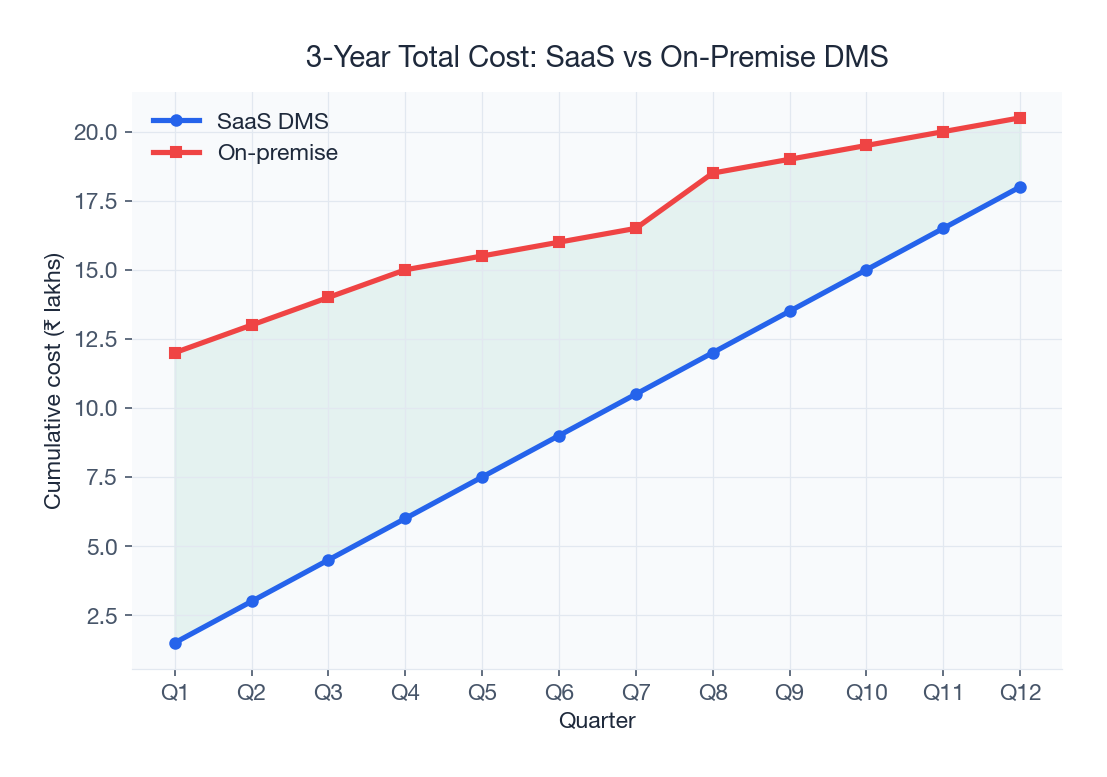
3-Year TCO Comparison (200-Distributor Operation)
| Item | SaaS DMS | On-Premise DMS |
|---|---|---|
| Year 1 (setup + subscription) | Rs 12-18L | Rs 30-55L |
| Year 2 (subscription + support) | Rs 6-12L | Rs 5-10L (AMC) |
| Year 3 (subscription + support) | Rs 6-12L | Rs 5-10L (AMC) + Rs 5-10L (upgrade) |
| 3-Year Total | Rs 24-42L | Rs 40-75L |
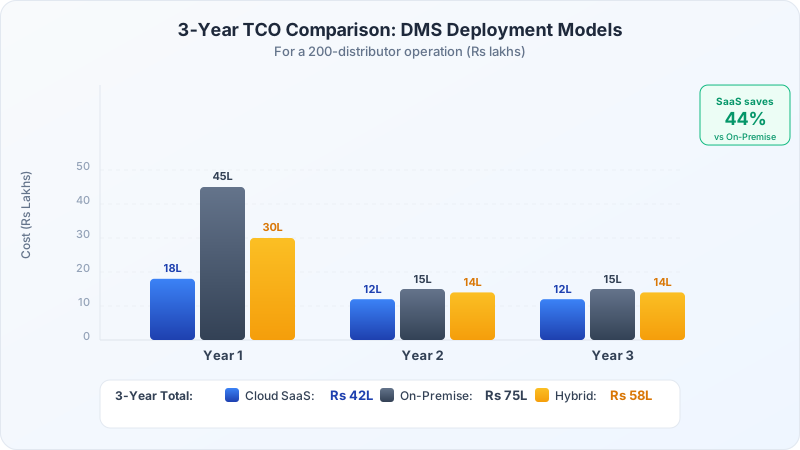
SaaS wins on total cost in nearly every scenario. The only exception is very large enterprises (1,000+ distributors) with unique customization needs where on-premise licensing costs are amortized over massive user bases. For a detailed pricing analysis, read our DMS pricing guide for India. Also compare: free vs paid distribution management software.
See SpireStock's transparent pricing plans for details.
Migration Guide: Switching from Manual to Digital
Implementing DMS is not just a software installation -- it is a transformation of how your distribution operates. Based on hundreds of implementations across Indian brands, here is a proven migration framework. For common pitfalls, also read DMS implementation mistakes Indian distributors make.
Phase 1: Audit Current State (2 Weeks)
- Document all current workflows: how orders are placed, how billing happens, how schemes are communicated, how collections are tracked
- Map your distributor hierarchy: CFAs, super stockists, distributors, sub-stockists
- Identify pain points: where does information get lost? Where do errors happen? What takes the most time?
- Catalog all master data: product list, price lists, distributor database, retailer database, territory mapping
- Assess technology readiness: do distributors have smartphones? What is connectivity like in your geographies?
Phase 2: Data Preparation (2 Weeks)
- Clean and standardize master data: product codes, GST rates, HSN codes, distributor details
- Resolve data conflicts: duplicate retailers, inconsistent pricing, unmapped territories
- Prepare opening balances: outstanding receivables, current inventory levels, pending claims
- Configure the DMS: set up organizational hierarchy, user roles, approval workflows, scheme rules
- Integrate with Tally/accounting system: map chart of accounts, voucher types, tax codes. See Tally integration for distribution software
Phase 3: Pilot (4 Weeks)
- Select 10-20 distributors in one city/region for the pilot
- Train pilot distributors and their staff: hands-on training, not slide decks. Field visits, not webinars
- Run parallel systems (old + new) for 2 weeks to validate accuracy
- Collect feedback daily: what works, what does not, what is confusing
- Iterate on configuration: adjust workflows, reports, and alerts based on real-world usage
- Measure pilot KPIs: order accuracy, billing speed, user adoption rate, error rates
Phase 4: Phased Rollout (4-8 Weeks)
- Roll out region by region, not all at once. Typical sequence: pilot city → state → zone → national
- Assign a dedicated rollout team: at least one person per 50 distributors during the transition
- Conduct training in batches of 15-20 distributors
- Set up a support helpline (WhatsApp group + phone) for the first 30 days
- Monitor adoption metrics daily: app logins, orders placed via DMS, billing compliance
Phase 5: Optimization (Ongoing)
- After 90 days of full rollout, review analytics to identify optimization opportunities
- Fine-tune beat plans based on actual visit data
- Optimize schemes based on ROI analysis
- Expand integrations: connect payment gateways, enable e-invoicing, integrate advanced analytics
- Plan for advanced modules: AI-powered forecasting, retailer self-ordering app, delivery tracking
Common Migration Pitfalls
- Skipping the pilot -- rolling out to all distributors at once almost always fails. Pilot first, always.
- Underinvesting in training -- field staff need hands-on training, not slide decks. Budget 2-3x what you think is enough.
- Ignoring offline capability -- rural connectivity issues derail pure-cloud platforms. Test offline mode extensively.
- Over-customizing -- chasing every niche request delays go-live and inflates costs. Start with 80% standard workflows.
- No change management -- distributors resist new systems without clear incentives and support. Show them the "what's in it for me."
- Dirty master data -- garbage in, garbage out. Clean your product catalog, retailer database, and price lists before migration.
- No executive sponsor -- DMS projects that lack C-suite backing get deprioritized and die.
- Switching accounting systems simultaneously -- never change DMS and Tally/ERP at the same time. Stabilize one before tackling the other.
The ROI Equation: How DMS Pays for Itself
Distribution management software is not an expense; it is an investment with measurable returns. Here is how to calculate the ROI for your specific operation.
Revenue Impact
- Better outlet coverage: DMS-driven beat planning ensures 95%+ outlet coverage (vs 60-70% with manual). More outlets served = more sales. Incremental revenue: 10-15%.
- Fewer stockouts: Automated reorder triggers and demand visibility reduce stockouts by 40-60%. Each avoided stockout preserves Rs 500-2,000 in lost sales per outlet per instance.
- Scheme optimization: Data-driven scheme design replaces spray-and-pray promotions. ROI per scheme rupee spent improves 20-30%.
- New product launch velocity: DMS enables faster distribution of new SKUs to target outlets, reducing time-to-shelf from 4-6 weeks to 1-2 weeks.
Cost Savings
- Fuel and logistics: Route optimization saves 15-25% on fuel costs. For a fleet of 50 vehicles, this is Rs 3-5 lakh/month.
- Headcount efficiency: One operations person with DMS can manage what previously required 3 without it. Savings: Rs 5-8 lakh/year per role avoided.
- Billing automation: GST-compliant invoicing that took 2-3 hours/day now takes 15 minutes. Billing staff can be redeployed to higher-value activities.
- Crate loss reduction: For dairy/beverage brands, DMS-based asset tracking reduces crate loss from 8-12% to 2-3%. Savings: Rs 15-30 lakh/year for a mid-size operation.
- Scheme leakage prevention: Automated scheme application eliminates the 8-15% leakage common with manual processes. For a brand spending Rs 5 crore/year on trade schemes, that is Rs 40-75 lakh saved.
Working Capital Improvement
- Faster collections: Automated reminders and real-time outstanding visibility reduce average collection period by 5-10 days. For Rs 10 crore monthly billing, that frees up Rs 1.5-3 crore in working capital.
- Inventory optimization: Better demand visibility reduces safety stock requirements by 15-20%, freeing up working capital trapped in excess inventory.
Sample ROI Calculator: 200-Distributor Operation
| Benefit Category | Annual Impact | Calculation Basis |
|---|---|---|
| Revenue uplift (10% better coverage) | Rs 2-4 crore | On Rs 20-40 crore annual secondary sales |
| Fuel/logistics savings | Rs 36-60 lakh | 15-25% on Rs 2.4 crore annual fleet cost |
| Scheme leakage prevention | Rs 40-75 lakh | 8-15% of Rs 5 crore scheme spend |
| Crate loss reduction | Rs 15-30 lakh | 60% reduction on Rs 50 lakh annual loss |
| Billing efficiency | Rs 12-18 lakh | 2 FTE equivalent saved |
| Working capital freed | Rs 1.5-3 crore | 5-10 day reduction in collection period |
| Total Annual Benefit | Rs 4.5-9 crore | |
| Annual DMS Cost | Rs 8-15 lakh | SaaS subscription + support |
| ROI Multiple | 30-60x |
For a more detailed ROI analysis framework, see ROI and payback calculation for distribution software in India.
Case Studies: DMS in Action
Theory is useful, but real-world results are what matter. Here are three case studies from different categories and geographies.
Case Study 1: Maharashtra Dairy Brand -- 400 Distributors
Background: A regional dairy brand in western Maharashtra with 400 distributors, 3 processing plants, and daily delivery routes covering 12,000+ retail outlets. Pre-DMS, they managed operations through a combination of Tally (billing), Excel (scheme tracking), and phone calls (orders).
Challenges:
- Crate loss was running at 11% annually, costing Rs 45 lakh/year
- Order cutoff was 8 PM, but distributors routinely called in orders until midnight, causing production planning chaos
- Scheme calculation disputes consumed 3-4 days of every month-end closing
- No visibility into secondary sales -- the brand could not tell which SKUs were selling at retail level
- Collections averaging 18 days outstanding
Solution: Implemented SpireStock DMS with order management, crate tracking, scheme engine, and analytics. Phased rollout over 8 weeks, starting with 40 distributors in Pune.
Results (after 6 months):
- Crate loss reduced from 11% to 3.2% -- saving Rs 35 lakh/year
- 100% orders placed via app before 8 PM cutoff
- Month-end closing reduced from 5 days to 1 day
- Secondary sales visibility for all 12,000 outlets
- Average collection period down from 18 to 11 days, freeing Rs 2.1 crore working capital
Case Study 2: South Indian FMCG Snacks Company -- 800 Distributors
Background: A popular snacks brand based in Tamil Nadu with 800 distributors across 4 southern states (Tamil Nadu, Karnataka, Kerala, Andhra Pradesh). The company was growing at 25% annually but distribution operations could not keep pace.
Challenges:
- Trade scheme spend of Rs 12 crore/year with estimated 12% leakage (Rs 1.44 crore lost)
- Salesmen covering only 55% of their assigned outlets per cycle
- No mechanism to track secondary sales -- pricing and scheme compliance was unverifiable
- Expansion into new territories required 6-8 weeks to onboard each new distributor
- 4 different billing systems across the 4 states, with no consolidated reporting
Solution: Deployed a comprehensive DMS covering order management, scheme management, field force tracking, and a unified billing engine. Implementation in Chennai first, then Bangalore, Hyderabad, and Kerala in sequence.
Results (after 12 months):
- Scheme leakage reduced from 12% to 1.5% -- Rs 1.26 crore annual savings
- Salesman outlet coverage improved from 55% to 88%
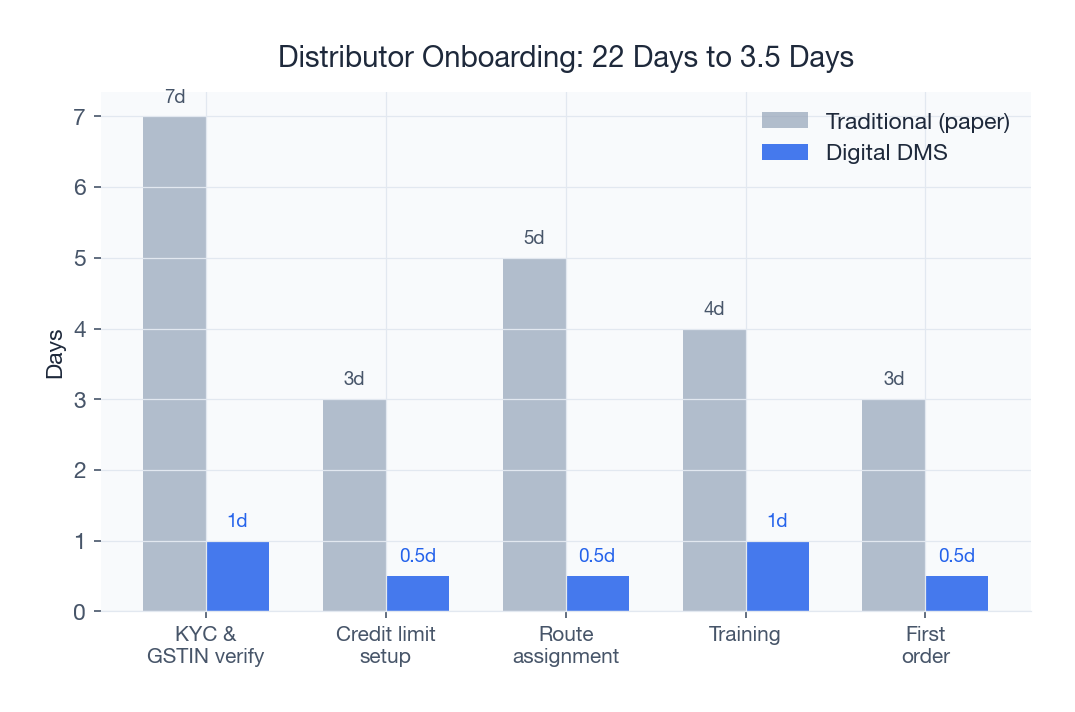
- Distributor onboarding time reduced from 6 weeks to 5 days
- Single consolidated dashboard for all 4 states
- 15% revenue growth directly attributed to better outlet coverage
Case Study 3: North Indian Beverage Distributor -- 150 Routes
Background: A beverage distribution company in Delhi NCR operating 150 daily routes with a fleet of 150 vehicles serving 25,000 retail outlets. The company distributed for 3 major beverage brands and needed to optimize logistics costs while managing returnable bottles across brands.
Challenges:
- Fuel costs of Rs 35 lakh/month with no route optimization
- Bottle reconciliation taking 2 full-time staff and still inaccurate
- Drivers making unauthorized stops and detours -- estimated 15% route deviation
- Paper-based proof of delivery causing disputes on 8% of deliveries
- No visibility into vehicle utilization -- suspected 30%+ capacity underutilization
Solution: Implemented DMS with route optimization, GPS-based delivery tracking, digital proof of delivery, and returnable asset management. Deployed across all 150 routes simultaneously (possible because it was a single-company operation with centralized control).
Results (after 4 months):
- Fuel costs reduced by 22% -- from Rs 35 lakh to Rs 27.3 lakh/month (Rs 92.4 lakh annual savings)
- Route deviation dropped from 15% to under 2%
- Delivery disputes eliminated -- digital POD with photo and signature for every delivery
- Bottle reconciliation automated -- 2 FTEs redeployed, accuracy improved from 92% to 99.5%
- Vehicle utilization improved by 18%, enabling the company to reduce fleet size by 12 vehicles
How DMS Enables Data-Driven Distribution
The most transformative impact of distribution management software is not operational efficiency -- it is the shift from gut-feel to data-driven decision-making. Here is how leading Indian brands use DMS data for strategic advantage.
Territory Performance Heatmaps
DMS analytics generate geographic heatmaps showing sales density, growth rate, and penetration at the territory level. This reveals white spaces (areas with retailers but low coverage), hot zones (high-density areas that may be over-served), and declining territories that need intervention. Territory intelligence feeds directly into territory management strategy.
SKU-Level Demand Forecasting
With 6-12 months of secondary sales data, DMS platforms can predict demand at the SKU-territory level. This enables smarter production planning (produce what will sell, not what you hope will sell), optimized inventory allocation (push the right SKUs to the right distributors), and proactive stockout prevention. Read more in our guide on demand forecasting for dairy distribution.
Distributor Health Scoring
The DMS aggregates multiple signals -- order frequency, payment timeliness, claim rates, growth trajectory, scheme compliance, salesman productivity -- into a composite distributor health score. This score identifies at-risk distributors (declining health = potential exit) and top performers (candidates for territory expansion). Proactive intervention with at-risk distributors prevents the single most expensive event in distribution: losing a distributor and their retailer relationships. For survival benchmarks, see our analysis: why FMCG distributors fail in India.
Retailer Outlet Profiling
Over time, the DMS builds a comprehensive profile of each retail outlet: order history, preferred SKUs, average order value, payment behavior, scheme responsiveness, and visit frequency. This retailer intelligence enables micro-segmentation -- different service levels, promotions, and visit frequencies for different outlet tiers. The result is more efficient resource allocation and higher per-outlet revenue. For retailer-specific technology, explore retailer tracking solutions.
From Insights to Action
Data without action is just expensive storage. The best DMS platforms translate insights into automated actions:
- If a distributor's order frequency drops below threshold → auto-alert to the area sales manager
- If a retailer has not ordered in 14 days → add to the salesman's priority visit list
- If a territory's secondary sales drop 15% week-on-week → trigger a review meeting
- If a scheme is underperforming vs target → auto-suggest modification or budget reallocation
This is the evolution from "reporting software" to "decision automation" -- and it is where the most advanced DMS platforms are heading in 2026 and beyond.
Distribution Software Pricing in India
Pricing varies widely based on features, user count, and deployment model. Here is a typical breakdown:
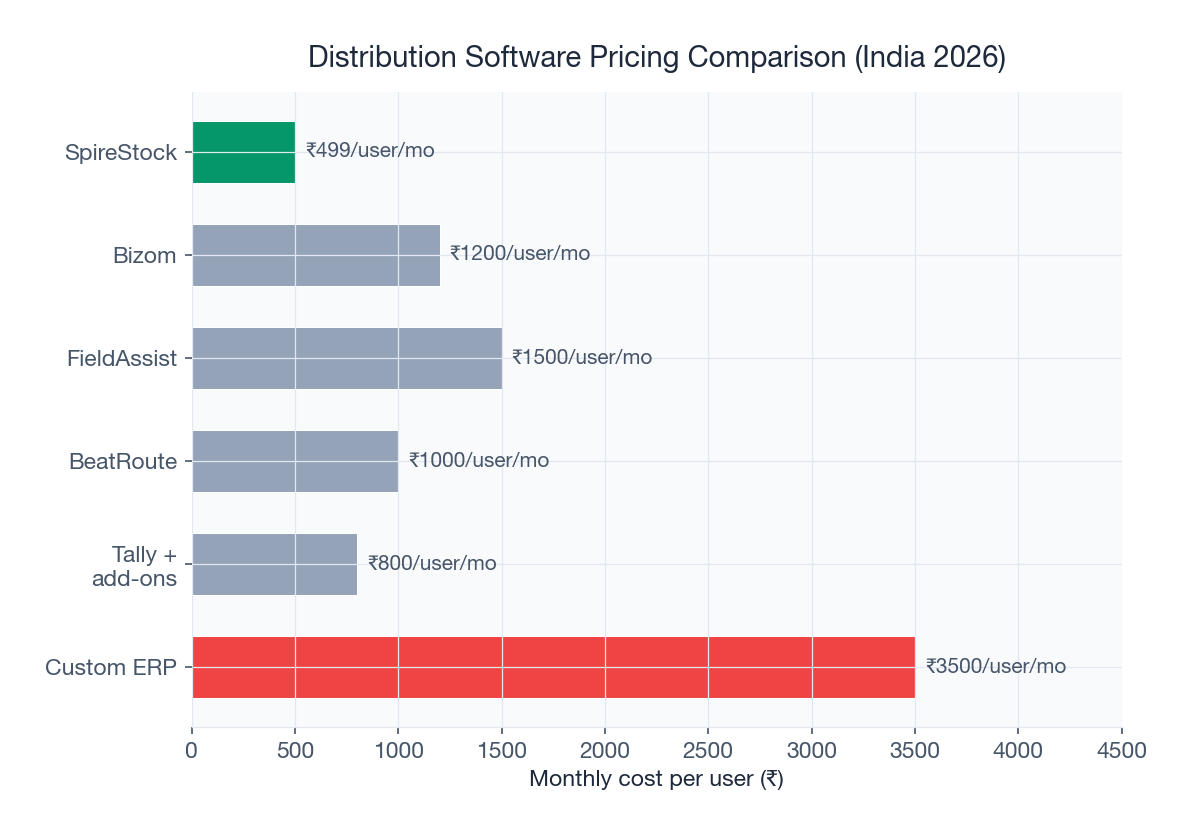
- Starter plans: Rs 5,000-15,000/month for up to 20 users or 50 distributors
- Growth plans: Rs 25,000-75,000/month for 50-300 distributors
- Enterprise plans: Custom pricing, typically Rs 1-5 lakh/month for 500+ distributors
- Implementation: Rs 1-10 lakh one-time, depending on customization
- Training and support: Often included; sometimes Rs 10,000-50,000/month for premium SLA
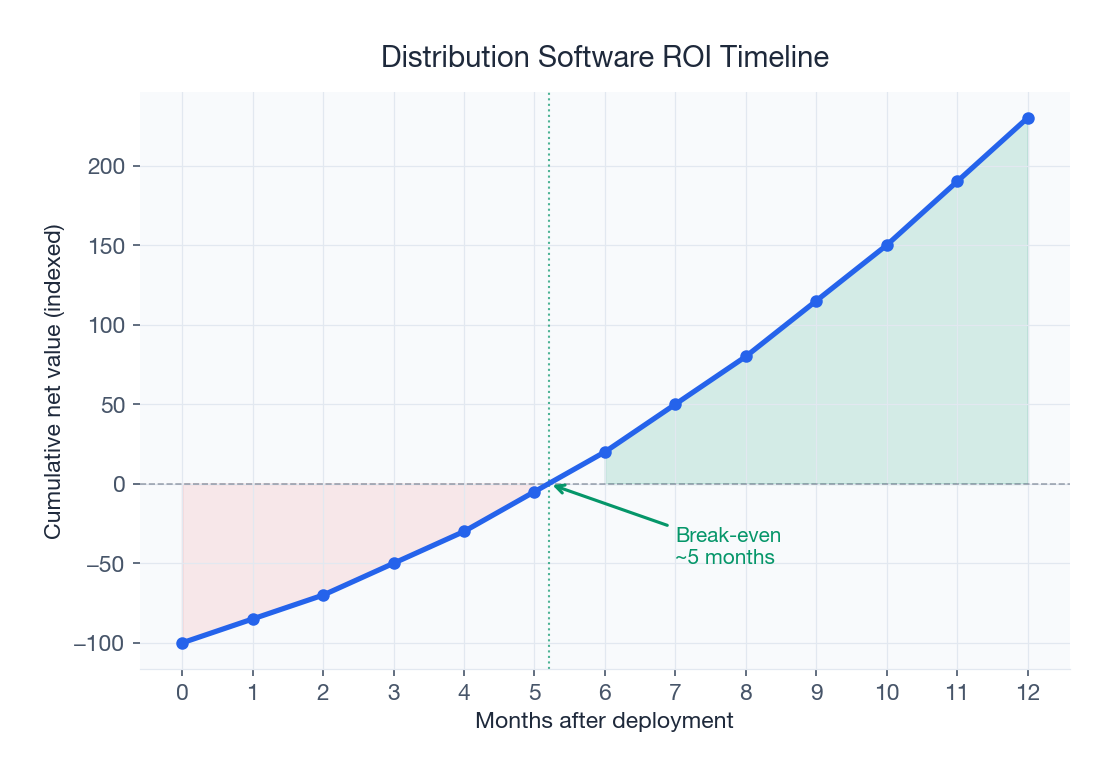
See SpireStock's transparent pricing plans for details. For a comprehensive pricing analysis with vendor comparisons, read our DMS pricing guide for India. ROI is typically achieved within 3-6 months.
How to Choose the Right Software
Step 1: Define Your Requirements
List your workflows, pain points, and non-negotiable features. Does your business need returnable asset tracking? Multi-plant routing? Vernacular support? Offline mode? Start with the DMS buyer's checklist.
Step 2: Shortlist Vendors
Look for vendors with proven India experience, GST compliance, and mobile-first design. Check case studies in your specific category -- a vendor who excels in FMCG may not understand the daily-order dynamics of dairy distribution.
Step 3: Run a Pilot
Never commit to a full rollout without a 30-60 day pilot. Test with 10-20 distributors in one region before scaling. Measure concrete KPIs during the pilot: order accuracy, user adoption rate, billing speed, and support responsiveness.
Step 4: Evaluate Integration
Ensure the platform integrates with your existing tools -- Tally, SAP, Busy, payment gateways, e-invoicing portals. API-first platforms provide future-proof integration capability.
Step 5: Check Support Quality
Distribution software failure during a busy day can cost crores. Verify SLA, support hours, and escalation paths. Ask: "What happens if the system goes down at 6 AM on dispatch day?"
Step 6: Assess Vendor Viability
DMS is a long-term commitment. Evaluate the vendor's financial stability, product roadmap, client retention rate, and team size. A vendor who shuts down in 2 years leaves you stranded with data migration headaches and retraining costs.
City-Level Distribution Software in India
Regional considerations matter -- distribution dynamics vary significantly by geography. A Mumbai distributor faces different challenges (traffic congestion, high real estate costs, dense retail) than a Jaipur distributor (sprawling geography, lower tech adoption, traditional trade dominance). SpireStock serves brands across major Indian metros with local support:
- Mumbai distribution software -- India's FMCG capital with the highest distributor density
- Delhi distribution software -- Complex NCR logistics across 3 states. See also: FMCG distribution in Delhi NCR
- Bangalore distribution software -- Tech-savvy distributors, growing modern trade. Read: milk delivery management in Bangalore
- Hyderabad distribution software -- Emerging FMCG hub with strong dairy presence
- Chennai distribution software -- Gateway to South India distribution. See: beverage distribution challenges in Chennai
- Pune distribution software -- Major dairy and FMCG manufacturing hub. Read: FMCG distribution in Pune
- Ahmedabad distribution software -- Heart of Gujarat's dairy ecosystem. See: dairy supply chain in Gujarat
- Kolkata distribution software -- Eastern India's distribution gateway
- Indore distribution software -- Central India food processing hub
- Surat distribution software -- Growing FMCG market in Gujarat
Ready to transform your distribution? SpireStock has helped 500+ Indian brands digitize their distribution across all these cities and more. Book a free demo to see how we can help your business, or start with a comprehensive guide to starting a distribution business in India.
The Future: AI-Powered Distribution
The next generation of distribution software uses AI for predictive ordering, automated scheme optimization, and real-time anomaly detection. Key trends to watch:
- Predictive ordering: ML models that auto-generate suggested orders based on historical patterns, seasonality, and local events -- reducing manual order placement by 60-70%.
- Dynamic route optimization: Routes that adjust in real-time based on traffic, order priority, and vehicle capacity -- beyond static beat plans.
- Anomaly detection: AI that flags unusual patterns -- sudden drop in a distributor's orders, abnormal return rates, suspected scheme misuse -- before they become costly problems.
- Conversational interfaces: Distributors placing orders via voice commands in Hindi, Tamil, or Gujarati, powered by LLMs integrated with the DMS.
- Computer vision: Shelf auditing via smartphone camera -- salesmen take a photo, AI identifies SKU presence, share of shelf, and planogram compliance.
Platforms that adopt these capabilities will deliver exponentially more value than first-generation DMS systems. For brands evaluating DMS today, choose a platform with a credible AI roadmap -- the gap between AI-enabled and legacy DMS will only widen. See our analysis of FMCG distribution trends for 2026.
Frequently Searched Comparisons
Indian buyers often search for specific comparisons. Here are quick takes on the most common ones:
- Tally vs DMS: Tally is accounting software; DMS is distribution operations software. You need both. They integrate, not compete. Deep dive: SpireStock vs Tally for distribution.
- ERP vs DMS: ERPs handle enterprise-wide functions. DMS handles distribution-specific workflows. Large companies use both; mid-market companies often use DMS + Tally. Read: ERP vs DMS comparison.
- SFA vs DMS: Sales Force Automation focuses on field team management. DMS covers the full distribution cycle including billing, inventory, and schemes. Modern platforms combine both. See: best SFA apps for Indian distributors.
- Excel vs DMS: Excel works for 5 distributors. It breaks at 50. At 200, it is a liability. Read: why Indian distributors still use Excel (and why they should stop).
- Van sales vs pre-sales: Two different distribution models that require different DMS configurations. Understand the difference: van sales vs pre-sales distribution models and van sales management software.
Conclusion
Distribution management software is no longer optional for Indian businesses -- it is the foundation on which scalable, profitable, data-driven distribution is built. Whether you are a dairy brand with 50 distributors, an FMCG manufacturer with 500, or a beverage company expanding into new states, the right software pays for itself within months.
The Indian distribution ecosystem -- with its multi-tier channels, 1.5 crore kirana stores, and complex trade schemes -- demands software built specifically for this market. Generic ERPs and manual processes cannot keep pace with the speed, scale, and compliance requirements of modern Indian distribution.
Start by understanding your requirements, run a focused pilot, and measure results rigorously. The ROI will speak for itself.
Explore our distribution tracking features, browse our distributor management solutions, check the complete DMS features checklist, or talk to our distribution experts today.
For the complete picture, see our distributor management system guide.
Sources & References
Frequently Asked Questions
Distribution management software is a purpose-built platform that manages the flow of goods, information, and money between manufacturers, distributors, and retailers. It handles order management, inventory, invoicing, schemes, collections, and analytics for channel-driven businesses.
Pricing ranges from Rs 5,000/month for starter plans (up to 20 users) to Rs 1-5 lakh/month for enterprise deployments. Mid-size brands typically pay Rs 25,000-75,000/month. Implementation costs Rs 1-10 lakh one-time.
ERPs handle enterprise-wide functions like finance, HR, and production. Distribution management software is specialized for channel sales, daily orders, trade schemes, secondary sales, field force, and retailer visibility. Most FMCG brands run both.
Typical implementation takes 4-8 weeks: 1-2 weeks for configuration, 2-3 weeks for pilot, and 2-3 weeks for full rollout. Complex customizations can extend this to 12-16 weeks.
The best platforms support offline mode for mobile apps, essential for rural India where connectivity is unreliable. Data syncs automatically when connectivity returns. Always verify offline capability during vendor evaluation.
Any business that sells through a channel network: dairy, FMCG, beverages, bakery, fresh produce, pharma OTC, and consumer goods. If you have distributors and retailers, distribution software improves efficiency significantly.
Related SpireStock Features
Real-time GPS tracking of vehicles and drivers with route optimization for faster deliveries.
End-to-end order lifecycle from placement to delivery with multi-level approval workflows.
Powerful dashboards with sales trends, MIS reports, and distribution analytics.
Related Industries
Streamline FMCG distribution with order management, beat planning, retailer tracking, and GST billing. Built for Indian FMCG supply chains.
End-to-end dairy distribution software for milk, curd, paneer, and ghee brands. Manage orders, crates, cold chain, and GST billing in one platform.
Related Solutions
Manage your entire distributor network digitally. Onboarding, credit limits, outstanding tracking, and performance analytics. Start free trial.
Track and manage your retail network. Geo-tag outlets, capture secondary sales, manage beats, and monitor retailer performance. Try SpireStock.
Related Entities
Ready to Streamline Your Distribution?
Start your free 14-day trial and see how SpireStock can transform your dairy, FMCG or consumer-goods distribution operation, from order capture to crate recovery.

SpireStock Team
Distribution Technology Experts
SpireStock Team writes for SpireStock on distribution management, supply-chain optimisation and field operations for Indian dairy and FMCG brands.