Why Indian Dairy Distributors Need Specialized Software in 2026
India produces over 230 million tonnes of milk annually, making it the world's largest dairy producer. Yet a staggering 70% of dairy distributors still manage operations using paper registers, WhatsApp messages, and spreadsheets. This gap between production scale and operational capability is costing the industry crores in lost efficiency every year. Whether you run a dairy plant in Pune or manage FMCG distribution across Maharashtra, the need for purpose-built distribution software has never been more urgent.
Dairy distribution software is purpose-built technology that handles the unique demands of dairy supply chains, from perishable inventory management to daily recurring orders, crate tracking, and cold chain compliance. Unlike generic ERP systems, dairy-specific platforms understand that milk doesn't wait. If you are ready to modernize your operations, start your free 14-day trial and see the difference within the first week.
The Indian Dairy Distribution Landscape in 2026
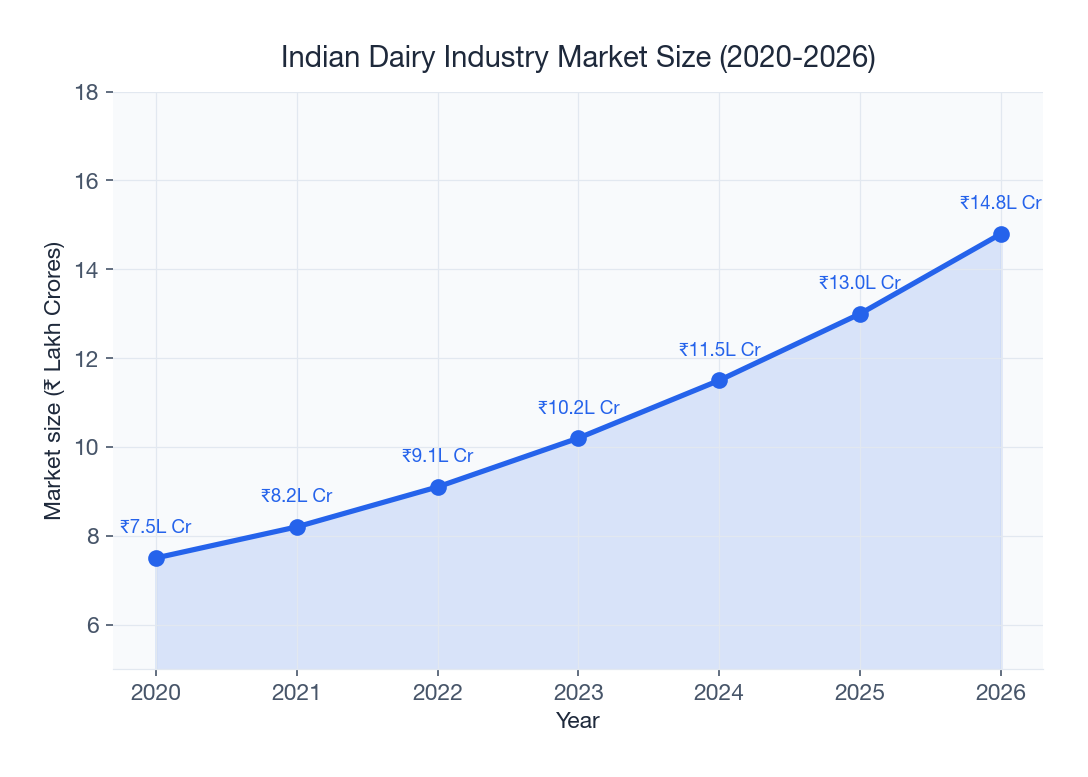
India's dairy sector is valued at over Rs 11 lakh crore, with brands like Amul, Mother Dairy, and Nandini leading a market that serves 1.4 billion consumers. The distribution network behind these brands involves over 15 million retail touchpoints, hundreds of thousands of distributors, and daily logistics operations that rival any industry in the world.
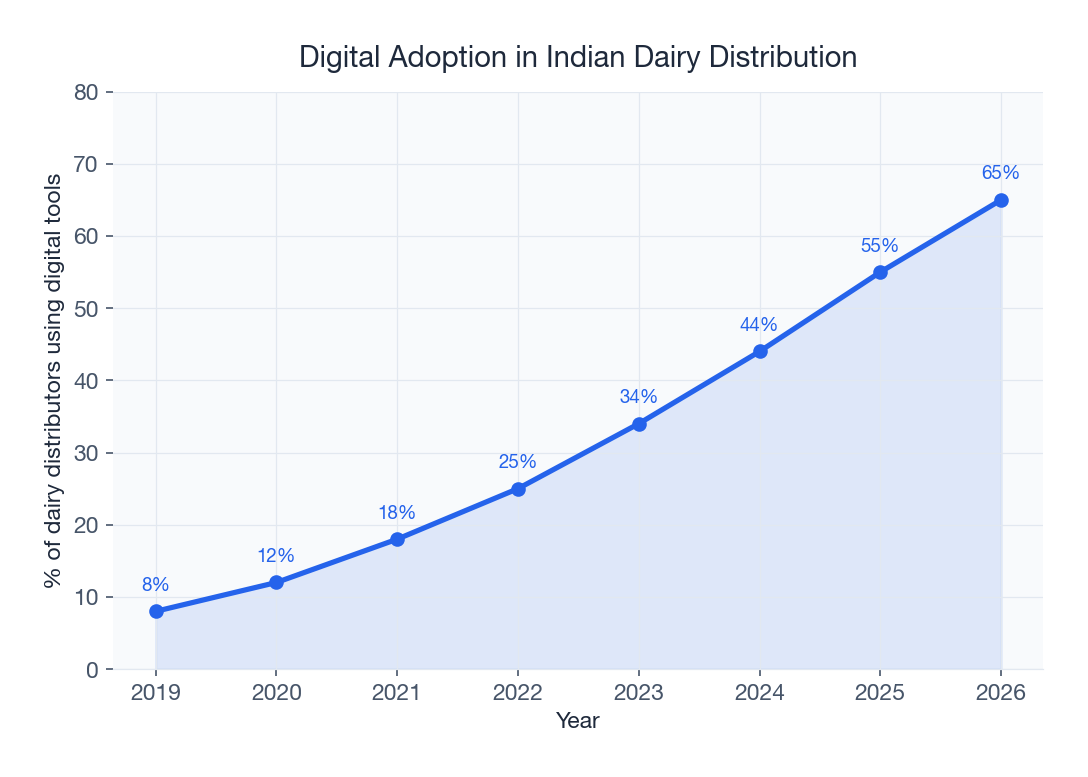
Yet the technology powering most of this distribution is decades behind. A 2025 CRISIL report found that only 18% of Indian dairy distributors use any form of digital order management. The remaining 82% rely on phone calls, paper challans, and manual ledgers, methods that are slow, error-prone, and impossible to scale.
Why Generic ERPs Fall Short for Dairy
Companies that try to force-fit SAP, Tally, or other generic platforms into dairy distribution workflows quickly discover critical gaps. Generic ERPs do not natively support daily recurring order cycles, returnable asset tracking, perishable inventory with expiry management, production-unit-based order routing, or the complex scheme structures that drive FMCG trade. The cost of customizing a generic ERP to handle these requirements often exceeds Rs 50 lakh, with no guarantee of success.
Purpose-built dairy distribution software handles all of these scenarios out of the box, at a fraction of the cost. Read our detailed comparison in Dairy Distribution: ERP vs CRM, What You Actually Need.
Key Features to Look for in Dairy Distribution Software
1. Order Management Tailored for Dairy
Dairy distribution runs on daily orders with tight cutoff windows. Your software must support recurring order templates, production-unit-based scheduling, and multi-level approval workflows. SpireStock's order management module handles thousands of daily orders with real-time status tracking from placement to OTP-verified delivery. Distributors place orders via the mobile app before the cutoff, the system aggregates demand per production unit, and approved orders flow directly into dispatch planning.
2. Crate and Returnable Asset Tracking
Crate management is one of the biggest pain points for Indian dairy distributors. Lost crates cost the industry an estimated Rs 500 crore annually. A robust crate management system tracks every crate across your distribution network, issued, returned, damaged, and outstanding, eliminating disputes and reducing losses by up to 80%. Each transaction is recorded digitally with timestamps, quantities, and responsible parties, creating an indisputable audit trail.
3. Route Optimization for Milk Delivery
With delivery windows as tight as 4 hours for fresh dairy products, route optimization isn't optional, it's survival. Modern software calculates the most efficient delivery sequences considering traffic patterns, delivery time windows, vehicle capacity, and product temperature requirements. For a fleet of 20 vehicles operating in Mumbai, optimized routes can save Rs 8-12 lakh annually in fuel costs alone.
4. GST-Compliant Billing and Invoicing
India's GST framework adds complexity to dairy billing with different rates for various products, 0% for fresh milk, 5% for packaged dairy, 12% for butter and cheese, and 18% for ice cream. Your software should auto-generate GST-compliant invoices with proper HSN codes, handle credit notes for returns, and support e-invoicing mandates. Automated tax calculation across mixed-rate invoices eliminates the errors that plague manual billing.
5. Real-Time Sales Analytics
Data-driven decision making separates growing dairies from stagnant ones. Sales analytics dashboards give you visibility into distributor performance, product-wise trends, and territory-level insights that help you allocate resources effectively. Track daily sell-through rates, identify underperforming territories, and benchmark distributors against each other, all in real time.
6. Scheme Engine for Trade Promotions
Indian dairy and FMCG distribution runs on trade schemes, flat discounts, slab-based incentives, seasonal promotions, and retailer-specific deals. A configurable scheme management engine applies the correct incentives automatically during order processing, ensuring 100% accuracy and complete transparency for your channel partners.
How Indian Dairy Companies Benefit from Distribution Software
| Metric | Before Software | After Software | Improvement |
|---|---|---|---|
| Order processing time | 3-4 hours | 30 minutes | 60-80% faster |
| Delivery cost per drop | Rs 18-25 | Rs 12-16 | 25-35% lower |
| Crate loss rate | 8-15% annually | 1-3% annually | 80% reduction |
| Billing accuracy | 85-90% | 99.5%+ | Near-perfect |
| Payment collection cycle | 18-25 days | 10-14 days | 35-45% faster |
| Scheme application accuracy | 70-80% | 100% | Zero leakage |
Beyond Dairy: Multi-Category Distribution
While dairy distribution has unique requirements, the best distribution software also supports adjacent categories that many dairy companies handle. Whether you distribute beverages, bakery and confectionery products, or packaged FMCG goods, a unified platform eliminates the need for separate systems per category. Companies like Britannia, which distribute biscuits, bread, dairy, and beverages through overlapping networks, benefit enormously from a single platform that handles all categories.
The multi-plant distribution capability allows you to manage orders, dispatch, and billing across multiple production units, each with their own product catalogs, pricing, and cutoff schedules, from a single dashboard.
Choosing the Right Software for the Indian Market
When evaluating dairy distribution software for the Indian market, consider these factors:
- Vernacular support, your field staff may not be comfortable with English-only interfaces. Look for Hindi, Marathi, Tamil, Kannada, and Telugu support.
- Offline capability, internet connectivity is unreliable in many distribution territories across tier-2 and tier-3 cities
- Mobile-first design, distributors and delivery staff operate from smartphones, not desktops. The mobile app should handle 90% of daily workflows.
- GST compliance, ensure the platform stays updated with latest tax regulations and supports e-invoicing
- Scalability, your software should handle growth from 50 to 5,000 distributors without breaking
- Integration, API-based connectivity with Tally, Busy, SAP, and other accounting systems
The dairy distribution industry is at an inflection point. Companies that adopt digital tools now will have an insurmountable advantage within 2-3 years as the market consolidates around efficiency leaders. Check our pricing plans to find the right fit for your operation size.
Real-World Implementation: A Case Study Approach
Consider a mid-sized dairy company operating in western India with 350 distributors across Gujarat and Maharashtra. Before implementing distribution software, they processed orders via phone calls (average 4 hours daily for the sales team), managed crates through paper registers (losing Rs 22 lakh annually), and generated invoices manually in Tally (3 billing staff working full-time). After implementing SpireStock:
- Order processing dropped from 4 hours to 45 minutes daily
- Crate losses fell from Rs 22 lakh to Rs 3.5 lakh annually
- Billing staff reduced from 3 full-time to 1 part-time resource
- Payment collection improved from 22-day average to 13-day average
- ROI achieved within 11 weeks of go-live
Implementation Best Practices
Rolling out dairy distribution software across an Indian distribution network requires careful planning. Start with a pilot region, typically 20-30 distributors, and expand once you've ironed out workflows. Ensure your field team has adequate training, and designate digital champions in each territory who can support adoption among less tech-savvy distributors.
Integration with your existing accounting software (Tally, Busy, or SAP) is critical for a smooth transition. Look for platforms that offer API-based integration rather than manual data import/export. The typical implementation timeline is 2-4 weeks for pilot and 6-8 weeks for full rollout.
Ready to transform your dairy distribution? SpireStock has helped over 500 dairy and FMCG companies across India digitize their distribution operations. Book a free demo to see how it works for your specific operation.
Real-World Implementation Scenarios
Understanding how dairy distribution software performs in actual Indian operating conditions helps contextualize the ROI. The three case studies below represent typical transformations we see across our customer base, from single-city operators to multi-state dairy giants.
Case Study 1: Sahyadri Dairy Foods, Pune
Sahyadri Dairy Foods operates 180 distributors across Pune, Satara, and Kolhapur, handling 95,000 litres of milk and dairy products daily. Before SpireStock, their sales team spent 4.5 hours every morning taking phone orders and transcribing them into Tally. Crate losses were running at Rs 34 lakh annually, and scheme disputes with distributors were consuming 20+ management hours weekly. After a 6-week implementation using our distributor management solution, daily order processing dropped to 40 minutes, crate losses fell to Rs 5.2 lakh, and scheme-related escalations dropped to near zero. Total first-year savings: Rs 48.6 lakh against software cost of Rs 9.6 lakh.
Case Study 2: Gokul Creamery, Ahmedabad
Gokul Creamery distributes milk, curd, paneer, and flavoured drinks through 240 distributors in Ahmedabad and Surat. Modelled on regional champions like Amul and Parag Milk Foods, Gokul faced rapid growth without the back-office infrastructure to match. Fuel costs were bleeding Rs 2.4 crore annually across their 32-vehicle fleet. After deploying our fleet management solution with route optimization, they cut kilometres driven by 24%, saving Rs 58 lakh in fuel in year one. Payment collection cycles improved from 21 days to 12 days, unlocking Rs 1.1 crore in working capital.
Case Study 3: Neelkanth FMCG Distributors, Mumbai
Neelkanth handles multi-category distribution, dairy from a brand like Mother Dairy, packaged water similar to Bisleri, and bakery products, across 140 routes in Mumbai and Thane. Managing three separate systems created constant data reconciliation headaches and blind spots at distributor level. Consolidating onto a single SpireStock instance reduced IT overhead by Rs 18 lakh annually and cut month-end closing from 9 days to 2 days. The finance team reclaimed over 400 hours per year previously lost to manual reconciliation.
Cost & ROI Analysis
For Indian dairy and FMCG operations, the math on distribution software is unusually favourable. Here is a typical cost-benefit breakdown for a mid-sized operation (150-300 distributors, 20-40 vehicles, Rs 60-120 crore annual turnover):
| Category | Annual Cost/Saving | Notes |
|---|---|---|
| SpireStock software (platform) | Rs 8-14 lakh | Per-distributor SaaS pricing, includes mobile apps |
| Implementation (one-time) | Rs 2-4 lakh | Setup, data migration, training |
| Fuel & route savings | Rs 30-60 lakh saved | 20-30% reduction via optimized routing |
| Crate leakage recovery | Rs 18-35 lakh saved | 80% reduction in loss rate |
| Billing staff rationalization | Rs 6-12 lakh saved | Reduction from 3 FTE to 1 FTE typical |
| Scheme leakage prevention | Rs 15-30 lakh saved | 100% accurate scheme application |
| Working capital unlock | Rs 40-90 lakh released | Faster collection cycles |
| Net Year-1 Impact | Rs 65-130 lakh positive | Payback period: 2-4 months |
Even the most conservative scenarios show payback within 4 months. For companies handling multiple categories, dairy, beverages, bakery, fresh produce, and consumer goods, the numbers scale linearly with revenue, making the business case even stronger.
Conclusion: The Time to Digitize Is Now
The dairy distribution industry in India is undergoing a once-in-a-generation digital transformation. Companies that act now, investing in purpose-built distribution software, will reduce costs, improve accuracy, scale faster, and build stronger channel relationships. Those that wait will find it increasingly difficult to compete as digitally-enabled competitors pull ahead. Whether you manage a single-city milk delivery operation or a multi-state dairy distribution network, the right software pays for itself within months. Read more about the broader digital transformation happening in our article on Digital Transformation in India's Dairy Industry and our guide to milk distribution management systems.
This guide covers one part of the picture. For the category as a whole — what a DMS does, the modules that matter, how it differs from ERP and SFA, and what it costs in India — see our distributor management system guide.
This page covers one angle. For the broader treatment, see our comparison of the best dairy distribution software.
Sources & References
Frequently Asked Questions
Dairy distribution software is a specialized platform designed to manage the end-to-end operations of dairy product distribution, including order management, delivery tracking, crate management, invoicing, and sales analytics, tailored for the unique requirements of perishable dairy supply chains.
Pricing varies based on features and scale. Cloud-based SaaS solutions like SpireStock typically range from Rs 5,000 to Rs 50,000 per month depending on the number of users and distributors. This is significantly more affordable than on-premise ERP deployments.
Yes, modern dairy distribution apps like SpireStock support offline mode. Field staff can take orders, record deliveries, and manage crates without internet. Data syncs automatically when connectivity is restored.
A typical implementation takes 2-4 weeks for the initial setup and pilot, with full rollout across the distribution network completed in 6-8 weeks. SpireStock provides dedicated onboarding support throughout the process.
Yes, significantly. Dairy-specific software handles perishable inventory with expiry tracking, daily recurring orders, crate/returnable asset management, cold chain monitoring, and scheme engines, features that generic ERPs either lack entirely or require expensive customization.
Yes, multi-plant support is essential for larger dairy operations. SpireStock supports unlimited production units, each with their own product catalogs, pricing, and order cutoff schedules.
Absolutely. SpireStock auto-calculates GST based on product HSN codes, generates GST-compliant invoices, supports e-invoicing, and provides GSTR-ready reports for seamless tax filing.
Most dairy companies see ROI within 3-6 months through reduced delivery costs (25%), fewer crate losses (80%), faster order processing (60%), and improved collection rates (40%). The payback period is typically under 4 months.
Related SpireStock Features
Related Solutions
Manage your entire distributor network digitally. Onboarding, credit limits, outstanding tracking, and performance analytics. Start free trial.
GPS fleet tracking, driver management, and route optimization for dairy and FMCG delivery vehicles. Reduce fuel costs by 25%. Try SpireStock.
Related Entities
Ready to Streamline Your Distribution?
Start your free 14-day trial and see how SpireStock can transform your dairy, FMCG or consumer-goods distribution operation, from order capture to crate recovery.

SpireStock Team
Product & Industry Insights
SpireStock Team leads product at SpireStock, where the team ships distribution management software for India's dairy, FMCG and consumer-goods brands.