GST and the Indian Dairy Industry: Why Compliance Is Non-Negotiable
The Goods and Services Tax transformed India's indirect tax landscape when it replaced a patchwork of central and state levies in 2017. For most industries, GST simplified things. For dairy distribution, it introduced a unique maze of complexities. Different dairy products attract different GST rates, from 0% for unpackaged fresh milk to 12% for processed dairy items like butter and cheese. A single delivery truck might carry products spanning three different tax slabs, and getting any of them wrong means compliance risk, penalties, and disrupted operations.
India's dairy distribution market, valued at over Rs 12 lakh crore, processes millions of invoices daily. With CBIC tightening enforcement and e-invoicing thresholds dropping steadily, the days of approximate GST compliance are over. This guide covers everything dairy distributors need to know about GST billing in 2026, including recent updates, HSN codes, e-invoicing requirements, and how automated billing technology simplifies compliance. Whether you are a cooperative like Amul processing thousands of invoices daily or a regional dairy serving a single city, this guide has actionable steps for you.
If you are evaluating distribution platforms with built-in GST compliance, talk to our team about how SpireStock handles multi-rate dairy billing automatically.
GST Rates for Dairy Products (2026): The Complete Rate Card
Understanding which GST rate applies to which product is the foundation of dairy billing compliance. Here is the definitive rate card for 2026:
Exempt (0% GST)
- Fresh milk (unpackaged/loose), HSN 0401
- Curd, lassi, and buttermilk (unbranded and unpackaged)
- Paneer (unbranded and unpackaged)
- Fresh cream (unbranded and unpackaged)
5% GST
- Milk and cream in concentrated or sweetened forms, HSN 0402
- Branded and packaged curd, lassi, buttermilk, HSN 0403
- UHT milk in branded packaging
- Skimmed milk powder, HSN 0402
- Whey, HSN 0404
- Branded paneer in pre-packaged form
12% GST
- Butter, HSN 0405
- Cheese and processed cheese, HSN 0406
- Ghee (branded), HSN 0405
- Condensed milk, HSN 0402
- Flavoured milk drinks, HSN 2202
- Ice cream and frozen desserts, HSN 2105
18% GST
- Casein, HSN 3501
- Some dairy-based food preparations, HSN 1901
- Dairy whiteners in certain formulations
| Product Category | HSN Code | GST Rate | Packaging Condition | Annual Impact (per Rs 1 Cr turnover) |
|---|---|---|---|---|
| Fresh milk (loose) | 0401 | 0% | Unpackaged | Rs 0 |
| Pouch milk (branded) | 0401 | 0% | Pre-packaged | Rs 0 |
| Branded curd/lassi | 0403 | 5% | Pre-packaged and labelled | Rs 5 lakh |
| Butter | 0405 | 12% | Any | Rs 12 lakh |
| Cheese/Paneer (branded) | 0406 | 12% | Pre-packaged and labelled | Rs 12 lakh |
| Flavoured milk | 2202 | 12% | Any | Rs 12 lakh |
| Ice cream | 2105 | 18% | Any | Rs 18 lakh |
Critical note: The 2024 amendment on "pre-packaged and labelled" goods changed the GST treatment of several dairy items. Products sold in packages under 25 kg with a registered brand name now attract GST even if the product category was previously exempt. Always verify current rates from the CBIC website or your tax advisor. SpireStock's billing module is updated within 48 hours of any GST council notification.
E-Invoicing for Dairy Distributors: Mandatory Compliance
E-invoicing is now mandatory for businesses with annual turnover above Rs 5 crore (the threshold has been progressively lowered from Rs 500 crore in 2020). For dairy distributors in cities like Mumbai and Delhi, this means:
- Every B2B invoice must be registered on the Invoice Registration Portal (IRP) to obtain an Invoice Reference Number (IRN)
- Invoices must include a QR code containing the IRN and key invoice details
- The e-invoice must be generated before or at the time of issuing the physical invoice
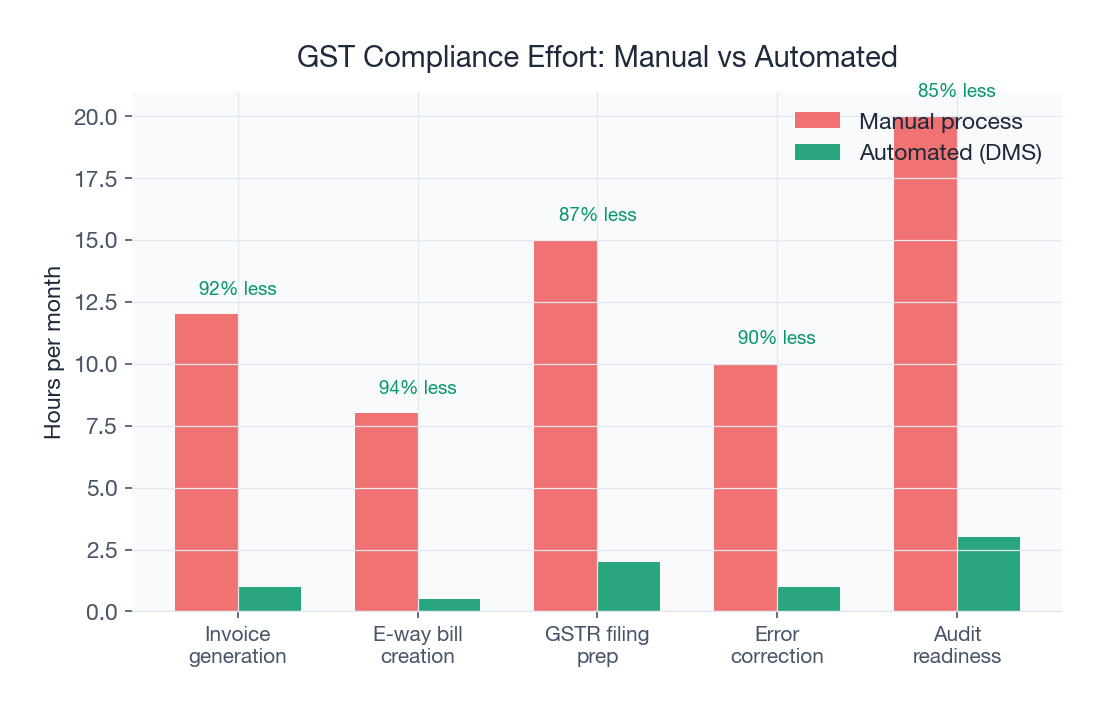
- E-invoicing data auto-populates GSTR-1, reducing return filing effort by 40-60%
- Cancelled invoices must be reported within 24 hours on the IRP
For a dairy distributor generating 200-500 invoices daily across multiple product categories and GST rates, manual e-invoicing is impractical. Automated billing systems generate e-invoices seamlessly as part of the normal billing workflow, the invoice is created, validated, registered with IRP, and the IRN/QR code is embedded automatically in one step.
Companies like Heritage Foods and Dodla Dairy process thousands of e-invoices daily using automated systems. Regional dairies can achieve the same compliance with platforms like SpireStock at a fraction of the cost.
E-Invoice Implementation Timeline
| Step | Activity | Timeline | Estimated Cost |
|---|---|---|---|
| 1 | Register on IRP portal and obtain API credentials | 1-2 days | Free |
| 2 | Configure billing software for IRP integration | 3-5 days | Rs 10,000-50,000 (one-time) |
| 3 | Map all products with correct HSN codes and GST rates | 2-3 days | Internal effort |
| 4 | Test e-invoice generation in sandbox environment | 3-5 days | Internal effort |
| 5 | Go live with parallel running (manual + digital) for 1 week | 7 days | Internal effort |
| 6 | Full migration to automated e-invoicing | 1 day | Nil |
E-Way Bill Requirements for Dairy Transport
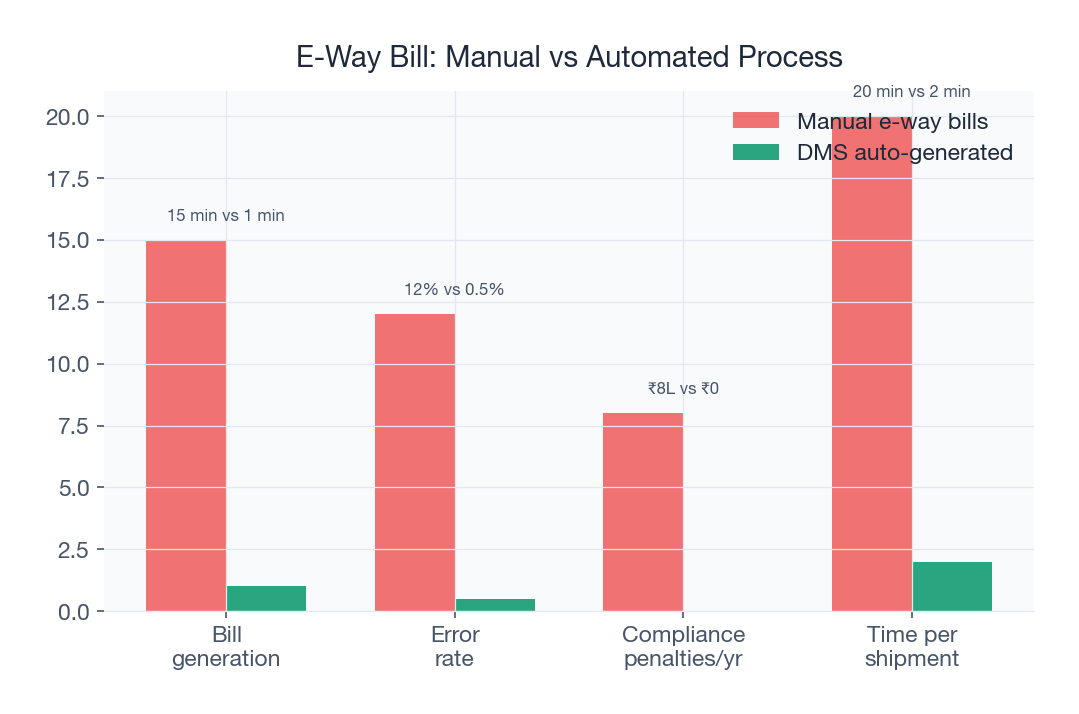
E-way bills are required for movement of goods valued above Rs 50,000. Key considerations for dairy distributors operating across multiple cities:
- Generate e-way bills for inter-state movements and intra-state movements above the state-specific threshold
- E-way bill validity depends on distance, 200 km per day for regular cargo, with special provisions for perishable goods
- Consolidated e-way bills can cover multiple consignments in one vehicle, critical for multi-drop dairy delivery routes
- E-way bill must accompany the goods during transit and be available for verification by tax authorities
- For dairy products transported in refrigerated vehicles, ensure vehicle number matches the e-way bill
- E-way bills can be generated through the NIC portal, SMS, or through integrated distribution management software
Many dairy distributors operating within a single city may fall below the Rs 50,000 threshold per consignment. However, inter-state movements (e.g., Ahmedabad to Mumbai) almost always require e-way bills. Automated systems that generate e-way bills alongside invoices eliminate the risk of missed compliance.
Credit Notes and Returns: The Dairy-Specific Challenge
Dairy distribution has inherently higher return rates than most FMCG categories, typically 3-8% of daily sales volume. Expired products, damaged packages, and temperature-compromised goods all require proper credit note processing for GST adjustment. This is where many dairy distributors fall short.
Credit Note Requirements
- Every return must have a corresponding credit note issued within the prescribed time limit
- Credit notes must reference the original invoice number and date
- GST adjustment on credit notes must match the original invoice tax treatment
- Credit notes must be reported in GSTR-1 for the relevant period
- Aggregate credit notes are allowed for multiple returns from the same buyer in a month
For a dairy distributor processing 50-100 returns daily, manual credit note management is a compliance nightmare. Automated billing platforms generate credit notes automatically when returns are recorded, with correct GST adjustments and original invoice linkage. Read more about how leading dairies handle this in our guide on payment collection for dairy distributors.
Common GST Billing Mistakes in Dairy Distribution
- Wrong HSN codes, Using generic food product codes (e.g., 2106) instead of dairy-specific HSN codes (0401-0406) leads to misclassification and potential penalties of Rs 10,000-25,000 per instance
- Incorrect rate application, Applying 5% GST to a product that should be exempt (e.g., loose milk), or missing the 12% rate on butter. With multiple rates on a single invoice, errors are common without automation
- Missing credit notes for returns, Dairy has the highest return rates in FMCG. Every return needs a proper credit note for GST adjustment. Missing these leads to over-reporting of output tax
- Late e-invoice generation, Generating e-invoices after dispatch instead of before or at dispatch. The IRP rejects invoices generated more than 24 hours after the document date
- Ignoring place of supply rules, Inter-state dairy distribution requires IGST instead of CGST+SGST. Mis-applying this leads to wrong tax credit chains across state boundaries
- Incorrect treatment of free goods under schemes, Products given free under trade schemes still need GST accounting. Many distributors miss this, leading to assessment discrepancies
- Missing debit notes for rate differences, When contract prices change mid-month, debit notes must be issued for the differential. Manual processes frequently miss these
How Technology Simplifies GST Compliance
Automated billing platforms handle GST complexity so your team does not have to make judgment calls on every invoice:
- Product-level GST configuration, Set HSN code and GST rate once per product in the master catalog. The system applies them correctly to every invoice, eliminating manual rate lookup errors
- Automatic e-invoice generation, E-invoices are generated, validated, and registered with IRP automatically as part of the billing flow. IRN and QR codes are embedded without manual intervention
- E-way bill integration, System generates e-way bills automatically based on shipment value, distance, and state boundaries
- Credit note management, Returns recorded in the system automatically trigger proper credit notes with correct GST adjustments, original invoice references, and GSTR-1 reporting
- GSTR-ready reports, Generate GSTR-1, GSTR-3B, and GSTR-2A reconciliation reports directly from the system, reducing filing time by 60-70%
- Rate update management, When GST rates change, update once centrally in the product master and it applies across all future invoices
- Multi-state compliance, For distributors operating across states, the system automatically applies IGST for inter-state and CGST+SGST for intra-state, based on delivery addresses
- Audit trail, Every invoice, credit note, and modification is logged with timestamps and user details, providing a complete audit trail for GST assessments
GST Filing Calendar for Dairy Distributors
| Return | Due Date | What It Covers | Penalty for Late Filing |
|---|---|---|---|
| GSTR-1 | 11th of following month | Outward supply details (all sales invoices) | Rs 50/day (Rs 20/day for nil return) |
| GSTR-3B | 20th of following month | Summary return with tax payment | Rs 50/day + 18% interest on tax due |
| GSTR-9 | 31st December | Annual return | Rs 200/day (max 0.25% of turnover) |
| GSTR-9C | 31st December | Reconciliation (turnover above Rs 5 Cr) | Same as GSTR-9 |
Best Practices for Dairy GST Billing in 2026
- Use distribution software with built-in GST compliance rather than manual calculations or spreadsheets
- Maintain a comprehensive product master with correct HSN codes, GST rates, and packaging classifications
- Reconcile GST returns monthly against your sales analytics data, not just at quarter-end
- Process credit notes within 24 hours of return acceptance, never batch them for month-end
- Keep your software updated with the latest GST rate changes and council notifications
- Train billing staff specifically on dairy GST rules, including the packaging-based exemption criteria
- Conduct quarterly internal GST audits to catch systemic errors before they compound
- Maintain separate HSN-wise summary reports for audit readiness
- Use SpireStock's GST billing features to auto-generate GSTR-ready data from daily billing operations
Implementation Cost and ROI
Implementing automated GST-compliant billing for dairy distribution is surprisingly affordable:
| Component | Manual Process Cost (Annual) | Automated Process Cost (Annual) | Savings |
|---|---|---|---|
| Billing staff (2-3 dedicated) | Rs 6-9 lakh | Rs 2-3 lakh (1 person) | Rs 4-6 lakh |
| GST filing (CA fees) | Rs 1.5-3 lakh | Rs 50,000-1 lakh | Rs 1-2 lakh |
| Error penalties (average) | Rs 50,000-2 lakh | Near zero | Rs 50,000-2 lakh |
| Software subscription | Nil | Rs 1-3 lakh | (Rs 1-3 lakh) |
| Net Annual Savings | Rs 4.5-7 lakh |
Ready to automate your dairy GST billing? Schedule a demo to see how SpireStock handles multi-rate dairy billing, automatic e-invoicing, and GSTR-ready reporting in a single platform. Check our pricing plans for operations of every scale.
Sources & References
- GST Council, Goods and Services Tax Council
- FSSAI, Food Safety and Standards Authority of India
- IBEF, India Brand Equity Foundation, FMCG Sector
Frequently Asked Questions
Fresh unpackaged milk is GST-exempt (0%). Branded/packaged UHT milk attracts 5% GST. Flavoured milk drinks attract 12% GST. The rate depends on the specific product, packaging, and branding. Always verify current rates with CBIC or your tax advisor.
E-invoicing is mandatory for businesses with annual turnover above Rs 5 crore. Most mid-to-large dairy distributors fall above this threshold and must generate e-invoices for all B2B transactions through the Invoice Registration Portal.
Common dairy HSN codes: 0401 (milk and cream), 0402 (concentrated/sweetened milk), 0403 (buttermilk, curd, yogurt), 0404 (whey), 0405 (butter, ghee), 0406 (cheese, paneer). Specific sub-codes apply based on product type and form.
SpireStock auto-calculates GST based on product HSN codes, generates e-invoices through IRP integration, creates e-way bills for eligible shipments, manages credit notes for returns, and produces GSTR-ready reports, all as part of the normal billing workflow.
Incorrect GST rates can lead to short-payment notices from tax authorities, penalties, and interest charges. For dairy distributors handling multiple product categories with different rates, automated billing software that applies correct rates based on HSN codes is the most reliable safeguard.
Related SpireStock Features
Related Solutions
Track distributor and retailer payments. Cash, UPI, cheque collection with reconciliation, ageing reports, and credit limit management.
Manage your entire distributor network digitally. Onboarding, credit limits, outstanding tracking, and performance analytics. Start free trial.
Related Entities
Ready to Streamline Your Distribution?
Start your free 14-day trial and see how SpireStock can transform your dairy, FMCG or consumer-goods distribution operation, from order capture to crate recovery.

SpireStock Team
Distribution Technology Experts
SpireStock Team writes for SpireStock on distribution management, supply-chain optimisation and field operations for Indian dairy and FMCG brands.