The Scale of Returnable Asset Challenge in Indian FMCG
India's FMCG distribution network circulates billions of returnable assets, plastic crates, glass bottles, pallets, insulated containers, display racks, and vending equipment. These assets represent a capital investment of Rs 10,000-15,000 crore industry-wide, yet most companies track them through paper registers or, worse, do not track them at all. The result is a chronic leakage problem that drains 5-15% of the asset pool every year, silently wiping out margin from businesses already operating on razor-thin spreads. For operators in dairy distribution and FMCG distribution, this silent drain is often the single largest non-product cost they never formally measure.
For dairy companies, where crate management involves daily circulation of thousands of units between plant, distributor, and retailer, the problem is especially acute. A mid-sized dairy in Pune with 180 distributors can easily have 80,000-120,000 crates in circulation at any given moment, a working capital commitment of Rs 3-5 crore that most CFOs track less rigorously than they track stationery spend. Multiply that across every beverage distribution operator using returnable glass, every bakery using reusable trays, and every consumer goods brand running a deposit-refund model, and you begin to grasp the scale of the problem across Indian supply chains.
The good news: digital returnable asset tracking is one of the fastest-payback investments available. Most companies recover their entire implementation cost within 90-120 days through reduced losses alone, and the discipline it enforces has knock-on benefits in credit management, retailer trust, and overall operational maturity. Companies that get this right also discover that their finance team, operations team, and sales team finally stop arguing about who owes whom what, because there is a single version of the truth that everyone can see at once.
Types of Returnable Assets in FMCG Distribution
The Full Inventory of Reusables
- Plastic crates, the most common returnable in dairy and beverage distribution, costing Rs 250-500 each
- Glass bottles, still used for premium milk, juices, and beverages; fragile and high-value at Rs 15-40 per unit
- Pallets, wooden or plastic platforms for bulk movement, costing Rs 500-2,000 each
- Insulated containers, specialized units for cold chain products, ranging Rs 2,000-10,000
- Kegs and drums, used in beverage and industrial dairy distribution, Rs 3,000-15,000 per unit
- Display equipment, branded coolers, racks, and shelving placed at retail points, Rs 8,000-80,000 each
Total Asset Exposure by Company Size
| Company Size | Crates in Circulation | Asset Value (INR) | Typical Annual Leakage | As % of Profit |
|---|---|---|---|---|
| Small (10-50 distributors) | 8,000-25,000 | Rs 30-90 lakh | Rs 5-12 lakh | 2-4% |
| Mid-size (50-200) | 40,000-120,000 | Rs 1.5-4.5 crore | Rs 18-55 lakh | 3-6% |
| Large (200-500) | 150,000-400,000 | Rs 5-15 crore | Rs 60 lakh-2 crore | 4-7% |
| Very Large (500+) | 500,000+ | Rs 20+ crore | Rs 2.5+ crore | 5-9% |
Those percentages are not hypothetical, they reflect what finance teams at mid-sized FMCG operators have reported after running rigorous audits. For a Rs 150-crore dairy, losing 6% of net profit to a category most leadership teams ignore is an unforced error that compounds year after year. The companies that eventually run the audit almost always regret not doing it five years sooner.
Why Traditional Tracking Methods Fail
Paper-Based Challans
Paper delivery challans record crate counts at dispatch and return, but they are easily lost, difficult to reconcile, and create a time lag between transaction and recording. By month-end, matching thousands of paper records across dozens of distributors in Delhi or Hyderabad becomes a reconciliation nightmare that swallows entire days of your accounts team. Lost challans, smudged ink, and illegible handwriting make disputes effectively unwinnable.
Spreadsheet Tracking
Excel-based tracking is a step up from paper but still suffers from delayed data entry, version control issues, and the inability to provide real-time balances. When disputes arise, there is no definitive audit trail, just two versions of the truth with a timestamp on the argument. Worse, a single accidental edit can corrupt months of historical data with nobody noticing until a reconciliation goes sideways.
Trust-Based Operations
Many companies still operate on informal trust: the distributor tells the sales rep how many crates came back, the sales rep reports that to the office, and the number gets recorded. This breaks down the moment business volumes scale or staff turnover increases, leaving an unquantifiable gap in your asset records that nobody is motivated to investigate.
Why RFID Alone Is Not the Answer
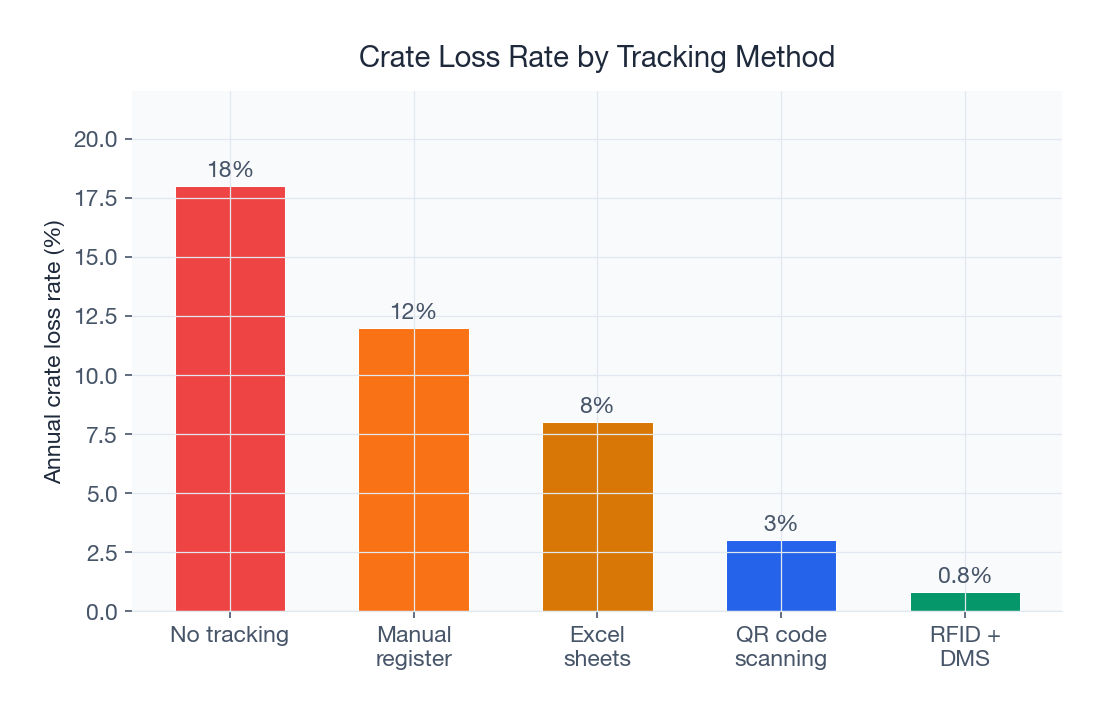
Some operators jump straight to RFID or QR-code tags on every crate. That works for high-value assets (insulated boxes, kegs) but is overkill for Rs 300 crates where the tag costs 20-30% of the asset value. Start with quantity-based digital tracking and add item-level tagging only where asset value justifies the per-unit instrumentation. Most successful deployments use RFID only for the top 10-15% of assets by value.
Digital Returnable Asset Tracking: How It Works
A digital tracking system creates a real-time, transaction-level record of every asset movement:
- Issuance, when assets are dispatched, the delivery driver records quantities on the mobile app against the receiving party
- Return, when assets come back, they are scanned or counted and logged, adjusting the balance
- Transfer, assets moving between distributors or locations are tracked as transfers
- Damage/Write-off, damaged assets are recorded separately, maintaining accurate counts of usable inventory
- Retailer-level visibility, optional tier-3 tracking extends down to individual retail outlets via retailer tracking
Every movement generates a timestamped record with photographic evidence, distributor signature, and GPS coordinates, creating an audit trail that stands up to legal scrutiny when disputes escalate. This is particularly valuable when you need to deduct crate losses from a final settlement with a distributor who is exiting the network.
Key Features of Effective Asset Tracking Systems
Real-Time Balance Visibility
See exactly how many assets are at each location, plant, warehouse, in transit, at each distributor, and at retail points. Drill down from network-wide totals to individual distributor accounts in seconds. Sales analytics should surface this alongside order and payment data for a single operational dashboard. The best operators check this dashboard as religiously as they check their cash position.
Threshold-Based Alerts
Configure maximum holding limits per distributor. The system alerts you when any partner exceeds their limit, enabling proactive recovery before balances become unmanageable. A distributor holding 1,200 crates when their limit is 800 should trigger a call today, not a surprise at month-end.
Integration with Distribution Workflows
Asset tracking works best when embedded in normal delivery workflows. When a delivery is recorded in the order management system, the crate issuance is captured in the same transaction. No separate step needed, it is part of the delivery process. Add mobile app-based signature capture at the distributor dock and you have a legally defensible audit trail without adding a single extra minute to driver time.
Deposit and Financial Integration
Link asset balances with financial records. Security deposits tied to outstanding assets flow into invoicing automatically. When assets are returned, deposit credits are generated, maintaining financial accuracy without manual journal entries.
ROI of Digital Asset Tracking
The business case for digital asset tracking is compelling:
- 60-80% reduction in asset losses, accountability drives dramatically better return rates
- 90% fewer disputes, digital audit trail resolves discrepancies objectively
- 50% less management time on reconciliation, automated balances replace manual counting
- Payback in 2-4 months, the value of prevented losses far exceeds the software cost
- Better supplier negotiation, accurate loss data helps you negotiate better rates with crate manufacturers
- Working capital release, better return rates mean you need fewer crates in circulation to service the same order volume
A Bisleri regional bottler that rolled out digital crate tracking in 2024 reported recovering Rs 1.8 crore in previously written-off bottle assets within the first six months. Amul-aligned cooperatives running similar discipline have shaved 8-12% off their annual crate procurement budget simply by extending asset lifetimes. The pattern repeats across every operator who commits to the approach instead of doing it half-heartedly.
Implementation Approach
Step 1: Clean Baseline Count
Start with a physical count of all outstanding assets and import accurate opening balances. Skip this step and you will be arguing over legacy numbers forever. Budget 2-3 weeks for a proper baseline across a 200-distributor network, and have two independent teams verify each distributor's count before loading it into the system. Do not let the distributors self-report; it is human nature to round in favour of yourself.
Step 2: Enforce 100% Digital Recording
Partial adoption (some transactions digital, some paper) undermines the system and should be avoided. Set a hard cutover date and remove paper challans from trucks that week. Within 14 days the discipline becomes routine; within 30 days the reconciliation team forgets what paper challans even looked like.
Step 3: Weekly Audit Rhythm
Pull the asset aging report every Monday morning and escalate any distributor holding assets beyond their agreed limit. The crate and asset management solution makes this a 5-minute ritual, not a 5-hour excavation. Consistency over six months is what shifts behaviour permanently.
Step 4: Tie to Scheme and Credit Policies
Link asset return performance to scheme eligibility and credit limits. Distributors who maintain 96%+ return rates unlock premium schemes; those below 88% face credit limit reductions until they bring balances in line. The moment financial incentives align with crate discipline, behaviour changes almost overnight.
Cross-Industry Applications and Sustainability
While crate management is most associated with dairy, the principles apply equally to beer and soft drink distributors, mineral water brands, cooking oil companies (tin containers), pharmaceutical cold-chain operators (insulated boxes), and even e-commerce fulfilment networks using reusable totes. Any business that circulates reusable packaging through a distribution network benefits from the same tracking discipline, and the same 2-4 month payback window applies almost universally.
Beyond financial recovery, better asset tracking dramatically reduces the carbon footprint of your packaging. Every crate that does not have to be replaced represents 3-5 kg of avoided plastic production and associated manufacturing emissions. For brands courting ESG-conscious buyers or meeting internal sustainability targets, crate tracking is one of the highest-impact, lowest-cost green initiatives available, and it pays for itself. A Rs 280-crore beverage operator in Ahmedabad cut its annual plastic purchasing by 14 tonnes simply by raising crate return rates from 86% to 96% through digital tracking. For an operational blueprint, see our guides on reducing crate loss in dairy distribution and returnable packaging sustainability.
Ready to Eliminate Asset Leakage?
For FMCG distributors managing high volumes of returnable assets, digital tracking is one of the most impactful and fastest-to-implement operational improvements available. Talk to our team for a free asset leakage assessment, review SpireStock pricing to see what implementation looks like at your scale, or book a live demo to see the crate module in action against your distributor network. The first 15 minutes of the call are enough to size the opportunity in your business, and every month you delay is another few lakhs of unrecovered asset value quietly slipping off the balance sheet.
Advanced Analytics for Asset Optimization
Once you have a clean baseline and month-over-month return data, a whole new category of optimization opens up. You can analyze asset turnover by distributor, identify which retailers are the primary source of leakage, predict when asset pools will need topping up based on seasonal demand, and model the cost impact of moving from 88% return rates to 95%. These analyses used to require custom consulting engagements; modern DMS platforms provide them out of the box.
The single most valuable report for most operators is the asset aging report sorted by distributor. It answers one question: which distributors are sitting on your capital? That one insight drives 80% of the collection and enforcement actions that move the needle on crate recovery. A dairy in Hyderabad used this report weekly for six months and reduced its outstanding asset balance from Rs 1.7 crore to Rs 95 lakh without adding a single new process.
Scaling the Discipline Across Your Network
Start with your top 20 distributors by volume. Perfect the process with them first. Roll out to the next 50, then the next 100, and so on. Each wave takes about two weeks to stabilize, and within four months a 200-distributor network is running at full digital discipline. The critical success factor is never rolling back to paper for any exception, once a distributor sees they can still pay by paper challan when something gets complicated, the entire enforcement structure collapses.
For brands with particularly complex asset pools spanning multiple container types and return pathways, consider pairing the rollout with formal standard operating procedures that document exactly how each asset type flows through the system. This is especially valuable for operators running both forward and reverse logistics, where containers may be used for multiple product types across seasons.
Sources & References
Frequently Asked Questions
Returnable assets are reusable containers and equipment that circulate through the distribution chain and are expected to return to the origin, including plastic crates, glass bottles, pallets, insulated containers, kegs, and branded display equipment.
Indian FMCG companies collectively lose an estimated Rs 2,000-3,000 crore annually to unreturned, stolen, or damaged returnable assets. Individual companies typically experience 5-15% annual shrinkage in their asset pool without digital tracking.
Yes, quantity-based digital tracking through a mobile app is effective and affordable for most operations. Delivery staff simply enter the count during delivery and pickup. Barcode/QR code scanning can be added for higher accuracy when needed, while RFID is suitable for high-value assets.
With digital tracking, every return is recorded with timestamp, location, and the person who logged it. Both the delivery driver and the distributor can view the transaction in real time. This transparent audit trail resolves 90% of disputes immediately.
Yes, security deposits create financial accountability that motivates timely returns. Common models include per-crate deposits (typically Rs 50-200) deducted at issuance and refunded on return, or a lump-sum deposit based on estimated maximum holding.
Yes, modern tracking systems handle multi-tier movement, from plant to C&F, C&F to distributor, and distributor to retailer. Each hand-off is recorded, providing visibility into asset position at every level of the distribution hierarchy.
If multiple products or brands share the same crate type, the system can track at both the asset-type level (total crates) and the usage level (which products were carried). This is particularly relevant for dairy companies with diverse product ranges.
Key reports include: outstanding balance by distributor, aging analysis of unreturned assets, loss/damage trends over time, return rate rankings, asset utilization rates, and financial impact of asset losses. Review these monthly at minimum.
Related SpireStock Features
Related Industries
Streamline FMCG distribution with order management, beat planning, retailer tracking, and GST billing. Built for Indian FMCG supply chains.
End-to-end dairy distribution software for milk, curd, paneer, and ghee brands. Manage orders, crates, cold chain, and GST billing in one platform.
Related Solutions
Track returnable crates, bottles, and kegs across your distribution network. Automated ledger, shortage alerts, and loss prevention. Try free.
Manage your entire distributor network digitally. Onboarding, credit limits, outstanding tracking, and performance analytics. Start free trial.
Related Entities
Ready to Streamline Your Distribution?
Start your free 14-day trial and see how SpireStock can transform your dairy, FMCG or consumer-goods distribution operation, from order capture to crate recovery.

SpireStock Team
Product & Industry Insights
SpireStock Team leads product at SpireStock, where the team ships distribution management software for India's dairy, FMCG and consumer-goods brands.