The Paper Challan Problem: Why Indian FMCG Distribution Loses Crores Every Year
Every morning across India, dairy distributors print hundreds of paper challans (delivery notes) and hand them to delivery drivers. The driver visits 40-80 kirana stores, hands over products, gets a signature on the challan, collects cash or notes down credit, and returns in the evening with a crumpled stack of signed papers. This system has been the backbone of Indian FMCG delivery for decades, trusted by generations of distributors in Mumbai, Delhi, Pune, and Bangalore. And it is fundamentally broken.
Paper challans get wet during monsoons, torn during handling, lost in the van's clutter, or deliberately tampered with. Signatures are illegible and unverifiable: that scrawl at the bottom of the challan could be the shop owner, his helper, or the driver himself. A retailer can claim they received 8 cases when the challan says 10, and there is no way to prove otherwise. A driver can claim a shop was closed when it was actually open. A delivery boy can divert 5 packets of paneer to a friend's shop and no one would ever know.
The result is a steady hemorrhage of money through delivery disputes, fake returns, quantity discrepancies, and untraceable deliveries that most distributors accept as the cost of doing business. But it does not have to be this way. Digital proof of delivery (ePOD) replaces paper challans with multi-layered verification that creates an indisputable digital record of every delivery, solving a problem that has plagued Indian distribution for decades.
What Delivery Disputes Actually Cost: The Numbers
Before dismissing delivery disputes as a minor nuisance, consider the actual financial impact for a mid-sized dairy distributor operating 6-12 delivery routes serving 100-200 retailers:
| Dispute Type | Monthly Frequency | Average Value Per Incident | Annual Cost |
|---|---|---|---|
| Quantity discrepancy (retailer claims less delivered) | 25-40 cases | Rs 500-2,000 | Rs 3-6 lakh |
| Fake returns (driver claims return, sells elsewhere) | 5-10 cases | Rs 2,000-5,000 | Rs 2-4 lakh |
| Wrong product delivery claims | 10-20 cases | Rs 500-1,500 | Rs 1-2 lakh |
| Missing delivery (challan signed but goods not received) | 3-5 cases | Rs 3,000-8,000 | Rs 2-3 lakh |
| Late delivery disputes (quality deterioration) | 15-25 cases | Rs 1,000-3,000 | Rs 3-5 lakh |
| Settlement and reconciliation staff time | Ongoing | Rs 25,000-40,000/month | Rs 3-5 lakh |
Total annual cost per route cluster: Rs 14-25 lakh. Scale this to 3-5 route clusters per distributor, and the total dispute-related losses reach Rs 37-68 lakh for a mid-sized operation. For large distributors in metro cities operating 15-20 routes, the figure can cross Rs 1 crore annually. These are not theoretical losses; they show up directly in the P&L as credit notes, write-offs, and settlement adjustments.
What Digital Proof of Delivery (ePOD) Actually Includes
A comprehensive ePOD system captures multiple verification layers at every delivery point, creating a chain of evidence that is virtually impossible to dispute:
- OTP verification: The retailer receives a one-time password on their registered mobile number when the driver arrives. Delivery is confirmed in the system only when the correct OTP is entered on the driver's device. This proves the retailer (or their authorized representative) acknowledged receipt.
- Geotagged photo capture: The driver photographs the delivered products at the retailer's counter or storage area. The photo is automatically timestamped and geotagged with GPS coordinates, proving that the products were physically present at the retailer's location.
- GPS location stamp: The exact latitude and longitude of the delivery are recorded via the driver's mobile GPS, confirming the driver was physically at (or within 50 metres of) the retailer's registered address. This eliminates ghost deliveries and route deviations.
- Precise timestamp: The exact time of delivery is recorded automatically, down to the second. Critical for time-sensitive dairy products where delivery within the cold-chain window matters for quality and FSSAI compliance.
- Digital signature: The retailer signs on the driver's mobile screen, replacing illegible paper signatures with a captured digital image stored permanently in the system.
- Itemized line-item confirmation: Each product and quantity is confirmed individually at the point of delivery, not just a bulk acknowledgment. If the retailer accepts 8 out of 10 cases, exactly 8 are recorded as delivered and 2 as returned, with the retailer's OTP confirming these exact quantities.
- QR code scanning (optional): For high-value or controlled deliveries, QR codes on cases or crates can be scanned during handover, linking specific physical units to the delivery record.
How ePOD Works at the Kirana Store Level
For dairy and FMCG distribution where drivers make 40-80 stops per route across congested Indian cities, the ePOD workflow must be fast, simple, and reliable even with poor connectivity. Here is the typical flow through the SpireStock mobile app:
- Arrival detection: As the driver approaches the kirana store, the app auto-detects the GPS location and matches it with the retailer's registered address. If the driver is not within the geofence radius (typically 50-100 metres), the system flags the delivery attempt.
- Order display: The driver selects the delivery from the day's route list, organized by optimized delivery sequence from route optimization. The app displays the itemized order: 5 cases Amul Taaza, 3 cases Amul butter, 10 pouches paneer.
- Product handover: The driver hands products to the retailer. For each line item, the driver marks the actual delivered quantity. If the retailer rejects 2 cases of butter (near expiry, damaged packaging), the driver marks only 1 case as delivered and 2 as returned, with a reason code.
- Retailer verification: The retailer confirms receipt via OTP sent to their registered mobile number. The driver enters the OTP on their device. Alternatively, the retailer signs on the driver's phone screen. Both methods create a verified confirmation trail.
- Photo capture: The driver photographs the delivered products at the retailer's counter. The app enforces photo capture before allowing delivery completion, ensuring visual evidence exists for every delivery.
- Completion and sync: The app records GPS coordinates, timestamp, OTP or signature, photo, and item-wise quantities. The delivery is marked complete and the data syncs to the server in real time (or queued for sync when offline).
The entire ePOD process adds 30-60 seconds per delivery stop. For a 50-stop route, total additional time is 25-50 minutes per day, a small investment that eliminates Rs 15-25 lakh in annual dispute losses.
Handling Real-World Edge Cases in Indian Delivery
Dairy delivery in India is messy. Shops are closed unexpectedly, retailers refuse partial orders, mobile networks fail in congested areas, and substitute receivers accept deliveries. A robust ePOD system handles every scenario that Indian FMCG drivers encounter daily:
- Shop closed: Driver photographs the closed shop with GPS tag and timestamp. System marks as undelivered with reason code "shop closed" and automatically reschedules for the next available slot. The timestamped photo prevents the driver from falsely claiming the shop was closed to avoid a difficult delivery.
- Partial delivery: Retailer accepts only some items. The driver marks specific items as delivered and specific items as returned, each with its own confirmation and reason. The billing module generates a partial invoice matching only the accepted quantities.
- No mobile network: The app works fully offline, storing all ePOD data (OTP entry, photos, GPS, signatures) locally on the driver's phone. When connectivity resumes, data syncs automatically. This is critical for deliveries in tier-2 and tier-3 cities like Lucknow and Surat where mobile coverage can be inconsistent in commercial areas.
- Retailer refuses OTP process: Fallback to digital signature on the driver's phone. If the retailer refuses both, photo with GPS serves as evidence of delivery attempt. The system escalates such deliveries for supervisor review.
- Substitute person at shop: If the shop owner is absent and a helper receives the delivery, the system records the alternate receiver's name and sends the OTP to the helper's phone number (after supervisor approval via the app). The delivery record shows that a substitute receiver accepted the goods.
- Cash collection at delivery: When the driver collects cash on delivery, the payment collection module records the amount collected alongside the delivery confirmation, linking payment to the exact items delivered. This eliminates the end-of-day cash reconciliation nightmare.
Integration with Invoicing, Returns, and Settlement
ePOD is not a standalone function. Its real power emerges when integrated with the entire distribution workflow, creating a closed loop from order to payment:
- Invoice generation: The billing module generates the invoice only after ePOD confirmation, ensuring invoices always match actual deliveries. No more invoicing for 10 cases when only 8 were delivered, a common source of retailer disputes.
- Automatic returns processing: Items marked as returned during delivery automatically create return entries and trigger credit notes. The returns are categorized by reason (near-expiry, damaged, wrong product) for brand-level reporting.
- Payment reconciliation: The payment collection module links cash and cheque collections to confirmed deliveries. When a retailer pays Rs 15,000 at delivery, it is automatically matched against the items they confirmed receiving, preventing the all-too-common dispute about what was delivered versus what was billed.
- Route analytics and optimization: Actual delivery times, sequence compliance, and stop durations from ePOD data feed into route optimization algorithms, improving future route planning based on real-world delivery patterns rather than theoretical distances.
- Retailer performance tracking: The retailer tracking system uses ePOD data to identify patterns: which retailers frequently dispute deliveries, which always accept full orders, which tend to return products. This intelligence helps sales teams prioritize accounts and manage credit limits.
Cold Chain Documentation at the Point of Delivery
For dairy products, the temperature at the point of delivery is not just a quality concern but a compliance requirement under FSSAI regulations. An advanced ePOD system can capture temperature evidence at delivery:
- Temperature reading from a Bluetooth-enabled thermometer placed against the product or inside the delivery crate at the point of handover
- Photo of the delivery vehicle's temperature gauge showing the cold compartment temperature at delivery time
- Automatic flagging if the delivery time exceeds the cold chain window (e.g., more than 4 hours since loading for chilled dairy products)
- Temperature data stored as part of the delivery record for batch-level traceability during FSSAI audits
This documentation protects the distributor from quality complaints where the cold chain was maintained during transit but the retailer's storage was inadequate. When a retailer claims that curd was "already spoiled on delivery," the ePOD record showing a 4-degree-Celsius reading at handover proves otherwise.
Paper Challan vs Digital ePOD: Complete Comparison
| Parameter | Paper Challan | Digital ePOD |
|---|---|---|
| Delivery confirmation method | Handwritten signature (often illegible) | OTP + Photo + GPS + Digital signature |
| Dispute resolution | He-said-she-said (unresolvable) | Timestamped multi-layer digital evidence |
| Location verification | None (driver could be anywhere) | GPS coordinates within 50m of retailer address |
| Timestamp accuracy | Approximate (often written after the fact) | Exact to the second (auto-captured) |
| Quantity verification | Bulk acknowledgment on challan | Item-wise confirmation with OTP |
| Return documentation | Separate process, often forgotten | Integrated in delivery flow with reason codes |
| Real-time delivery visibility | None until driver returns (6-10 hours) | Live dashboard showing every delivery as it happens |
| Offline capability | Yes (paper works everywhere) | Yes (offline sync when connectivity resumes) |
| Storage and retrieval | Physical files in boxes, nearly impossible to search | Digital archive with instant search by date, retailer, product, or batch |
| Cold chain documentation | Not captured at delivery point | Temperature recording with Bluetooth thermometer |
| FSSAI audit readiness | Days of manual compilation from paper files | One-click report generation for any date range |
| Cost per delivery | Rs 2-3 (paper, printing, filing) | Near zero (digital) |
| Driver accountability | Low (paper can be manipulated) | High (GPS + OTP + Photo = irrefutable) |
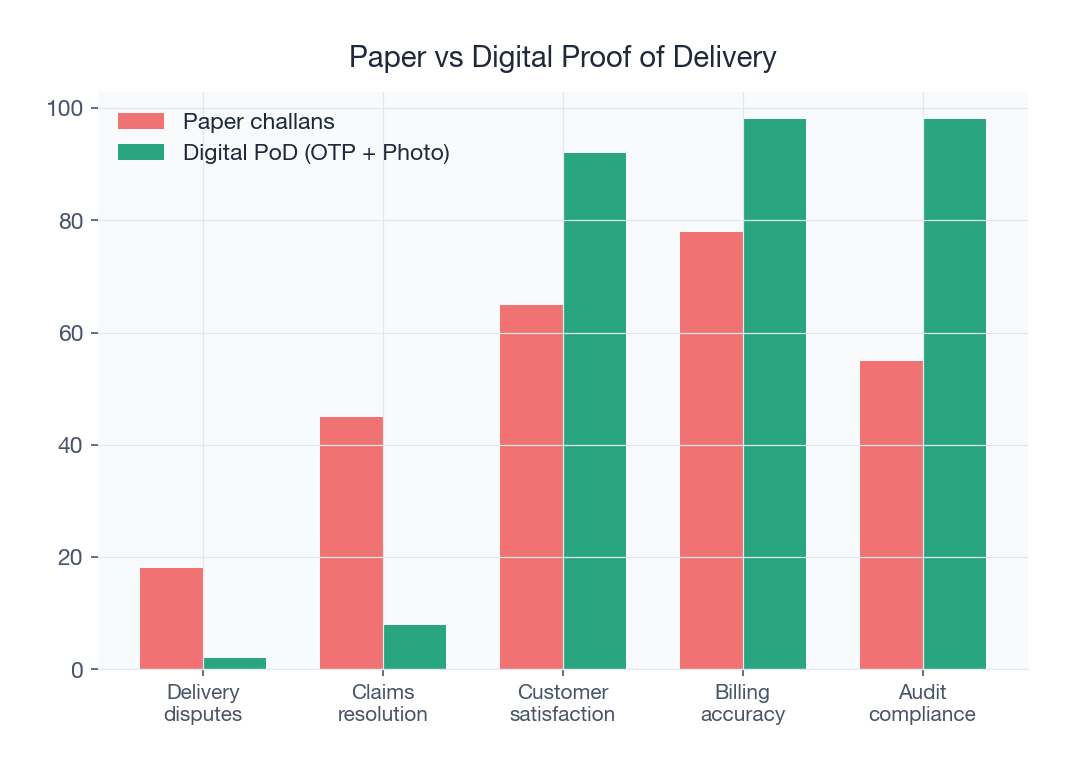
| Annual dispute cost | Rs 37-68 lakh for mid-sized distributor | Rs 3-5 lakh (90%+ reduction) |
Reducing Delivery Fraud: How ePOD Catches Pilferage
Delivery fraud is an uncomfortable reality in Indian FMCG distribution. Common fraud patterns include:
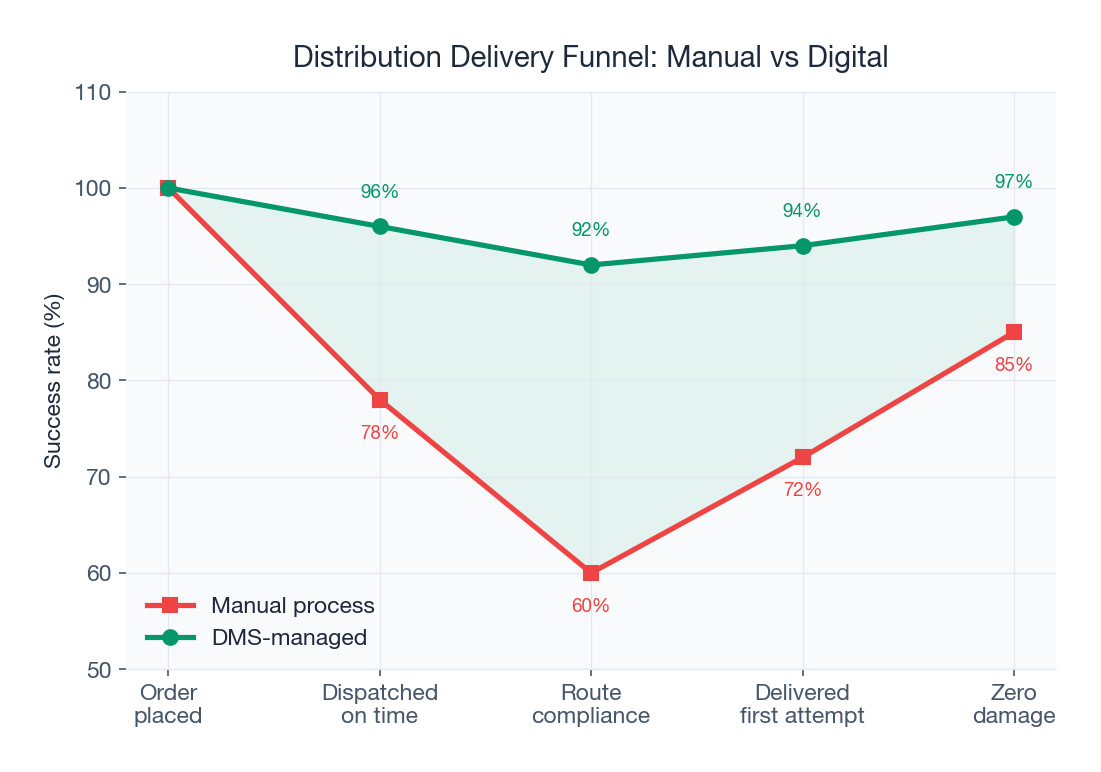
- Quantity skimming: Driver delivers 8 cases but records 10 on the paper challan, selling the extra 2 cases to an unregistered shop for cash. ePOD prevents this because the retailer's OTP confirms only 8 cases.
- Ghost deliveries: Driver marks a delivery as complete without actually visiting the shop, keeping the products. GPS verification and retailer OTP make ghost deliveries impossible.
- Fake returns: Driver claims 5 cases were returned by a retailer, but actually diverts them. With ePOD, returns require the retailer's OTP and a photo of the returned products at the shop, preventing fabrication.
- Route deviation for personal sales: Driver deviates from the assigned route to sell products to unauthorized outlets. GPS tracking through distribution tracking detects route deviations in real time and alerts supervisors.
One SpireStock customer in Hyderabad discovered Rs 4.2 lakh in monthly driver pilferage within the first three weeks of implementing ePOD. Two drivers were diverting an average of Rs 70,000 worth of products monthly to unauthorized outlets. The GPS and OTP trail made the evidence incontrovertible.
Case Study: Pune Dairy Distributor with 12 Routes
A dairy distributor in Pune serving 480 retail outlets across 12 delivery routes, handling products from multiple dairy brands, implemented SpireStock's ePOD module. Before implementation, the distributor was losing Rs 22 lakh annually to delivery disputes and spending Rs 3.6 lakh on staff dedicated to dispute resolution and challan management. Results after 6 months:
- Delivery disputes reduced by 92%: From 85 monthly disputes to 7 (and those 7 were resolved instantly using ePOD evidence)
- Annual savings: Rs 19.5 lakh (dispute resolution + fake return elimination + challan printing costs)
- Driver accountability: Two cases of systematic pilferage identified and stopped within the first month, saving an estimated Rs 8 lakh annually
- Retailer satisfaction: 78% of retailers reported improved delivery experience in a post-implementation survey. OTP confirmation gave them confidence in their own records.
- Payback period: 9 weeks (software and hardware cost recovered through dispute and pilferage savings)
- FSSAI audit: Passed with commendation for digital traceability records. Inspector specifically noted the delivery-level temperature documentation.
Implementation Considerations for Indian Distribution Operations
- Smartphones for drivers: Each delivery driver needs a smartphone with camera, GPS, and minimum 3G connectivity. Budget Rs 8,000-12,000 per device for a reliable Android phone. Many distributors provide company-owned phones to ensure consistent hardware quality and prevent the "my phone was not working" excuse.
- Driver training: Typical training takes 2-3 days covering the delivery workflow, photo capture standards, OTP process, and offline mode operation. Older drivers who have used paper challans for 15-20 years may need an additional week of supervised operation. Assign a tech-comfortable driver as a buddy for each reluctant adopter.
- Retailer onboarding: Brief retailers about OTP verification during the first few deliveries. Most kirana store owners adapt within 1-2 weeks. The key messaging is that OTP protects their interests too: if they claim a short delivery, they have digital proof. In our experience, retailer resistance drops to near-zero once they see that disputes are resolved instantly using ePOD data.
- Connectivity planning: Ensure the app has robust offline capability for areas with poor mobile network coverage, common in wholesale markets, basement godowns, and semi-urban delivery territories. All ePOD data should be captured and stored locally, syncing when connectivity resumes.
ePOD Beyond Delivery: Field Sales Verification
The verification principles behind ePOD extend naturally to field sales operations. Sales representatives can use similar mechanisms for attendance tracking with GPS check-in and check-out at retail outlets, confirming their presence during claimed visits. Order confirmation through retailer OTP for new orders prevents fake order booking. Merchandising verification through photo proof of display compliance, shelf share, and visibility execution provides brands with ground-level data. Scheme verification through photos of scheme material deployment at outlets ensures trade promotions are actually executed in the market. Explore our field force tracking guide for comprehensive coverage of field sales verification.
Choosing the Right ePOD Solution
When evaluating ePOD solutions for Indian dairy and FMCG distribution, prioritize these capabilities:
- Multiple verification methods: OTP, photo, signature, and QR scan, not just one method. Different delivery scenarios require different verification types.
- Robust offline mode: Essential for Indian delivery conditions. The app must capture all data locally and sync seamlessly.
- Integration with billing and returns: Standalone ePOD has limited value. It must connect to your invoicing, returns, and payment collection workflows.
- Vernacular support: Driver interfaces should support Hindi, Marathi, Tamil, Kannada, and other regional languages for adoption in tier-2 and tier-3 cities.
- Low data consumption: Drivers on limited mobile data plans need an app that compresses photos and minimizes bandwidth usage.
- Supervisor dashboard: Real-time visibility for distribution managers showing live delivery progress, exceptions, and alerts across all routes.
Still using paper challans for delivery? SpireStock's ePOD module replaces them with OTP verification, geotagged photo capture, and GPS stamps, creating irrefutable delivery evidence that eliminates disputes and catches fraud. Distributors across dairy, FMCG, beverage, and bakery distribution have reduced delivery disputes by 90%+ and recovered lakhs in annual losses. Start your free trial or view pricing to see the impact on your operations.
Sources & References
Frequently Asked Questions
Digital proof of delivery (ePOD) replaces paper challans with multi-layered digital verification at each delivery point. It typically includes OTP verification (retailer confirms via one-time password), geotagged photo capture of delivered products, GPS location stamp confirming driver was at the retailer's address, exact timestamp, and item-wise delivery confirmation.
The ePOD process adds approximately 30-60 seconds per delivery stop. For a 50-stop route, total additional time is 25-50 minutes per day. This is a small trade-off considering it eliminates Rs 37-68 lakh in annual delivery disputes for a mid-sized distributor.
For the rare cases where a retailer does not have a mobile phone, fallback options include digital signature on the driver's phone screen, photo of the delivered products with GPS tag, or confirmation by a nearby shop owner. The system is flexible enough to handle edge cases while maintaining accountability.
Yes, a good ePOD app works in offline mode. All delivery data (OTP, photos, GPS, signatures) is captured and stored locally on the driver's phone. When internet connectivity resumes, the data syncs automatically to the server. This is critical for deliveries in semi-urban and rural areas with patchy connectivity.
The primary costs are: smartphones for delivery drivers (Rs 8,000-12,000 per device if they do not already have one) and the DMS subscription that includes the ePOD module. Total investment for a 10-route operation is typically Rs 1-2 lakh. Given that ePOD saves Rs 15-25 lakh annually in dispute costs, payback is typically under 3 months.
Yes, ePOD creates a complete digital trail of every delivery including timestamps, GPS locations, and optionally temperature readings. This satisfies FSSAI's traceability requirements and provides instant audit readiness. During FSSAI inspections, you can generate delivery history reports for any product, batch, or retailer within minutes.
Related SpireStock Features
Mobile app for distributors, retailers, and delivery teams.
Zone, town, and route-based delivery management with optimization.
End-to-end order lifecycle from placement to delivery with multi-level approval workflows.
Geo-tagged attendance with location verification and travel analytics.
Related Industries
End-to-end dairy distribution software for milk, curd, paneer, and ghee brands. Manage orders, crates, cold chain, and GST billing in one platform.
Streamline FMCG distribution with order management, beat planning, retailer tracking, and GST billing. Built for Indian FMCG supply chains.
Manage beverage distribution with cold chain tracking, crate management, route optimization, and real-time delivery monitoring. Try SpireStock free.
Distribution software for bakeries and confectionery brands. Manage short-shelf-life products, daily dispatch, returns, and retailer credit efficiently.
Related Solutions
GPS fleet tracking, driver management, and route optimization for dairy and FMCG delivery vehicles. Reduce fuel costs by 25%. Try SpireStock.
Manage your entire distributor network digitally. Onboarding, credit limits, outstanding tracking, and performance analytics. Start free trial.
Track and manage your retail network. Geo-tag outlets, capture secondary sales, manage beats, and monitor retailer performance. Try SpireStock.
Related Entities
Ready to Streamline Your Distribution?
Start your free 14-day trial and see how SpireStock can transform your dairy, FMCG or consumer-goods distribution operation, from order capture to crate recovery.

SpireStock Team
Distribution Technology Experts
SpireStock Team writes for SpireStock on distribution management, supply-chain optimisation and field operations for Indian dairy and FMCG brands.