The Harsh Reality: Why Most New FMCG Distributors Don't Make It
India's FMCG distribution network is one of the largest in the world, with over 7.5 million retail outlets served by an estimated 400,000+ distributors. Yet the churn rate is alarming. Industry data from the Federation of Indian Chambers of Commerce and Industry (FICCI) suggests that approximately 40% of new FMCG distributors shut down within their first three years of operation. In cities like Delhi, Mumbai, and Bangalore, where competition is fierce and operating costs are high, the failure rate can climb even higher.
But failure in FMCG distribution is rarely sudden. It's a slow bleed — months of negative cash flow, mounting bad debts, eroding margins, and eventually, the decision to shut shop. The good news is that most of these failures follow predictable patterns. If you understand the warning signs early, you can course-correct before it's too late.
Whether you're starting a new distribution business or trying to stabilize an existing one, this guide covers the ten most common reasons FMCG distributors fail in India — and the specific steps successful distributors take to avoid each one.
Survival Rates: The Numbers Behind Distributor Failure
| Distributor Size (Annual Turnover) | 1-Year Survival Rate | 3-Year Survival Rate | 5-Year Survival Rate | Primary Failure Cause |
|---|---|---|---|---|
| Micro (< ₹50 Lakh) | 72% | 38% | 18% | Undercapitalization, bad debt |
| Small (₹50 Lakh – ₹2 Crore) | 82% | 55% | 35% | Credit control, single-brand dependence |
| Medium (₹2 Crore – ₹10 Crore) | 91% | 72% | 58% | Operational inefficiency, territory conflicts |
| Large (> ₹10 Crore) | 96% | 88% | 78% | Market shifts, channel disruption |
The data is clear: smaller distributors face disproportionately higher risk. A micro-distributor with less than ₹50 lakh annual turnover has only an 18% chance of surviving five years. Scale provides resilience — but smart operations can level the playing field regardless of size.
Reason #1: Undercapitalization — Starting Too Thin
The most common killer of new FMCG distribution businesses is simply not having enough working capital. Many aspiring distributors in cities like Ahmedabad and Jaipur enter the business thinking ₹10-15 lakh is sufficient. In reality, a serious FMCG distribution operation requires ₹25-50 lakh in working capital at minimum, depending on the brand and territory.
The math is unforgiving. If a brand requires 15-day advance payment and retailers pay on 21-30 day credit, you need enough capital to fund that 35-45 day cash gap across your entire inventory. Add security deposits (₹2-5 lakh per brand), vehicle costs, warehouse rent, and staff salaries — and a ₹15 lakh investment evaporates in the first quarter.
Key insight: Successful distributors maintain a working capital buffer of at least 2x their monthly purchase value. If you buy ₹20 lakh worth of goods per month, keep ₹40 lakh available — not invested, not lent out, readily accessible.
How successful distributors avoid this
- Realistic financial planning: They build detailed cash flow projections for the first 18 months before signing any distribution agreement. The FMCG distributor margin guide provides realistic benchmarks for capital planning.
- Phased brand additions: Instead of taking on three brands simultaneously, they start with one, stabilize operations, then add the second brand only after the first generates positive cash flow.
- Credit line management: They secure overdraft facilities or distributor financing before they need it, not during a cash crunch.
Reason #2: Poor Credit Control Leading to Bad Debt
Bad debt is the silent assassin of distribution businesses. A distributor in Pune serving 500 retailers might extend ₹30-40 lakh in credit at any given time. If even 5% of that becomes unrecoverable — ₹1.5 to 2 lakh — it wipes out the margin from ₹20-25 lakh in sales.
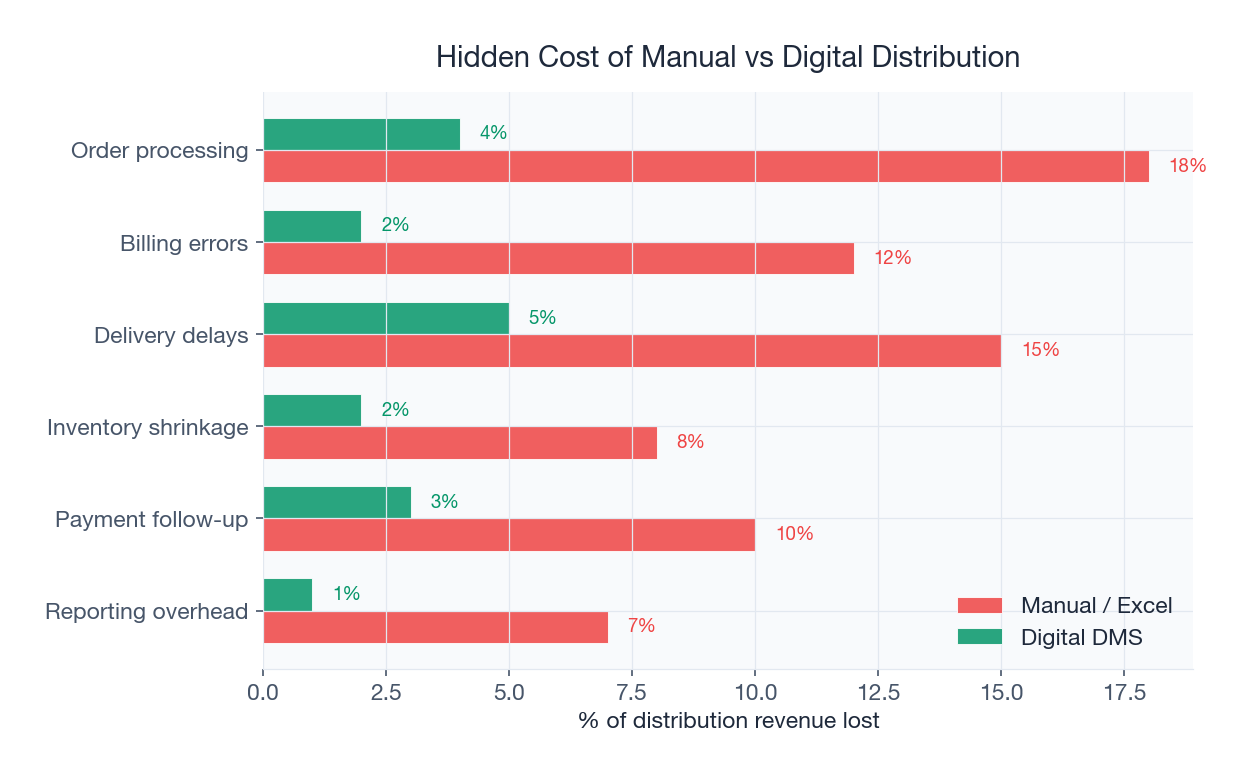
The pattern is predictable: a new retailer places a few small orders, pays on time, builds trust, then places a large order and disappears. Or a long-standing retailer gradually extends their payment cycle from 15 days to 30, then 45, then 60 — and by the time the distributor reacts, ₹3 lakh is stuck.
Warning signs of credit trouble
- Rising DSO (Days Sales Outstanding): If your average collection period crosses 25 days, it's a red flag.
- Concentration risk: If more than 15% of your outstanding is with a single retailer, you're exposed.
- Partial payments becoming routine: Retailers who consistently pay 70-80% and let the rest roll over are heading toward default.
- New retailers demanding credit immediately: A retailer who won't do even 2-3 cash-and-carry orders before asking for credit is a risk.
Modern payment collection systems can flag overdue accounts automatically, send reminders, and block further dispatches to defaulting retailers. Distributors using such tools report 30-40% reduction in overdue amounts within six months.
Reason #3: Zero Sales Visibility — Flying Blind
Most failed distributors share a common trait: they had no real-time understanding of what was selling, where, or why. They relied on month-end summaries from their accountant, by which time the damage was already done — slow-moving stock had piled up, fast-moving items had stocked out, and seasonal opportunities had passed.
Consider a typical scenario in Chennai: a distributor carries 400 SKUs across three FMCG brands. Without sales analytics, they can't tell which 50 SKUs generate 80% of revenue, which 100 SKUs are dead weight consuming warehouse space, or which retailers have reduced their order frequency — an early indicator of a competitor gaining ground.
Key insight: Distributors who review daily sales dashboards are 3x more likely to survive their first three years compared to those who review numbers monthly. Real-time visibility turns data into decisions.
What successful distributors track daily
- SKU-level sales velocity: Not just total sales, but units moved per SKU per day.
- Retailer ordering patterns: Frequency changes, basket size shifts, and category preferences.
- Return and expiry rates: By brand, by category, by delivery route.
- Salesperson performance: Orders per beat, coverage completion, and productive calls ratio.
Reason #4: Single-Brand Dependence
Putting all your eggs in one basket is risky in any business, but in FMCG distribution, it can be fatal. Distributors who depend on a single brand for more than 70% of their revenue are extremely vulnerable. Brand companies regularly restructure their distribution networks — splitting territories, appointing super-stockists, or moving to direct distribution — and the loyal single-brand distributor gets left with nothing.
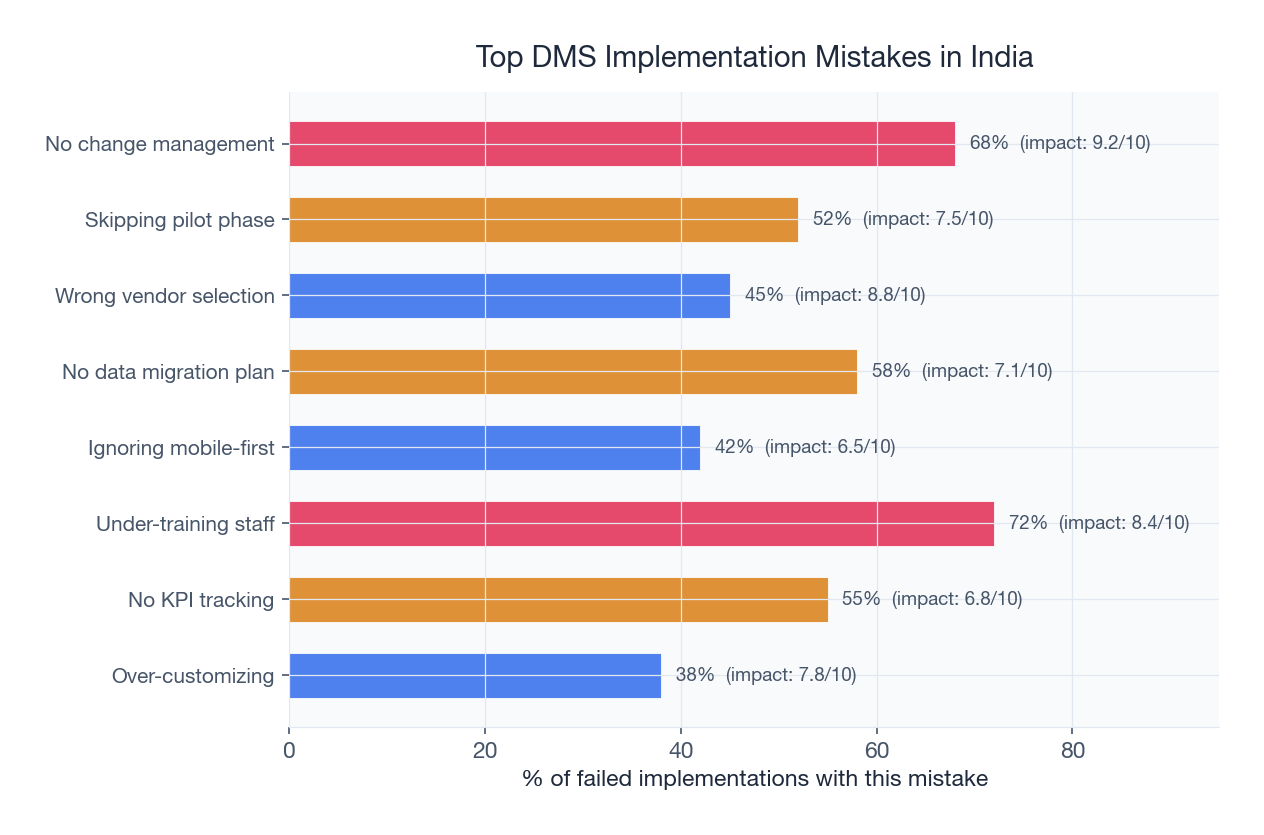
This pattern played out across multiple cities in 2024-25 when several major brands consolidated their distribution networks. Distributors in Hyderabad and Kolkata who had built their entire business around a single brand found themselves without a primary revenue source overnight.
How to diversify smartly
- Complementary categories: If you distribute dairy, add bakery or beverages — the same cold chain serves multiple categories.
- Non-competing brands: Carry brands that serve different price points or product segments within the same category.
- Using a multi-brand distribution platform: Technology that lets you manage multiple brands with separate billing, schemes, and reporting without operational chaos.
Reason #5: Ignoring Technology Until It's Too Late
The Excel-based distribution model that worked in 2015 is a liability in 2026. Yet many distributors — especially those in Tier 2 and Tier 3 cities like Indore, Nagpur, and Lucknow — resist adopting distribution management software until their manual processes collapse under the weight of scale.
The irony is that technology adoption costs have plummeted. A full-featured DMS solution costs ₹5,000-15,000 per month for a small distributor — less than a delivery boy's salary. Yet the perception of "complexity" and "cost" keeps distributors stuck on notebooks and WhatsApp groups for order management.
| Business Process | Manual Method | With DMS Software | Time Saved |
|---|---|---|---|
| Order Collection | Phone calls, WhatsApp | Digital order management | 70% |
| Invoice Generation | Tally manual entry | Auto-generated invoices | 85% |
| Outstanding Tracking | Register, ledger books | Real-time dashboard | 90% |
| Scheme Application | Manual calculation | Auto-applied schemes | 95% |
| Sales Reporting | Month-end compilation | Live analytics | 80% |
Reason #6: Poor Warehouse and Inventory Management
A distributor's warehouse is their factory floor, yet many treat it as an afterthought. Poor warehouse management leads to a cascade of problems: expired stock (especially critical in dairy distribution and FMCG), damaged goods from improper stacking, picking errors that frustrate retailers, and phantom inventory where the system says 50 cases but only 40 exist.
In perishable categories, expiry-related losses alone can eat 2-4% of turnover. A dairy distributor in Surat handling ₹1 crore monthly could lose ₹2-4 lakh per month to expiry if FIFO (First In, First Out) isn't strictly enforced.
Warehouse red flags
- No batch tracking: If you can't tell which stock arrived when, FIFO is impossible.
- Inventory variance above 2%: The gap between system stock and physical stock should be under 2%. Above that indicates theft, damage, or recording errors.
- High return rates: If retailers return more than 3% of dispatched goods, your picking accuracy or expiry management needs attention.
- No zone-based storage: Fast-moving SKUs should be near the loading dock, slow-movers at the back.
Reason #7: Not Tracking Expiry and Returns Systematically
Returns and near-expiry stock are a margin destroyer that many distributors track only on paper — if at all. The problem compounds in categories like bakery and confectionery and beverages where shelf life is limited and seasonal demand fluctuations can leave distributors holding unsold stock.
The real cost of returns goes beyond the product value. There's the logistics cost of pickup, the warehousing cost of storing returned goods, the administrative cost of credit notes, and the relationship cost when brand companies dispute the claim. A distributor handling brands like Britannia or Parle Agro needs airtight documentation to ensure timely claim settlement.
Key insight: For every ₹1 in expired product cost, the total impact on the distributor including handling, logistics, and opportunity cost is approximately ₹2.50. Prevention through better demand forecasting and stock rotation is always cheaper than cure.
Reason #8: Failing to Build Strong Retailer Relationships
Distribution is fundamentally a relationship business. Distributors who treat retailers as mere order-filling endpoints rather than partners eventually lose them to competitors. In a market where 3-4 distributors might service the same area, the one with the strongest retailer relationships wins.
Strong relationships aren't just about giving longer credit or higher margins. They're built on consistency — delivering on time, having the right stock always available, resolving complaints quickly, and helping retailers understand schemes and promotions. A retailer tracking system helps maintain these relationships at scale by ensuring no retailer falls through the cracks.
Relationship-building practices of successful distributors
- Regular beat coverage: Every retailer gets a visit at their scheduled frequency — not just when it's convenient.
- Scheme transparency: Retailers know exactly what schemes are running and what they're earning.
- Quick complaint resolution: Damage replacements and billing errors resolved within 48 hours, not weeks.
- Market intelligence sharing: Informing retailers about upcoming launches, price changes, and promotional periods.
Reason #9: Territory Overlap and Channel Conflicts
Territory encroachment — where another distributor sells in your designated area — is a growing problem, especially in fast-growing cities like Bangalore and Pune. When two distributors serve the same retailers, it triggers a price war that destroys margins for both. The complete guide to channel conflict management in FMCG covers this in depth.
Even worse is when the brand company itself creates conflict by appointing overlapping distributors or launching a D2C channel that competes with its own distribution network. The distributor, who invested capital and relationships to build the market, suddenly finds the brand selling directly at lower prices.
Protecting your territory
- Written agreements: Ensure your distribution agreement clearly defines geography — pin codes, not vague "areas."
- Data-backed evidence: Use distribution tracking to document your coverage and market development efforts.
- Direct communication: Flag encroachment issues to the brand's Area Sales Manager immediately with evidence.
- Industry associations: Join local distributor associations that can collectively negotiate with brands on territory protection.
Reason #10: Mixing Personal and Business Finances
This might seem like basic business advice, but it's the downfall of a staggering number of family-run distribution businesses across India. The distributor withdraws ₹5 lakh for a family wedding from business funds, covers a relative's medical emergency from the cash drawer, or "invests" business profits in personal real estate — and suddenly there's no working capital to pay the brand company's next billing cycle.
The problem is compounded when there's no clear accounting separation. Many small distributors in cities like Coimbatore and Chandigarh use a single bank account for personal and business transactions, making it impossible to know the true financial health of the business.
Financial discipline fundamentals
- Separate accounts: Maintain distinct bank accounts for business operations and personal use. No exceptions.
- Fixed owner's draw: Pay yourself a fixed monthly salary from the business. Profits above that stay in the business until a formal quarterly review.
- Business-first cash flow: Brand payments, staff salaries, and operational costs always take priority over personal withdrawals.
- Professional accounting: Use proper invoicing and billing systems so every rupee is tracked and accounted for.
The Distributor Failure Warning Signs Checklist
If you recognize three or more of these signs in your business, it's time for urgent corrective action:
| Warning Sign | Severity | Immediate Action |
|---|---|---|
| DSO (Days Sales Outstanding) above 30 days | High | Freeze credit to worst offenders, implement strict collection schedule |
| Expired stock above 2% of inventory value | High | Implement FIFO, set up batch-level tracking and alerts |
| Single brand contributing >70% revenue | Medium | Begin discussions with complementary brands for diversification |
| No daily sales data visibility | Medium | Adopt a distribution management system immediately |
| Inventory variance above 3% | High | Conduct full physical audit, implement daily stock checks for top SKUs |
| Personal withdrawals exceeding owner's salary | Critical | Separate accounts, establish fixed draw immediately |
| Retailer complaints increasing month-on-month | Medium | Survey top 50 retailers, fix top 3 complaint categories |
| Delivery boys/salesmen turnover above 30% annually | Medium | Review compensation, implement incentive structure tied to performance |
| Brand company reducing your territory | Critical | Document coverage data, present growth plan to ASM, diversify brands |
| Month-end cash crunch becoming regular | Critical | Review cash flow, cut slow-moving SKUs, tighten credit immediately |
How Technology Changes the Survival Equation
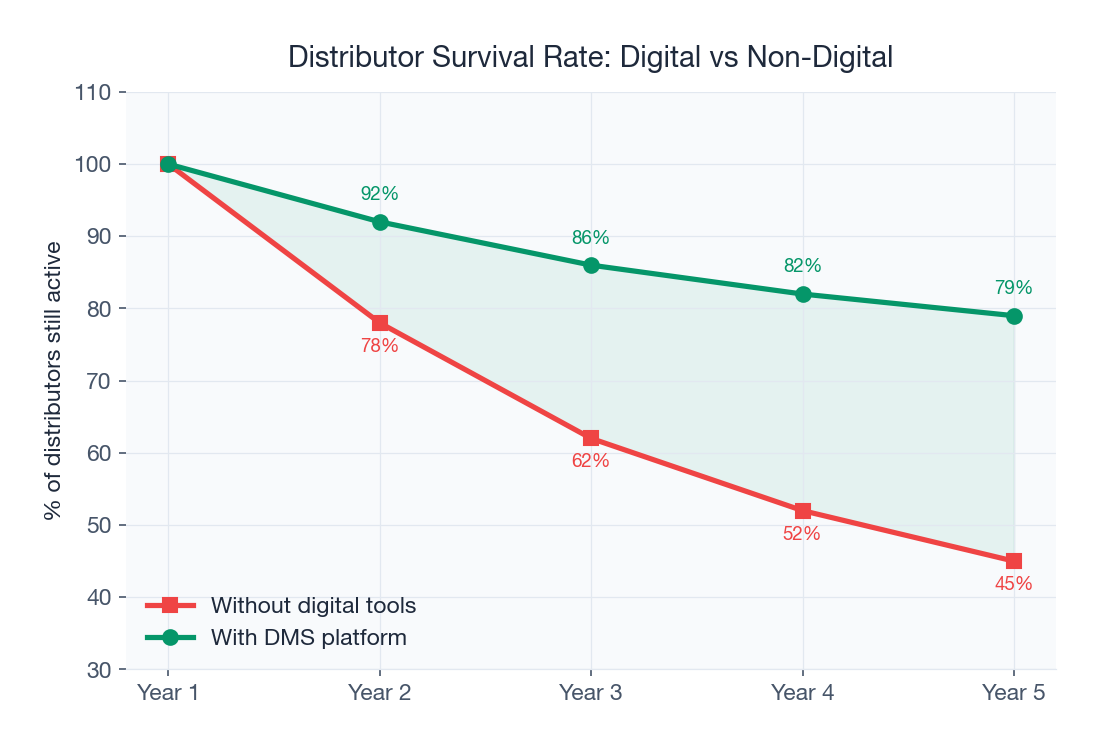
The data shows a striking correlation between technology adoption and distributor survival. According to a 2025 survey by the All India Consumer Products Distributors Federation (AICPDF), distributors using a DMS platform had a 5-year survival rate of 74% compared to just 31% for those relying on manual processes. The gap is widening as competition intensifies and brand expectations increase.
Modern distributor management solutions address nearly every failure point covered in this article:
- Cash flow protection: Automated credit limit enforcement and overdue alerts prevent bad debt accumulation.
- Inventory intelligence: Real-time stock tracking with expiry alerts and FIFO enforcement reduces waste.
- Sales visibility: Daily dashboards showing sales analytics by SKU, retailer, and salesperson enable proactive decisions.
- Operational efficiency: Digital order management and auto-invoicing free up time for relationship-building and growth.
- Brand compliance: Scheme tracking, beat adherence reporting, and territory mapping satisfy brand audit requirements.
Building a Distribution Business That Lasts
Surviving in FMCG distribution isn't about luck — it's about discipline, visibility, and adaptability. The distributors who make it past the three-year mark typically share these traits: they respect working capital like it's oxygen, they track their numbers daily (not monthly), they diversify revenue sources, and they invest in systems that give them control over their operations.
If you're planning to start a distribution business in 2026, go in with your eyes open. Understand the real margins and economics before committing capital. And if you're an existing distributor recognizing some of these warning signs, the time to act is now — not next quarter.
The FMCG distribution industry in India is worth over ₹5 lakh crore and growing. There's enormous opportunity for well-run distributors. But the era of surviving on relationships alone is over. You need relationships AND systems. The distributors who understand this will not only survive — they'll dominate their territories.
Ready to strengthen your distribution operations and avoid these common pitfalls? Talk to our distribution experts about how SpireStock can give you the visibility and control you need, or explore our pricing plans designed specifically for Indian FMCG distributors.
Sources & References
- Federation of Indian Chambers of Commerce and Industry (FICCI) — FMCG Distribution Sector Report 2025
- All India Consumer Products Distributors Federation (AICPDF) — Annual Distributor Survey 2025
- National Institute of Industrial Engineering (NITIE) — Supply Chain Resilience Study 2025
Frequently Asked Questions
Approximately 40% of new FMCG distributors in India shut down within their first three years of operation. Micro distributors with turnover below ₹50 lakh face even higher failure rates, with only 18% surviving beyond five years according to industry estimates.
Undercapitalization is the single biggest killer. Many new distributors start with ₹10-15 lakh when they need ₹25-50 lakh in working capital. The cash gap between paying brands upfront and collecting from retailers on credit drains insufficient capital within months.
A serious FMCG distributor should maintain working capital of at least 2x their monthly purchase value. For a distributor buying ₹20 lakh worth of goods monthly, that means ₹40 lakh in readily available capital, plus security deposits and operational expenses.
Distribution management software provides real-time sales visibility, automated credit control, inventory tracking with expiry alerts, and digital order management. DMS-using distributors have a 74% five-year survival rate versus 31% for manual-operation distributors.
Key warning signs include DSO exceeding 30 days, expired stock above 2% of inventory value, single-brand revenue dependence over 70%, regular month-end cash crunches, increasing retailer complaints, and personal withdrawals exceeding a fixed owner's salary.
No. Single-brand dependence above 70% of revenue is a significant risk. Brand companies regularly restructure distribution networks, and a dependent distributor can lose their primary income overnight. Smart diversification across complementary, non-competing brands is essential.
Bad debt is devastating because FMCG margins are thin at 3-8%. If just 5% of outstanding credit becomes unrecoverable, it can wipe out the profit from ₹20-25 lakh in sales. Systematic credit control and automated payment tracking are critical safeguards.
While some start with ₹10-15 lakh, realistically you need ₹25-50 lakh including working capital, security deposits of ₹2-5 lakh per brand, warehouse rent, vehicles, and staff costs. Underfunding is the primary cause of first-year failures.
Related SpireStock Features
Powerful dashboards with sales trends, MIS reports, and distribution analytics.
GST-compliant invoicing with HSN codes, gate passes, and financial ledger.
End-to-end order lifecycle from placement to delivery with multi-level approval workflows.
Related Industries
Streamline FMCG distribution with order management, beat planning, retailer tracking, and GST billing. Built for Indian FMCG supply chains.
End-to-end dairy distribution software for milk, curd, paneer, and ghee brands. Manage orders, crates, cold chain, and GST billing in one platform.
Related Solutions
Track distributor and retailer payments. Cash, UPI, cheque collection with reconciliation, ageing reports, and credit limit management.
Manage your entire distributor network digitally. Onboarding, credit limits, outstanding tracking, and performance analytics. Start free trial.
Related Entities
Ready to Streamline Your Distribution?
Start your free 14-day trial and see how SpireStock can transform your dairy, FMCG or consumer-goods distribution operation, from order capture to crate recovery.

SpireStock Team
Distribution Technology Experts
SpireStock Team writes for SpireStock on distribution management, supply-chain optimisation and field operations for Indian dairy and FMCG brands.