The Manual-to-Digital Distribution Transition
Every FMCG and dairy distributor in India faces the same question at some point: should we continue running the business on paper, phone calls and spreadsheets, or should we invest in a digital distribution platform? The honest answer depends on scale, ambition and risk tolerance, but the underlying trend is undeniable. Over 70% of new Indian distribution deployments in 2025-2026 are digital-first, and the gap in unit economics between manual and digital operators continues to widen every quarter.
This post provides a clear-eyed comparison of both approaches, using the same metrics a CFO or COO would use when making the call. Whether you run a small standalone distribution operation or a multi-state network, the data here will help you figure out what moving to digital actually means for your bottom line.
Side-by-Side Comparison
| Dimension | Manual Distribution | Digital Distribution (DMS) |
|---|---|---|
| Order capture | Phone, WhatsApp, paper | Retailer app, beat mobile app |
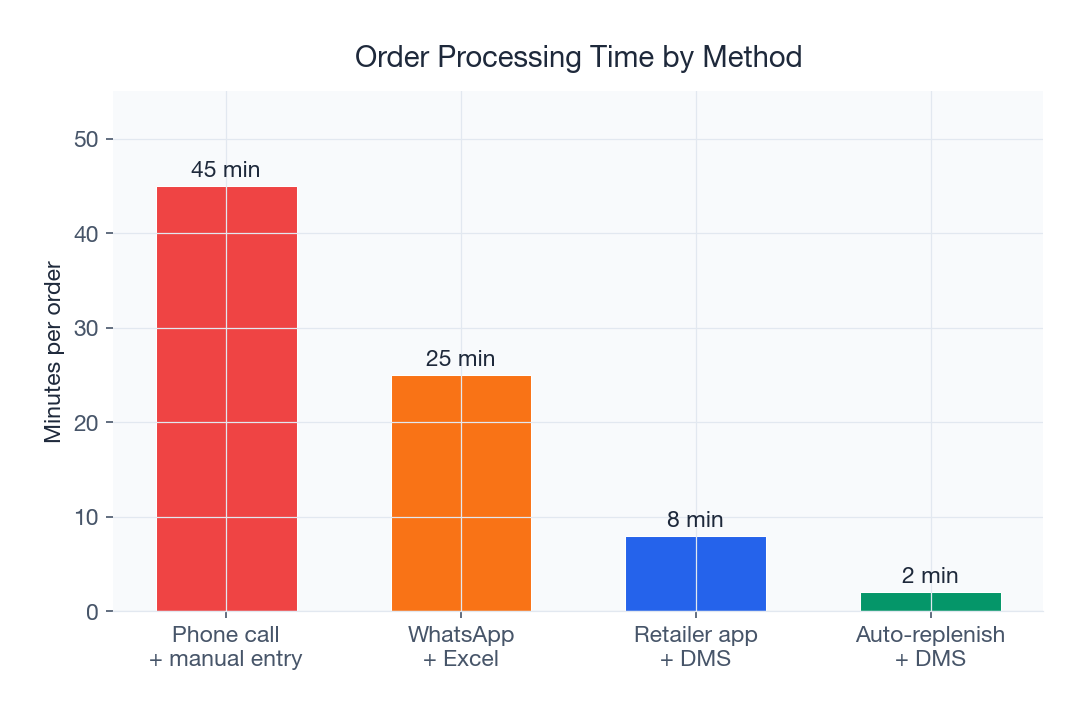
| Order-to-dispatch time | 6-12 hours | 30-90 minutes |
| Route planning | Manual sequencing by supervisor | AI-driven route optimization |
| Delivery visibility | Phone follow-ups | Real-time GPS tracking |
| Scheme application | Manual calculation on invoice | Automated scheme engine |
| Crate tracking | Paper registers | QR-based digital tracking |
| Field force productivity | 30-40 outlets/day | 50-70 outlets/day |
| Scheme compliance | 60-70% | 95-98% |
| Cost per delivery | Baseline | 22-30% lower |
| Month-end closing | 5-7 days | Same day |
| Errors in billing | 5-12% | Under 1% |
| Visibility into performance | Monthly reports | Real-time dashboards |
| Scalability | Linear (more outlets = more people) | Sub-linear (tech absorbs scale) |
Where Manual Operations Still Work
1. Very Small Distributors
If you serve fewer than 50 outlets with 1-2 salespeople, paper and phone calls still function. The cost of digital tools may exceed the benefits until you cross a minimum viable scale.
2. Extremely Traditional Markets
Some rural markets still prefer verbal relationships, cash transactions and handshake commitments. Pushing digital tools too aggressively can alienate retailers who value personal trust over technology.
3. Seasonal Micro Operations
Festival-time pop-up distributors who only operate for a few weeks each year may find digital tools impractical to deploy.
Why Digital Wins at Scale
1. The Linear vs Sub-Linear Cost Curve
Manual operations scale linearly, double your outlets, double your people, double your overhead. Digital operations scale sub-linearly: the software handles 3x the load at roughly the same cost. This is why digital distributors achieve 22-30% lower cost-to-serve as they grow.
2. Real-Time Visibility Drives Decisions
Manual operators discover problems at month-end. Digital operators fix them the same day. This difference compounds dramatically over time.
3. Scheme Compliance and Revenue Leakage
Manual scheme handling leaks 2-4% of gross sales to calculation errors, unclaimed entitlements and disputed settlements. A capable scheme engine recovers that money.
4. Field Force Productivity
With a digital mobile app, sales reps visit 50-70 outlets daily instead of 30-40. That's a 40-60% productivity lift without adding headcount.
5. Customer Experience
Digital retailers expect digital service. Kirana owners under 45 years old increasingly order via retailer apps and expect same-day fulfilment. Brands stuck on paper lose these accounts to digital-first competitors.
Pros and Cons
Manual Pros
- Lower upfront cost
- No technology learning curve
- Works offline
- Personal relationships front-and-center
Manual Cons
- Linear scaling
- High error rates
- Delayed visibility into problems
- Revenue leakage via scheme mismanagement
- Cannot serve modern trade SLAs
- Vulnerable to staff turnover (tribal knowledge)
Digital Pros
- Sub-linear cost scaling
- Real-time dashboards
- Near-zero billing errors
- Scheme compliance above 95%
- Field productivity +40-60%
- Resilient to staff churn (data lives in the system)
Digital Cons
- Upfront setup and training effort
- Requires internet connectivity for dashboards
- Resistance from old-school field force
- Subscription cost for SaaS tools
Pricing Ranges for Digital Distribution Tools
- Entry-level SaaS: Rs 2,000-5,000/month, basic order management and mobile app
- Mid-tier: Rs 8,000-20,000/month, full DMS with route optimisation, schemes, analytics
- Enterprise: Rs 30,000-1,50,000/month, multi-plant, multi-distributor, advanced analytics
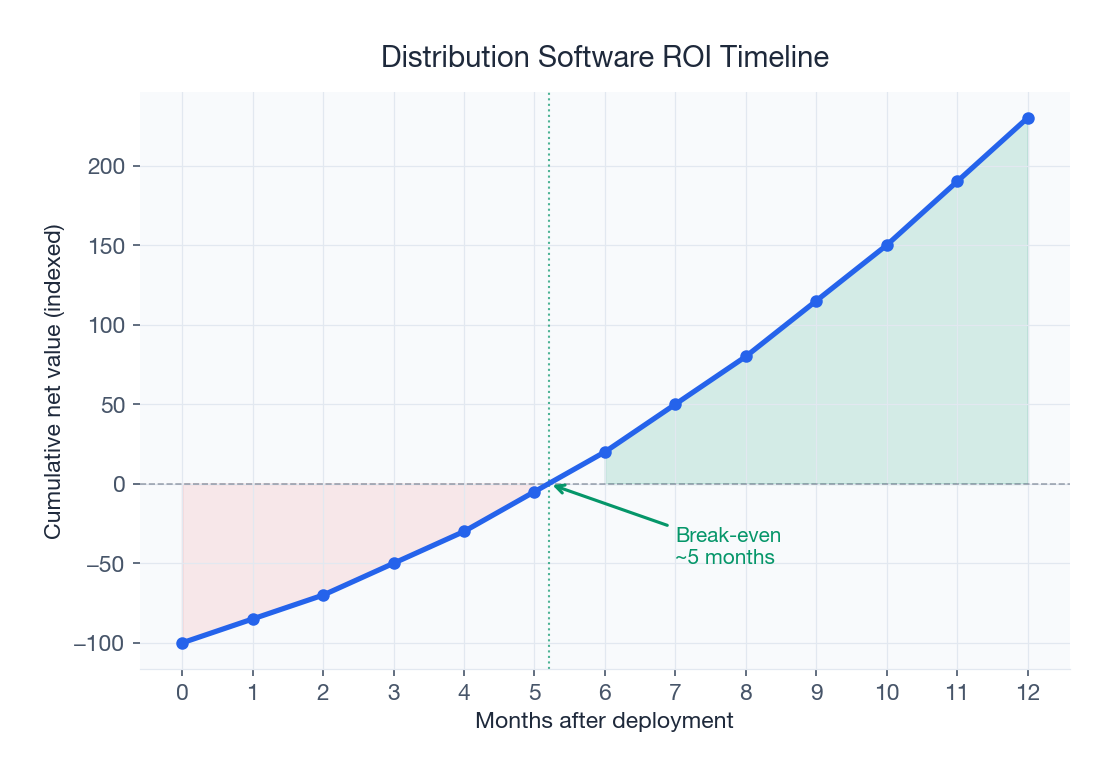
For most growing distributors, the mid-tier pays back within 3-6 months via productivity gains alone. See SpireStock pricing for detailed plans.
Case Study: A Bakery Distributor's Digital Leap
A bakery and confectionery distributor with 180 outlets in Pune moved from paper-based operations to a full digital platform. Within 6 months, they grew to 340 outlets without adding field staff, reduced delivery cost per outlet by 28%, and achieved scheme compliance of 97%. Their monthly analytics review now takes 30 minutes instead of 3 days.
Making the Transition: A Practical Roadmap
- Week 1-2: Audit existing processes, identify top pain points
- Week 3-4: Shortlist platforms and run demos (compare options in our 2026 rankings)
- Week 5-6: Pilot with one beat and 1-2 field officers
- Week 7-10: Expand to full distributor network
- Week 11-12: Measure ROI and adjust
Operators ready to explore digital can review SpireStock pricing or book a discovery call to map their transition. See also our digital transformation guide for more context.
The Real Cost of Running Manual Operations
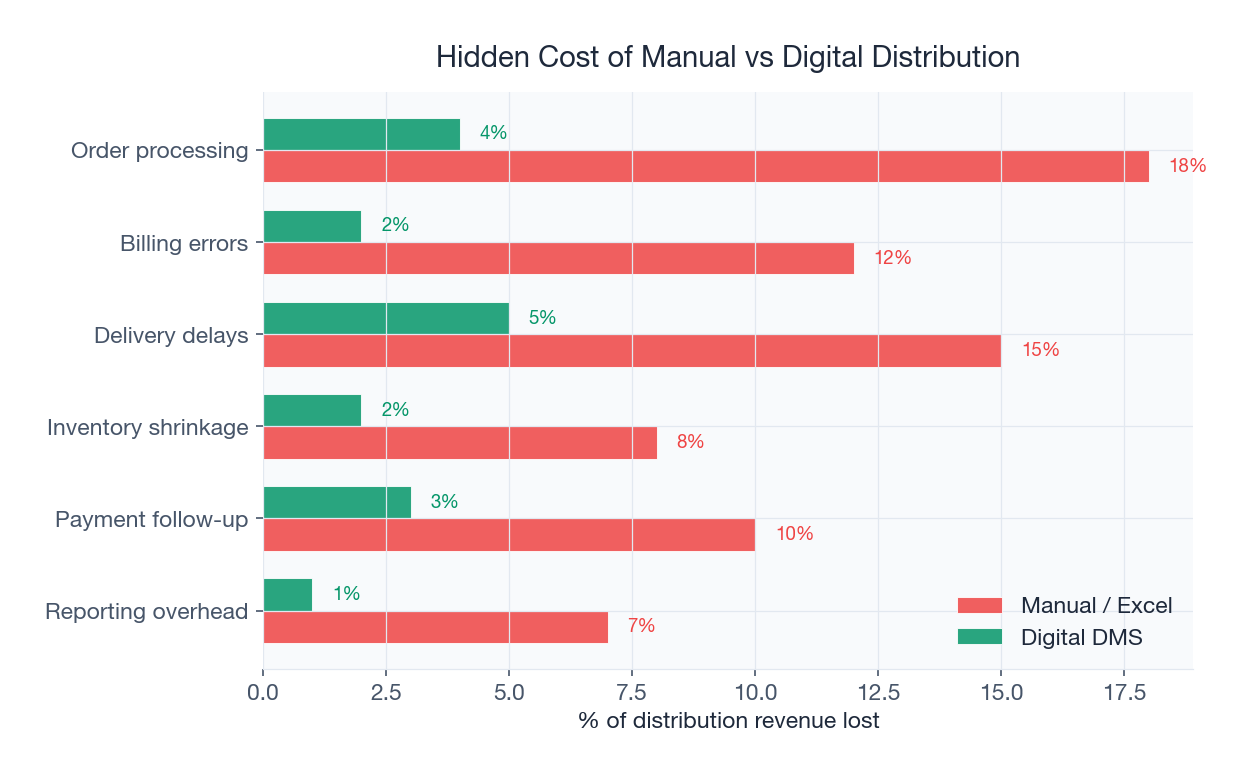
Most operators who stick with manual operations dramatically underestimate the total cost. The licence bill for a shared Tally installation may be Rs 18,000, but the true cost of manual distribution includes staff overhead, error-correction, revenue leakage, missed schemes, lost crates and opportunity cost. When calculated end-to-end, manual operations typically cost 2-4x more than a modern digital platform on a per-outlet basis.
Let's break down the hidden costs layer by layer.
Hidden Cost 1: Scheme Leakage
Manual scheme calculation leaks 2-4% of gross sales every month. For a distributor doing Rs 10 crore monthly, that's Rs 20-40 lakh of revenue lost to calculation errors, disputed settlements and unclaimed entitlements. Multiply across a year and the number exceeds most DMS subscription costs by 20-50x.
Hidden Cost 2: Billing Errors and Chargebacks
Manual invoicing produces 5-12% error rates. Each error leads to retailer disputes, rework, chargebacks and strained relationships. A large distributor can spend 30-40% of back-office time handling billing disputes that wouldn't exist with automated GST-compliant billing.
Hidden Cost 3: Crate and Returnable Asset Loss
Without digital tracking, crate losses run 5-8% annually. A mid-sized distributor with 20,000 crates at Rs 200 per crate bleeds Rs 2-3 lakh per month in pure asset loss. Digital crate management with QR codes reduces this to under 1%.
Hidden Cost 4: Field Force Under-Utilisation
Manual field force runs at 40 outlets per day vs 60-70 with a digital app. That's a 35-40% productivity gap. For a distributor with 20 field staff, closing that gap effectively adds 7-8 productive staff without any new hiring.
Hidden Cost 5: Delayed Decision-Making
Manual operators discover problems at month-end. By then, an underperforming beat has cost 30 days of sales. Digital operators see issues in real time and fix them the same day. This difference compounds dramatically, a 10% month-end correction becomes a 2% same-day fix.
Hidden Cost 6: Missed Modern Trade Opportunities
Modern trade chains like D-Mart, Reliance Smart and Big Bazaar require SLA compliance, digital invoicing and dock appointment systems. Manual operators simply cannot serve these accounts at scale. Missing modern trade is missing 25-35% of the addressable market in metros.
A Month in the Life of a Manual Distributor
Picture a manual distributor serving 450 outlets with 8 field staff. Here's a typical month:
- Week 1: Staff reconcile last month's orders, payments and schemes. Approximately 40 hours lost to reconciliation.
- Week 2: Routine operations begin. Morning phone ordering chaos. Paper invoices written by hand. Evening cash counts and cheque deposits.
- Week 3: Mid-month scheme verification. 3-5 schemes running simultaneously. Disputes with 12-15 retailers. Staff chase missing crates.
- Week 4: Month-end rush. Billing errors surface. Credit notes generated manually. Field staff visit accounts to verify outstanding collections. Monthly reports delayed by 5-7 days.
By the time Week 4 closes, the owner has limited visibility into actual profitability. Key decisions, product mix, credit policies, field force deployment, are made on instinct rather than data.
A Month in the Life of a Digital Distributor
Same 450 outlets, same 8 field staff, but everything runs on SpireStock:
- Week 1: Automated reconciliation completed in 2 hours on the 1st of the month. Analytics dashboards show previous month's performance cleanly.
- Week 2: Orders placed via retailer app the previous night. Routes auto-sequenced. Invoices e-generated. Field staff working on productivity, not paperwork.
- Week 3: Scheme engine auto-applies all offers. Disputes near zero. Crates tracked digitally. Supervisor intervenes early on any anomaly.
- Week 4: Month-end is just another day. Real-time dashboards show profitability by beat, SKU, distributor. Decisions made on data, not guesswork.
Why Digital Platforms Scale Better
Software cost grows sub-linearly with outlet count. Whether you serve 500 or 5,000 outlets, your core DMS subscription doesn't increase proportionally. Staff cost, on the other hand, scales linearly in manual operations. This is why digital distributors' unit economics keep improving with scale while manual operators' margins compress.
The Adoption Curve: What to Expect
Moving from manual to digital isn't instant. Expect:
- Week 1-2: Resistance. Some staff will push back. A supervisor's buy-in is critical.
- Week 3-4: Initial adoption. Mobile app usage climbs to 70%. First ROI signals appear.
- Month 2: Scheme and billing automation stabilise. Errors drop sharply.
- Month 3: Full adoption. Productivity gains become visible.
- Month 6: Analytics-driven decision-making replaces gut-feel management.
- Month 12: Operations look fundamentally different. Scaling becomes possible without hiring.
Change Management Tips
- Pilot with your best field officer first. Use their success story to recruit adoption.
- Keep paper backup for the first 2 weeks. Confidence builds gradually.
- Celebrate early wins publicly. "Rajesh closed 65 outlets today, new record!"
- Use Hindi / regional language training videos. Accessibility accelerates adoption.
- Tie incentives to app usage. Small rewards drive behaviour.
- Don't fire non-adopters immediately. Coach, retrain, reposition.
Final Word
Manual distribution worked in the 2000s. It limped along in the 2010s. In 2026, it's an active handicap that ensures you lose accounts, margins and market share to digital-first competitors. Whether you're a Rs 5 crore local distributor or a Rs 500 crore multi-state operator, the math now favours going digital. Review our 2026 distribution software rankings, check out the features checklist, browse SpireStock pricing tiers, or book a readiness assessment call with our team.
Myth-Busting: Objections to Going Digital
Myth 1: "My team is too old to learn new tech"
Reality: well-designed mobile apps with Hindi/regional language UIs and intuitive workflows are learned in 1-2 days by staff of all ages. The obstacle is usually the tool's design, not the learner's age.
Myth 2: "We don't have good internet in rural areas"
Reality: offline-first mobile apps work without internet. They capture data locally and sync when connectivity returns. Rural distributors use them successfully every day.
Myth 3: "SaaS subscriptions are more expensive than one-time licenses"
Reality: total cost of ownership over 3 years usually favours SaaS by a wide margin. Hardware maintenance, IT staff and hidden upgrade costs add up.
Myth 4: "Digital data is risky"
Reality: cloud platforms use bank-grade encryption and backup redundancy. Paper records are actually far more vulnerable to fire, theft, loss and tampering.
Myth 5: "Our business is unique and needs custom software"
Reality: 95% of distribution workflows are similar across operators. Modern SaaS platforms offer enough configurability to handle the remaining 5% without custom development.
The 90-Day Transition Plan
A realistic 90-day plan for moving from manual to digital operations:
- Days 1-15: Vendor evaluation, shortlist, demo scoring
- Days 16-30: Contract finalisation, master data prep, infrastructure setup
- Days 31-45: Pilot with 1-2 field officers and 1 distributor
- Days 46-60: Expand pilot to 3-5 officers, refine workflows
- Days 61-75: Full rollout across all distributors
- Days 76-90: Performance review, ROI measurement, continuous optimisation
Pricing Transparency
A key frustration in the DMS market is hidden pricing. Avoid platforms that:
- Quote only after discovery calls and never publish prices
- Charge hefty implementation fees on top of monthly costs
- Bundle essential features into premium tiers
- Lock customers into multi-year contracts
Transparent pricing (like SpireStock pricing) lets you budget accurately and switch if the platform doesn't deliver.
Beyond Technology: The Mindset Shift
The hardest part of moving from manual to digital isn't the software, it's the mindset. Managers must learn to trust data over instinct, to review metrics instead of anecdotes, and to act on trends rather than individual incidents. This shift takes months, not days. Leaders who invest in change management alongside software deployment see dramatically better outcomes than those who assume technology alone will solve operational problems.
Sources & References
Frequently Asked Questions
Hidden costs include excess labour (Rs 60,000-80,000/month for data entry staff), crate losses (15-25% annually), route inefficiency (25-35% excess fuel costs), billing errors (1-2% revenue leakage), and delayed decisions. For a mid-sized distributor, these hidden costs easily exceed Rs 3-5 lakh monthly.
Most dairy and FMCG distributors see positive ROI within 3-4 months. Key savings come from route optimization (25-30%), reduced crate losses (80% fewer disputes), billing accuracy (99%+), and productivity gains (40% improvement). Monthly savings typically exceed software costs by 3-5x.
A phased transition makes it manageable. Start with digital ordering and billing (2-3 weeks), add route optimization (1-2 weeks), then layer in crate tracking and analytics. SpireStock provides dedicated onboarding support including staff training and data migration.
Modern distribution apps are designed for ease of use with simple interfaces and vernacular language support. Most field staff become comfortable within 1-2 weeks of training. The key is starting with basic features and adding complexity gradually.
Yes. SpireStock offers pilot programs where you can digitize operations for a subset of distributors or one territory. This lets you validate the benefits before rolling out across your full network. Most pilots convert to full deployment within 4-6 weeks.
Related SpireStock Features
Related Industries
End-to-end dairy distribution software for milk, curd, paneer, and ghee brands. Manage orders, crates, cold chain, and GST billing in one platform.
Streamline FMCG distribution with order management, beat planning, retailer tracking, and GST billing. Built for Indian FMCG supply chains.
Related Solutions
Manage your entire distributor network digitally. Onboarding, credit limits, outstanding tracking, and performance analytics. Start free trial.
Boost field sales team productivity with beat planning, GPS attendance, order capture, and performance analytics. Built for Indian FMCG teams.
Related Entities
Ready to Streamline Your Distribution?
Start your free 14-day trial and see how SpireStock can transform your dairy, FMCG or consumer-goods distribution operation, from order capture to crate recovery.

SpireStock Team
Distribution Technology Experts
SpireStock Team writes for SpireStock on distribution management, supply-chain optimisation and field operations for Indian dairy and FMCG brands.