The Unique Complexity of Dairy Order Management
Unlike most industries where orders are placed weekly or monthly, dairy distribution operates on a daily ordering cycle. Distributors place fresh orders every day, sometimes multiple times a day, with production deadlines measured in hours. A delayed or missed order means lost sales that can never be recovered because dairy products cannot wait on a shelf the way packaged biscuits or detergent can.
This daily urgency, combined with the variety of SKUs (liquid milk, curd, buttermilk, paneer, ice cream, ghee), multiple production units, and complex trade schemes, makes dairy order management one of the most demanding workflows in FMCG distribution. If your team still processes orders through phone calls and WhatsApp, start your free 14-day trial and see how automation transforms the process within the first week.
The Cost of Manual Order Processing in Dairy
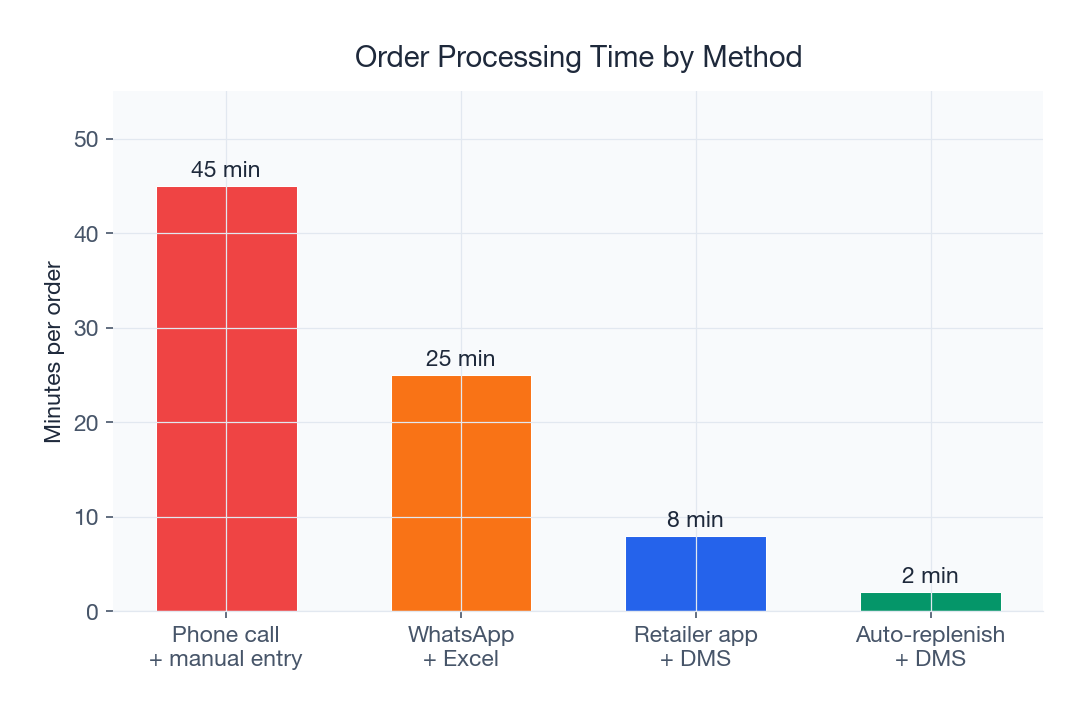
Before exploring the solution, let us quantify the problem. A mid-sized dairy company operating 300 distributors across Ahmedabad and Gujarat processes 300-500 orders daily. When these orders come through phone calls and messages:
| Problem | Frequency | Annual Cost |
|---|---|---|
| Transcription errors (wrong SKU, wrong quantity) | 3-5% of orders | Rs 8-15 lakh in credit notes and reshipments |
| Missed orders (calls not answered, messages overlooked) | 1-2% of orders | Rs 5-10 lakh in lost revenue |
| Late cutoff processing (orders compiled after deadline) | 5-10% of days | Production delays, overtime costs |
| Scheme calculation errors | 8-12% of invoices | Rs 5-10 lakh in over/under-billing |
| Manual order compilation time | 3-4 hours daily | Rs 6-8 lakh in salary costs for dedicated staff |
These are conservative estimates. Larger operations with 1,000+ distributors face proportionally higher costs. An automated order management system eliminates virtually all of these losses.
How a Dairy Order Management System Works
Order Placement
Distributors place orders through the mobile app or web portal. The system displays available products, applicable schemes, and real-time pricing. Standing orders can be set up for recurring daily requirements, with the option to modify quantities before the cutoff time. A distributor ordering 200 litres of toned milk, 50 kg of curd, and 30 kg of paneer every day does not need to re-enter this order, it repeats automatically, and they simply adjust when quantities change.
Scheme Application and Pricing
The integrated scheme engine automatically applies all applicable trade incentives, flat discounts, bulk-pack offers, slab-based quantities, and seasonal promotions. Distributors see their effective pricing before confirming the order, ensuring transparency. When Amul or any dairy brand runs a festive season promotion on ghee, the scheme is configured once and applied automatically to every qualifying order, no manual calculation, no errors.
Multi-Level Approval Workflow
SpireStock's order management supports configurable approval chains. An order can flow through stages: Initiated (by distributor) to Forwarded (by sales manager) to Approved (by plant manager) to Dispatched to Delivered. Each stage has role-based access and time-stamped audit trails. For high-value orders above Rs 1 lakh, an additional approval step can be configured, ensuring financial controls without slowing down routine orders.
Production Integration
Approved orders feed directly into production planning. Consolidated demand across all distributors and products gives production teams accurate volume targets, reducing both overproduction waste and stockout situations. The multi-plant distribution capability routes orders to the correct production unit automatically based on product category and geography.
Dispatch and Delivery
Once loaded, orders enter the delivery phase with real-time tracking. Delivery staff follow optimized routes, confirm deliveries via OTP from the receiving distributor, and log any partial deliveries or returns on the spot. Crate transactions are recorded simultaneously, crates issued with the delivery and empties collected during the same stop.
Key Benefits of Automated Order Management
- Zero transcription errors, orders are placed digitally, eliminating the errors that plague phone-based and paper-based ordering
- Enforced cutoff times, the system automatically closes order windows, ensuring production teams have confirmed demand in time. Distributors see countdown timers showing exactly how long they have before the cutoff.
- 100% scheme accuracy, automated application eliminates both under-billing (margin loss) and over-billing (distributor dissatisfaction)
- Complete audit trail, every action is logged with who, when, and what, invaluable for dispute resolution
- Faster processing, from hours of manual compilation to minutes of automated aggregation
- Demand forecasting, historical order data feeds into demand prediction, helping production planning become proactive rather than reactive
Order Management Across Industry Segments
While dairy has the most demanding order management requirements, the same system serves adjacent industries:
- Dairy distribution, daily cycles, standing orders, production cutoffs, cold chain compliance
- Beverage distribution, seasonal demand spikes (summer for water and cold drinks), promotion-heavy ordering
- Bakery and confectionery, same-day production-to-delivery cycles for fresh bread and pastries
- Fresh produce, variable quantities based on daily availability, weight-based ordering
- General FMCG, weekly or bi-weekly ordering with complex scheme structures and large SKU catalogs
Handling Dairy-Specific Order Scenarios
A good dairy order management system handles scenarios that generic platforms struggle with:
- Standing orders with daily modifications, base quantity repeats automatically, distributor adjusts only when needed. A distributor who orders 500 litres daily only needs to open the app when they want 600 instead.
- Multi-plant orders, a single distributor in Chennai ordering liquid milk from Plant A and ice cream from Plant B gets a unified experience, while the system routes each product line to the correct production unit
- Emergency/top-up orders, additional orders placed after the main cutoff for urgent demand, with separate approval workflows
- Return and replacement, handling of returned products with automatic credit note generation via the billing module
- Holiday and shutdown scheduling, managing order calendars around plant maintenance, national holidays, and regional festivals
- Split deliveries, large orders delivered in multiple loads across different time slots
Integration with Billing and Accounting
Orders seamlessly flow into invoicing and billing, generating GST-compliant invoices with correct product rates, scheme deductions, crate charges, and applicable taxes. This integration eliminates double data entry and ensures financial records perfectly match operational transactions. The system handles mixed-rate GST invoices (0% for fresh milk, 5% for packaged curd, 18% for ice cream) automatically, a common scenario in dairy distribution.
Integration with sales analytics transforms order data into actionable insights. Track order patterns, identify growth opportunities, and benchmark distributor performance, all flowing from the same order data that drives your daily operations.
Ready to automate your dairy order management? SpireStock processes over 50,000 dairy orders daily across India. Book a free demo to see how it handles your specific order workflows. Check our pricing plans to find the right fit.
Measuring Order Management Effectiveness
Track these metrics to continuously improve your order management process:
- Order fill rate, percentage of ordered quantity actually delivered (target: 95%+)
- Order processing time, time from placement to dispatch (target: under 2 hours)
- Order accuracy rate, percentage of orders delivered without errors (target: 99%+)
- Standing order adherence, how often standing orders are modified vs. accepted as-is (insight into demand stability)
- Cutoff compliance, percentage of orders placed before the defined cutoff time (target: 95%+)
- Digital adoption rate, percentage of distributors placing orders through the app vs. calling (target: 100%)
For companies in the dairy distribution space, investing in a robust order management system pays for itself within weeks through reduced errors, faster processing, and improved customer satisfaction. For related reading, explore our articles on milk distribution management systems and GST billing for dairy distribution.
Real-World Implementation Scenarios
The operational impact of a dedicated dairy order management system is best understood through illustrative deployments.
Case Study 1: Bhagyalakshmi Dairy, Bangalore
Bhagyalakshmi Dairy handles 130 distributors in Bangalore and Mysuru, operating similarly to Nandini's regional distributors. Before SpireStock, the sales team received 650-800 order calls every morning between 5:00 AM and 8:30 AM, an impossible volume that led to missed orders, wrong quantities, and furious distributors. After moving orders to the mobile app backed by SpireStock's distributor management solution, phone-based ordering dropped to under 2%. Order accuracy jumped to 99.7%, and the sales team was reassigned to market development. Year-1 savings: Rs 24 lakh, plus Rs 80 lakh revenue lift from better stock availability.
Case Study 2: Navnirman Foods, Ahmedabad
Navnirman Foods distributes dairy, bakery, and beverages (akin to Britannia's multi-category play) across 170 distributors in Ahmedabad. Standing order automation was the game-changer, 78% of their daily orders now auto-generate at midnight and flow straight to dispatch. Back-office order entry time dropped from 4.5 hours to 25 minutes daily.
Case Study 3: Uttaranchal Milk Producers, Delhi
Uttaranchal Milk Producers operates in Delhi NCR with 95 distributors. Modelled on Mother Dairy's network, they grapple with multi-plant order routing. SpireStock's production-unit-aware order routing automatically splits orders by plant, ensuring optimal dispatch sequencing. Cutoff compliance rose from 71% to 96%, and missed orders dropped from 3.8% to 0.4%.
Cost & ROI Analysis
For dairy, beverage, and FMCG distributors of all sizes, order management automation delivers one of the fastest payback profiles in the technology stack:
| Benefit | Annual Value (INR) | How It's Realized |
|---|---|---|
| Order entry FTE reduction | Rs 6-12 lakh | Self-service mobile ordering |
| Error-related write-offs | Rs 4-10 lakh | 99%+ order accuracy |
| Cutoff-miss losses recovered | Rs 8-20 lakh | Automated cutoff enforcement |
| Revenue lift from availability | Rs 25-60 lakh | Fewer missed orders, better stocks |
| Dispute resolution savings | Rs 2-6 lakh | Digital audit trail |
| SpireStock platform cost | (Rs 5-10 lakh) | Annual SaaS subscription |
| Net Year-1 benefit | Rs 40-98 lakh | Payback: 6-10 weeks |
The same benefits flow to operators across adjacent categories, dairy, beverages, bakery, fresh produce, and consumer goods. For deeper reading, see our guide to route optimization for milk delivery.
Sources & References
Frequently Asked Questions
Dairy operates on daily order cycles with tight production cutoffs, perishable products that can't be back-ordered, recurring standing orders, complex scheme structures, and returnable asset tracking, requirements that generic order management systems simply don't handle well.
Yes, SpireStock provides a dedicated mobile app for distributors to browse products, place orders, modify standing orders, track order status, and view their account details, all from their smartphones.
You can configure cutoff times per production unit. Orders placed before the cutoff are processed for the same day or next day's production. Orders after the cutoff are automatically queued for the following cycle. Distributors see countdown timers to the next cutoff.
When a delivery is made, the receiving distributor provides a one-time password (OTP) sent to their registered mobile number. The delivery staff enters this OTP in the app to confirm delivery, creating an irrefutable proof of receipt.
Yes, if the full ordered quantity isn't available, delivery staff can record partial deliveries. The system automatically generates a credit note or adjusts the invoice for the undelivered portion and flags the shortfall for management review.
The scheme engine evaluates each order against all active schemes and automatically applies applicable discounts, free goods, or incentives. Distributors can see the scheme benefit before confirming the order, and the invoicing system reflects all scheme deductions accurately.
Yes, orders can be modified until they reach a configured stage in the approval workflow. Typically, changes are allowed until the order is approved or sent for production. All modifications are logged in the audit trail.
Yes, you can configure minimum order quantities and minimum order values at the product level, category level, or distributor level. Orders that don't meet the minimum are flagged or blocked based on your policy settings.
Related SpireStock Features
End-to-end order lifecycle from placement to delivery with multi-level approval workflows.
Real-time GPS tracking of vehicles and drivers with route optimization for faster deliveries.
Mobile app for distributors, retailers, and delivery teams.
Related Solutions
Manage your entire distributor network digitally. Onboarding, credit limits, outstanding tracking, and performance analytics. Start free trial.
Boost field sales team productivity with beat planning, GPS attendance, order capture, and performance analytics. Built for Indian FMCG teams.
Related Entities
Ready to Streamline Your Distribution?
Start your free 14-day trial and see how SpireStock can transform your dairy, FMCG or consumer-goods distribution operation, from order capture to crate recovery.

SpireStock Team
Product & Industry Insights
SpireStock Team leads product at SpireStock, where the team ships distribution management software for India's dairy, FMCG and consumer-goods brands.