Why Choosing the Right DMS Matters More Than Ever
The Indian distribution technology market has exploded. Where five years ago you had maybe three serious options, today there are dozens of platforms claiming to solve your distribution challenges. The problem is not a lack of options — it is picking the right one from a crowded, noisy market. A wrong choice can lock your business into a system that does not fit your workflows, costing you lakhs in wasted implementation effort and months of lost productivity.
This guide cuts through the marketing noise. We have evaluated eight of the most widely used distributor management software platforms in India across features, pricing, industry fit, and real-world usability. We are upfront: SpireStock is our product, and we believe it is the best choice for dairy and perishable FMCG distribution. But we also know it is not the best fit for every business. If you run a pharma distribution network or a general trading company, other platforms on this list may serve you better.
According to the India Brand Equity Foundation (IBEF), India’s FMCG sector is projected to reach USD 220 billion by 2025, and distribution technology is a critical enabler of that growth. Whether you operate in Mumbai, Delhi, or tier-2 cities across India, the right DMS can transform your operations.
What to Look for in Distributor Management Software
Before diving into specific products, establish your evaluation criteria. Every distribution business has different priorities, but these seven capabilities are non-negotiable for Indian operations:
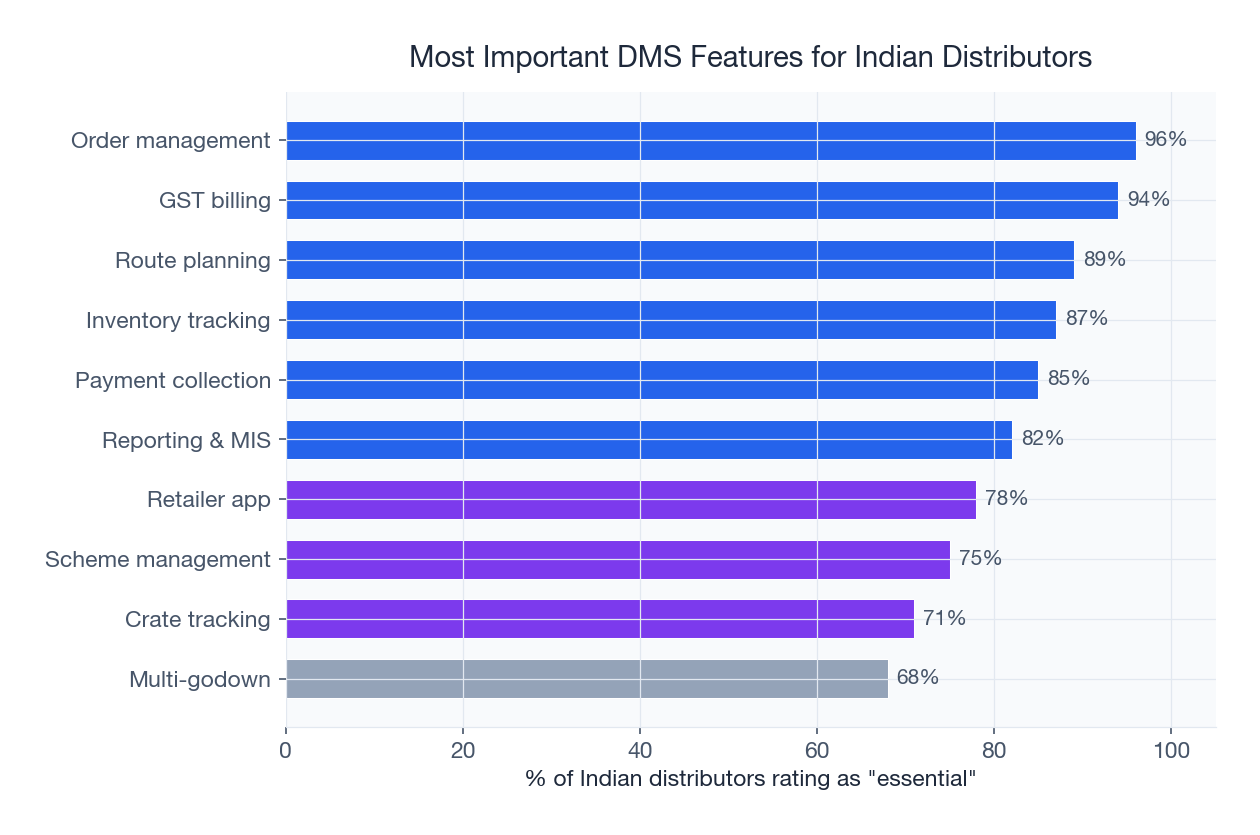
- GST-compliant invoicing — The software must handle multi-rate GST (0%, 5%, 12%, 18%, 28%), generate e-invoices for businesses above the Rs 5 crore threshold (as per GST Council mandate), and produce GSTR-ready reports.
- Mobile-first field operations — Your sales reps and delivery staff work from smartphones, not desktops. The mobile app must handle order capture, delivery confirmation, payment collection, and GPS-based tracking with offline support.
- Scheme and discount management — Indian FMCG distribution runs on trade schemes. Your DMS must support slab-based discounts, quantity-based offers, seasonal promotions, and retailer-specific pricing without manual calculation.
- Multi-level distribution hierarchy — Most Indian FMCG companies operate through super-stockists, distributors, sub-distributors, and retailers. The software must model this hierarchy accurately.
- Vernacular language support — Field staff in Karnataka need Kannada, in Tamil Nadu need Tamil, in UP need Hindi. English-only interfaces create adoption barriers.
- Offline capability — Internet connectivity remains patchy across tier-2 and tier-3 India. The app must function fully offline and sync when connectivity returns.
- Integration with accounting software — Tally remains the dominant accounting platform in Indian SMEs. Native Tally integration is almost mandatory; Busy and SAP integrations add value for larger operations.
The 8 Best Distributor Management Software Platforms in India
1. Bizom
Bizom is one of the most established DMS platforms in India, used by large FMCG companies like ITC, Marico, and Godrej. It excels at enterprise-scale field force automation with strong analytics and AI-driven insights. However, its pricing puts it out of reach for most small and mid-sized distributors, and implementation timelines can stretch to 3–6 months for complex setups.
Best for: Large FMCG enterprises with 500+ distributors and dedicated IT teams.
Limitations: High cost (typically Rs 8,000–15,000 per user/month), long implementation cycles, overkill for small operations.
2. FieldAssist
FieldAssist focuses on sales force automation and has strong adoption among mid-sized FMCG brands. Its beat planning and retailer intelligence modules are well-regarded. The platform handles beat planning effectively with GPS-based tracking and adherence monitoring.
Best for: Mid-sized FMCG brands (Rs 50–500 crore revenue) focused on sales force productivity.
Limitations: Weaker on supply chain and logistics features. Limited perishable goods handling. Pricing opaque.
3. BeatRoute
BeatRoute differentiates itself with a goal-driven sales engagement approach rather than pure activity tracking. Its retailer engagement scoring and AI recommendations help brands drive better outcomes. It has grown rapidly in the FMCG space.
Best for: Brands that want to move beyond activity tracking to outcome-driven sales management.
Limitations: Less mature on distribution logistics. Not ideal for dairy or perishable supply chains. Limited offline capability in some modules.
4. Tally (with Distribution Add-ons)
Tally is India’s most widely used business software, and many distributors extend it with third-party distribution modules. As our SpireStock vs Tally comparison details, Tally’s strength is accounting and GST compliance. But distribution management through Tally is essentially bolted-on functionality — it was not designed for field operations, route optimization, or mobile-first workflows.
Best for: Small distributors (under 50 retailers) who primarily need accounting with basic inventory management.
Limitations: No native mobile app for field staff. No GPS tracking. No route optimization. No scheme engine. Desktop-first architecture.
5. Marg ERP
Marg ERP has a strong presence among Indian traders and distributors, particularly in North India. It offers comprehensive billing, inventory, and GST compliance features. Marg’s pharma distribution module is particularly well-regarded.
Best for: Pharma distributors and North Indian trading businesses needing strong billing capabilities.
Limitations: Desktop-centric. Limited mobile and field force capabilities. Weak analytics. Not cloud-native.
6. SAP Business One / SAP S/4HANA
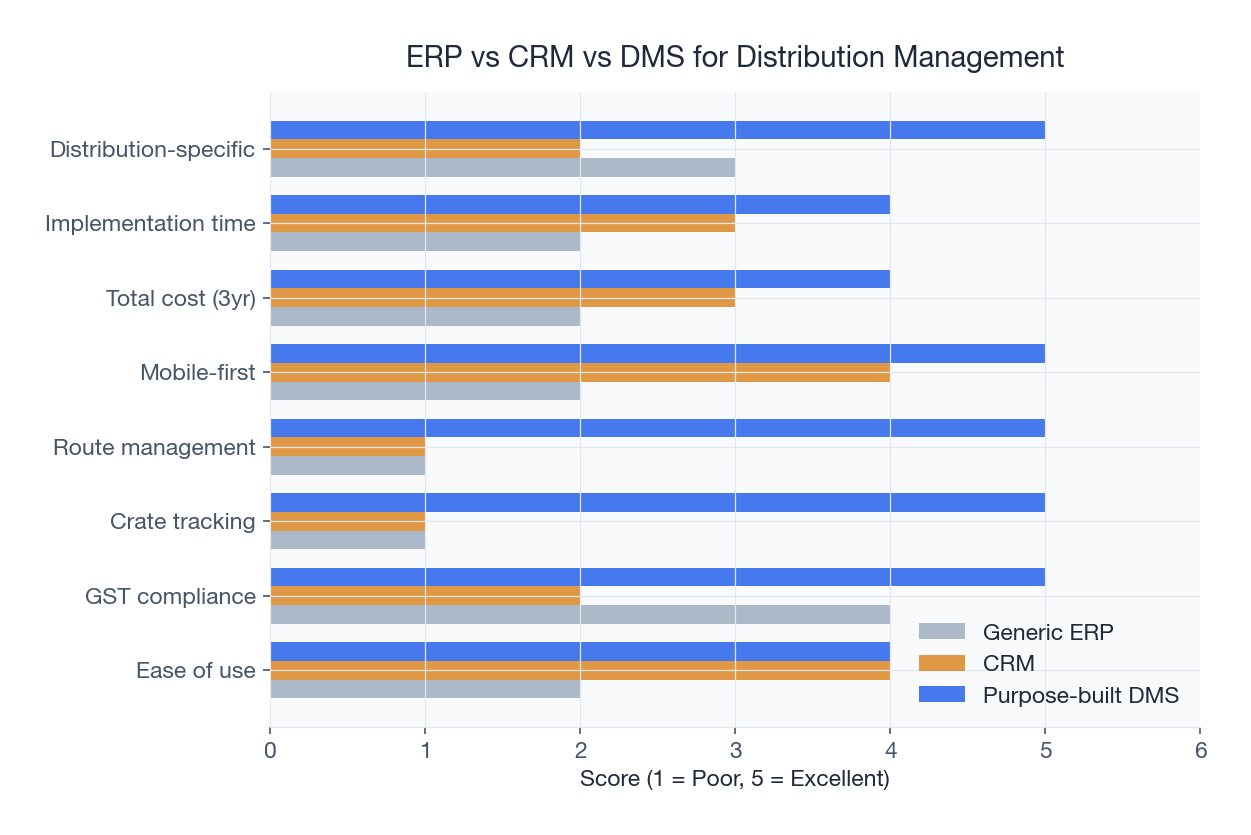
SAP is the gold standard for enterprise resource planning globally. SAP Business One targets mid-market companies, while S/4HANA serves large enterprises. Both offer robust distribution modules but require significant customization for Indian FMCG workflows. For a detailed comparison of ERP vs purpose-built DMS, see our ERP vs Distribution Management Software analysis.
Best for: Large enterprises (Rs 500+ crore revenue) already running SAP for other functions.
Limitations: Extremely expensive (Rs 15–50 lakh implementation + Rs 5–15 lakh annual). 6–12 month implementation. Requires SAP-certified consultants. Overkill for SMEs.
7. Oracle NetSuite
Oracle NetSuite provides cloud-native ERP with distribution capabilities. It is strong on inventory management, warehouse operations, and financial reporting. However, it lacks the India-specific features that FMCG distributors need.
Best for: Large businesses needing unified global ERP with distribution as one module.
Limitations: No native GST e-invoicing (requires third-party add-on). No Indian language support. No offline mobile capability. USD pricing makes it expensive for Indian SMEs.
8. SpireStock
SpireStock is purpose-built for dairy and perishable FMCG distribution in India. It handles the unique requirements that generic platforms miss: daily recurring orders, crate and returnable asset tracking, expiry-based inventory management, cold chain compliance, and production-unit-based order routing. The platform is mobile-first with offline capability and supports Hindi, Marathi, Tamil, Kannada, and Telugu.
Best for: Dairy companies, perishable FMCG distributors, and businesses with crate/returnable asset workflows. Check pricing plans for current rates.
Limitations: Industry-specific — not the best choice for pharma, electronics, or non-perishable general trade. Newer entrant compared to Bizom or FieldAssist. Limited presence outside India.
Head-to-Head Comparison Table
| Feature | Bizom | FieldAssist | BeatRoute | Tally | Marg | SAP | Oracle | SpireStock |
|---|---|---|---|---|---|---|---|---|
| Mobile app (offline) | Yes | Yes | Partial | No | No | Limited | Limited | Yes |
| GST e-invoicing | Yes | Yes | Yes | Yes | Yes | Add-on | Add-on | Yes |
| Scheme engine | Advanced | Good | Good | Basic | Basic | Custom | Custom | Advanced |
| Route optimization | Yes | Basic | No | No | No | Add-on | No | Yes |
| Crate tracking | No | No | No | No | No | Custom | No | Yes |
| Perishable inventory | Basic | No | No | No | No | Custom | Basic | Advanced |
| Vernacular support | Limited | Hindi | Hindi | Hindi | Hindi | No | No | 5 languages |
| Tally integration | Yes | Yes | Yes | Native | No | No | No | Yes |
| Starting price/user/mo | Rs 8,000+ | Rs 3,000+ | Rs 2,500+ | Rs 1,500* | Rs 1,000* | Rs 10,000+ | Rs 12,000+ | Rs 2,000+ |
| Implementation time | 3–6 months | 4–8 weeks | 4–8 weeks | 1–2 weeks | 1–2 weeks | 6–12 months | 4–8 months | 2–4 weeks |
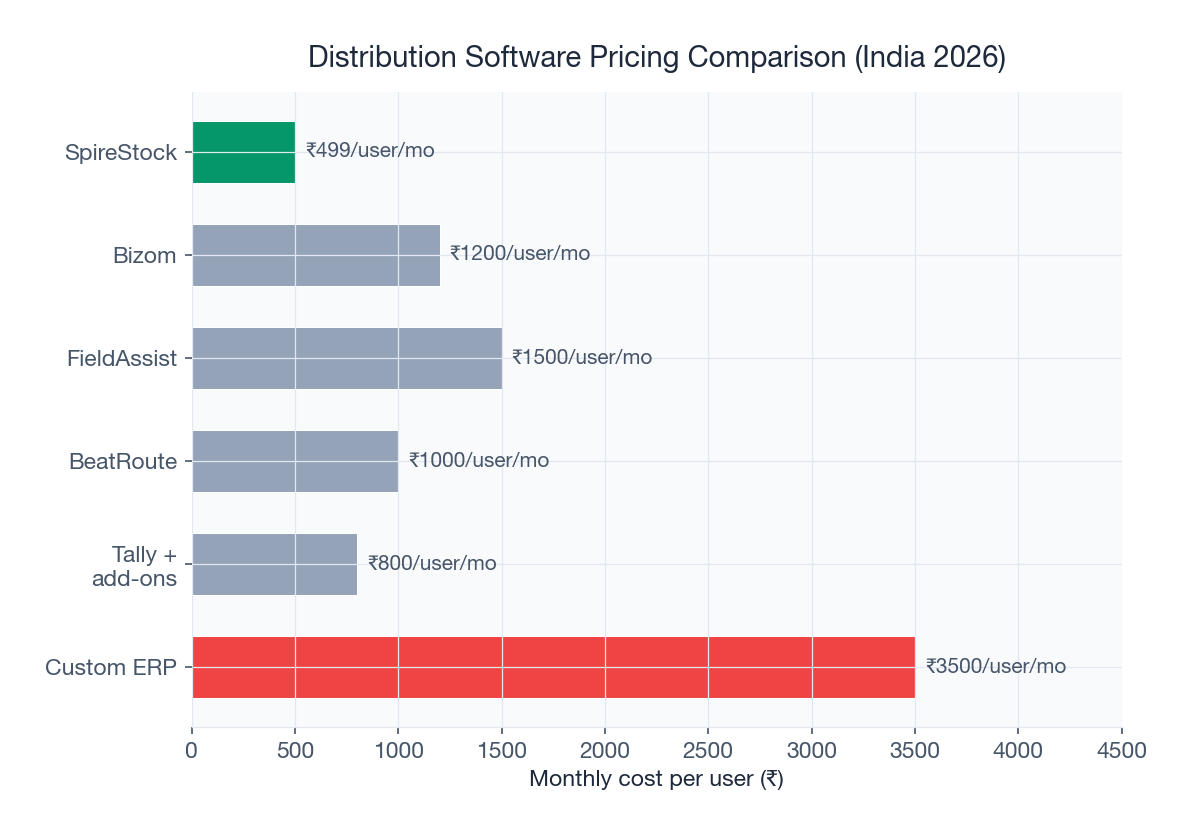
* One-time license; monthly equivalent estimated for comparison.
Decision Framework: How to Choose
Choosing distributor management software is not about finding the “best” platform in absolute terms. It is about finding the best fit for your specific business context. Use this framework:
- Define your primary pain point. Is it field force tracking? Order management? Billing accuracy? Route efficiency? Start with the platform that excels at your biggest problem.
- Match to your scale. A 20-distributor operation does not need Bizom or SAP. A 2,000-distributor enterprise should not rely on Tally with add-ons.
- Consider your industry vertical. Dairy and perishables need SpireStock. Pharma may need Marg. General FMCG has the most options.
- Evaluate total cost of ownership. License fees are just the start. Add implementation, training, customization, and integration costs. See our complete pricing guide for detailed breakdowns.
- Test with a pilot. Every platform on this list offers either a free trial or a paid pilot. Run a 30-day pilot with 10–20 distributors before committing to a full rollout.
- Check for Tally integration. If your accountant lives in Tally (and most Indian accountants do), seamless Tally sync is non-negotiable.
- Validate offline capability. Have your field staff test the mobile app in areas with poor connectivity. If it fails offline, it fails in real India.
- Ask about ongoing support. Post-implementation support quality varies dramatically. Ask for references from companies of similar size and industry.
Industry-Specific Recommendations
Based on our analysis, here are specific recommendations by industry vertical:
| Industry | Top Pick | Runner-Up | Why |
|---|---|---|---|
| Dairy & perishables | SpireStock | Bizom | Purpose-built perishable handling, crate tracking, cold chain |
| General FMCG (large) | Bizom | FieldAssist | Enterprise scale, AI analytics, deep customization |
| General FMCG (mid) | FieldAssist | BeatRoute | Best balance of features and affordability |
| Pharma distribution | Marg | Tally + add-on | Strong batch/expiry tracking, pharma compliance |
| Small trading business | Tally | Marg | Affordable, strong accounting, minimal learning curve |
| Multi-national enterprise | SAP | Oracle | Global ERP standardization, compliance requirements |
Migration and Implementation Considerations
Switching DMS platforms is not trivial. Here is what to expect during migration:
Data migration is typically the biggest challenge. You need to transfer product catalogs, retailer databases, pricing structures, outstanding balances, and transaction history. Budget 2–4 weeks for data cleanup and migration alone.
Training must cover three audiences: back-office staff (billing, dispatch), field staff (order capture, delivery), and management (analytics, reporting). Plan for 2–3 training sessions per audience, with refresher sessions at 30 and 60 days.
Parallel running is essential. Run your old and new systems simultaneously for at least 2–4 weeks to verify accuracy. This is painful but prevents costly errors during transition.
For the complete feature checklist to evaluate any DMS, refer to our Distribution Management Software Features Checklist.
The Cost Reality
Distributor management software in India ranges from nearly free (Tally with basic add-ons) to Rs 50+ lakh annually (SAP/Oracle for enterprise). For most Indian FMCG companies, the sweet spot is Rs 2,000–5,000 per user per month for a capable cloud-based DMS. At this range, you get mobile apps, GPS tracking, scheme management, and GST compliance without enterprise-level complexity or cost.
The FSSAI’s push toward digital traceability in food supply chains (FSSAI Food Safety and Standards Regulations, 2024) means that going digital is no longer optional for food and dairy distributors. Companies that delay will face compliance gaps as traceability mandates expand.
For a detailed cost breakdown, read our Distribution Management Software Cost in India: 2024 Pricing Guide. And if you are evaluating the fundamental choice between manual and digital processes, our Manual vs Digital Distribution analysis provides the full picture.
DMS Buying at a Glance
The reference figures a buyer needs before the first vendor call. Each is explained below.
| Parameter | Indian Market Reality |
|---|---|
| Typical pricing model | Per user per month, billed annually |
| Entry price band | Rs 400-900 per user per month |
| Mid-market band | Rs 900-1,800 per user per month |
| Enterprise | Custom, usually with a platform fee |
| Minimum users | 3-10 depending on vendor |
| Implementation time | 2-6 weeks small, 8-16 weeks multi-branch |
| One-time setup / onboarding fee | Common; negotiable, often waived on annual terms |
| Realistic payback period | 4-9 months where secondary sales visibility is the gap |
| Biggest hidden cost | Item master cleanup before go-live |
| Most common failure cause | Parallel manual registers kept after go-live |
Sizing the Requirement Before Talking to Vendors
Most bad DMS purchases start with a demo rather than a requirement. Vendors demo their strengths, and every platform looks capable for forty minutes. Writing down the shape of the operation first changes which questions get asked.
| Operation Size | What Actually Constrains You | What to Buy |
|---|---|---|
| 1 distributor, 1-2 reps, under 500 outlets | Order accuracy and billing, not analytics | Billing plus mobile order capture. Anything more goes unused. |
| 1 distributor, 3-8 reps, 500-2,000 outlets | Coverage visibility and scheme accuracy | Full DMS: beat planning, GPS check-in, scheme engine, claims |
| Multi-branch distributor | Consolidated stock and inter-branch transfers | Multi-location stock as a hard requirement, not a roadmap item |
| Brand with a distributor network | Secondary sales visibility across third parties | Distributor-facing platform with adoption support built in |
The distinction that matters most is the last one. A brand buying a DMS is buying other people's adoption, which is a fundamentally harder problem than buying software for your own staff, and vendor references should be checked on exactly that.
The Questions That Separate Vendors
Feature checklists rarely differentiate, because every vendor ticks every box. These questions do, because the answers vary widely and are hard to bluff.
| Question | Why It Separates | Answer to Look For |
|---|---|---|
| Does the mobile app work fully offline? | Rural beats lose signal for hours | Full order capture offline with queued sync, not read-only caching |
| How are stacked schemes resolved? | Overlapping offers are where billing disputes start | Configurable rule per scheme: exclusive, additive, sequential or capped |
| Is batch and expiry captured at inward? | Without it there is no FEFO and no recall trace | Mandatory batch and expiry per line at goods receipt |
| What happens on a partial claim settlement? | Short-settlement is invisible without line matching | Line-level reconciliation of settlement against submission |
| Can a rep add a new outlet in the field? | Determines whether the outlet universe stays real | In-app creation with duplicate detection on phone or geotag |
| How is GST classification stored? | Category defaults are the main source of tax error | HSN held per SKU and applied automatically at billing |
| What does data export look like on exit? | Lock-in risk | Full structured export of masters and transactions, on request |
Total Cost of Ownership, Not Licence Price
Licence is usually the smaller half of the first-year cost. Budgeting only for it is the most common reason implementations stall halfway.
| Cost Head | Typical Weight | Notes |
|---|---|---|
| Licence / subscription | Baseline | Per user per month; annual terms usually save 15-20% |
| Implementation and onboarding | 0.5-1.5x first-year licence | Often negotiable; sometimes waived on longer terms |
| Item master cleanup | Frequently the largest hidden cost | Duplicate SKUs, missing pack configs, inconsistent HSN |
| Devices | One-off | Only if reps do not already have adequate smartphones |
| Training and change management | Recurring in year one | Underfunding this is the single biggest predictor of failure |
| Integration | Variable | Tally or ERP sync; confirm it is included, not roadmap |
The honest way to justify the spend is arithmetic rather than feature comparison. Quantify what the current gaps actually cost: expiry write-offs, unrecovered claims, the working capital tied in claims outstanding, and the productive calls lost to manual reconciliation. Our distributor management system pillar covers what the software category actually does, and the distributor ROI guide sets out the method, and the claims management guide covers the leakage that is usually the largest single recoverable number.
Why DMS Implementations Fail
Failure is rarely about the software. Four patterns account for most of it.
Parallel registers survive go-live. Where staff do not trust the system, a paper register is kept alongside it, the two diverge, and the register wins. Removing the parallel record is harder and more important than configuring the software.
The item master was never cleaned. Duplicate SKUs and inconsistent pack configurations are faithfully reproduced by the new system, and every report is then disbelieved. This work belongs before go-live, not after.
Incentives were not moved. If reps are still measured on orders booked rather than on verified visits and delivered orders, GPS check-ins become a formality. See our guide to field sales KPIs for the metrics that actually change behaviour.
Everything was switched on at once. Order capture, schemes, claims, routing and analytics in week one guarantees that nothing is adopted properly. Sequencing order capture first, then schemes and claims, then analytics, consistently works better.
Final Verdict
There is no single “best” distributor management software for every Indian business. Bizom leads for large enterprises. FieldAssist and BeatRoute serve the mid-market well. Tally and Marg remain practical for small operations. SAP and Oracle suit multinationals.
For dairy and perishable FMCG distribution specifically, SpireStock offers the most complete feature set at a practical price point. But we encourage you to evaluate at least 2–3 options from this list before deciding. Request a free SpireStock demo and compare it head-to-head with the alternatives. The right choice is the one that fits your business — not the one with the biggest marketing budget.
Sources & References
Frequently Asked Questions
There is no single best option for all businesses. Bizom leads for large FMCG enterprises. FieldAssist is strong for mid-sized brands. SpireStock is the top choice for dairy and perishable FMCG. Tally remains practical for small distributors. The best software depends on your industry, scale, and primary pain points.
Most vendors price per user per month billed annually. Entry tiers commonly run Rs 400-900 per user per month, mid-market Rs 900-1,800, and enterprise on custom terms often with a platform fee. Minimum user counts of 3-10 are typical, and annual billing usually saves 15-20% against monthly.
Two to six weeks for a single distributor with a clean item master, and eight to sixteen weeks for a multi-branch operation or a brand rolling out across a distributor network. The variable that moves the timeline most is not the software but how much master data cleanup is needed first.
Item master cleanup. Duplicate SKUs, missing pack configurations and inconsistent HSN classification all have to be resolved before go-live, because the system will faithfully reproduce every ambiguity and every report will then be disbelieved. It is routinely the largest and least budgeted line.
Rarely because of the software. The four recurring causes are parallel manual registers surviving go-live, an item master that was never cleaned, field incentives that still reward orders booked rather than verified visits, and switching on every module at once instead of sequencing order capture first.
Adoption by third parties. A brand buying a DMS for its distributor network is buying other people's willingness to use it, which is a much harder problem than deploying to your own staff. Check vendor references specifically on distributor adoption rates and on what support is provided during rollout.
Pricing ranges from Rs 1,000–2,000 per user/month for basic tools (Tally, Marg) to Rs 8,000–15,000 per user/month for enterprise platforms (Bizom, SAP). Mid-range cloud DMS platforms like SpireStock and FieldAssist typically cost Rs 2,000–5,000 per user/month.
Tally is excellent for accounting and GST compliance but was not designed as a distribution management system. It lacks mobile apps for field staff, GPS tracking, route optimization, and scheme management. For small operations with under 50 retailers, Tally with add-ons can work. Larger operations need a dedicated DMS.
SpireStock is purpose-built for dairy distribution with features like crate tracking, perishable inventory with expiry management, daily recurring orders, cold chain compliance, and production-unit-based routing that generic platforms do not offer natively.
Implementation timelines vary: Tally/Marg take 1–2 weeks, mid-range platforms like SpireStock and FieldAssist take 2–8 weeks, and enterprise systems like SAP take 6–12 months. The timeline depends on data migration complexity, number of users, and customization requirements.
Cloud-based DMS is recommended for most Indian businesses. It offers lower upfront cost, automatic updates, mobile accessibility, and no server maintenance. On-premise may suit large enterprises with specific data residency requirements, but the total cost of ownership is typically 3–5x higher.
Related SpireStock Features
End-to-end order lifecycle from placement to delivery with multi-level approval workflows.
Real-time GPS tracking of vehicles and drivers with route optimization for faster deliveries.
Powerful dashboards with sales trends, MIS reports, and distribution analytics.
Related Industries
Streamline FMCG distribution with order management, beat planning, retailer tracking, and GST billing. Built for Indian FMCG supply chains.
End-to-end dairy distribution software for milk, curd, paneer, and ghee brands. Manage orders, crates, cold chain, and GST billing in one platform.
Related Solutions
Manage your entire distributor network digitally. Onboarding, credit limits, outstanding tracking, and performance analytics. Start free trial.
Boost field sales team productivity with beat planning, GPS attendance, order capture, and performance analytics. Built for Indian FMCG teams.
Related Entities
Ready to Streamline Your Distribution?
Start your free 14-day trial and see how SpireStock can transform your dairy, FMCG or consumer-goods distribution operation, from order capture to crate recovery.

SpireStock Team
Product & Industry Insights
SpireStock Team leads product at SpireStock, where the team ships distribution management software for India's dairy, FMCG and consumer-goods brands.