The Software Selection Dilemma
When dairy companies decide to digitize their distribution operations, they face a bewildering array of software categories: ERP (Enterprise Resource Planning), CRM (Customer Relationship Management), DMS (Distributor Management System), and hybrid solutions that combine elements of all three. Choosing wrong means either overspending on capabilities you do not need or under-investing in critical functionality that your operations depend on every day. The wrong pick can also damage your internal credibility, nothing erodes IT leadership faster than a Rs 3-crore ERP rollout that still cannot tell the sales team how many crates came back from a Mumbai distributor yesterday.
In the Indian context, this decision takes on additional weight. A wrong technology bet at a Rs 200-crore regional dairy in Ahmedabad or Chennai can set back the digital transformation roadmap by 18-24 months and burn Rs 1-3 crore in sunk costs before anyone notices the software was not designed for daily perishable-goods workflows. Let us cut through the confusion and help you understand what each system does, and does not do, for dairy distribution specifically.
This analysis applies equally to decision-makers running FMCG distribution, beverage distribution, bakery and confectionery, or consumer goods operations. The category differences matter less than the core workflow mismatch most distributors experience with generic enterprise software built for manufacturing or services, not for daily perishable-goods distribution.
ERP: The Enterprise Backbone
What It Does
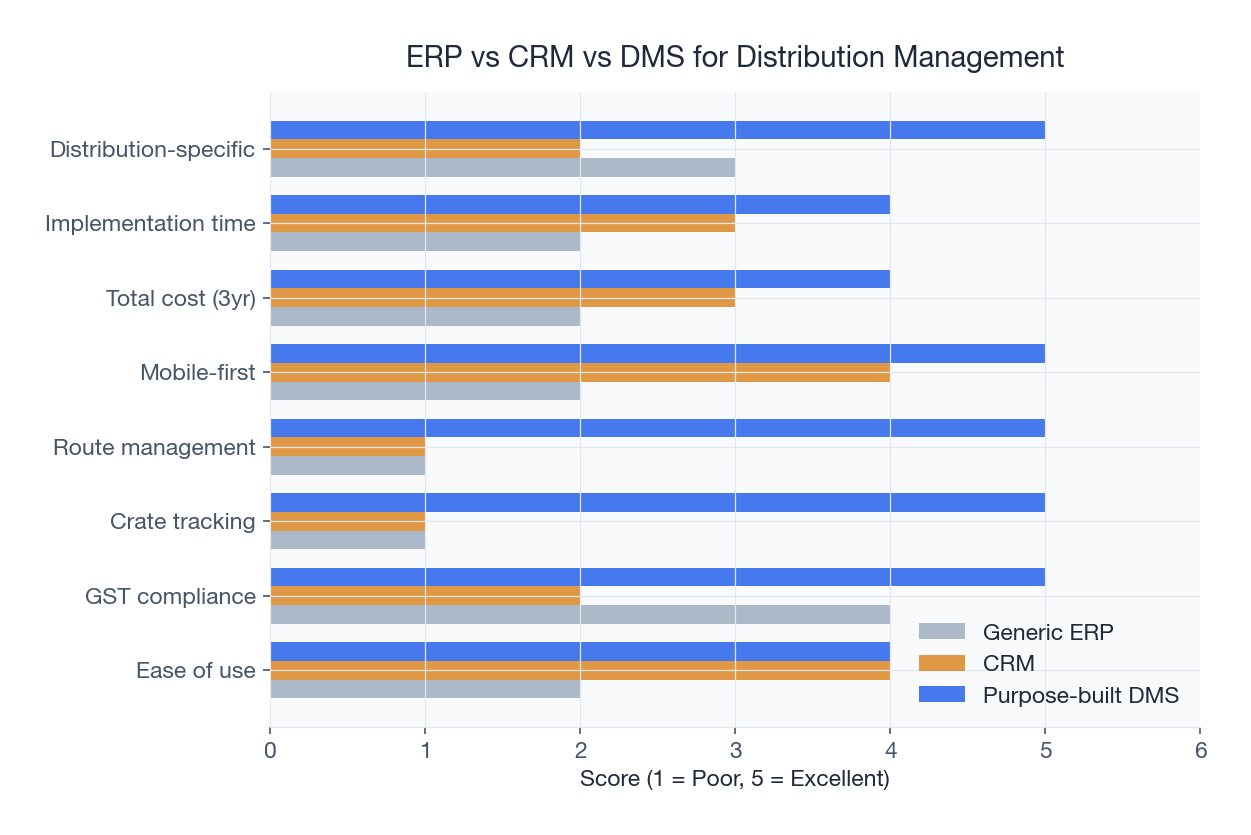
Enterprise Resource Planning systems like SAP, Oracle, and Microsoft Dynamics manage core business processes across an entire organization, finance, HR, procurement, manufacturing, inventory, and sales. They are designed for large enterprises that need a single source of truth across multiple departments and locations. Amul and Britannia both run SAP at the corporate layer for exactly this reason, and Mother Dairy uses a similar enterprise stack for its procurement and manufacturing backbone.
Strengths for Dairy
- Comprehensive financial management and reporting across entities
- Manufacturing and production planning integration with shop floor systems
- Multi-location inventory management across plants, C&F agents, and warehouses
- Regulatory compliance and audit trails for FSSAI, GST, and BIS standards
- Consolidated reporting for promoters, boards, and institutional investors
Weaknesses for Dairy Distribution
- Expensive, implementation costs run into crores (typical SAP S/4HANA rollout: Rs 1.5-4 crore license + Rs 2-6 crore implementation)
- Slow to customize, dairy-specific features (crate tracking, daily orders, scheme management) require costly customization
- Poor field mobility, ERP mobile apps are typically clunky and limited, frustrating delivery staff in congested routes
- Overkill for distribution focus, if your primary need is distribution management, 70% of ERP functionality goes unused
- Long change cycles, altering a scheme rule or launching a new SKU can take days of consultant effort
CRM: The Relationship Layer
What It Does
Customer Relationship Management platforms like Salesforce, HubSpot, and Zoho CRM manage the pre-sales and relationship side, lead management, customer profiling, communication tracking, and pipeline management. They excel at things like distributor acquisition funnels and long-cycle B2B deals where tracking every touchpoint matters.
Strengths for Dairy
- Distributor profiling and relationship management
- Communication and interaction tracking with timestamped activity logs
- Task and follow-up management for sales teams
- Integration with email, WhatsApp Business, and calling systems
Weaknesses for Dairy Distribution
- No operational capability, CRMs do not handle orders, deliveries, invoicing, or crate management
- Not built for recurring transactions, dairy's daily order cycle does not fit CRM's opportunity-based model
- Lacks distribution intelligence, no route optimization, delivery tracking, or supply chain visibility
- Per-user pricing stings, at Rs 2,500-12,000 per user per month, costs explode once you add field teams
DMS: The Distribution Specialist
What It Does
A Distributor Management System is purpose-built for managing the manufacturer-to-distributor-to-retailer supply chain. It handles order management, delivery tracking, returnable asset management, scheme application, and billing, all tuned for the specific rhythms of FMCG distribution where the same retailer is re-ordered every single day.
Strengths for Dairy
- Built for dairy workflows, daily orders, crate management, cold chain, perishable inventory
- Mobile-first design, distributors and delivery staff operate primarily from phones using the mobile app
- Faster implementation, weeks, not months or years
- More affordable, SaaS pricing makes it accessible to mid-sized companies
- Distribution intelligence, route optimization, territory management, and field force tracking
Weaknesses
- Does not replace core financial/accounting systems (but integrates with them)
- Manufacturing planning may need a separate system for multi-plant operators
Side-by-Side Comparison
| Dimension | ERP (SAP/Oracle) | CRM (Salesforce/Zoho) | DMS (SpireStock) |
|---|---|---|---|
| Total 3-year cost | Rs 4-10 crore | Rs 15-40 lakh | Rs 3-15 lakh |
| Time to go-live | 6-18 months | 2-4 months | 3-6 weeks |
| Daily order cycle | Custom build | Not supported | Native |
| Crate tracking | Custom build | Not supported | Native |
| Scheme engine | Custom build | Basic | Native |
| Mobile field app | Limited | Good | Offline-first |
| Route optimization | Module add-on | Not supported | Native |
| Best fit revenue band | Rs 500+ crore | B2B pipeline-led | Rs 10-500 crore |
| Implementation consultants needed | 8-25 | 2-5 | 0-2 |
The Right Choice for Most Dairy Companies
For most Indian dairy companies, especially those in the Rs 10-500 crore revenue range, a dedicated DMS is the optimal primary investment for distribution digitization. Here is why:
- Your distribution operations are where the most manual effort and inefficiency live
- A DMS delivers measurable ROI (cost savings, reduced losses, faster processing) within weeks
- It integrates with your existing Tally/SAP for accounting and finance
- The total cost of ownership is 5-10x lower than an ERP deployment
- Implementation is 5-10x faster than ERP rollouts
- Changes to pricing, schemes, and territories happen in minutes, not weeks
The same logic applies to adjacent verticals: FMCG, beverage, and consumer goods operators typically start with a DMS and layer ERP only when corporate complexity justifies it. A distributor management solution plus a robust accounting tool covers 85% of what a mid-sized distribution business actually needs, which leaves most budget free for growth investments rather than license fees.
The Hybrid Approach
Many successful dairy companies use a hybrid stack: a DMS like SpireStock for distribution operations, an accounting system (Tally, Busy) for financial management, and optionally a lightweight CRM for new distributor acquisition and relationship scoring. API integrations ensure data flows between systems without manual transfer. Orders created in the DMS generate invoices that post to Tally automatically; payments logged in Tally reflect in the DMS distributor ledger within seconds.
Analytics capabilities within a modern DMS often replace the reporting functions that companies traditionally relied on ERP for, further reducing the need for heavyweight enterprise software. A Rs 220-crore regional dairy we worked with in 2024 saved Rs 2.8 crore over three years by replacing a planned SAP Business One rollout with SpireStock plus Tally Prime, and shipped in 5 weeks instead of 14 months. Their finance team now reconciles two systems instead of fighting one monolithic customization backlog, and their field team actually uses the software instead of avoiding it.
Decision Framework by Revenue Band
Use this quick rule of thumb:
- Below Rs 50 crore, DMS + Tally. Nothing else needed. Adding an ERP at this stage is a classic mistake that crushes margin.
- Rs 50-200 crore, DMS + Tally/Busy + optional lightweight CRM for distributor acquisition.
- Rs 200-500 crore, DMS + mid-market ERP (SAP Business One, Oracle NetSuite) for finance and manufacturing.
- Above Rs 500 crore, DMS + full ERP (SAP S/4HANA or Oracle Fusion) with tight integration.
Whatever your band, the DMS is the piece that touches daily distribution pain, and therefore the piece with the fastest ROI. Even the largest enterprises benefit from a specialized DMS layer on top of their ERP; the combination is what operators like Nandini, Amul, and several large private dairies already use in production. The best deployments treat the DMS as the operational brain and the ERP as the accounting brain, with tight API integration keeping both in sync. This pattern also works beautifully for multi-plant distribution setups where different plants feed into a single distributor network.
Common Pitfalls to Avoid
Three patterns show up repeatedly in failed selection processes:
- Trusting the ERP sales promise, vendors will tell you the distribution module handles dairy workflows. It does, in theory. In practice you will be building everything custom and paying for the privilege.
- Ignoring mobile-first reality, if your field team cannot take orders from a smartphone in a Hyderabad slum with patchy 4G, the software is useless no matter how elegant the web dashboard is.
- Skipping the integration test, always validate that data actually flows from your chosen DMS into Tally/SAP during the evaluation, not after the purchase order is signed.
A fourth pattern worth calling out: buying software based on a feature checklist rather than on actual workflows. Every enterprise product will check every box in a 200-line RFP. What matters is whether a new sales trainee in Bangalore can open the app, take five orders, capture two payments, and update crate balances within fifteen minutes of handing the phone to them. That is the real test, and most ERPs fail it comprehensively.
For a deeper treatment of this decision, read our companion guides on SaaS vs on-premise deployment and the complete dairy distribution software guide. Both drill into practical evaluation criteria that will save you from multi-crore mistakes.
Your Next Step
If you are currently evaluating ERP proposals worth tens of crores, pause and talk to our team first, we can show you in 30 minutes whether a DMS-first approach would deliver 80% of the value at 20% of the cost. For transparent pricing, check the SpireStock pricing page. To see how a modern DMS replaces the distribution portions of legacy ERP and CRM deployments, request a demo tailored to your network size and we will show you the exact workflow your operations team would touch every day.
When You Actually Need All Three
For a handful of very large, vertically integrated dairy operations, think Rs 1000+ crore in revenue, multiple plants, thousands of distributors, complex financial structures, the three-system stack of ERP, CRM, and DMS genuinely does make sense. In these cases, the ERP handles finance, HR, procurement, and manufacturing. The CRM handles distributor and key-account acquisition and relationship scoring. The DMS handles daily operational distribution. Each system does what it is best at, and API integrations keep them in sync.
The critical insight is that even at this scale, the DMS is the operational brain that touches every daily transaction. The ERP updates nightly; the CRM updates weekly; the DMS updates every time a field officer taps submit on an order in Chennai or Mumbai. Any architecture that forces daily operational workflow through the ERP will bog down under the sheer transaction volume of perishable-goods distribution.
Real-World Selection Timeline
A well-run software selection process typically takes 6-10 weeks from kickoff to signed contract. Week 1-2: requirements gathering and stakeholder interviews. Week 3-4: vendor shortlisting and initial demos. Week 5-6: deeper demos with your actual data. Week 7-8: reference calls and commercial negotiation. Week 9-10: final approval and contract. Anything much faster risks a bad decision; anything much slower signals organizational paralysis.
During the demo phase, insist on seeing your own data in the vendor's system. Generic demos with dummy data rarely surface the real gotchas. Provide a sample distributor ledger, a week of order data, and three active schemes. Watch carefully how the system handles each.
Implementation Stories From the Field
Three short examples of how the ERP vs DMS decision has played out in real Indian dairy companies. A Rs 180-crore brand in Bangalore started with an ambitious SAP Business One rollout in 2022, burned Rs 1.6 crore and 16 months, and ended up with a system their distributors refused to use. They pivoted to a cloud DMS in early 2024 and were live on 140 distributors within five weeks. A Rs 80-crore dairy in Jaipur skipped the ERP entirely and built their entire operations on SpireStock plus Tally from day one; total TCO over three years was under Rs 9 lakh. A Rs 650-crore national brand took the hybrid path: SAP for corporate finance and manufacturing, SpireStock for distribution, with API integration keeping both in sync. Each company made the right choice for their scale and situation, and none of them regrets the decision.
Final Checklist Before You Sign
Before signing any software contract, verify the following in writing: total three-year TCO including all hidden fees, expected time to go-live with your actual data, names and contact details of three reference customers in your revenue band, clear data ownership and export terms, specific support SLAs for critical issues, roadmap commitments for upcoming GST and FSSAI compliance updates, and named implementation team members who will be assigned to your project. Any vendor unwilling to provide these in writing should be removed from consideration. A serious vendor will provide all of them without hesitation.
Sources & References
Frequently Asked Questions
For most mid-sized dairy companies, a dedicated DMS is more effective and affordable than an ERP for distribution management. ERPs make sense when you need integrated manufacturing, HR, procurement, and finance, but for distribution specifically, a DMS provides deeper functionality at a fraction of the cost.
A DMS doesn't replace core accounting software like Tally or SAP. Instead, it integrates with your accounting system, pushing invoice and payment data automatically. This gives you best-of-breed solutions for both distribution and finance.
ERP implementations for mid-sized dairy companies typically cost Rs 50 lakh to Rs 5 crore for setup plus Rs 5-20 lakh annually. A cloud-based DMS like SpireStock costs Rs 60,000 to Rs 6 lakh annually with minimal setup costs, a 10x to 50x cost reduction.
ERP: 6-18 months. CRM: 2-4 months. DMS: 3-6 weeks. The speed difference is significant, a DMS starts delivering ROI while an ERP is still in the configuration phase.
A CRM can manage the relationship side, profiling distributors, tracking communications, and managing the onboarding pipeline. But it cannot handle operational needs like orders, deliveries, crate tracking, and billing. Most dairy companies need a DMS, not a CRM, for their primary distribution challenges.
Essential integrations include accounting software (Tally, SAP), payment gateways, SMS/WhatsApp for notifications, GPS tracking services, and optionally e-invoicing portals. API availability is key, ensure the DMS offers open APIs for custom integrations.
Related SpireStock Features
End-to-end order lifecycle from placement to delivery with multi-level approval workflows.
GST-compliant invoicing with HSN codes, gate passes, and financial ledger.
Powerful dashboards with sales trends, MIS reports, and distribution analytics.
Related Solutions
Manage your entire distributor network digitally. Onboarding, credit limits, outstanding tracking, and performance analytics. Start free trial.
Boost field sales team productivity with beat planning, GPS attendance, order capture, and performance analytics. Built for Indian FMCG teams.
Related Entities
Ready to Streamline Your Distribution?
Start your free 14-day trial and see how SpireStock can transform your dairy, FMCG or consumer-goods distribution operation, from order capture to crate recovery.

SpireStock Team
Product & Industry Insights
SpireStock Team leads product at SpireStock, where the team ships distribution management software for India's dairy, FMCG and consumer-goods brands.