The Hidden Cost of Poor Crate Management in Dairy
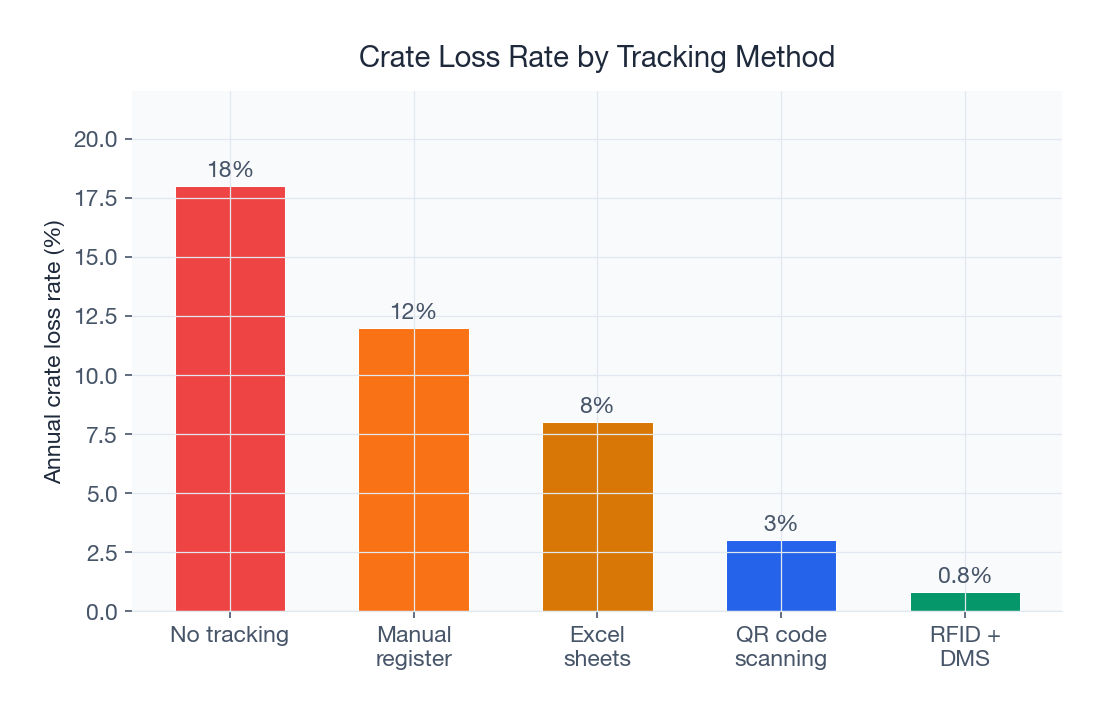
Every dairy distributor knows the frustration: crates go out, but fewer come back. Over time, this leakage adds up to lakhs, sometimes crores, in losses. A single milk crate costs Rs 250-400 to replace, and a mid-sized dairy operation may lose 5,000-10,000 crates annually. That's Rs 12-40 lakh vanishing quietly from your bottom line. Across India's dairy industry, returnable asset losses exceed Rs 500 crore every year.
But the financial loss is only part of the problem. Crate disputes between your company and distributors damage relationships, consume management time, and erode trust in your distribution network. Without a clear, digital record of every crate movement, these disputes become unresolvable "he said, she said" situations. If crate losses are eating into your margins, start your free 14-day trial and see how digital tracking can stop the leakage within weeks.
Understanding the Crate Leakage Problem
Returnable asset leakage in dairy distribution happens through multiple channels, and understanding each is essential to solving the problem:
- Distributor retention, distributors hold excess crates as informal "insurance" against future shortages, tying up your capital
- Cross-brand usage, your crates get used by competitors or for non-dairy purposes in the distributor's warehouse
- Retailer hoarding, retailers use crates for storage, display, or other purposes and delay returns
- Breakage and damage, rough handling, overloading, and sun exposure reduce crate lifespan
- Theft, crates have scrap value and are sometimes sold to recyclers
- Record-keeping gaps, paper challans get lost, quantities are misrecorded, and balances become irreconcilable
A dairy company operating 200 distributors across Ahmedabad and Gujarat found that 40% of their crate losses were due to record-keeping gaps alone, losses that simply disappeared when they moved to digital tracking.
What Is a Dairy Crate Management System?
A dairy crate management system is specialized software that tracks every returnable asset, crates, trays, bottles, insulated containers, throughout your distribution chain. SpireStock's crate management module provides real-time visibility into crate balances at every node: plant, warehouse, distributor, retailer, and in transit.
The system works not as a standalone tool, but as an integrated part of your distribution workflow. Crate transactions are recorded during normal delivery and pickup operations, not as a separate, additional task. This integration is what makes adoption easy and compliance near-universal.
How Crate Tracking Works
- Issuance recording, every crate dispatched is logged against the receiving distributor with timestamps and quantities
- Return logging, crates coming back are recorded at the point of return, with condition assessment
- Balance reconciliation, real-time calculation of outstanding crates per distributor
- Dispute resolution, complete audit trail available for any discrepancy
- Damage tracking, separate accounting for damaged vs. lost crates
- Transfer tracking, crate movements between distributors, warehouses, and depots are captured
Key Features of an Effective Crate Management System
Real-Time Balance Dashboard
See at a glance how many crates are outstanding across your entire network. Drill down to individual distributors to identify high-risk accounts that consistently hold excess crates. SpireStock's analytics present crate data visually, heat maps of crate concentration, trend lines showing return rates over time, and ranking tables of best and worst performers.
Automated Alerts and Thresholds
Set maximum crate holding limits per distributor. When a distributor's outstanding balance exceeds the threshold, the system triggers alerts and can even block further dispatches until returns are made. A beverage distributor in Jaipur reduced their outstanding crate balance by 60% within one month just by enabling threshold-based dispatch blocking.
Integration with Order and Delivery Systems
Crate management works best when linked to your order management and distribution tracking systems. When a delivery is made, crate issuance is automatically recorded. When returns are picked up, the balance adjusts in real time. This tight integration eliminates the manual reconciliation that consumes hours of staff time.
Mobile-Based Recording
Delivery drivers record crate transactions directly on their smartphones. No paper challans, no delayed data entry, no transcription errors. SpireStock's mobile app makes crate recording as simple as scanning or tapping a quantity. Even drivers with limited smartphone experience learn the process in under 10 minutes.
Financial Integration
Crate deposits, adjustments, and write-offs integrate directly with billing and invoicing. Crate security deposits are automatically added to invoices, and credit notes generated for returns. This ensures your financial records always match your physical asset records, eliminating the month-end reconciliation nightmare.
ROI of Implementing Crate Management Software
The return on investment for a dedicated crate management system is among the most compelling in distribution technology:
| Metric | Before Digital Tracking | After Digital Tracking | Improvement |
|---|---|---|---|
| Annual crate losses | 8-15% of total inventory | 1-3% of total inventory | 80% reduction |
| Distributor disputes (monthly) | 15-25 per 100 distributors | 1-3 per 100 distributors | 90% fewer |
| Reconciliation time (monthly) | 3-5 days | 2-3 hours | 95% faster |
| Financial write-offs | Rs 15-40 lakh/year | Rs 2-5 lakh/year | 85% reduction |
| Payback period | N/A | 6-12 weeks | Under 3 months |
Crate Management Beyond Dairy
While dairy distribution is the most crate-intensive FMCG segment, the same tracking principles apply to other industries:
- Beverage distribution, bottle crates for brands like Bisleri, Pepsi, and Coca-Cola involve millions of returnable units
- Bakery and confectionery, bread trays, biscuit crates, and display racks circulate daily
- Fresh produce, vegetable and fruit crates require similar tracking with added perishability concerns
- Consumer goods, pallets, roll cages, and shipping containers used in modern trade distribution
The crate and asset management solution supports all returnable asset types with configurable tracking rules, deposit values, and return timelines per asset category.
Best Practices for Dairy Crate Management
Technology alone isn't enough. Combine your dairy distribution software with these operational best practices:
- Set clear deposit policies, charge security deposits of Rs 50-100 per crate and refund on return. This creates a financial incentive for timely returns.
- Enforce return timelines, define maximum holding periods (typically 3-7 days) and apply penalties for overdue returns
- Regular physical audits, conduct quarterly physical counts and reconcile with digital records. Discrepancies should trigger investigation, not just write-offs.
- Distributor scorecards, track and share crate return rates as part of distributor performance evaluation. Make it a KPI that affects scheme eligibility.
- Incentivize returns, reward distributors with consistently high return rates (above 95%) with bonus schemes or priority supply
- Brand your crates, permanently mark crates with your brand logo and unique identifiers to deter misuse and aid identification during audits
Did you know? Companies that combine digital crate tracking with deposit-based policies and distributor scorecards achieve return rates above 97%, compared to the industry average of 85-88%. Talk to our team about designing the right crate management strategy for your operation.
Moving from Paper to Digital: A Step-by-Step Guide
If you are currently managing crates through paper registers or Excel sheets, the transition to a digital system is straightforward:
- Step 1: Baseline audit, conduct a physical count across all locations and establish current outstanding balances per distributor
- Step 2: Import balances, load the audited balances into the digital system as opening balances
- Step 3: Configure rules, set up holding limits, deposit values, alert thresholds, and return timelines
- Step 4: Train delivery staff, a 30-minute training session on the mobile app is sufficient for most drivers
- Step 5: Parallel run, run digital and paper systems in parallel for 1 week to validate accuracy
- Step 6: Go fully digital, switch off paper-based tracking and use the digital system as the single source of truth
Most dairy companies complete this migration within 2-3 weeks and see measurable improvements immediately. Check our pricing plans for cost details. For a broader look at how this fits into your distribution technology stack, read our guide on dairy distribution software in India and our article on returnable asset tracking for FMCG.
Real-World Implementation Scenarios
Three illustrative case studies show how Indian dairy and FMCG businesses have recovered crate losses through digital tracking.
Case Study 1: Godavari Dairy Products, Hyderabad
Godavari Dairy Products distributes milk, curd, and paneer through 170 distributors in Hyderabad and Warangal, following a business model similar to Heritage Foods. Pre-digital, they were losing 6,800 crates annually, roughly Rs 27 lakh at a replacement cost of Rs 400 per crate. Disputes consumed 15-20 hours of management time every week. After 4 weeks of implementing SpireStock's crate asset management solution, losses dropped to 950 crates (Rs 3.8 lakh) in year one, a 86% reduction saving Rs 23.2 lakh against software cost of Rs 4.2 lakh.
Case Study 2: Surya Fresh Milk, Lucknow
Surya Fresh Milk runs a direct-to-consumer and distributor-led operation in Lucknow, modelled on subscription brands like Country Delight. With 45,000 daily deliveries and 12,000 crates in circulation, crate leakage was running at 12% annually, Rs 18 lakh gone. Digital issuance via the SpireStock mobile app reduced leakage to 1.8% in the first year, recovering Rs 15 lakh and eliminating the twice-weekly reconciliation meetings that consumed senior management bandwidth.
Case Study 3: Kailash Dairy Distributors, Delhi
Kailash Dairy Distributors handles products from a brand like Mother Dairy across 95 routes in Delhi NCR. Losses stood at Rs 38 lakh annually. After deploying digital tracking with QR-coded crates, disputes dropped 94%, losses fell to Rs 4.5 lakh, and the operations team recovered Rs 33 lakh in year one. Additionally, they reduced their crate inventory float by 15%, freeing up Rs 11 lakh of working capital.
Cost & ROI Analysis
Crate management is one of the fastest-payback modules in any distribution software implementation. The math below shows why dairy, beverage, and FMCG distributors should prioritize it:
| Parameter | Without Digital Tracking | With SpireStock | Financial Impact |
|---|---|---|---|
| Crate loss rate | 8-15% annually | 1-3% annually | 80% reduction |
| Average annual loss (mid-sized dairy) | Rs 22-45 lakh | Rs 3-6 lakh | Rs 19-39 lakh recovered |
| Dispute resolution hours/month | 40-80 hours | 2-5 hours | Rs 2-4 lakh saved |
| Crate inventory float | 15-20% buffer | 5-8% buffer | Rs 8-15 lakh freed |
| Software cost (annual) | - | Rs 2-4 lakh | Investment |
| Net Year-1 benefit | - | - | Rs 27-54 lakh |
| Payback period | - | - | 4-8 weeks |
For companies operating multiple categories (dairy, beverages, bakery, fresh produce), the returns compound as every returnable asset across the network benefits from the same tracking system. For deeper reading, see our route optimization guide.
Conclusion: Every Crate Counts
Crate management may not be the most glamorous aspect of dairy distribution, but it is one of the most financially impactful. The difference between a 85% return rate and a 97% return rate can mean Rs 20-30 lakh annually for a mid-sized operation. With digital tracking technology now accessible and affordable, there is no reason to continue losing money to preventable crate leakage. The ROI is proven, the implementation is fast, and the impact is immediate.
Sources & References
Frequently Asked Questions
A mid-sized dairy distributor with 500+ active distributors typically loses Rs 15-50 lakh annually to missing, damaged, or disputed crates. Larger operations can see losses exceeding Rs 1 crore per year without systematic crate tracking.
The system records every crate issuance and return digitally, delivery staff log transactions on a mobile app during deliveries and pickups. The system maintains real-time balances per distributor and provides a complete audit trail of every movement.
Yes, modern crate management systems support multiple asset types, milk crates, bottle crates, insulated containers, pallets, and custom containers. Each type can have its own tracking rules, deposit values, and return timelines.
With a digital system, you can pull up the complete transaction history for that distributor, every issuance, return, and adjustment with timestamps and responsible parties. This auditable trail resolves most disputes instantly.
No, modern systems work entirely through smartphone apps. Delivery staff simply enter quantities during their normal delivery workflow. For large operations that want additional accuracy, optional barcode or QR code scanning can be enabled.
Yes, you can configure maximum outstanding crate limits for each distributor. When a distributor exceeds their limit, the system alerts your team and can optionally block further dispatches until crates are returned.
Implementation typically takes 1-2 weeks. This includes importing your current distributor balances, configuring tracking rules, training delivery staff on the mobile app, and going live. Most companies see immediate benefits from day one.
Yes, in SpireStock, crate balances integrate with the invoicing system. Crate deposits can be automatically added to invoices, and credit notes generated for returns. This ensures financial accuracy alongside physical asset tracking.
Related SpireStock Features
Related Industries
End-to-end dairy distribution software for milk, curd, paneer, and ghee brands. Manage orders, crates, cold chain, and GST billing in one platform.
Streamline FMCG distribution with order management, beat planning, retailer tracking, and GST billing. Built for Indian FMCG supply chains.
Related Solutions
Track returnable crates, bottles, and kegs across your distribution network. Automated ledger, shortage alerts, and loss prevention. Try free.
Manage your entire distributor network digitally. Onboarding, credit limits, outstanding tracking, and performance analytics. Start free trial.
Related Entities
Ready to Streamline Your Distribution?
Start your free 14-day trial and see how SpireStock can transform your dairy, FMCG or consumer-goods distribution operation, from order capture to crate recovery.

SpireStock Team
Product & Industry Insights
SpireStock Team leads product at SpireStock, where the team ships distribution management software for India's dairy, FMCG and consumer-goods brands.