The Hidden Tax on Dairy Distributors: Crate Loss
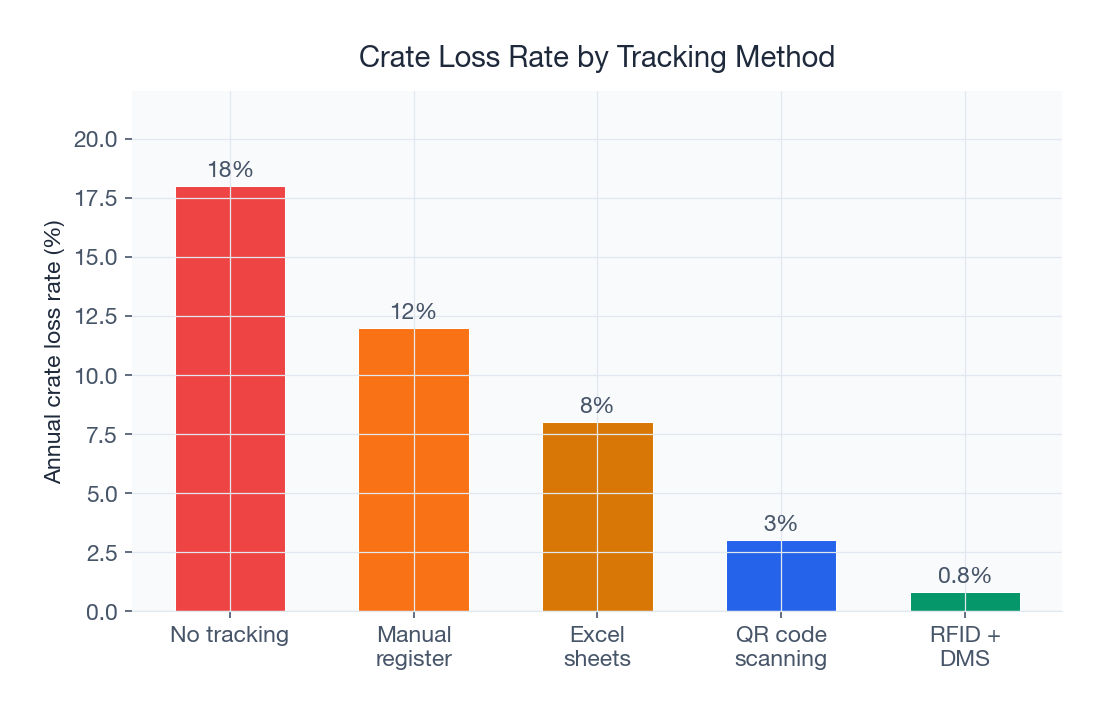
Crate loss is one of the most under-discussed profit killers in Indian dairy distribution. An average dairy distributor loses 5-8% of their crates annually, and premium operators report figures as high as 12% in high-density urban beats. At Rs 180-250 per crate, a mid-sized distributor with 20,000 crates in rotation can easily bleed Rs 8-15 lakh every year. Over five years, that's more than the cost of a full-stack dairy distribution platform.
The good news: crate loss is almost entirely preventable with the right processes and technology. In this guide, we'll break down why crates disappear, which interventions actually work, and how leading operators have reduced crate loss to under 1% annually. By the end, you'll have a concrete action plan to stop the bleeding in your own operation.
Crate Loss Benchmarks
| Operator Type | Annual Loss Rate | Cost per 10k crates |
|---|---|---|
| Unmanaged (paper registers) | 8-12% | Rs 14-24 lakh |
| Semi-digital (Excel trackers) | 5-7% | Rs 9-14 lakh |
| Basic DMS with crate module | 2-4% | Rs 3.5-8 lakh |
| Advanced QR-based tracking | Under 1% | Under Rs 2 lakh |
| RFID / IoT tracked | Under 0.5% | Under Rs 1 lakh |
Why Crates Disappear
1. Poor Retailer Accountability
When retailers aren't required to sign for crates or don't have a clear deposit ledger, empties "walk off" quietly. They may get used for vegetables, stored in back rooms or sold to scrap dealers. The absence of visibility equals the absence of accountability.
2. Paper-Based Registers
Paper registers are impossible to reconcile in real time. By the time anyone notices a discrepancy, the trail has gone cold. Salespeople mark "returned" to keep their books clean, even when crates are still sitting at the retailer.
3. Driver Collusion
In the worst cases, drivers collude with scrap dealers to sell crates. Without GPS tracking and photo-proof reconciliation, the company has no way to detect this.
4. Urban Density
Dense urban beats with 60+ drops have high crate turnover, and high loss rates. It's simply harder to keep track of which retailer has how many.
5. Festival and Seasonal Spikes
Festival periods bring surges in demand. Additional crates go out, but reconciliation often slips during the rush. Losses spike during these periods.
6. Broken Crates Misreported
Broken crates that should be written off with documentation are often mixed with genuine losses, making it impossible to separate preventable losses from unavoidable wear.
The Five-Layer Intervention Model
Layer 1: Digital Deposit Ledgers
Every retailer should have a digital deposit ledger that tracks how many crates they owe at any given time. DMS crate management modules handle this automatically. The moment a crate leaves the warehouse toward a retailer, their ledger shows the liability.
Layer 2: QR-Based Crate Tracking
Each crate gets a unique QR code. Every pickup and drop-off scans the code. The system knows which crate is where in real time. This alone reduces loss rates by 60-70% compared to paper.
Layer 3: Daily Reconciliation
Reconciliation should happen daily, not monthly. Crate asset management workflows run end-of-day reports showing outstanding crates per retailer. Any retailer exceeding their deposit limit triggers an alert.
Layer 4: Photo-Proof Empties Pickup
Field staff capture photos of empties picked up during each drop. The mobile app ties the photo to the retailer, SKU and count. Drivers can no longer mark empties as "returned" without evidence.
Layer 5: Driver Performance Metrics
Driver-level crate loss metrics expose outliers quickly. Drivers with persistent discrepancies can be retrained, reassigned or investigated. GPS attendance tracking combined with crate KPIs builds a complete accountability picture.
Case Study: A Mumbai Dairy Distributor's Crate Turnaround
A Mumbai dairy distributor with 18,000 crates in circulation was losing Rs 11 lakh annually to crate loss, a 9.2% loss rate. After deploying an integrated crate management module with QR tracking, digital deposit ledgers and photo-proof pickups, their loss rate dropped to 0.8% within 9 months. That's an annual savings of more than Rs 10 lakh, enough to fund their entire DMS subscription several times over. See our Mumbai dairy distribution deep-dive for more on the city's operational realities.
ROI Calculation: Is It Worth It?
| Metric | Before | After | Delta |
|---|---|---|---|
| Crates in rotation | 18,000 | 18,000 | - |
| Annual loss rate | 9.2% | 0.8% | -8.4% |
| Annual crate loss cost | Rs 11.0 lakh | Rs 96,000 | -Rs 10.0 lakh |
| DMS subscription cost | - | Rs 2.4 lakh/yr | +Rs 2.4 lakh |
| Net savings | - | - | +Rs 7.6 lakh/yr |
Best Practices for Crate Loss Reduction
- Digitise deposit ledgers first. You can't manage what you don't measure.
- Enforce deposit limits per retailer. No new deliveries to retailers over their limit.
- Use QR codes, not paper. The upfront cost pays back in weeks.
- Reconcile daily. Monthly reconciliation is too late.
- Photo-proof empties pickup. Eliminates driver gaming.
- Incentivise retailers to return empties (small cash discount or priority delivery).
- Invest in tamper-evident crate designs that deter scrap dealers.
- Train drivers on KPIs. Transparency drives compliance.
- Run surprise audits once a quarter.
Extension: FMCG and Beverage Returnable Assets
Crate loss isn't a dairy-only problem. Beverage distributors track bottles, kegs and cases. FMCG distributors track display racks and visicoolers. The same five-layer approach applies. See our returnable asset tracking guide for FMCG-specific details.
Next Steps
If crate loss is eating your margins, the time to act is now. Explore our 2026 distribution software rankings for platforms with strong crate modules, review SpireStock pricing, or book a 30-minute crate assessment with our team to see how much you could save in the first year.
Anatomy of a Crate's Journey
Understanding why crates disappear requires following them through a typical day. Let's trace a single crate from dispatch to return.
Step 1: Warehouse Loading (6 AM)
The crate is filled with dairy SKUs at the warehouse. Its QR code is scanned and linked to the outbound route manifest. Digital crate management logs this as "dispatched, outbound" with a timestamp and driver ID.
Step 2: Delivery to First Outlet (7:15 AM)
The driver delivers the crate to a kirana. Photo-proof is captured. The system updates the outlet's deposit ledger. The crate is now the outlet's responsibility until pickup.
Step 3: Retail Storage (7:15 AM - next morning 6 AM)
The crate sits at the retailer. In paper-based systems, this is the black hole where losses happen. Digital systems make the outlet accountable via a visible deposit ledger and automated reminders.
Step 4: Empty Pickup (Next Day 6:30 AM)
On the next visit, the driver picks up the empty crate, scans the QR code, and captures a photo. The system logs the return and clears the retailer's deposit liability.
Step 5: Warehouse Return (9 AM)
Back at the warehouse, the crate is scanned as "returned, inbound." Daily reconciliation dashboards confirm the crate is accounted for.
Any break in this chain, missed scans, missing photos, delayed returns, triggers alerts. Over time, patterns emerge: specific retailers with chronic delays, specific drivers with high discrepancy rates, specific routes with above-average losses.
The Six Hidden Causes of Crate Loss
Cause 1: Retailers Using Crates for Other Purposes
Kirana owners often use empty crates as display shelves, storage boxes or transport containers for their own inventory. They forget to return them, and the cost is absorbed by the distributor.
Cause 2: Scrap Dealers
Plastic crates have resale value in the informal scrap market. Unscrupulous operators, including some drivers, sell crates to scrap dealers for cash. Without tracking, this is impossible to detect.
Cause 3: Damage Misreporting
Crates get damaged during handling. Honest damage should be documented and written off. Dishonest operators report damage to cover actual losses or theft.
Cause 4: Warehouse-Level Shrinkage
Even inside the warehouse, crates can go missing through inventory-count errors, staff theft or damage during stacking. Digital RFID or QR scanning at warehouse entry and exit prevents this.
Cause 5: Weather and Environmental Damage
Prolonged monsoon exposure, heat stress and UV degradation reduce crate lifespan. This is legitimate wear-and-tear that should be budgeted separately from "loss."
Cause 6: Customer Disputes
Retailers sometimes dispute deposit balances, claiming they returned crates that were never logged. Without digital proof, distributors often absorb these disputes to maintain relationships.
Building a Crate Loss Prevention Programme
Phase 1: Baseline (Month 1)
Establish your current loss rate. Count crates at the warehouse, reconcile against records, identify gaps. Most distributors discover their actual loss rate is 30-50% higher than what their books show.
Phase 2: Digitisation (Months 2-3)
Deploy QR codes on all crates. Roll out mobile app scanning at dispatch and pickup. Build the per-retailer deposit ledger.
Phase 3: Process Discipline (Months 3-4)
Train drivers on the scanning workflow. Enforce photo-proof pickups. Review daily reconciliation reports. Identify and address outliers.
Phase 4: Retailer Engagement (Months 4-6)
Communicate deposit limits to retailers. Enforce blocks on new deliveries to over-deposit retailers. Incentivise prompt returns with small rewards.
Phase 5: Continuous Improvement (Ongoing)
Review monthly loss trends. Investigate persistent outliers. Refine processes. Celebrate reductions publicly to reinforce behaviour.
Crate Loss Reduction KPIs
| KPI | Baseline | 6-Month Target | 12-Month Target |
|---|---|---|---|
| Annual loss rate | 8% | 3% | Under 1% |
| % crates with QR codes | 0% | 100% | 100% |
| Daily reconciliation % | 0% | 85% | 100% |
| Driver scan compliance | N/A | 90% | 98%+ |
| Retailer dispute rate | 12% | 5% | Under 1% |
| Total crates in rotation | Baseline | Stable | Stable |
Technology Investment Breakdown
For a distributor with 20,000 crates:
- QR code labels: Rs 60,000-80,000 (one-time)
- DMS crate module: Rs 3,000-5,000/month
- Mobile app licences: Included in most DMS subscriptions
- Training: Rs 20,000-40,000 (one-time)
- Total Year 1: Rs 1.5-2 lakh
Against annual savings of Rs 8-12 lakh, the payback is typically 2-3 months.
Success Stories Across Categories
Crate loss reduction programmes have delivered transformational results across multiple categories:
- Dairy (Mumbai): 9.2% to 0.8% loss rate in 9 months
- Beverages (Chennai): 7.5% to 1.1% in 6 months
- Bakery (Delhi NCR): 6% to 0.5% in 4 months
- Fresh produce (Bangalore): 5.5% to 1.5% in 5 months
- Flavoured milk (Hyderabad): 8% to 0.9% in 8 months
Cross-Industry Lessons
Crate loss reduction principles apply across dairy, beverages, bakery, fresh produce and any category that uses returnable containers. The core interventions remain the same: digital tracking, daily reconciliation, photo-proof pickups, driver accountability and retailer engagement. See our returnable asset tracking FMCG guide for category-specific adaptations.
Getting Started This Quarter
If you're serious about cutting crate loss, start this quarter. The interventions are well-understood, the technology is affordable, and the ROI is fast. Review our 2026 software rankings for platforms with strong crate modules, explore SpireStock pricing, or book a 30-minute crate audit call with our team to quantify your potential savings.
Operational Playbook: Week-by-Week Rollout
Week 1: Baseline and Planning
Physically count all crates. Reconcile against books. Identify the actual loss rate. Most operators find the real rate is 30-50% higher than what they thought. Document the baseline, set targets and communicate them to the team.
Week 2: Technology Setup
Order QR code labels. Configure the crate management module. Set up deposit ledgers per retailer. Train the finance team on new workflows.
Week 3: Warehouse Operations
Label every crate. Scan them into the system with initial assignment. Update the warehouse process to require scanning at every dispatch and return.
Week 4: Field Force Training
Train drivers on the mobile app. Practice scanning workflows. Handle edge cases: missing crates, damaged crates, split deliveries. Build driver confidence.
Week 5: Retailer Communication
Inform retailers about the new digital tracking system. Share deposit limits. Explain the consequences of exceeding limits. Reinforce the importance of returning empties.
Week 6: Full Rollout
Enable daily reconciliation reports. Review outstanding crates per retailer. Intervene on outliers. Celebrate early wins to build momentum.
Weeks 7-12: Refinement
Monitor trends. Identify patterns by driver, route and retailer. Refine workflows. Address edge cases as they emerge.
Cross-Category Lessons
The same principles apply to beverages, fresh produce and bakery. For beverage distributors, track bottles and kegs. For fresh produce distributors, track reusable crates and bins. For bakery operators, track display racks and pallets. Whatever the asset, the five-layer approach works.
Measuring Success
Track these metrics monthly:
- Annual loss rate (target: under 1%)
- Daily reconciliation coverage (target: 100%)
- Driver scan compliance (target: 98%+)
- Retailer deposit limit adherence (target: 95%+)
- Crate lifecycle average (target: 3-5 years)
- Dispute rate (target: under 1%)
When Technology Isn't Enough
Technology alone doesn't solve crate loss. It provides visibility and accountability, but the human layer, training, discipline, incentives, still matters. Operators who combine technology with strong management practices achieve the best results.
Starting Now
If crate loss is eating 3% or more of your revenue, the case for immediate action is clear. Don't wait for next quarter. Start with a week-long baseline audit, then evaluate platforms. Within 90 days, you can cut losses by 70%+ and fund your DMS investment multiple times over.
Sources & References
Frequently Asked Questions
India's dairy industry loses an estimated Rs 500-800 crore annually to crate attrition. Individual dairy companies typically lose 2-5% of distribution costs to crate losses, translating to Rs 10-15 lakh annually for mid-sized operations.
Digital crate tracking software like SpireStock's crate management module is the most effective approach. It logs every crate movement (issue, return, transfer, damage) with timestamps and maintains real-time balances per distributor, eliminating paper-based disputes.
Most companies see 40-50% reduction within 3 months of implementing digital tracking and process improvements. With consistent execution, 60-80% reduction is achievable within 6 months. The key is combining technology with process discipline and team training.
Yes, financial accountability is important for behaviour change. Options include security deposits, penalty charges for overdue crates, or replacement billing. The approach should be fair and clearly communicated, the goal is prevention, not punishing distributors.
Yes. SpireStock's crate management module provides complete crate lifecycle tracking, real-time distributor crate ledgers, automated overdue alerts, reconciliation tools, and analytics, everything needed to reduce crate losses by 60-80%.
Related SpireStock Features
Related Solutions
Track returnable crates, bottles, and kegs across your distribution network. Automated ledger, shortage alerts, and loss prevention. Try free.
Manage your entire distributor network digitally. Onboarding, credit limits, outstanding tracking, and performance analytics. Start free trial.
Related Entities
Ready to Streamline Your Distribution?
Start your free 14-day trial and see how SpireStock can transform your dairy, FMCG or consumer-goods distribution operation, from order capture to crate recovery.

SpireStock Team
Distribution Technology Experts
SpireStock Team writes for SpireStock on distribution management, supply-chain optimisation and field operations for Indian dairy and FMCG brands.