Why Indian Distributors Need Specialised Billing Software in 2026
Billing is the financial backbone of every distribution business. For Indian distributors handling FMCG, dairy, or beverage products, billing is also the single most complex operational function — thanks to India's multi-layered GST framework, evolving e-invoicing mandates, TCS/TDS requirements, and the sheer volume of daily transactions.
Consider a mid-sized FMCG distributor in Delhi serving 800 retailers. Every day, they generate 150-250 invoices, each requiring correct GST calculation across multiple tax slabs (5%, 12%, 18%, and 28%), proper HSN code mapping, scheme deductions, trade discounts, and credit adjustments. Doing this manually — or even with basic Tally entries — means 3-4 billing staff working full shifts, a 5-8% error rate, and month-end reconciliation nightmares that stretch into the second week.
Distributor billing software automates this entire cycle, from order confirmation to GST-compliant invoice generation, e-invoice submission, credit/debit note management, and accounting system integration — reducing billing time by 80% and errors to near zero. If your billing team still spends more time on data entry than on exception handling, book a free demo to see what automated billing looks like in practice.
Understanding India's GST Billing Requirements for Distributors
Multi-Rate GST Handling
Indian distributors deal with products spanning multiple GST slabs within a single invoice. A dairy distributor's invoice might include fresh milk (0% GST), flavoured milk (12% GST), butter (12% GST), ice cream (18% GST), and protein supplements (18% GST). An FMCG distributor's single invoice could span 5%, 12%, 18%, and 28% items. The billing software must automatically calculate the correct CGST, SGST, and IGST amounts for each line item based on product HSN codes and the buyer's state — with zero manual intervention.
The complexity multiplies when you factor in cess (applicable to certain categories), composition scheme dealers (who require different invoice formats), and mixed supply vs. composite supply classification rules. A single miscalculation cascades into GSTR-1 mismatches, ITC disputes with buyers, and potential penalty notices from the GST department.
GST Rate Quick Reference for Common Distribution Categories
| Product Category | GST Rate | HSN Chapter | Common Examples |
|---|---|---|---|
| Fresh milk, curd, lassi | 0% | 0401-0403 | Unbranded pouch milk, fresh curd |
| Packaged dairy, paneer | 5% | 0401-0406 | Branded paneer, UHT milk, cheese |
| Butter, ghee, flavoured milk | 12% | 0405, 2202 | Table butter, flavoured drinks |
| Ice cream, protein supplements | 18% | 2105, 2106 | Ice cream tubs, whey protein |
| Aerated beverages | 28% + cess | 2202 | Carbonated drinks, energy drinks |
| Biscuits (up to Rs 100/kg) | 5% | 1905 | Glucose biscuits, cream crackers |
| Premium biscuits, chocolates | 18% | 1905, 1806 | Premium cookies, chocolate bars |
| Detergents, toiletries | 18% | 3401-3402 | Washing powder, soap, shampoo |
This matrix illustrates why manual GST calculation is error-prone for distributors handling diverse product portfolios. A single invoice for a general trade retailer in Pune might contain items from 4-5 different GST slabs.
E-Invoicing Mandates
As of 2025, e-invoicing is mandatory for all businesses with turnover exceeding Rs 5 crore. The system must generate invoices in the prescribed JSON format, submit them to the Invoice Registration Portal (IRP) to obtain an Invoice Reference Number (IRN), embed the signed QR code into the invoice, and handle acknowledgement/rejection workflows. For distributors generating hundreds of invoices daily, this must happen automatically and instantaneously — any delay disrupts dispatch operations.
The government has progressively lowered the e-invoicing threshold from Rs 500 crore in 2020 to Rs 5 crore in 2025, and industry experts expect this to drop to Rs 1 crore or even zero threshold by 2027. Distributors who implement e-invoicing capabilities now are future-proofing their billing infrastructure rather than scrambling to comply when the next threshold reduction is announced.
HSN Code Compliance
Every product line item must carry the correct HSN (Harmonised System of Nomenclature) code. For FMCG and dairy distributors managing 200-2,000 SKUs, maintaining an accurate HSN master and ensuring correct mapping during invoice generation is critical. Errors trigger GST return mismatches and potential penalty notices. The software maintains a validated HSN master linked to your product catalogue, eliminating classification errors entirely.
HSN requirements have also become stricter: businesses with turnover above Rs 5 crore must report 6-digit HSN codes in invoices and GST returns. The billing system must enforce this at the point of invoice creation, rejecting any line item without a valid HSN mapping rather than allowing errors to propagate into filed returns.
TCS and TDS Requirements
Tax Collected at Source (TCS) applies to certain categories, while Tax Deducted at Source (TDS) under GST applies to government entities and large corporates. The billing software must automatically identify transactions requiring TCS/TDS, calculate the correct amounts, generate the required certificates, and include these in GST return filings. For distributors supplying to institutional buyers, government canteens, or e-commerce operators (who must collect TCS under Section 52), this automation saves hours of manual computation and eliminates compliance risk.
Credit and Debit Notes
Returns, pricing corrections, scheme adjustments, and damaged goods all require proper credit or debit notes linked to the original invoice. These notes must comply with GST rules — carrying the original invoice reference, correct tax adjustments, and proper reason codes. Without automation, credit note management becomes a reconciliation nightmare, especially for dairy distributors handling 5-10% daily returns on perishable products. For the complete return workflow, see our guide on damaged goods and return management for FMCG distributors.
Key Features of Distributor Billing Software
1. One-Click Invoice Generation from Confirmed Orders
When an order is confirmed through the order management system, the billing module generates a fully compliant invoice in seconds. All calculations — base price, trade discount, scheme deductions, GST per slab, cess if applicable, round-off — happen automatically. The SpireStock invoice and billing module generates invoices at a rate of 500+ per hour, compared to 15-20 per hour with manual Tally entry.
The one-click generation also handles batch-wise billing — critical for dairy distribution where each invoice line item must reference the specific batch being dispatched. The system picks the correct batch based on FEFO (First Expiry First Out) rules, prints batch numbers and expiry dates on the invoice, and deducts from the appropriate batch in inventory. This eliminates the manual batch selection that causes errors and slows down billing at dairy godowns during the morning rush.
2. Multi-Rate GST Engine
The GST calculation engine handles all complexity transparently. It determines CGST+SGST for intra-state transactions and IGST for inter-state transactions, applies correct rates per HSN code, handles composite and mixed supply rules, and calculates reverse charge where applicable. Tax summary breakdowns appear on every invoice, making it easy for retailers and distributors to verify amounts and claim Input Tax Credit.
For distributors operating near state borders — common in cities like Ahmedabad (Gujarat-Rajasthan border) or Bangalore (Karnataka-Tamil Nadu border) — the system automatically determines whether an invoice requires CGST+SGST or IGST based on the retailer's registered state, preventing the misclassification errors that trigger GST demand notices.
3. Automated E-Invoicing via IRP
The software integrates directly with the GST Network's Invoice Registration Portal. When an invoice is finalised, it is automatically submitted to the IRP, the IRN and QR code are fetched and embedded, and the signed invoice is ready for print or digital dispatch — all within seconds. Failed submissions are flagged with clear error descriptions for quick resolution, and the system retries automatically after correcting identified issues.
SpireStock supports both NIC (National Informatics Centre) and third-party GSP (GST Suvidha Provider) integrations for e-invoicing, providing redundancy in case the primary channel is down. During high-volume periods — like month-end billing pushes — the system queues invoices intelligently to stay within IRP rate limits while maximizing throughput.
4. Scheme and Discount Auto-Application
Indian distribution runs on complex trade schemes — buy 10 get 1 free, slab-based discounts, seasonal promotions, retailer-tier pricing, and brand-specific incentives. The scheme management engine auto-applies all applicable schemes during invoice generation, ensuring that the distributor, retailer, and brand all see transparent, accurate pricing. This eliminates the scheme leakage that costs the average FMCG distributor Rs 8-15 lakh annually. Read more in our detailed guide on scheme management for FMCG distribution.
The billing system also handles the GST treatment of schemes correctly — differentiating between trade discounts (deducted from invoice value before tax), post-sale discounts (requiring credit notes), and free goods (which may attract tax on MRP). Getting scheme-related GST treatment wrong is one of the most common audit triggers for Indian distributors.
5. Credit Limit Enforcement at Point of Billing
Distributors extend credit to retailers, and managing credit limits is critical for cash flow health. The billing system enforces credit limits at the point of invoice generation — blocking or flagging orders that would exceed a retailer's approved credit. Outstanding balances, ageing analysis, and collection reminders are all automated. For deeper insights, read our article on distributor credit limit management.
The system supports configurable enforcement levels: hard block (no invoice generated until outstanding is cleared), soft block (invoice generated but flagged for manager approval), and warning only (invoice generated with a credit risk alert). Different retailers can have different enforcement policies based on their payment history and relationship tenure.
6. Tally and Accounting System Integration
Most Indian distributors run their accounting on Tally, Busy, or similar platforms. Billing software must integrate seamlessly — pushing vouchers, ledger entries, and tax summaries into the accounting system without manual re-entry. SpireStock offers API-based Tally integration that syncs invoices, credit notes, payment receipts, and journal entries in real time, eliminating the double-entry burden that plagues most distributor offices.
The integration supports all common Tally voucher types: sales vouchers, receipt vouchers, journal vouchers for scheme adjustments, debit notes, credit notes, and contra entries. For distributors using Tally Prime, the sync handles multi-currency, multi-godown, and batch-wise entries natively. For those still on Tally ERP 9, backward-compatible sync ensures no distributor is left behind during the upgrade cycle.
7. Payment Collection and Reconciliation
The billing cycle does not end at invoice generation. The payment collection module tracks outstanding amounts per retailer, supports multiple payment modes (cash, cheque, UPI, NEFT), and automatically reconciles collections against invoices. Field salesmen can record collections via the mobile app, and the system posts entries to the accounting ledger instantly. For more on optimising collections, see our guide on payment collection for distributors.
Impact of Billing Automation on Distributor Operations
| Metric | Manual/Tally Billing | Automated Billing Software | Impact |
|---|---|---|---|
| Invoices per hour | 15-20 | 500+ | 25x faster |
| Billing errors | 5-8% of invoices | Under 0.3% | 98% reduction |
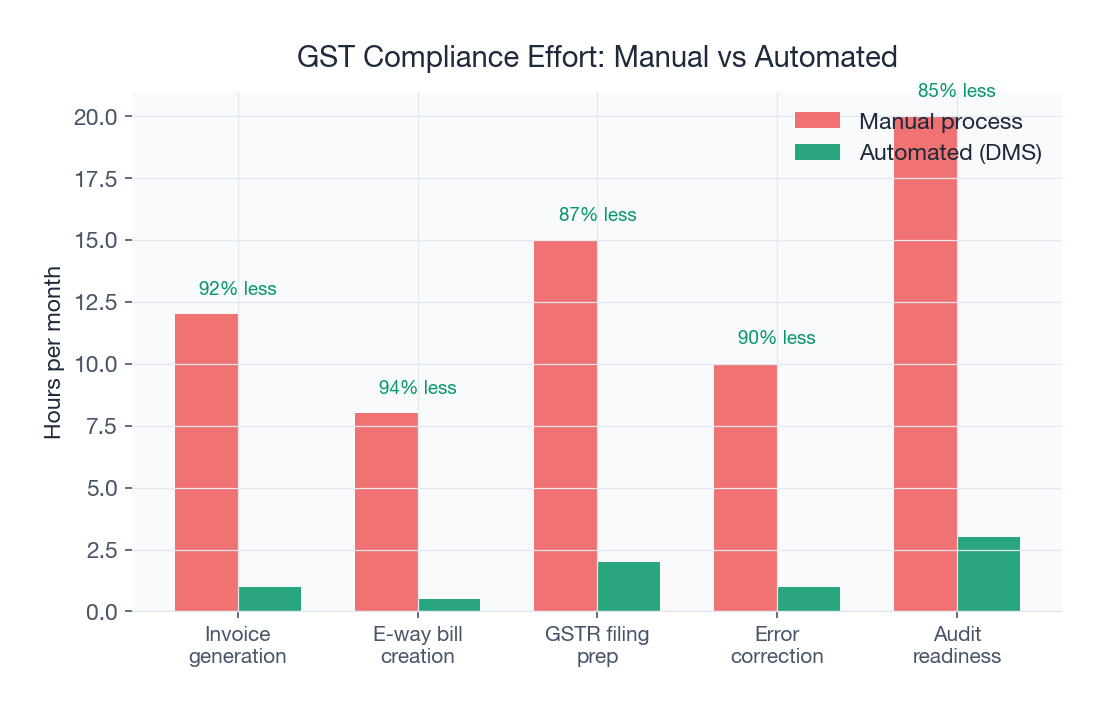
| GST return preparation | 3-5 days/month | 2-3 hours/month | 90% time saved |
| Credit note processing | 24-48 hours | Instant | Real-time adjustments |
| Month-end closing | 7-10 days | 1-2 days | 80% faster |
| Billing staff required | 3-4 FTEs | 1 FTE | 60-75% reduction |
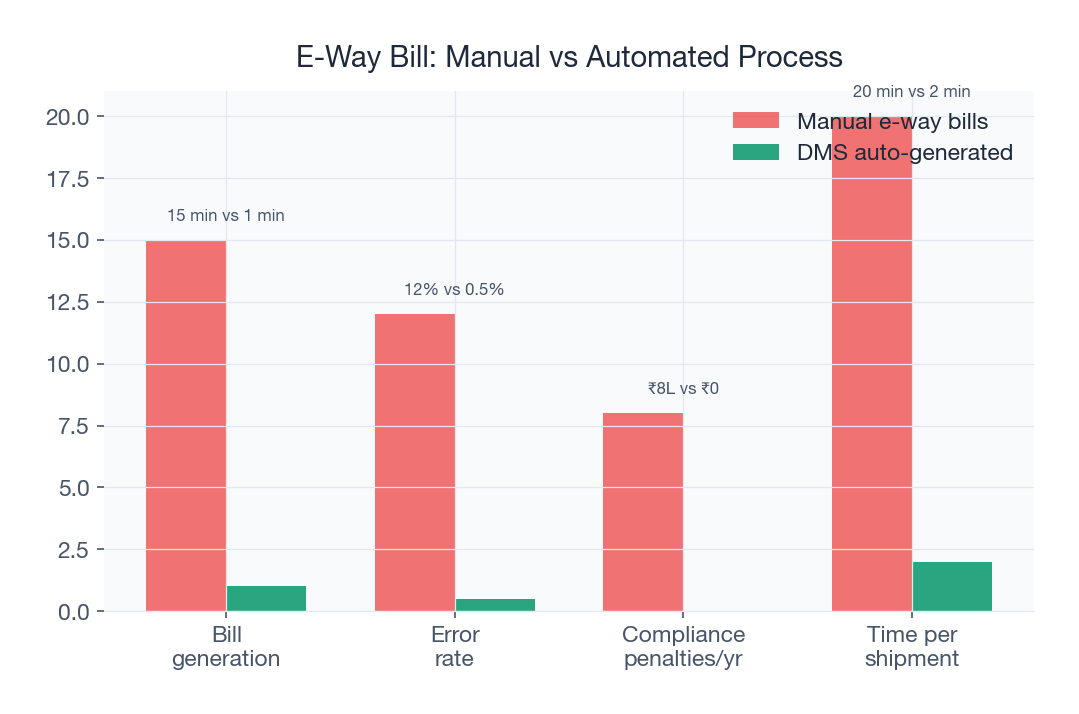
| E-invoice rejection rate | 8-12% (manual JSON) | Under 1% | 90% fewer rejections |
Billing Speed Optimization for High-Volume Distributors
For large distributors processing 500+ invoices daily, billing speed is not just about efficiency — it directly impacts dispatch timing. In dairy distribution, the morning billing window (5 AM to 8 AM) determines whether delivery vehicles leave on time. Every minute of billing delay pushes delivery schedules back, affecting product freshness and retailer satisfaction.
SpireStock optimizes billing speed through several mechanisms:
- Pre-calculated pricing — Product prices, scheme deductions, and tax rates are pre-computed when the order is confirmed, so invoice generation requires no calculation at billing time
- Batch pre-allocation — FEFO-based batch allocation happens during order confirmation, so the billing system already knows which batch goes to which retailer
- Bulk invoice generation — Generate invoices for an entire route or delivery vehicle in a single action rather than one-by-one
- Parallel e-invoicing — Submit to IRP in parallel while printing physical copies, rather than waiting for IRN before printing
- Template-based printing — Pre-formatted invoice templates with your company branding eliminate formatting overhead
Distributors who have switched from Tally-based billing to SpireStock report that their morning billing cycle drops from 2-3 hours to 20-30 minutes, enabling earlier vehicle departures and fresher product delivery.
GST Return Readiness and Compliance Reporting
Beyond invoice generation, the software maintains complete GST return readiness at all times. GSTR-1 data (outward supplies) is auto-compiled from all invoices and credit notes. GSTR-3B summary data is calculated automatically. HSN-wise summaries for the annual return are available at any time, not just at year-end. E-way bill data integrates directly with the billing workflow for goods exceeding Rs 50,000 in value — read our comprehensive guide on e-way bills for distributors.
The sales analytics dashboard provides real-time visibility into billing volumes, tax collected, outstanding receivables, and scheme payouts — giving distributors and brand principals a complete financial picture without waiting for month-end reports. For distributors managing multiple brand principals through multi-tenant workspaces, each company's billing and tax data is maintained separately while the distributor gets a consolidated operational view.
Choosing the Right Billing Software for Indian Distributors
When evaluating distributor billing software, prioritise these factors:
- GST update frequency: Tax rules change regularly — rate revisions, new e-invoicing requirements, and HSN code updates. Your software vendor must push GST rate and rule updates within days, not months.
- E-invoicing reliability: With hundreds of daily invoices, the IRP integration must be rock-solid with automatic retry, error handling, and fallback to secondary GSP channels during outages.
- Tally integration depth: Surface-level CSV exports are not enough. Look for real-time API-based sync that handles all voucher types and supports both Tally Prime and Tally ERP 9.
- Offline billing capability: In tier-2 cities like Kolkata or Chennai, internet outages should not halt billing. The system must generate invoices offline and sync when connectivity returns.
- Multi-company support: Many distributors handle multiple brand principals. The software should support separate books per company while allowing consolidated reporting.
- Scalability: Your billing system must handle growth from 100 to 5,000 invoices per day without performance degradation.
- Batch-wise billing: Essential for dairy and perishable goods distributors who need batch numbers, manufacturing dates, and expiry dates on every invoice line.
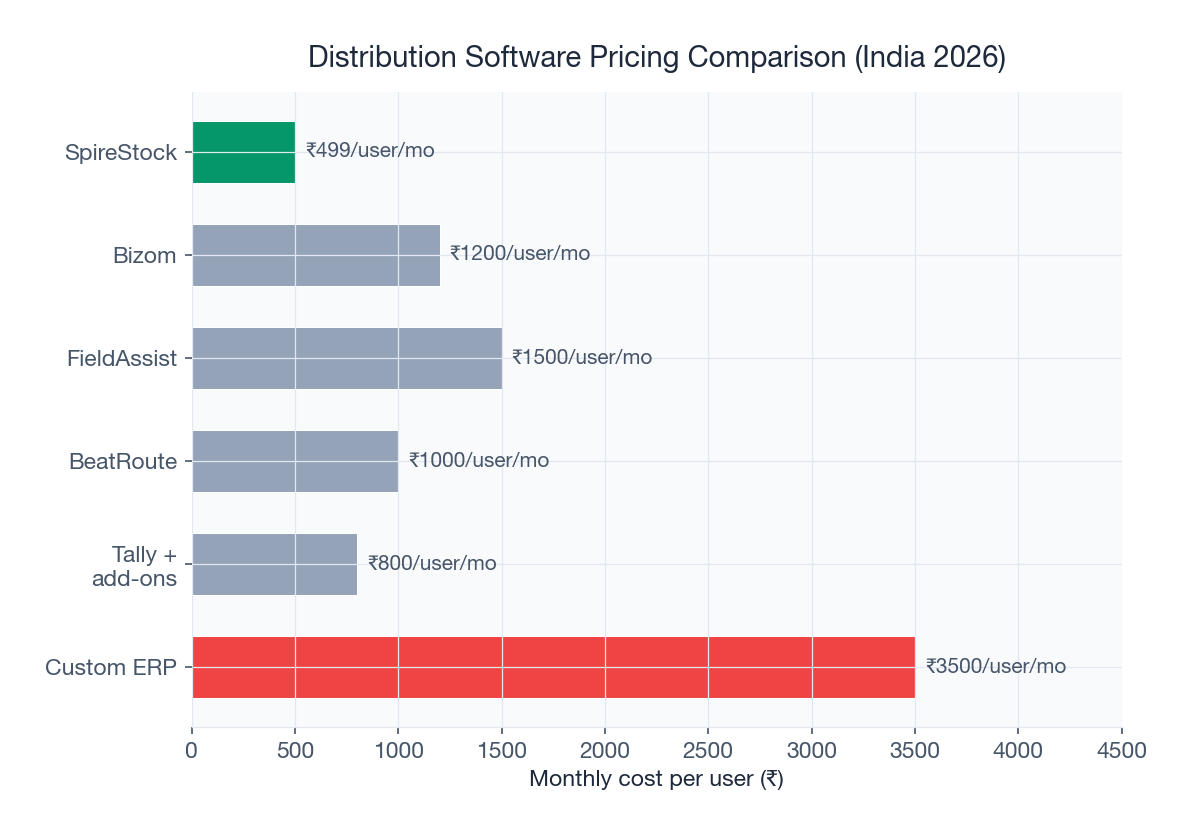
Check our pricing plans to find the right fit for your distribution scale. For a broader view of distribution software capabilities, read our buyer's guide to distributor management software.
Implementation and Transition from Manual Billing
Transitioning from Tally-based or manual billing to automated software requires careful data migration — product masters with HSN codes, retailer ledgers with opening balances, scheme configurations, and tax settings. Most implementations complete in 2-3 weeks, with parallel running (generating invoices in both old and new systems) for the first week to validate accuracy. SpireStock's onboarding team handles the entire migration, including Tally data import, so your billing operations experience zero downtime.
The ROI on billing automation is among the fastest in distribution technology. Most distributors see payback within 6-8 weeks through reduced staff costs, elimination of billing errors, and faster payment collection cycles. For a detailed ROI framework, refer to our distribution software ROI calculation guide. If you are comparing the shift from manual to digital across all distribution functions, our guide on manual vs. digital distribution provides a comprehensive view.
Frequently Asked Questions
What is distributor billing software with GST compliance?
Distributor billing software with GST compliance is a platform that automates invoice generation, GST calculation across multiple tax slabs, e-invoicing submission to the IRP, credit/debit note management, and accounting system integration — purpose-built for the high-volume, multi-rate billing requirements of Indian FMCG and dairy distributors.
Can the software handle multiple GST rates on a single invoice?
Yes. The GST engine automatically applies the correct rate per line item based on HSN codes, calculates CGST/SGST or IGST based on transaction type, and generates a tax-wise breakup. A single invoice can include items across 0%, 5%, 12%, 18%, and 28% slabs without any manual intervention.
Does it integrate with Tally?
SpireStock offers real-time API-based Tally integration that syncs invoices, credit notes, payment receipts, and journal entries automatically. This eliminates manual voucher entry and ensures your accounting books are always up to date with billing data. Both Tally Prime and Tally ERP 9 are supported.
How does e-invoicing work within the software?
When an invoice is finalised, the system automatically submits it to the GST Network's Invoice Registration Portal in the prescribed JSON format, retrieves the Invoice Reference Number (IRN) and signed QR code, and embeds them in the invoice — all within seconds, with no manual steps required.
What about credit notes for returns and adjustments?
The software generates GST-compliant credit and debit notes linked to original invoices, with proper reason codes, tax adjustments, and IRP submission. For dairy distributors handling daily returns of perishable products, this automation is critical for maintaining accurate books and GST filings.
How much can billing automation save an Indian distributor?
A typical mid-sized distributor saves Rs 12-25 lakh annually through reduced billing staff (2-3 fewer FTEs), elimination of billing errors (avoiding Rs 3-5 lakh in annual write-offs), faster GST return preparation (saving 3-4 days per month of accountant time), and improved collection cycles (unlocking Rs 20-40 lakh in working capital). See our guide to reducing distribution costs for the complete savings breakdown.
Automate your distribution billing. SpireStock handles GST compliance, e-invoicing, Tally integration, and high-volume billing for distributors across India. Start your free 14-day trial and see invoices generated in seconds, not hours.
This guide covers one part of the picture. For the category as a whole — what a DMS does, the modules that matter, how it differs from ERP and SFA, and what it costs in India — see our distributor management system guide.
Sources & References
Frequently Asked Questions
Distributor billing software with GST compliance automates invoice generation, multi-rate GST calculation, e-invoicing submission, credit/debit note management, and accounting integration — purpose-built for high-volume billing requirements of Indian FMCG and dairy distributors.
Yes. The GST engine applies the correct rate per line item based on HSN codes, calculates CGST/SGST or IGST based on transaction type, and generates tax-wise breakups. A single invoice can span 0%, 5%, 12%, 18%, and 28% slabs without manual intervention.
SpireStock offers real-time API-based Tally integration that syncs invoices, credit notes, payment receipts, and journal entries automatically, eliminating manual voucher entry and keeping accounting books always current.
When an invoice is finalised, the system automatically submits it to the GST Network's IRP in the prescribed JSON format, retrieves the IRN and signed QR code, and embeds them in the invoice — all within seconds with no manual steps.
The software generates GST-compliant credit and debit notes linked to original invoices with proper reason codes, tax adjustments, and IRP submission. This is critical for dairy distributors handling daily perishable product returns.
A typical mid-sized distributor saves Rs 12-25 lakh annually through reduced billing staff, elimination of errors, faster GST returns, and improved collection cycles unlocking Rs 20-40 lakh in working capital.
Related SpireStock Features
GST-compliant invoicing with HSN codes, gate passes, and financial ledger.
End-to-end order lifecycle from placement to delivery with multi-level approval workflows.
Powerful dashboards with sales trends, MIS reports, and distribution analytics.
Related Industries
Streamline FMCG distribution with order management, beat planning, retailer tracking, and GST billing. Built for Indian FMCG supply chains.
End-to-end dairy distribution software for milk, curd, paneer, and ghee brands. Manage orders, crates, cold chain, and GST billing in one platform.
Related Solutions
Manage your entire distributor network digitally. Onboarding, credit limits, outstanding tracking, and performance analytics. Start free trial.
Track distributor and retailer payments. Cash, UPI, cheque collection with reconciliation, ageing reports, and credit limit management.
Related Entities
Ready to Streamline Your Distribution?
Start your free 14-day trial and see how SpireStock can transform your dairy, FMCG or consumer-goods distribution operation, from order capture to crate recovery.

SpireStock Team
Distribution Technology Experts
SpireStock Team writes for SpireStock on distribution management, supply-chain optimisation and field operations for Indian dairy and FMCG brands.