Why You Need a Structured Evaluation Checklist
The distribution management software (DMS) market in India has exploded. From startups to enterprise vendors, there are now over 40 platforms claiming to solve your distribution challenges. The problem is not finding software, it is choosing the right one. A wrong choice costs not just the license fee but 6-12 months of wasted implementation effort, lost productivity during transition, and the organizational fatigue that makes your team resistant to trying again.
This 30-point checklist gives you a structured framework to evaluate any DMS platform. Whether you are a dairy distributor in Pune, an FMCG company in Delhi, or a beverage brand in Bangalore, these criteria apply universally. Use the scoring rubric at the end to compare vendors objectively. For a complete overview of how DMS platforms work, start with our guide on dairy distribution software in India.
According to a 2024 Gartner report on supply chain technology adoption in emerging markets, 58% of distribution software purchases in India result in "significant underutilization" within 18 months, primarily because buyers did not evaluate fit rigorously during the selection process. This checklist is designed to prevent that outcome.
Category 1: Core Features (10 Points)
These are non-negotiable capabilities. Any DMS worth considering must deliver on all 10.
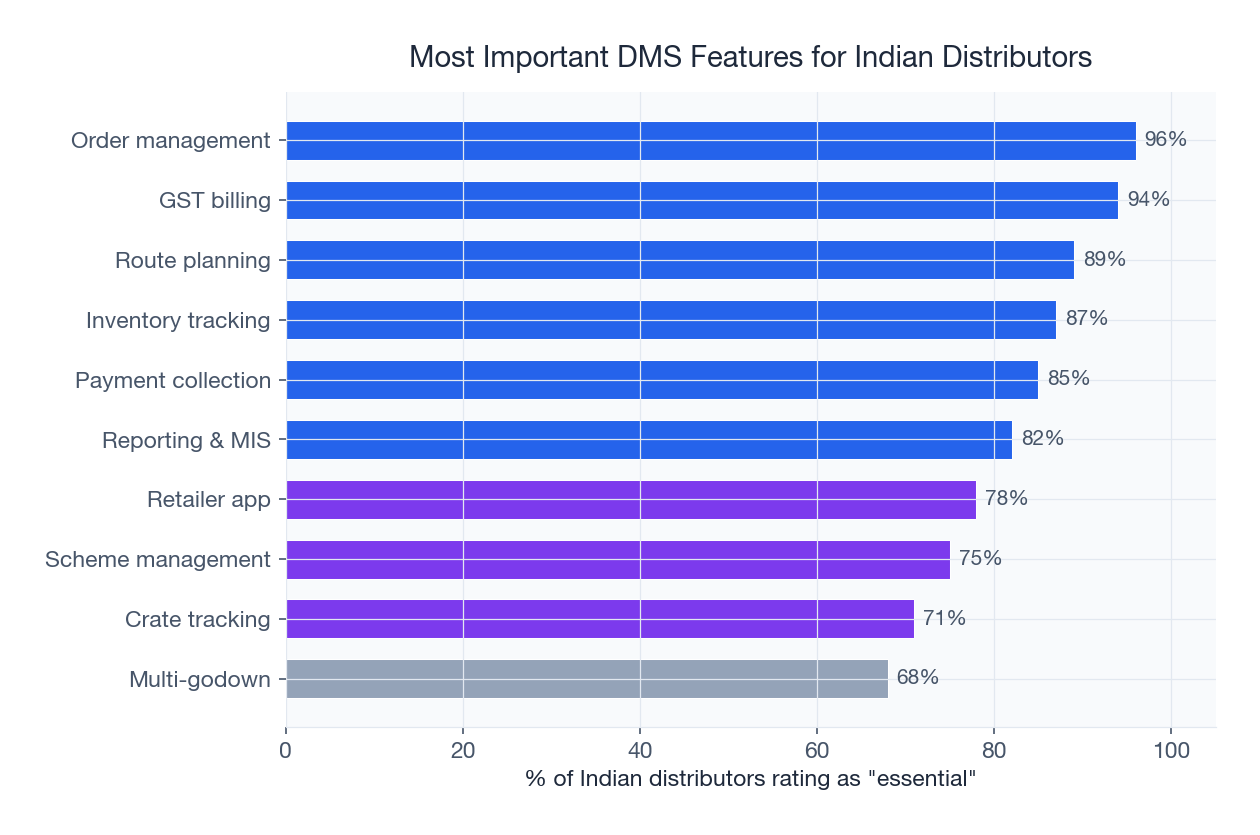
- Order management with recurring order support, Can distributors place daily orders via app? Does the system support order templates, cutoff times, and production-unit routing? For dairy and perishable distribution, this is the foundation. See how modern order management should work.
- GST-compliant invoicing with HSN codes, Does the system generate invoices with correct GST rates (0%, 5%, 12%, 18%) and HSN codes? Does it support e-invoicing as mandated by GSTN for businesses above Rs 5 crore turnover? Can it handle credit notes for returns?
- Inventory management with expiry tracking, For perishable goods, FIFO (First In First Out) enforcement and batch-level expiry tracking are essential. The system should alert dispatchers before stock expires and prevent dispatch of near-expiry products unless explicitly overridden.
- Crate and returnable asset tracking, If you deal in returnable assets (crates, cylinders, kegs), the system must track every unit issued, returned, damaged, and outstanding at the distributor level. Read about crate management best practices.
- Route planning and optimization, Does the system support beat planning, route sequencing, and GPS-based tracking? Can it optimize routes dynamically based on traffic, delivery windows, and vehicle capacity? Route optimization typically saves 20-30% on fuel costs.
- Payment collection and reconciliation, The system must support multiple payment modes (cash, UPI, cheque, NEFT), track outstanding balances per distributor, and reconcile payments against invoices automatically.
- Scheme and promotion management, Can you configure flat discounts, slab-based incentives, product-linked schemes, and time-bound promotions? Does the scheme engine apply discounts automatically during invoicing with full audit trail?
- Returns and damage management, Handling returns is complex in distribution. The system should support return authorization, quality inspection workflows, credit note generation, and restock/dispose decisions per return item.
- Multi-level user hierarchy, Distribution operations involve head office, regional managers, area sales managers, distributors, delivery staff, and retailers. The system must support role-based access with appropriate visibility at each level.
- Reporting and analytics dashboard, Real-time dashboards with drill-down capability for sales, collections, outstanding, scheme performance, and delivery metrics. Exportable reports in PDF and Excel for management review. See what sales analytics should look like.
Category 2: Integrations (5 Points)
No DMS operates in isolation. Integration capability determines how well the software fits into your existing technology ecosystem.
- Tally/Busy/SAP accounting integration, Most Indian businesses run Tally for accounting. The DMS must sync invoices, payments, and credit notes to your accounting software, ideally in real time, at minimum daily batch sync.
- GSTN and e-invoicing integration, Direct API integration with the GST Network for filing returns and generating IRN (Invoice Reference Numbers) for e-invoicing compliance. Manual upload/download is not acceptable at scale.
- Payment gateway and UPI integration, Integrated payment collection via UPI, Razorpay, or similar gateways reduces reconciliation effort and improves collection speed. QR-code-based collection at the point of delivery is increasingly standard.
- ERP and warehouse management integration, If you operate warehouses or use an ERP system, the DMS must share inventory, order, and dispatch data via API. Check for pre-built connectors vs. custom integration requirements.
- Open API for custom integration, No matter how many pre-built integrations exist, you will need custom connectivity at some point. A well-documented REST API is essential for future-proofing your investment.
Category 3: Mobile Experience (5 Points)
In Indian distribution, 80%+ of daily interactions happen on mobile devices. The mobile experience is not secondary, it is the product for most users.
- Native Android and iOS apps, Web-wrapped apps perform poorly on Indian smartphone hardware and network conditions. Native apps with optimized performance on mid-range Android devices (Rs 8,000-15,000 range) are essential.
- Offline capability with smart sync, The app must function fully offline for order taking, delivery confirmation, and payment recording. Data should sync automatically when connectivity returns, with conflict resolution for concurrent edits.
- GPS and location tracking, Real-time location tracking for delivery vehicles and field sales staff. Geo-fencing for delivery confirmation (ensure the delivery actually happened at the correct location). Battery-optimized tracking that does not drain devices.
- Camera-based proof of delivery, Photo capture at delivery point, OTP-based delivery confirmation, and digital signature capture. These eliminate disputes about whether deliveries occurred and in what condition.
- Vernacular language support, Hindi, Marathi, Tamil, Kannada, Telugu, Gujarati, your field team works in local languages. The mobile app must support at least 5-6 Indian languages to drive adoption.
Category 4: Security and Compliance (4 Points)
Distribution data includes financial transactions, customer information, pricing strategies, and competitive intelligence. Security cannot be an afterthought.
- Data encryption (at rest and in transit), All data must be encrypted using AES-256 or equivalent at rest, and TLS 1.2+ in transit. This is non-negotiable for any cloud-hosted platform.
- Role-based access control (RBAC), Granular permissions that control who can view, edit, approve, and delete data. A delivery driver should not see pricing; a distributor should not see other distributors' data.
- Audit trail and data retention, Every transaction, edit, and deletion must be logged with timestamp, user, and before/after values. Data retention policies must comply with GST record-keeping requirements (minimum 6 years under current law).
- FSSAI traceability compliance, For food and dairy distribution, the system must maintain traceability records as required by the Food Safety and Standards Authority of India. Batch tracking from production to final delivery point, with recall capability if needed.
Category 5: Pricing and Commercial Terms (3 Points)
Pricing structures vary dramatically across DMS vendors. Understanding the total cost of ownership prevents sticker shock after year one.
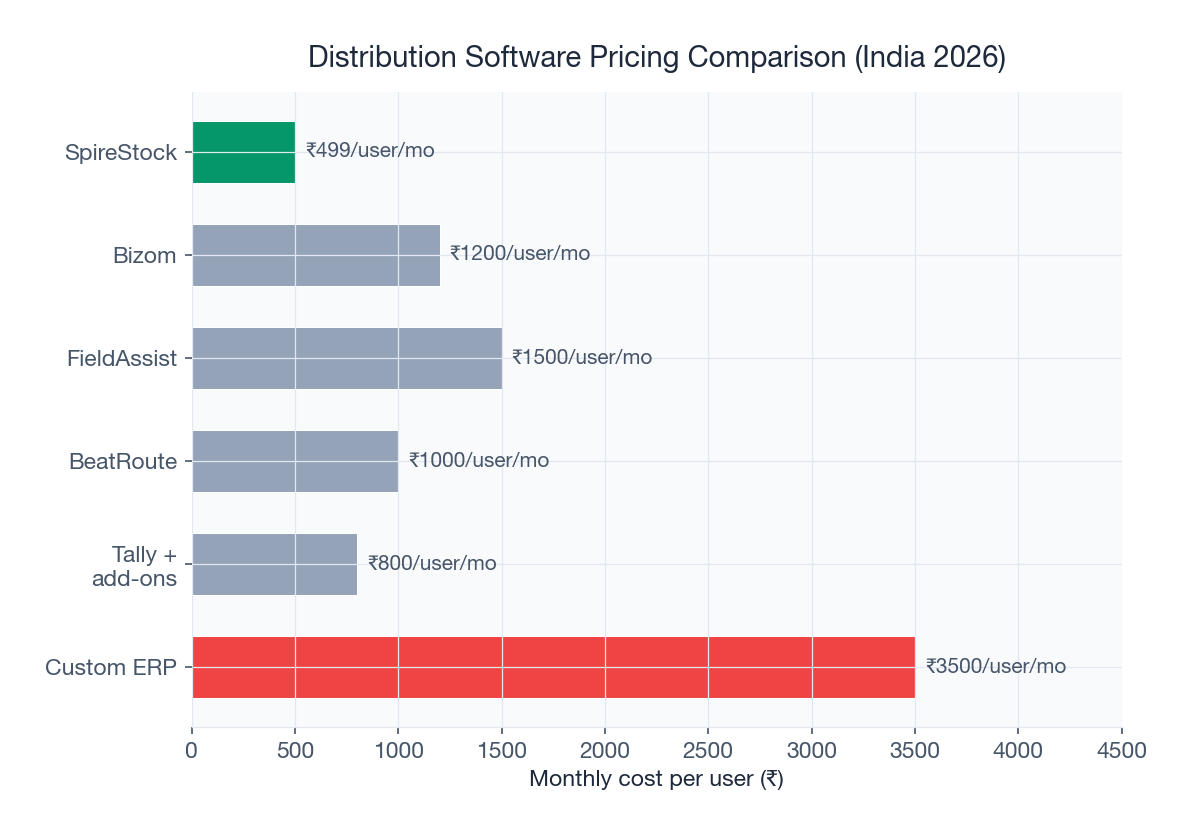
- Transparent pricing model, Per-user, per-distributor, or flat monthly fee? Understand exactly what is included and what costs extra. Watch for hidden charges: implementation fees, training fees, integration fees, data migration fees, and per-transaction charges.
- Flexible contract terms, Avoid long lock-in periods. Monthly or quarterly billing with annual discount options is the healthiest model. Ensure you can export all your data if you decide to switch.
- Total cost of ownership clarity, Ask vendors for a 3-year TCO estimate including license, implementation, training, customization, integration, and support. Compare this against the savings the software is expected to deliver.
Budget Ranges by Company Size
| Company Size | Distributors | Annual Revenue | Recommended DMS Budget (Annual) | Implementation Budget (One-Time) |
|---|---|---|---|---|
| Small | 20-80 | Rs 5-25 crore | Rs 2-5 lakh | Rs 50,000-1.5 lakh |
| Medium | 80-300 | Rs 25-100 crore | Rs 5-14 lakh | Rs 1.5-4 lakh |
| Large | 300-1000 | Rs 100-500 crore | Rs 14-40 lakh | Rs 4-10 lakh |
| Enterprise | 1000+ | Rs 500+ crore | Rs 40-100+ lakh | Rs 10-25+ lakh |
Category 6: Support and Onboarding (3 Points)
The quality of vendor support determines whether your software investment succeeds or stalls after go-live.
- Dedicated onboarding and implementation support, The vendor should provide a named implementation manager, structured onboarding plan, data migration assistance, and user training. Check if training is included or billed separately. Read about distributor onboarding best practices for what good onboarding looks like.
- Ongoing technical support with SLA, What is the average response time? Is support available via phone, chat, and email? Is there a dedicated support portal with ticket tracking? For dairy distribution where operations start at 4 AM, check support hours carefully.
- Regular product updates and roadmap transparency, How frequently does the vendor release updates? Is there a public product roadmap? Do they incorporate customer feedback into development priorities? A vendor that has not released meaningful updates in 6+ months is a red flag.
The Scoring Rubric: How to Use This Checklist
Score each of the 30 items for every vendor you evaluate using this rubric:
| Rating | Score | Definition |
|---|---|---|
| Must-have (fully met) | 3 | The vendor delivers this capability out of the box, with no customization or workaround required. Verified in demo or trial. |
| Nice-to-have (partially met) | 2 | The vendor offers this with some limitations, requires minor customization, or has it on the near-term roadmap (next 3 months). |
| Bonus (basic/planned) | 1 | The vendor acknowledges the need but the feature is basic, requires significant customization, or is on the long-term roadmap. |
| Missing | 0 | The vendor does not offer this capability and has no plans to add it. |
Maximum score: 90 points (30 items x 3 points each)
Scoring thresholds:
- 75-90 (Excellent): Shortlist for final evaluation and pricing negotiation
- 60-74 (Good): Viable option, check if gaps are in your critical areas
- 45-59 (Adequate): May work for smaller operations with simpler needs
- Below 45 (Insufficient): Do not proceed, critical gaps will cause implementation failure
Red Flags During the Evaluation Process
Beyond the checklist, watch for these warning signs during vendor evaluation:
- No free trial or pilot option, Any vendor confident in their product should offer a 14-30 day trial. Refusal suggests the product does not perform as demoed.
- Demo-only environment, If the vendor only shows a curated demo and will not let you test with your own data, be cautious. Real-world performance often differs from demo conditions.
- Vague implementation timeline, "It depends" is not an answer. A credible vendor can provide a week-by-week implementation plan based on your operation size.
- No reference customers in your segment, If the vendor cannot connect you with 2-3 existing customers in your industry and size range, their claims are unverified.
- Long-term lock-in with no exit clause, Contracts longer than 1 year without a clear data export and exit process should be avoided.
How to Run the Evaluation Process
- Shortlist 3-5 vendors, Based on industry reputation, referrals, and initial research. Do not evaluate more than 5, it becomes unwieldy.
- Send the checklist in advance, Give each vendor this 30-point checklist and ask them to self-assess before the demo. This saves time and reveals honesty.
- Structured demo with your data, Provide each vendor with a sample dataset from your actual operations. Run the same 5-6 scenarios (order placement, dispatch, delivery, returns, billing, reporting) with every vendor for apples-to-apples comparison.
- Reference calls, Speak with at least 2 existing customers per shortlisted vendor. Ask specifically about implementation experience, support quality, and hidden costs.
- Pilot with the finalist, Before committing, run a 2-4 week pilot with 10-20 distributors. This is the only way to validate real-world performance.
For dairy-specific considerations, refer to our comprehensive guide on choosing dairy distribution software. If you are setting up a new distribution network from scratch, our guide on setting up a distribution network in India covers the foundational decisions you need to make before selecting software.
Conclusion
Buying distribution management software is one of the most impactful technology decisions a distribution business makes. The right choice accelerates growth, cuts costs, and gives you competitive advantages that compound over years. The wrong choice wastes money, frustrates your team, and sets your digital transformation back by 12-18 months. Use this checklist to evaluate objectively, score systematically, and choose confidently. If you would like to see how SpireStock scores on this checklist, request a free demo with your own data.
This guide covers one part of the picture. For the category as a whole — what a DMS does, the modules that matter, how it differs from ERP and SFA, and what it costs in India — see our distributor management system guide.
Sources & References
Frequently Asked Questions
Shortlist 3-5 vendors based on industry reputation and referrals. Fewer than 3 limits your options; more than 5 becomes unwieldy. Send all vendors the same structured checklist, run identical demo scenarios with your real data, and score each using the Must-have/Nice-to-have/Bonus rubric.
For small operations (20-80 distributors), expect Rs 2-5 lakh annually. Medium businesses (80-300 distributors) should budget Rs 5-14 lakh. Large operations (300-1000 distributors) may spend Rs 14-40 lakh. Always calculate 3-year total cost of ownership including implementation, training, and integration.
Cloud-based (SaaS) is the right choice for 95% of Indian distributors. It requires no server infrastructure, updates automatically, scales easily, and works on mobile devices. On-premise only makes sense for very large enterprises with specific data sovereignty requirements and dedicated IT teams.
Critical for Indian operations. Many distribution routes pass through areas with poor internet connectivity. The mobile app must capture orders, deliveries, and payments offline and sync automatically when connectivity returns. Test offline capability thoroughly during your pilot, it is a top reason for field team rejection.
Choosing based on demo impressions rather than structured evaluation. Demos are designed to impress. Instead, test with your own data, check reference customers in your industry, run a pilot with real distributors, and score every vendor on the same 30-point checklist. The vendor who scores highest on your critical categories, not the one with the flashiest demo, is the right choice.
Related SpireStock Features
End-to-end order lifecycle from placement to delivery with multi-level approval workflows.
Real-time GPS tracking of vehicles and drivers with route optimization for faster deliveries.
Powerful dashboards with sales trends, MIS reports, and distribution analytics.
Related Industries
Streamline FMCG distribution with order management, beat planning, retailer tracking, and GST billing. Built for Indian FMCG supply chains.
End-to-end dairy distribution software for milk, curd, paneer, and ghee brands. Manage orders, crates, cold chain, and GST billing in one platform.
Related Solutions
Manage your entire distributor network digitally. Onboarding, credit limits, outstanding tracking, and performance analytics. Start free trial.
Boost field sales team productivity with beat planning, GPS attendance, order capture, and performance analytics. Built for Indian FMCG teams.
Related Entities
Ready to Streamline Your Distribution?
Start your free 14-day trial and see how SpireStock can transform your dairy, FMCG or consumer-goods distribution operation, from order capture to crate recovery.

SpireStock Team
Distribution Technology Experts
SpireStock Team writes for SpireStock on distribution management, supply-chain optimisation and field operations for Indian dairy and FMCG brands.