The Deployment Decision
When selecting dairy distribution software, one of the most consequential decisions is the deployment model: SaaS (Software as a Service), cloud-hosted and subscription-based, or on-premise, installed on your own servers with a perpetual license. Each model has genuine advantages, and the right choice depends on your company's specific situation, budget profile, and operational requirements.
Let us break down this comparison honestly, without the usual vendor bias toward one model or the other. This analysis applies to operators in dairy distribution, FMCG distribution, beverage distribution, bakery and confectionery, and consumer goods categories alike. The specific numbers scale with company size, but the fundamental tradeoffs are the same whether you are a Rs 40-crore regional dairy in Jaipur or a Rs 600-crore multi-plant operator in Ahmedabad.
SaaS: Cloud-Based Distribution Software
How It Works
SaaS software runs on the provider's cloud infrastructure (typically AWS, Azure, or Google Cloud, often with an India-based data centre region). You access it through a web browser or mobile app. The provider handles all server management, updates, backups, and security. You pay a monthly or annual subscription based on usage, with the price scaling up or down as your needs change.
Advantages for Dairy Distribution
- Low upfront cost, no server hardware, no installation fees, no large capital expenditure. Start for Rs 5,000-50,000/month depending on scale.
- Fast deployment, go live in weeks, not months. Critical for dairy companies that need results quickly.
- Automatic updates, new features, security patches, and GST compliance updates are deployed automatically. You are always on the latest version.
- Mobile-first, cloud platforms are designed for mobile access, essential for field staff and distributors using mobile apps.
- Scalability, easily add users, distributors, and data as you grow. No hardware capacity planning needed.
- Anywhere access, access your distribution data from any device, any location. Perfect for dairy owners who travel between plants.
- Disaster recovery, your data is backed up across multiple locations. Server failures do not mean data loss.
Considerations
- Internet dependency, core platform needs connectivity (though mobile apps work offline)
- Ongoing cost, subscription fees continue as long as you use the service (but total cost of ownership is typically lower)
- Data residency, your data lives on the provider's servers (though reputable providers use India-based data centres)
- Customization limits, heavy custom code is harder in a multi-tenant SaaS environment than in an on-premise deployment
On-Premise: Self-Hosted Distribution Software
How It Works
Software is installed on servers you own or lease, typically at your office or a co-located data centre. You buy a perpetual license and manage the infrastructure yourself or through an IT partner. This is the traditional enterprise software model that dominated the 2000s and still has a loyal following in regulated industries.
Advantages
- Full data control, data never leaves your premises. Important for companies with strict data governance requirements.
- No internet dependency for core operations, the system runs on your local network.
- One-time license cost, after the initial purchase, you own the software (though annual maintenance fees apply).
- Deep customization, on-premise software can be customized extensively to match unique processes.
Considerations
- High upfront investment, server hardware, network infrastructure, and license fees can run Rs 10-50 lakh initially
- IT overhead, you need IT staff (or a partner) to manage servers, backups, security, and updates
- Slower updates, upgrades require planned downtime and IT intervention; many on-premise installations fall behind on versions
- Scaling complexity, adding capacity means buying more hardware and reconfiguring infrastructure
- Mobile limitations, providing secure mobile access from outside your network adds complexity
- Disaster recovery responsibility, backup and recovery is your responsibility; hardware failures can cause data loss without proper systems
Total Cost of Ownership: An Honest Comparison
| Cost Category | SaaS (3 years) | On-Premise (3 years) |
|---|---|---|
| Software license | Rs 5.4 lakh subscription | Rs 8-15 lakh upfront |
| Server hardware | Rs 0 | Rs 4-8 lakh |
| Implementation | Included | Rs 3-6 lakh |
| Annual maintenance | Included | Rs 6-12 lakh |
| IT staff (0.5 FTE) | Rs 0 | Rs 9-15 lakh |
| Backup and DR | Included | Rs 2-4 lakh |
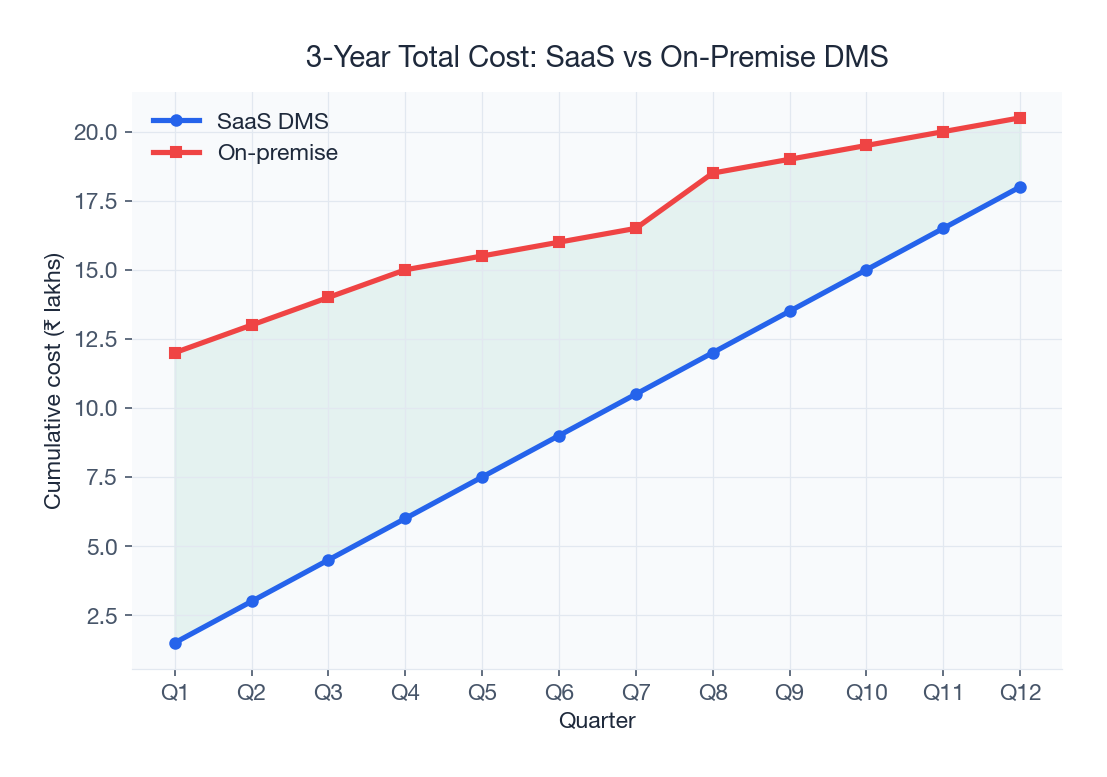
| Total 3-year TCO | Rs 5.4 lakh | Rs 32-60 lakh |
The math strongly favours SaaS for most mid-sized dairy companies. The gap widens further when you factor in the opportunity cost of delayed deployment (on-premise takes 3-6 months vs. 2-4 weeks for SaaS). Every month of delayed deployment is a month of continued manual-process cost that rarely makes it into the TCO spreadsheet but absolutely shows up on the P&L.
Making the Right Choice for Your Dairy Business
Choose SaaS If:
- You want to start quickly and see ROI within weeks
- Your budget prioritizes operational expenditure over capital expenditure
- You need mobile access for field staff and distributors
- You do not want to manage IT infrastructure
- You are growing and need flexible scalability
- Your operations span multiple locations or cities
Consider On-Premise If:
- Regulatory or corporate policy mandates on-premise data storage
- You operate in areas with no internet connectivity at all (not even mobile data)
- You have existing IT infrastructure and staff that would be underutilized
- You need deeply customized integrations with legacy manufacturing systems
Data Security and Compliance
A common concern with SaaS is data security, but the reality is that reputable cloud providers invest more in security than almost any individual company could justify. AWS, Azure, and Google Cloud each spend billions annually on security engineering, compliance certifications (SOC 2, ISO 27001, PCI DSS), and infrastructure redundancy. A small on-premise server in a dusty server room in Hyderabad cannot match that level of protection no matter how much the IT head tries.
Indian data residency is also increasingly well-covered. Providers now offer Mumbai, Hyderabad, and Chennai data centre regions so your data never leaves Indian borders, satisfying the growing expectations of distributor management platforms that serve regulated categories.
Integration Patterns That Work in Both Models
Whichever deployment model you choose, you will need to integrate with Tally/Busy/SAP for accounting, payment gateways for UPI and card processing, and WhatsApp/SMS for distributor communication. SaaS platforms typically offer these integrations out of the box; on-premise deployments usually require custom middleware. This adds another 15-25% to on-premise project costs that is easy to miss during initial vendor selection.
The Market Trend
The Indian dairy distribution market is moving decisively toward SaaS. Over 80% of new distribution software deployments in 2025-2026 are cloud-based. The combination of lower cost, faster deployment, mobile-first design, and automatic compliance updates makes SaaS the natural fit for the FMCG distribution sector. Even brands like Amul, Mother Dairy, and Britannia, long-time users of on-premise enterprise systems, are increasingly adopting SaaS for new deployments, particularly in distribution and field force management layers.
SpireStock's cloud platform leverages order management, distribution tracking, and analytics, all accessible from any device. The platform is built on the same hyperscale cloud infrastructure that runs the world's largest consumer apps, so you inherit enterprise-grade reliability without enterprise-grade cost.
Migration From On-Premise to SaaS
If you are currently running on-premise software and considering SaaS, migration is entirely feasible. Modern providers offer structured migration support including data extraction, cleansing, mapping, and phased cutover. A mid-sized dairy in Bangalore migrated 18 months of transactional history and 280 distributor master records to SpireStock's cloud in just three weeks in late 2024, running parallel for the first 14 days to validate data integrity before cutting over fully.
For deeper reading on the software decision landscape, see our companion guides on ERP vs CRM vs DMS and digital transformation in Indian dairy. Both provide additional context for the deployment decision.
Ready to Decide?
If you are unsure which deployment model is right for your business, talk to our team for a tailored assessment. Review SpireStock pricing to see transparent SaaS plans, or book a demo to compare the SaaS experience against your current software footprint. Most operators find the decision much clearer after a 30-minute walkthrough of the actual product than after any amount of spreadsheet analysis.
Hybrid Cloud: The Middle Path
A small but growing number of dairy companies are adopting hybrid cloud architectures where the core DMS runs on SaaS but certain highly sensitive data (for example, pricing agreements with large retail chains) lives in on-premise databases linked to the cloud platform via secure APIs. This approach combines the operational agility of SaaS with targeted data residency control, and it works particularly well for companies subject to specific enterprise customer requirements around data handling.
The tradeoff is complexity: hybrid architectures require more sophisticated IT management than pure SaaS. For most mid-sized operators, the complexity is not worth it, pure SaaS with India-based data centres is sufficient to meet every practical security and compliance requirement. Only a handful of edge cases genuinely benefit from the hybrid approach.
Vendor Due Diligence Checklist
Whichever deployment model you choose, apply rigorous vendor due diligence. Check: financial stability of the provider, customer reference lists in your specific industry, security certifications (SOC 2 Type II at minimum), data export capabilities so you are never trapped, uptime SLAs, and the size and experience of the implementation team. Ask specifically about the vendor's roadmap for India-specific compliance requirements like GST changes and FSSAI updates. A good vendor will have a clear answer; a weak vendor will wave you off.
Also investigate the vendor's track record with companies at your stage of growth. A provider optimized for Rs 2000-crore enterprises will be over-engineered and expensive for a Rs 80-crore regional dairy; a provider optimized for Rs 20-crore startups may lack the sophistication a larger operator needs. Match the vendor's sweet spot to your actual profile.
Common Misconceptions About SaaS
"SaaS is less secure than on-premise." False for most mid-sized companies. Professional cloud providers invest far more in security than an in-house IT team can justify. The real security risks in most dairy companies are weak passwords, unpatched servers, and stolen laptops, all of which on-premise software is equally vulnerable to.
"SaaS is more expensive over time." Usually false when all costs are counted. On-premise looks cheaper on the license line but explodes on hardware, IT staffing, maintenance, and infrastructure upgrades. The three-year TCO almost always favours SaaS for companies under Rs 500 crore in revenue.
"SaaS does not work offline." Partially false. The mobile apps are offline-capable and sync when connectivity returns. The web dashboard does require connectivity, but that is a reasonable assumption at headquarters in Pune, Chennai, or Mumbai.
Future-Proofing Your Technology Stack
Whichever model you choose, build the stack so that individual components can be replaced without disrupting the whole. Use standard APIs, avoid proprietary data formats, and insist on data export capabilities. The software industry evolves quickly; no decision you make today is permanent. The goal is flexibility: the ability to adopt new tools as they emerge without ripping out your foundation. Companies that build for flexibility adapt faster and survive longer than companies that bet everything on a single vendor relationship.
Questions to Ask Any Vendor
Specific questions that separate serious vendors from superficial ones: "Show me how your system handles a distributor ordering products from two plants simultaneously." "Walk me through a typical GST update deployment." "Demonstrate offline order capture and sync." "Pull a real customer's aging report on a demo call." "Give me three reference customers I can call directly." A vendor who handles these questions smoothly is likely to be a reliable long-term partner; a vendor who deflects or delays is showing you their implementation DNA.
The Bottom Line Recommendation
For 90% of Indian dairy companies in 2026, SaaS is the right choice. The TCO is lower, the deployment is faster, the features are richer, and the ongoing maintenance burden is dramatically smaller. On-premise remains a legitimate choice only for the handful of companies with genuinely unique requirements around data residency, customization depth, or integration with legacy manufacturing systems. If you are not certain on-premise is the right choice, default to SaaS. The probability that you will regret choosing SaaS is lower than the probability that you will regret choosing on-premise. This is not a universal rule, but it is the right starting position in 2026 for any dairy company making this decision today.
Sources & References
Frequently Asked Questions
SaaS (Software as a Service) dairy distribution software is hosted on cloud servers and accessed via web browser or mobile app. You pay a monthly/annual subscription instead of a large upfront license fee. The provider handles all server management, updates, and security.
Reputable SaaS providers use bank-grade encryption, regular backups across multiple data centres, and strict access controls. Your data is typically safer in a professionally managed cloud than on a local server without dedicated IT security expertise.
SpireStock's mobile app works offline, orders, deliveries, and payments can be recorded without internet. Data syncs when connectivity returns. The web dashboard requires internet, but critical field operations continue uninterrupted.
Yes, migration is possible but involves data transfer, user retraining, and process adjustment. It's smoother to start with SaaS from the beginning. If you're currently on on-premise and considering the switch, most providers offer migration support.
Most providers offer monthly and annual subscription options. Annual contracts typically come with a 15-20% discount. SpireStock offers flexible terms with no long-term lock-in, allowing you to scale up or down as needed.
Yes, your data remains your property. Reputable SaaS providers offer data export capabilities and contractual guarantees that your data will be returned to you if you terminate the service. Always verify data ownership terms before signing.
SaaS platforms are updated continuously, typically weekly or bi-weekly for minor improvements and monthly for significant features. Updates are deployed automatically without downtime. You always have access to the latest features, security patches, and compliance updates.
Yes, modern SaaS platforms offer API-based integrations with major accounting and ERP systems. SpireStock integrates with Tally, Busy, SAP, and other common business software used by Indian dairy companies.
Related SpireStock Features
Related Solutions
Manage your entire distributor network digitally. Onboarding, credit limits, outstanding tracking, and performance analytics. Start free trial.
Manage distribution across multiple production units and plants. Centralized control with plant-level autonomy for dairy and FMCG brands.
Related Entities
Ready to Streamline Your Distribution?
Start your free 14-day trial and see how SpireStock can transform your dairy, FMCG or consumer-goods distribution operation, from order capture to crate recovery.

SpireStock Team
Product & Industry Insights
SpireStock Team leads product at SpireStock, where the team ships distribution management software for India's dairy, FMCG and consumer-goods brands.