FSSAI Licensing Framework for Dairy Distributors in 2026
The Food Safety and Standards Authority of India (FSSAI) is the apex regulatory body governing all food business operators in India, from street food vendors to multi-billion-rupee dairy conglomerates. For dairy distributors, FSSAI compliance is not optional or aspirational: it is the legal prerequisite for operating. An unlicensed dairy distributor faces business closure orders, fines up to Rs 5 lakh, and criminal prosecution. Yet a surprising number of distributors across Mumbai, Delhi, Pune, and tier-2 cities operate with expired licenses, incorrect license categories, or incomplete compliance documentation, often unknowingly.
This guide covers the complete 2026 FSSAI compliance landscape for Indian dairy distributors, including the latest regulatory changes, licensing categories, traceability mandates, record-keeping requirements, and how distribution management software transforms compliance from a periodic scramble into an automated daily process.
License Types and Turnover Thresholds
FSSAI requires every food business operator to obtain the appropriate license based on their annual turnover and scale of operations. Here is the current framework as of 2026:
| License Type | Turnover Threshold | Annual Fee | Validity | Applicable To | Processing Time |
|---|---|---|---|---|---|
| Basic Registration | Up to Rs 12 lakh | Rs 100 | Lifetime (2026 update) | Small retailers, petty food traders | 7-15 days |
| State License | Rs 12 lakh to Rs 20 crore | Rs 2,000-5,000/year | 1-5 years (renewable) | Most dairy distributors | 30-60 days |
| Central License | Above Rs 20 crore | Rs 7,500/year | 1-5 years (renewable) | Large distributors, multi-state operations | 30-60 days |
The vast majority of dairy distributors in India fall under the State License category. A distributor with Rs 5 crore annual turnover operating within a single state needs a State License. A distributor operating across state boundaries or with turnover exceeding Rs 20 crore needs a Central License. The application is made through Form B on the FoSCoS (Food Safety Compliance System) portal at foscos.fssai.gov.in.
Key Documents Required for License Application
- Identity proof of the food business operator (Aadhaar card, PAN card, or passport)
- Business registration documents (GST registration certificate, partnership deed, LLP agreement, or company incorporation certificate)
- Complete list of food products handled with HSN codes and product categories (milk, curd, paneer, ghee, ice cream, etc.)
- Food safety management plan detailing your handling, storage, and dispatch procedures for perishable dairy products
- List of equipment and machinery including cold storage units, refrigerated vehicles, temperature monitoring devices, and weighing equipment
- Water test report from an NABL-accredited laboratory (if water is used in any processing at the distribution facility)
- Medical fitness certificates for all staff who handle food products, including delivery drivers and godown workers
- FoSTaC certificate (Food Safety Training and Certification) for the designated food safety supervisor at your facility
- NOC from local municipal authority for the godown premises
- Blueprint or layout plan of the storage facility showing cold storage zones, loading docks, and product flow
2026 Regulatory Changes Every Dairy Distributor Must Know
FSSAI has introduced several significant regulatory changes in the 2025-2026 period that directly affect dairy distribution operations. Distributors who are unaware of these changes risk non-compliance during inspections.
1. Lifetime Validity for Basic Registration
From 2026, Basic Registration (for food businesses with annual turnover up to Rs 12 lakh) is valid for the lifetime of the business, eliminating the need for periodic renewal. While this primarily affects small retailers and petty food vendors rather than distributors, it is relevant if you serve small retailers who need FSSAI registration. As a distributor, you should verify that your retailer network has valid registrations because FSSAI increasingly expects distributors to confirm their customers' compliance status.
2. Risk-Based Inspection Model
This is the most impactful change for dairy distributors. FSSAI has moved from routine scheduled inspections to a risk-based inspection model where inspection frequency and intensity are determined by the risk profile of the food business. Dairy distribution is classified as high-risk due to the perishable nature of products, the cold chain requirements, and the potential for food safety incidents from temperature abuse.
High-risk classification means more frequent inspections, typically 1-2 per year, compared to the previous random schedule. However, there is a significant upside: distributors with a clean compliance history, digital record-keeping, and a documented food safety management system can earn a lower risk score over time, resulting in fewer surprise inspections. This creates a direct, tangible incentive for investing in compliance infrastructure and digital record-keeping through a distribution management system.
3. Enhanced FoSCoS Portal with Digital Compliance Tracking
The FoSCoS (Food Safety Compliance System) portal has been significantly enhanced for 2026. All compliance interactions, from license application and renewal to inspection reports and improvement notices, are now managed through this single digital portal. The portal sends automated renewal reminders 90 days before license expiry, tracks the status of improvement notices, and maintains a digital compliance history for each food business operator. Distributors can download their compliance reports and inspection history directly from the portal.
4. Mandatory FLRS (Food Labelling and Registration System) Compliance
Product label approvals are now managed through FLRS. While this primarily affects manufacturers, distributors have an indirect responsibility: you must verify that all products you handle have valid FLRS approvals and proper labeling. This means checking that every product in your godown displays the manufacturer's FSSAI license number, manufacturing date, expiry date, batch number, MRP, and nutritional information as per current labeling regulations. Distributing products with non-compliant labels makes the distributor liable alongside the manufacturer.
5. Strengthened Recall Framework
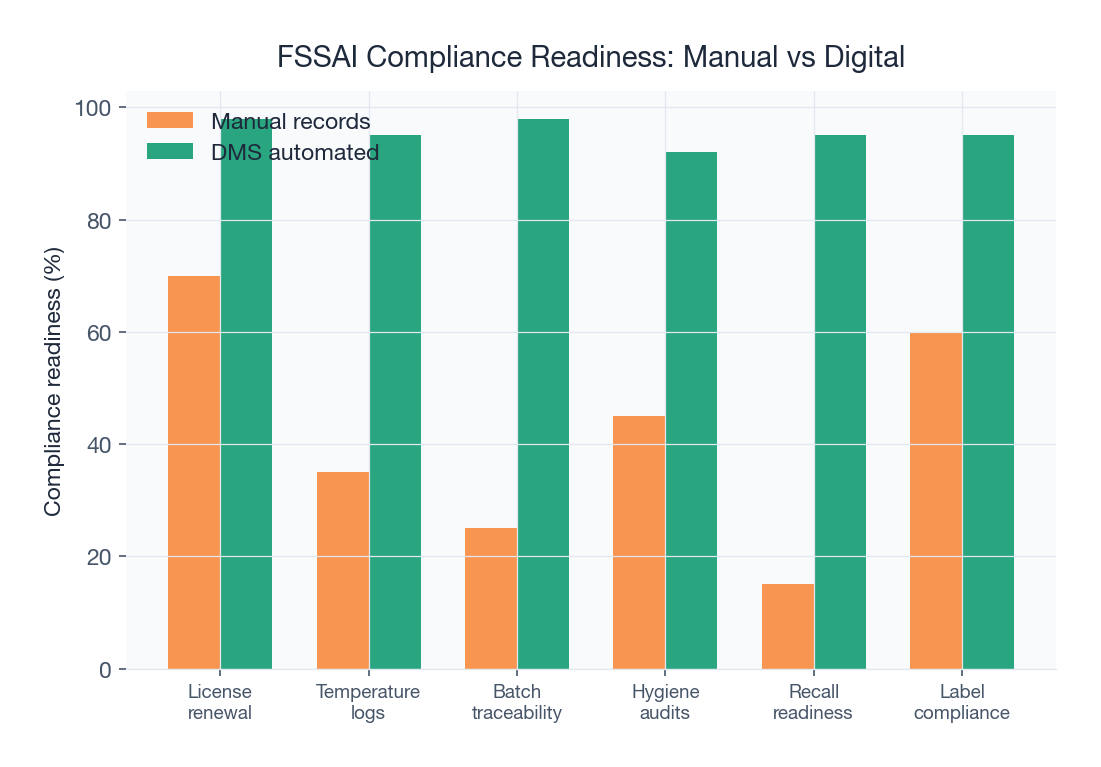
FSSAI has strengthened its product recall framework in 2026, requiring food business operators at every level of the supply chain to participate in recalls within specified timeframes. For dairy distributors, this means having the capability to identify every retailer who received a specific batch within 24 hours of a recall notification, and to initiate retrieval within 48 hours. Manual record-keeping makes meeting these timeframes virtually impossible for a distributor handling hundreds of daily transactions.
One-Up-One-Down Traceability: The Core FSSAI Mandate
FSSAI mandates one-step-forward, one-step-back traceability for all food business operators. For a dairy distributor, this means:
- One step back (supplier traceability): You must be able to identify the source (manufacturer, dairy plant, C&F agent) for every product in your godown, including the batch number, manufacturing date, date of receipt, quantity received, and invoice reference. If FSSAI asks "where did you get Batch X of this curd?", you must answer within hours, not days.
- One step forward (customer traceability): You must be able to identify every retailer to whom you sold a specific batch, including date of sale, quantity sold, and invoice reference. If FSSAI asks "who did you sell Batch X to?", you must provide the complete distribution trail with documentation.
In the event of a product recall triggered by contamination, adulteration, or quality failure, FSSAI expects distributors to provide both one-step-back and one-step-forward traceability within hours. A distributor handling 200+ daily transactions through paper registers and Tally entries simply cannot produce this information in the required timeframe. The order management and billing modules in a DMS automatically create this complete traceability chain as part of normal business operations, making recall readiness a byproduct of daily work rather than a separate compliance exercise.
The Six Categories of Mandatory Records for Dairy Distributors
FSSAI requires dairy distributors to maintain six distinct categories of records, each serving a specific food safety purpose. During an inspection, the FSSAI officer can request any of these records for any date range, and failure to produce them results in non-compliance notices and penalties.
1. Vehicle and Transit Temperature Logs
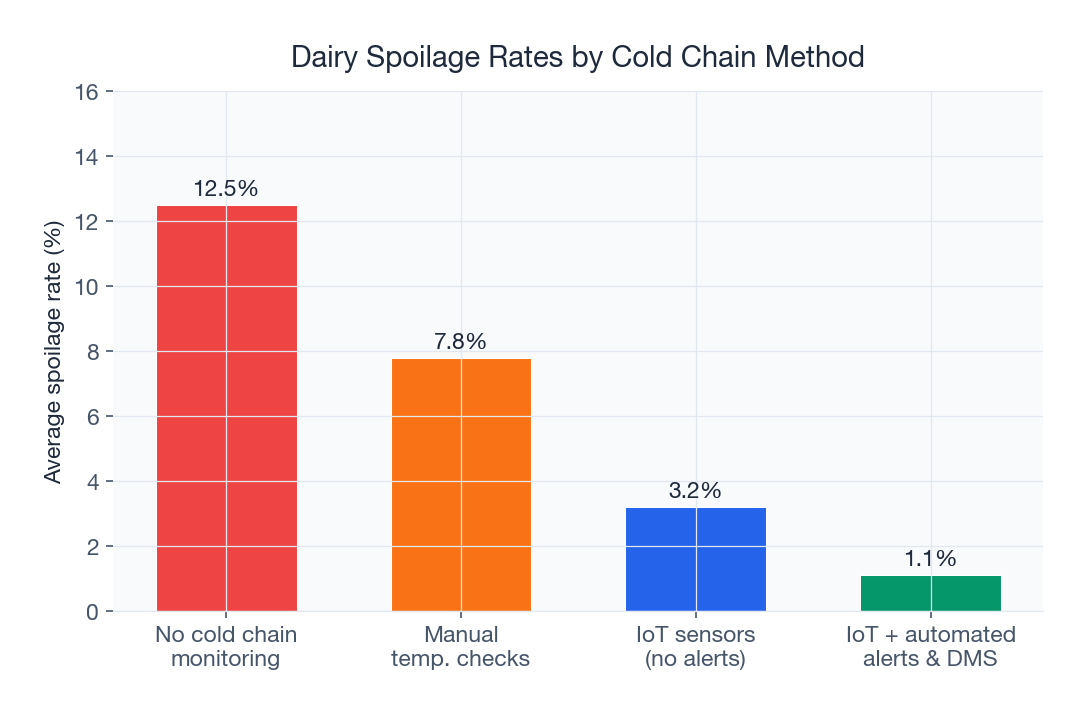
Every delivery vehicle carrying dairy products must have temperature monitoring capability. Logs must demonstrate that chilled dairy products (milk, curd, paneer, buttermilk) were maintained at 2-8 degrees Celsius and frozen products (ice cream, frozen desserts) were maintained below -18 degrees Celsius throughout transit. Temperature readings must be recorded at vehicle loading, at intermediate points during the route, and at delivery. FSSAI inspectors specifically request these transit temperature logs during audits. Digital temperature logging through IoT sensors integrated with the fleet management system provides continuous, tamper-proof records that satisfy even the most rigorous inspectors.
2. Cold Storage and Godown Temperature Records
Godown cold room temperatures must be logged continuously. For walk-in cold rooms, FSSAI expects temperature readings at least every 4 hours, with best practice being continuous IoT-based monitoring. For deep freezers, readings at least twice daily. Any temperature excursion (cold room rising above 8 degrees due to power failure, door left open, or compressor malfunction) must be documented with the duration of the excursion, the maximum temperature reached, and the corrective action taken. Products exposed to temperature abuse must be assessed for safety and potentially quarantined or discarded.
3. Batch Receipt and Dispatch Records
This is the documentation backbone of traceability. Every batch received must be logged with: supplier name and FSSAI license number, batch number, manufacturing date, expiry date, quantity received, date and time of receipt, and condition at receipt. Every batch dispatched must be logged with: retailer name and FSSAI registration number, batch number, quantity dispatched, date of dispatch, and invoice reference. For a distributor handling 200 SKUs across 200 retailers, this generates 400-600 daily records that must be accurate, complete, and retrievable. Read our guide on batch tracking and traceability in dairy for implementation best practices.
4. Documented Recall Procedures
A written, documented recall procedure must exist at every dairy distribution facility, detailing the step-by-step process for identifying affected batches, notifying affected retailers, retrieving recalled products, quarantining recalled inventory, and reporting to FSSAI. The procedure must name the responsible person (food safety supervisor), specify communication channels, and include contact details for your suppliers and major customers. Critically, the procedure must be tested annually through a mock recall exercise, and records of the mock recall (participants, timeline, outcomes, lessons learned) must be maintained.
5. Pest Control Records
Regular pest control treatment records for all storage facilities must be maintained, including the service provider's name and license number, chemicals and methods used, treatment dates, and results of post-treatment inspections. For dairy distribution godowns, treatments are typically required quarterly, with additional treatments during monsoon months when pest activity increases. Rodent and insect monitoring stations should be in place with regular inspection logs.
6. Staff Health and Training Records
Annual medical check-up records for all staff who handle food products, including delivery drivers, godown workers, and loading staff. Certificates must confirm absence of communicable diseases (typhoid, hepatitis, tuberculosis). Additionally, records of food safety training for all food-handling staff must be maintained. The designated food safety supervisor must hold a valid FoSTaC certificate, which requires renewal training every 2 years.
How a DMS Automates FSSAI Compliance
A dairy distributor handling 200 retailers across 8 routes generates approximately 500+ compliance-relevant records per day: 200 delivery records, 200 invoice records, 50-80 return records, 30-40 payment records, 8 vehicle temperature logs, and route completion records. Maintaining this volume accurately on paper is not just inefficient; it is practically impossible over any sustained period.
| FSSAI Requirement | Manual Approach | DMS-Automated Approach | Risk Reduction |
|---|---|---|---|
| Batch traceability (one-up-one-down) | Physical registers, hours to trace one batch | Instant search by batch, product, or retailer | Recall response from days to minutes |
| Vehicle temperature logs | Manual readings on paper sheets | IoT sensors with continuous digital logging | Eliminates falsified or missing readings |
| Expiry management (FEFO) | Physical stock inspection, often missed | Automated FEFO alerts and dispatch logic | Near-zero expired product dispatch |
| Delivery records with traceability | Paper challans filed in boxes | Digital ePOD with GPS, photos, timestamps | Complete delivery trail for any date |
| Recall readiness | Manual search through registers (days) | One-click affected retailer identification (minutes) | Meets FSSAI 24-hour recall timeline |
| Staff health record tracking | Paper files in HR folder, missed renewals | Digital records with automated renewal reminders | No expired medical certificates |
| Audit report generation | Days of preparation before inspector visit | Instant compliance report export for any date range | Always audit-ready |
FSSAI Audit Preparation: 12-Point Checklist
When an FSSAI inspector visits your dairy distribution facility, whether scheduled or surprise, these 12 items must be in order. Using this as a monthly self-audit checklist ensures you are always prepared:
- Valid FSSAI license displayed prominently at the entrance of the premises (original, not photocopy)
- FoSTaC (Food Safety Training and Certification) certificate of the designated food safety supervisor
- Cold storage temperature logs for the last 30 days, showing continuous compliance with 2-8 degrees Celsius for chilled and below -18 degrees for frozen
- Vehicle temperature logs for the last 30 days, covering all delivery routes
- Batch receipt register (digital or physical) with complete supplier traceability for all products currently in stock
- Batch dispatch register (digital or physical) with complete retailer traceability for all dispatches in the last 90 days
- Pest control treatment records for the last 12 months, including service provider details and chemicals used
- Staff medical fitness certificates for all food handlers (must be current, not older than 12 months)
- Documented recall procedure (updated within the last 12 months) with evidence of annual mock recall exercise
- Product label compliance verification records showing all distributed products meet FSSAI labeling requirements
- Cleaning and sanitation schedule for all storage areas and equipment, with execution records signed by responsible staff
- Complaint and non-conformance register documenting any quality complaints received and corrective actions taken
The analytics and reporting module in SpireStock can generate items 3, 4, 5, 6, and 11 from this checklist with a single click, covering the most documentation-intensive audit requirements automatically.
Penalties for FSSAI Non-Compliance: What Is at Stake
FSSAI penalties are structured to be proportionate to the severity of the violation, but even minor infractions carry significant financial consequences for dairy distributors:
| Violation Category | Penalty Range | Additional Consequences | Typical Scenario |
|---|---|---|---|
| Operating without valid license | Up to Rs 5 lakh | Immediate business closure order | Expired license not renewed on time |
| Selling expired products | Up to Rs 5 lakh | Product seizure, license suspension | FEFO not enforced, expired curd dispatched |
| Temperature non-compliance | Rs 1-3 lakh | Improvement notice, re-inspection within 30 days | Cold storage found at 12 degrees instead of 8 |
| Incomplete traceability records | Rs 1-2 lakh | Compliance notice, follow-up audit within 60 days | Cannot trace batch to supplier or customers |
| Adulterated products found | Up to Rs 10 lakh + imprisonment | Criminal prosecution, license cancellation | Products fail quality testing |
| Misleading product labeling | Rs 3-5 lakh | Product recall order, brand notification | Distributing mislabeled products |
| Obstruction of FSSAI inspector | Up to Rs 3 lakh | Criminal prosecution possible | Refusing access or delaying records |
| No food safety supervisor | Rs 25,000-1 lakh | Compliance notice, mandatory FoSTaC training | FoSTaC-trained person not on staff |
Beyond direct penalties, FSSAI non-compliance creates business risk through brand relationship damage. Dairy brands and C&F agents increasingly require distributors to demonstrate FSSAI compliance before awarding or renewing distribution agreements. A single compliance failure can cost a distributor their brand appointment, which may be worth crores in annual revenue.
Building a Compliance-First Distribution Operation: 6-Step Approach
The most effective approach to FSSAI compliance is to build it into daily operations rather than treating it as a separate, periodic exercise. Here is a practical 6-step framework used by SpireStock customers across Ahmedabad, Bangalore, Hyderabad, and Chennai:
- Start with the right license: Verify your license type matches your actual turnover. Many distributors outgrow their Basic Registration without upgrading to a State License, which is a technical violation carrying penalties. Set calendar reminders for renewal 90 days before expiry.
- Appoint and train a food safety supervisor: Send at least one team member for FoSTaC training (available through FSSAI-recognized training partners). This person becomes the compliance owner who oversees daily food safety operations, maintains records, and interfaces with FSSAI inspectors during audits.
- Digitize record-keeping: Implement a distribution management system that captures batch tracking, delivery records, and temperature logs as part of normal business operations. The key insight is that compliance records should be a byproduct of daily work, not a separate data entry task.
- Implement FEFO enforcement: Configure first-expiry-first-out logic across all godowns and van loading processes. This serves dual purposes: it is good business practice (reducing wastage and write-offs) and FSSAI expects it. The expiry management system should automatically prioritize near-expiry batches for dispatch and alert when products approach expiry thresholds.
- Schedule monthly self-audits: Use the 12-point checklist above as a monthly internal audit template. The food safety supervisor walks through each point, flags gaps, and initiates corrective actions. Monthly self-audits catch issues before FSSAI inspectors do and build the compliance habit across the organization.
- Conduct annual mock recall: Once a year, simulate a product recall for a random batch. Measure how quickly your team can identify all affected retailers, generate recall notifications, and document the retrieval process. Target: complete retailer identification within 2 hours, notification within 4 hours. With digital traceability through your DMS, this should be achievable; without it, even a mock recall will expose critical gaps.
Temperature Monitoring: The Most Common Compliance Failure
In our experience working with dairy distributors across India, temperature non-compliance is the single most common FSSAI violation. The requirement is straightforward: chilled dairy at 2-8 degrees Celsius, frozen dairy below -18 degrees, continuously documented. The reality is that power cuts, compressor failures, loading dock exposure during summer, and delivery van refrigeration breakdowns create constant temperature excursion risks.
Modern IoT-based temperature monitoring integrated with fleet management provides continuous, automated temperature logging in cold rooms and delivery vehicles. The system sends real-time alerts when temperatures breach thresholds, allowing immediate corrective action (backup generator activation, product transfer to functioning cold room, route adjustment to prioritize temperature-sensitive deliveries). The continuous digital log satisfies FSSAI documentation requirements and provides evidence of corrective action during audits.
How SpireStock Simplifies FSSAI Compliance for Dairy Distributors
SpireStock's distributor management platform builds FSSAI compliance into the daily distribution workflow, making compliance automatic rather than additional work:
- Complete batch traceability: Every product tracked from receipt (one step back) to retail delivery (one step forward) with full documentation chain. Batch tracking happens as part of normal receiving and dispatch operations.
- FEFO automation: Near-expiry alerts, first-expiry-first-out dispatch logic, and expiry dashboards across all godowns and vans. Products approaching expiry are automatically prioritized for the next dispatch cycle.
- Digital delivery records: ePOD with GPS coordinates, photos, timestamps, and retailer verification for every delivery. Creates the delivery-level traceability FSSAI requires.
- Temperature integration: Support for IoT temperature sensors in cold rooms and vehicles, with continuous logging and real-time alerts for temperature excursions.
- Instant recall capability: Identify every retailer who received a specific batch in under 2 minutes. Generate recall notification lists with contact details, quantities, and delivery dates, all from the analytics dashboard.
- One-click compliance reports: Generate FSSAI audit reports covering batch traceability, delivery records, temperature logs, and dispatch summaries for any date range with a single click.
- License and certificate tracking: Track FSSAI license validity, FoSTaC certificate renewal dates, medical certificate expiry, and pest control treatment schedules with automated reminders.
Worried about your next FSSAI inspection? SpireStock builds compliance into your daily operations with automated batch tracking, FEFO management, digital delivery records, temperature monitoring integration, and one-click audit reports. Dairy distributors across India's dairy sector and fresh produce distribution are passing FSSAI audits with zero preparation because compliance is built into every transaction. Start your free trial or view pricing to make FSSAI compliance automatic for your distribution operation.
Sources & References
Frequently Asked Questions
Most dairy distributors need an FSSAI State License (for turnover between Rs 12 lakh and Rs 20 crore). Distributors with turnover above Rs 20 crore or operating in multiple states need a Central License. The application is made through Form B on the FoSCoS portal. Processing takes 30-60 days.
Key 2026 changes include: Basic Registration now valid for lifetime (affects small retailers), risk-based inspection model (dairy classified as high-risk), enhanced FoSCoS portal with digital compliance tracking, and mandatory FLRS for product label approvals. Distributors with digital record-keeping benefit from fewer surprise inspections under the risk-based model.
FSSAI mandates chilled dairy products (milk, curd, paneer, buttermilk) at 2-8 degrees Celsius throughout the distribution chain. Frozen products (ice cream, frozen desserts) must stay below -18 degrees Celsius. Temperature must be monitored and logged at storage and during transit. Any temperature excursion must be documented with corrective action.
Under the new risk-based model, dairy distribution is classified as high-risk and may face inspections 1-2 times per year. However, distributors with clean compliance history and digital record-keeping may have lower inspection frequency. Inspections can also be triggered by consumer complaints, recall events, or random selection.
The consequences depend on the severity. Minor non-conformances result in an improvement notice with a deadline to fix issues. Major non-conformances can lead to fines (Rs 1-5 lakh), product seizure, license suspension, or in severe cases involving adulteration, criminal prosecution with imprisonment. Repeated non-conformances lead to escalating penalties.
Yes, significantly. A DMS automates batch traceability (instant recall capability), FEFO-based expiry management, digital delivery records with GPS and timestamps, temperature logging integration, and compliance report generation. Distributors using DMS pass FSSAI audits with minimal preparation because compliance is built into daily operations.
Related SpireStock Features
GST-compliant invoicing with HSN codes, gate passes, and financial ledger.
Powerful dashboards with sales trends, MIS reports, and distribution analytics.
End-to-end order lifecycle from placement to delivery with multi-level approval workflows.
Related Industries
End-to-end dairy distribution software for milk, curd, paneer, and ghee brands. Manage orders, crates, cold chain, and GST billing in one platform.
Distribution management for fruits, vegetables, and perishable goods. Cold chain tracking, wastage reduction, and daily order management. Try free.
Related Solutions
Manage your entire distributor network digitally. Onboarding, credit limits, outstanding tracking, and performance analytics. Start free trial.
GPS fleet tracking, driver management, and route optimization for dairy and FMCG delivery vehicles. Reduce fuel costs by 25%. Try SpireStock.
Related Entities
Ready to Streamline Your Distribution?
Start your free 14-day trial and see how SpireStock can transform your dairy, FMCG or consumer-goods distribution operation, from order capture to crate recovery.

SpireStock Team
Distribution Technology Experts
SpireStock Team writes for SpireStock on distribution management, supply-chain optimisation and field operations for Indian dairy and FMCG brands.