Gujarat: The Milk Bowl of India
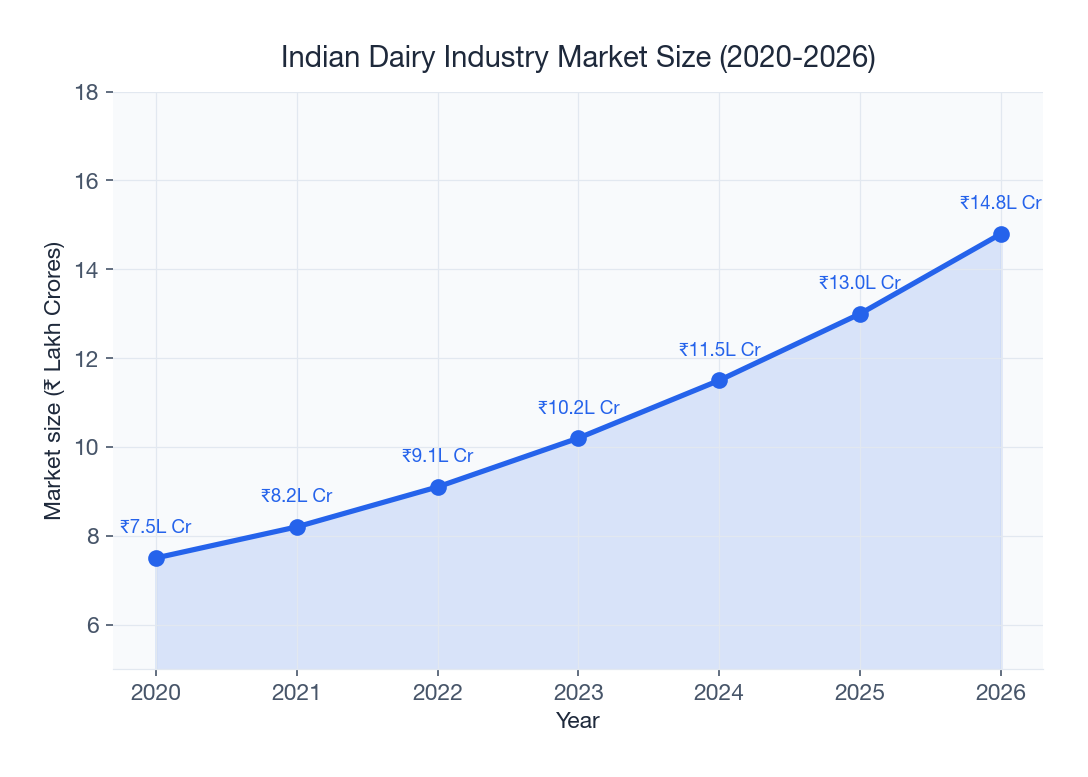
Gujarat is synonymous with India's dairy story. Home to the iconic Amul cooperative, the state produces nearly 14% of the country's milk and hosts the largest dairy cooperative network in the world, the Gujarat Cooperative Milk Marketing Federation (GCMMF). For any dairy operator in India, understanding how Gujarat's dairy supply chain works is a masterclass in scale, organisation and technology adoption.
But Gujarat's dairy story isn't just Amul. Brands like Sumul (Surat), Dudhsagar (Mehsana), Banas (Banaskantha), Valsad and Vasudhara all operate independent cooperative unions that together handle millions of litres daily. Add private players like Mother Dairy, Parag and fast-growing regional startups, and you have one of the most sophisticated and competitive dairy markets in Asia.
Gujarat Dairy Market Snapshot
| Metric | Gujarat | National Avg |
|---|---|---|
| Annual milk production | 1.8 crore tonnes | 52 lakh tonnes (avg state) |
| Cooperative unions | 18 district unions | 3-4 |
| Village-level societies | 18,600+ | 5,500 |
| Farmers linked | 36 lakh | 12 lakh |
| Dominant brand | Amul (~65%) | Regional |
| Key processing cities | Anand, Ahmedabad, Surat, Mehsana | Varies |
| Export contribution | 40% of India's dairy exports | - |
How Gujarat's Dairy Supply Chain Actually Works
1. The Three-Tier Cooperative Model
Gujarat pioneered the three-tier cooperative structure: village-level primary societies collect milk from farmers, district unions process it into finished products, and the state federation markets it through brands like Amul. This structure allowed Gujarat to scale where other states struggled, and it continues to be a case study in operational excellence taught globally.
2. Twice-Daily Collection from 36 Lakh Farmers
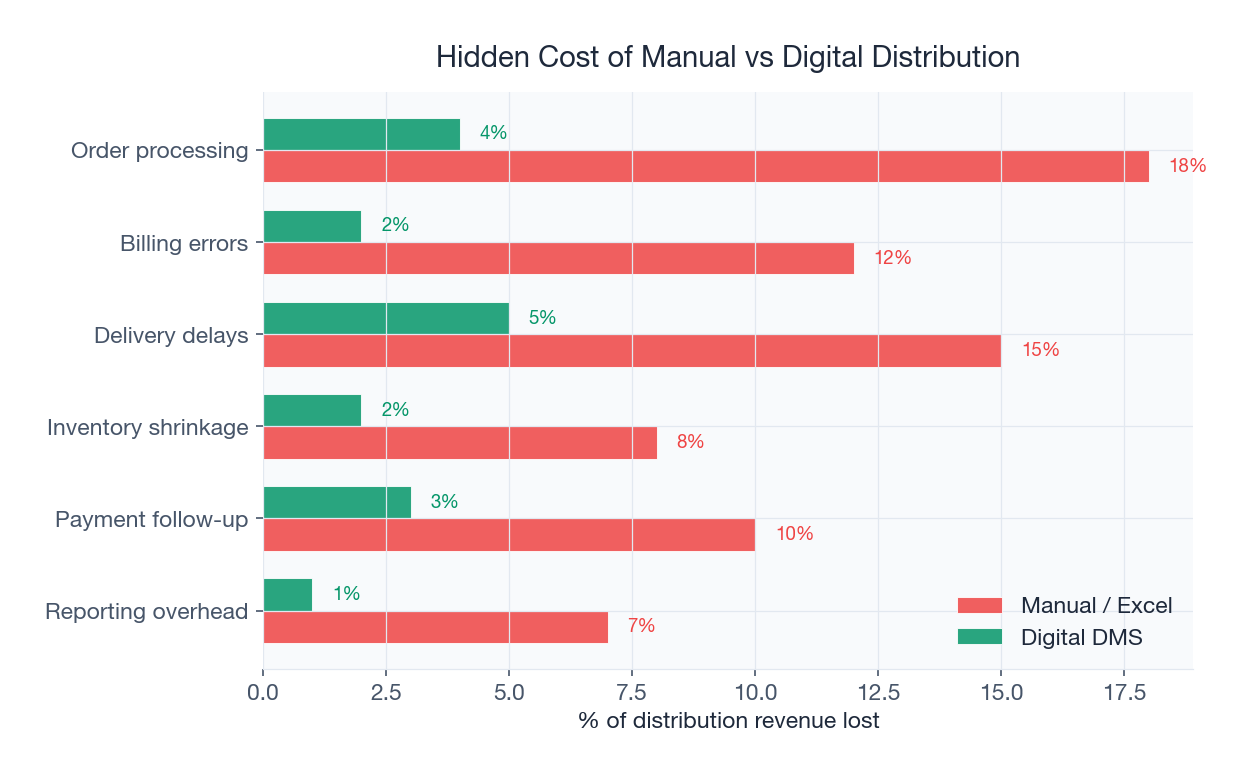
Each morning and evening, milk is collected from 36 lakh farmers across 18,600+ village cooperatives. The volume, perishability and quality variation is staggering. Automated milk collection units (AMCUs), digital fat-testing machines and electronic weighing systems have replaced manual paper registers across the majority of village societies, a transformation enabled by dedicated multi-plant distribution platforms.
3. District Union Processing
Milk flows from villages to district unions where it is chilled, tested, standardised and processed into liquid milk, curd, buttermilk, ghee, butter, cheese, ice cream and powder. Each district union runs multiple plants with complex scheduling. Distribution tracking software gives plant managers visibility into incoming tanker loads, storage utilisation and processing queues in real time.
4. Distribution Across India
From Gujarat's plants, finished products travel to wholesalers, distributors and retailers across India and abroad. The distribution layer alone involves thousands of trucks, refrigerated containers and multi-state routing. Modern dairy distribution platforms coordinate this movement with scheme engines, GST billing and route optimisation built in.
5. Retail Reach and the Amul Parlour Network
Amul alone operates over 10,000 branded parlours and countless distributor-fed kirana outlets. Managing price lists, schemes and MRP compliance across this footprint requires a capable scheme engine that can handle cascading offer structures.
Technology Driving Gujarat's Dairy Edge
Automated Milk Collection
AMCUs with weight, fat and SNF testing automatically credit farmers based on quality. Real-time dashboards show collection volumes by village, allowing supervisors to detect anomalies within hours instead of days.
Cold Chain Orchestration
Gujarat's summers regularly cross 45 degrees C, making cold chain integrity critical. IoT-enabled BMCs (bulk milk coolers) transmit temperature data every 60 seconds, triggering alerts the moment deviations occur. See our cold chain management guide for a deeper dive.
Multi-Plant Production Planning
A union like Banas may run 3-5 plants simultaneously, each producing different SKUs from the same incoming milk pool. Multi-plant distribution software allocates volume dynamically based on demand signals and plant capacity.
GST-Compliant Invoicing at Scale
With exports to 40+ countries and sales across every state, GST compliance at Amul's scale is a technology challenge. Automated invoicing with e-invoice integration handles millions of documents per month without manual intervention.
Sales Analytics at Village Granularity
Amul managers can see performance down to the individual village society or kirana outlet. Sales analytics at this granularity enables targeted interventions, whether it is a procurement push, a scheme rollout or a quality correction.
Distribution Hotspots: Ahmedabad and Surat
Ahmedabad is the state's commercial nerve centre, consuming over 22 lakh litres of milk daily and hosting Gujarat's largest network of FMCG wholesalers. Surat, driven by the textile and diamond industries, is the second-largest consumption hub with unique migrant-population dynamics that cause demand spikes during festive periods. Both cities rely heavily on route optimization and digital order management to serve dense neighbourhoods within tight morning windows.
Lessons for Dairy Operators Across India
- Invest in the village layer. Clean procurement data upstream makes everything downstream easier.
- Standardise technology across unions. Gujarat's shared platforms created network effects that ad-hoc tools can never replicate.
- Measure farmer trust as a KPI. Transparent payment cycles and fat testing are what keeps 36 lakh farmers loyal.
- Scheme management is an art. Gujarat's distributors run dozens of concurrent schemes without compliance failures.
- Cold chain is non-negotiable. In 45 degrees C summers, a single BMC failure can cost lakhs.
Where Gujarat's Dairy Tech Is Heading
Blockchain-based farmer payments, AI-driven fat estimation, drone-based cold chain monitoring and carbon-neutral dairy logistics are all on the roadmap. Operators who want to participate in India's dairy future would do well to study Gujarat's playbook. If you are ready to modernise your own distribution chain, compare leading platforms in our 2026 software rankings, review subscription plans on SpireStock pricing, and book a Gujarat-specific consultation with our cooperative specialists.
A Closer Look at the District Unions
Amul (Kaira District Cooperative Milk Producers' Union)
The flagship and the most famous. Based in Anand, Amul procures from over 8 lakh farmers across 1,200+ villages and processes over 35 lakh litres daily at peak. Its distribution network spans every Indian state and 50+ countries. Amul's scale is the result of five decades of cooperative discipline, branded marketing and relentless technology adoption. For every dairy operator in India, Amul is the benchmark.
Sumul (Surat)
Sumul handles around 22 lakh litres per day and serves the entire South Gujarat belt. Its operations focus heavily on urban Surat with additional plants in Navsari and Valsad. Sumul has invested heavily in cold chain monitoring and automated dispatch systems.
Dudhsagar (Mehsana)
One of Gujarat's oldest district unions, processing around 18 lakh litres daily. Mehsana dairy is known for its premium buffalo milk and cheese production. Dudhsagar's technology investments in recent years have focused on farmer payment transparency and procurement analytics.
Banas (Banaskantha)
Located in Gujarat's semi-arid northern belt, Banas dairy has scaled from a regional player to a major cooperative processing over 25 lakh litres daily. Its success story includes aggressive village-level mobilisation, digital farmer payments and multi-plant operations across Palanpur and Diyodar.
Valsad and Vasudhara (Valsad)
Serving the southern coast of Gujarat and bordering Maharashtra, Valsad and Vasudhara dairies specialise in branded curd, paneer and ethnic South Gujarat dairy products. Their distribution platforms are tightly integrated with Mumbai and Pune markets.
The Amul Brand Architecture and Scheme Discipline
Amul runs dozens of concurrent schemes across SKU categories and channel types. Butter, ghee, ice cream, curd, paneer, cheese, chocolate, UHT milk and flavoured milk each have their own trade structures. Managing this manually would be impossible, Amul's success rests on strong scheme engine automation that calculates eligibility, applies discounts at invoice level, and settles claims within defined cycles. Competing brands that try to match Amul's scheme complexity without equivalent technology end up bleeding margin through calculation errors and leakage.
The Village-Level Digital Revolution
Gujarat's village cooperatives have undergone a quiet technology revolution. AMCUs (Automated Milk Collection Units) equipped with digital fat-testing, weight measurement and SNF analysis now cover over 14,000 villages. Farmers get SMS receipts within minutes of pouring, and payments are credited directly to bank accounts within a single payment cycle. This transparency has dramatically reduced disputes and built the kind of trust that competitors cannot easily replicate.
Export Operations from Gujarat
Gujarat accounts for roughly 40% of India's dairy exports, primarily ghee, butter, milk powder, cheese and Indian-style sweets. Export operations demand multi-currency invoicing, export compliance documentation, cold-chain certification and port-centric logistics. A capable billing platform with export modules handles the compliance layer, freeing operational teams to focus on volume.
Distribution Realities in Rural Gujarat
Outside the major cities, Gujarat's rural distribution spans taluka-level wholesalers and village-level kiranas. Routes here can be 80-120 km with 40-60 drops, a very different beat structure from urban dense routes. Route optimisation in this context prioritises fuel efficiency and multi-drop sequencing over traffic avoidance.
Cooperative Governance and Technology Decisions
Unlike private dairy companies, cooperatives are governed by elected boards representing farmer-members. Technology decisions must balance efficiency with farmer-friendly outcomes, payments, transparency, quality-based pricing and training. Platforms that tick both boxes (operational efficiency plus farmer engagement) win cooperative contracts more often than pure-efficiency tools.
Key KPIs for Gujarat Dairy Operations
| KPI | Average | Top-Quartile |
|---|---|---|
| Farmer payment cycle | 10-14 days | Daily / T+1 |
| Procurement accuracy | 96% | 99.5%+ |
| Plant utilisation | 72% | 88%+ |
| Spoilage rate | 1.5% | Under 0.3% |
| Dispatch on time | 85% | 97%+ |
| Scheme compliance | 82% | 96%+ |
| Export defect rate | 0.8% | Under 0.1% |
Lessons from Gujarat for the Rest of India
- Farmer trust is the ultimate competitive moat. Invest in transparent payment cycles and quality-based pricing.
- Cooperative structures scale brilliantly when backed by technology. The alternative, fragmented private procurement, has failed in most states.
- Brand consistency matters more than product variety. Amul proved that a single strong brand with a curated range beats a sprawling SKU catalogue.
- Automation at every layer beats manual excellence anywhere. Gujarat's edge is not that it works harder, but that its systems are tighter.
- Invest in exports early. Export revenue provides currency hedge, margin cushion and brand credibility.
What Operators Outside Gujarat Can Do
If you run a cooperative or private dairy outside Gujarat, the Gujarat playbook is open to you. Invest in village-level digitisation, adopt multi-plant distribution software, automate your schemes, build a trusted brand and set farmer payment transparency as a non-negotiable KPI. You can benchmark your operation using our 2026 distribution software rankings or talk to our Gujarat-experienced consultants about a phased modernisation plan.
The Amul Model in Action
Amul's operational discipline sets the standard that other Indian dairy operators measure themselves against. Core principles that define the Amul model include: twice-daily milk collection with same-day payment clarity, quality-based pricing transparent to every farmer, multi-plant production flexibility, national distribution via 10,000+ parlours and kirana networks, and aggressive brand investment that keeps Amul top-of-mind across generations.
Replicating this model without Amul's decades of investment requires strong technology foundations. Multi-plant distribution software, analytics dashboards and scheme automation are the tools that let modern cooperatives match Amul's operational sophistication in a fraction of the time.
Gujarat's Export Playbook
Gujarat accounts for 40% of India's dairy exports, but the path to export was not automatic. Key ingredients:
- FSSAI and international export compliance at every plant
- GDP (Good Distribution Practice) for cold chain
- Multi-currency billing and export documentation
- Aggressive brand investment in target markets (Middle East, US, Australia, SE Asia)
- Product innovation for diaspora tastes (ghee, paneer, Indian sweets)
- Tight integration with shipping and port operations
Distributors outside Gujarat can replicate this playbook by adopting similar disciplines around quality, branding and international compliance.
Procurement Technology Evolution
The evolution of milk procurement technology in Gujarat has happened in four waves:
- 1970s-80s: Manual registers, manual fat testing, cash payments
- 1990s-2000s: Electronic weighing, mechanical fat testers, bank transfers
- 2010s: AMCUs, SMS alerts, village-level digital dashboards
- 2020s: Blockchain-based payment records, IoT-enabled quality checks, AI-driven fraud detection
Each wave has improved farmer trust, reduced disputes and enabled procurement growth. Operators outside Gujarat who skip straight to the latest wave can leapfrog decades of incremental progress.
Lessons Beyond Gujarat
The biggest lesson from Gujarat is that distribution excellence is the result of disciplined technology investment combined with deep cooperative trust. Neither alone is enough. Dairy operators in Karnataka, Maharashtra, Andhra Pradesh and Punjab have studied the Gujarat playbook and now run increasingly sophisticated operations of their own. The next decade will see similar excellence emerge across North India as cooperatives there adopt modern DMS platforms.
Women's Cooperatives and Empowerment
One of the quietest but most impactful aspects of Gujarat's dairy revolution has been the rise of women's cooperatives. Several district unions now have active women's empowerment programmes, training female farmers on cattle care, quality standards and financial literacy. Transparent digital payment systems have been particularly important because they give women direct access to their earnings without intermediary gatekeepers. This has lifted household incomes, children's education outcomes and rural women's agency across thousands of villages.
Emerging Innovations at the Village Level
Village cooperatives in Gujarat are now piloting the next wave of technology: solar-powered BMCs that operate without grid electricity, mobile quality-testing apps that let farmers verify fat content in real time, blockchain-based payment ledgers that create immutable payment records, and AI-powered fraud detection that flags suspicious milk collection patterns. These innovations, backed by Gujarat's mature cooperative infrastructure, are setting benchmarks that other states will spend the next decade catching up to.
Sources & References
Frequently Asked Questions
Gujarat produces over 160 lakh tonnes of milk annually, making it India's largest milk-producing state. The state's dairy sector is valued at over Rs 1 lakh crore and employs millions through the cooperative structure.
GCMMF (Amul) uses a three-tier cooperative structure for procurement and a network of 10,000+ distributors and millions of retail outlets for distribution. While procurement is highly systematized, the distribution side is increasingly adopting digital tools for order management, tracking, and analytics.
Yes. Modern platforms support multi-tier operations where village-level collection, district union processing, and distributor-level sales each have appropriate visibility and controls. SpireStock can be configured for cooperative hierarchies.
Gujarat's extreme summer temperatures (45°C+) create significant cold chain challenges. Dairy spoilage rates can double during March-June. Temperature-monitored distribution with real-time alerts and cold chain analytics helps maintain product quality throughout the supply chain.
Absolutely. Cloud-based platforms like SpireStock eliminate the need for heavy IT investment. Even a small dairy with 20-50 distributors can see ROI within 3-4 months through reduced crate losses, faster billing, and better delivery efficiency.
Related SpireStock Features
Real-time GPS tracking of vehicles and drivers with route optimization for faster deliveries.
End-to-end order lifecycle from placement to delivery with multi-level approval workflows.
Powerful dashboards with sales trends, MIS reports, and distribution analytics.
Related Solutions
Manage your entire distributor network digitally. Onboarding, credit limits, outstanding tracking, and performance analytics. Start free trial.
Manage distribution across multiple production units and plants. Centralized control with plant-level autonomy for dairy and FMCG brands.
Related Entities
Ready to Streamline Your Distribution?
Start your free 14-day trial and see how SpireStock can transform your dairy, FMCG or consumer-goods distribution operation, from order capture to crate recovery.

SpireStock Team
Distribution Technology Experts
SpireStock Team writes for SpireStock on distribution management, supply-chain optimisation and field operations for Indian dairy and FMCG brands.