The Field Force Productivity Challenge in Dairy Sales
Dairy companies deploy field sales teams to manage distributor relationships, acquire new outlets, ensure product visibility, and drive secondary sales. But without visibility into what these teams actually do in the field, companies are essentially flying blind, paying salaries and travel allowances with little objective data on productivity and effectiveness. For a Rs 150-crore regional dairy with 35 field officers, that is Rs 2-3 crore of annual field investment with almost no way to measure whether it is delivering value. In dairy distribution, that blind spot is no longer acceptable because the competitive pressure has outpaced the tolerance for opaque field operations.
Studies show that the average FMCG sales representative spends only 35-40% of their field time on productive activities, customer visits, order taking, problem-solving. The rest is consumed by travel, waiting, administrative tasks, and unproductive downtime. Field force tracking technology can shift this ratio dramatically, and the same lesson applies across FMCG distribution, beverage distribution, and consumer goods operators running structured field teams. The 40% productive-time baseline is the industry average; best-in-class operators push this above 60% with disciplined tracking and coaching.
What Field Force Tracking Covers
Attendance and Location Tracking
SpireStock's attendance tracking uses GPS-based check-in to verify that field staff are where they should be. Morning mark-in, distributor visit check-ins, and end-of-day check-out create a transparent activity record that respects privacy while ensuring accountability. Unlike older biometric punch systems tied to a fixed office, GPS-based tracking works wherever your team needs to be, which for a dairy field officer is rarely the office.
Visit and Activity Logging
Each distributor or retail visit is logged with location, time spent, activities performed (order taken, payment collected, issue resolved, merchandising check), and outcomes. This structured data replaces vague "I visited 10 distributors today" reports with verifiable facts that managers can actually use for coaching conversations and performance evaluations.
Route Adherence Monitoring
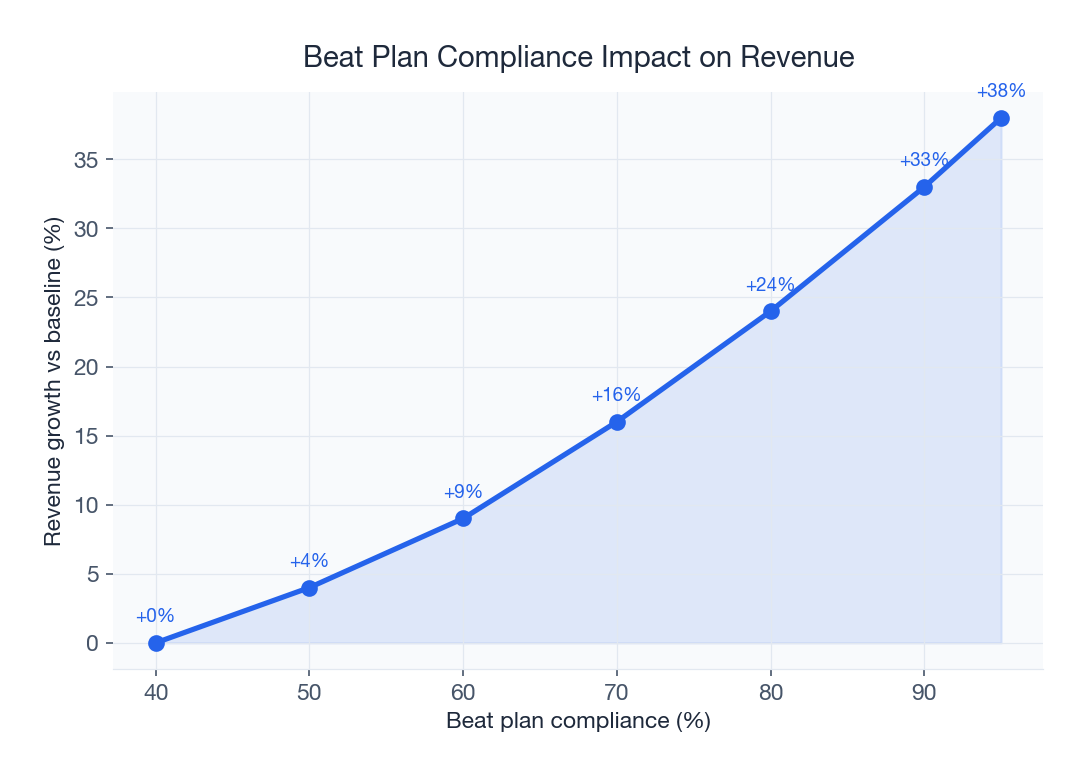
Field staff are assigned daily beat plans, a sequence of distributors and retailers to visit. The tracking system monitors adherence to the planned route, flagging deviations and missed visits. Combined with route optimization, this ensures optimal use of field time and exposes the small-but-significant percentage of visits that never actually happened despite being claimed.
Real-Time Field Communication
When field staff encounter issues, a distributor complaint, a competitor threat, or a stock-out situation, they can report it instantly through the app. This real-time communication enables faster responses than waiting for the end-of-day report or a chance phone call. A field officer who flags a competitor scheme this morning means your regional manager can design a response by afternoon.
Order and Payment Capture
Field officers can take orders from retailers and collect payments directly through the mobile app, flowing straight into order management and invoicing without any paper trail. The productivity impact here alone typically justifies the tracking investment within a quarter.
Productivity Impact Data
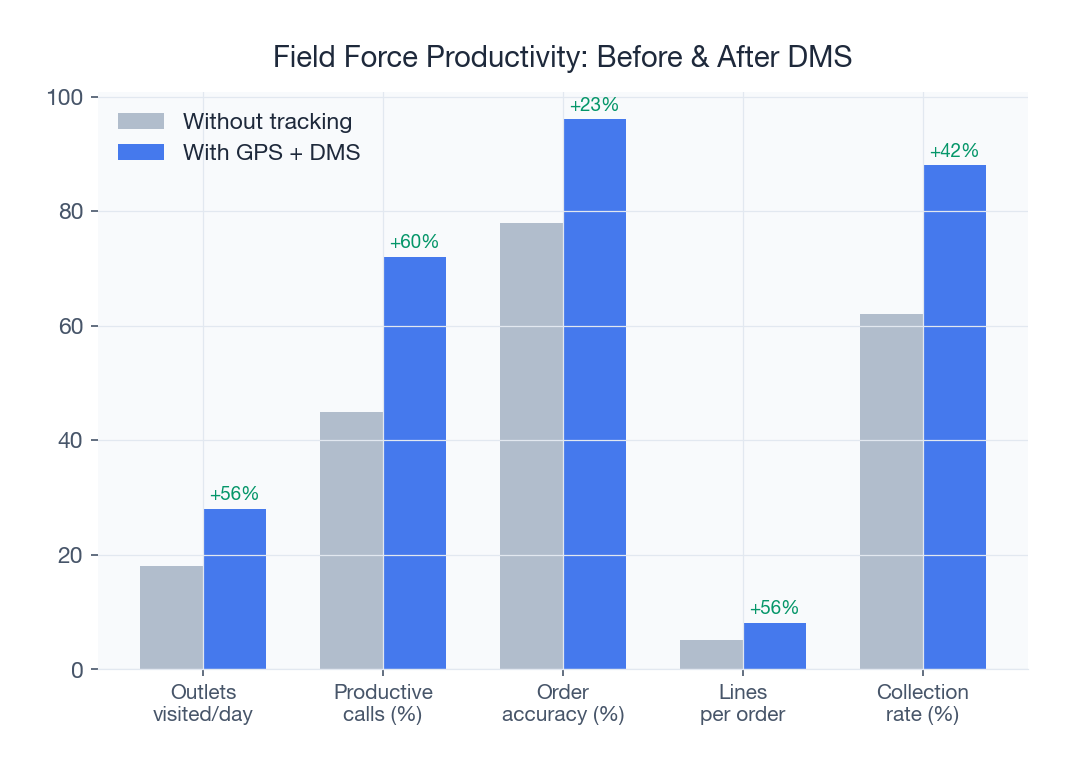
| Metric | Before Tracking | After Tracking | Improvement |
|---|---|---|---|
| Productive field time | 36% | 58% | +22 pts |
| Visits per day per rep | 8.2 | 11.6 | +41% |
| Order capture rate | 44% | 71% | +27 pts |
| Same-day payment collection | 22% | 59% | +37 pts |
| Beat plan adherence | 61% | 92% | +31 pts |
| New outlet activation | 3.1/month | 5.8/month | +87% |
These are median numbers from SpireStock deployments across 2024-2025. Individual results vary, but the direction and magnitude are remarkably consistent across company sizes and geographies.
Benefits of Field Force Tracking in Dairy Sales
- 40% productivity improvement, more productive time per day through reduced inefficiency and clearer accountability
- 30% more visits per day, optimized beat plans and reduced unproductive time enable more customer touchpoints
- Better market intelligence, structured visit reports provide consistent, comparable data across territories
- Objective performance evaluation, data-driven assessments replace subjective manager impressions
- Faster issue resolution, real-time reporting of distributor issues enables same-day resolution
- Lower attrition in top performers, objective data protects high performers from unfair evaluation
- Faster onboarding, new hires see the full playbook and ramp up 30-50% faster
Building an Effective Field Tracking System
Design Beat Plans Thoughtfully
Beat plans should balance coverage (visiting all distributors regularly) with depth (spending enough time at each stop for meaningful engagement). Typically, field staff should visit 8-12 distributors per day in urban areas like Bangalore and Mumbai, and 5-8 in semi-urban territories. Pair this with clear sales productivity targets per visit, not just visit counts. Quality matters more than quantity.
Focus on Outcomes, Not Just Activities
Tracking visits is important, but what matters is results, orders placed, payments collected, issues resolved, new outlets activated. Ensure your system captures both activities and outcomes so managers can connect effort to results. A visit with no order and no outcome is less valuable than a 10-minute visit that resulted in a Rs 40,000 order and three new SKU placements.
Integrate with Distribution Data
Field tracking becomes most powerful when linked to order management and sales analytics. Managers can see not just where their team visited, but what business resulted from those visits, connecting field effort to revenue impact in ways that static attendance systems never could. The most valuable insight usually comes from correlating visit frequency to distributor growth rates.
Respect Privacy and Build Trust
Field tracking should enhance accountability, not create a surveillance culture. Be transparent about what is tracked and why. Use data for coaching and support, not just policing. Share performance insights with the field team so they can self-improve, top performers in particular appreciate objective data that vindicates their hard work.
Technology Considerations for Indian Conditions
For Indian dairy distribution specifically, your field tracking solution must support:
- Offline operation, capture data even in areas without connectivity, common in semi-urban markets like parts of Jaipur and tier-2 cities
- Battery efficiency, GPS tracking should not drain phones by midday, which is a common complaint with poorly engineered apps
- Low-end device support, field staff may use budget smartphones in the Rs 7,000-15,000 range with limited RAM
- Simple interface, minimal taps for common actions like visit check-in and order capture
- Multi-language support, Hindi, Tamil, Kannada, Marathi, and Telugu coverage for pan-India teams
Common Implementation Pitfalls
Companies that struggle with field tracking rollouts usually make one of three mistakes. First, they treat it as a policing tool rather than a productivity tool, which guarantees field resistance. Second, they fail to train managers on how to actually use the data for coaching, the app captures rich insight but nobody turns it into action. Third, they expect immediate results; real behaviour change takes 60-90 days of consistent reinforcement before it becomes self-sustaining.
Companies that avoid these pitfalls see adoption above 85% within eight weeks and measurable productivity gains by week 12. Brands like Mother Dairy and several regional players have refined these playbooks over years, and the lessons are widely applicable, even to companies many times smaller than the original adopters.
Coaching Culture: Where the Real Value Lives
The biggest misconception about field tracking is that the value is in the dashboard. The actual value is in what managers do with the data every week during one-on-ones with their team. A top performer's data reveals their patterns; a struggling rep's data reveals exactly where intervention is needed. Managers who run structured weekly coaching conversations using the tracking data typically lift team productivity 15-20% beyond the tool's baseline impact, an additional gain on top of the 40% most deployments deliver.
Leading dairy distribution companies are using field force tracking not just for monitoring, but as a coaching tool that helps sales teams become more effective every day. The data reveals opportunities, which distributors need more attention, where competitor activity is increasing, and which areas have untapped potential for the broader FMCG distribution network. For related reading, see our guides on dairy sales tracking apps and route optimization for milk delivery.
Ready to Unlock Field Productivity?
Talk to our team about deploying SpireStock's field force tracking across your sales organization, review SpireStock pricing for transparent per-user plans, or book a demo to see the mobile app and coaching dashboard live against your territory structure. The first week of rollout typically surfaces enough insight to justify the entire annual investment.
Frequently Asked Questions About Field Tracking
How do I handle field team resistance in the first few weeks? Start with volunteers and top performers. Make the early wins visible. Do not punish people for learning-curve mistakes. Within three weeks, most field teams shift from resistance to engagement as they see how the app simplifies their daily work.
What if drivers deliberately leave their phones in the office? This is rare but does happen. Build in a check that flags any visit logged without a GPS coordinate. Make the first offence a coaching conversation, the second a formal warning, and the third a termination consideration. Consistency is what makes the policy credible.
How do I handle tracking during field emergencies or personal calls? The app should support a pause or break mode that stops tracking temporarily but logs the break. This respects privacy while maintaining data integrity for the actual work hours.
Integration With HR and Payroll
Advanced deployments integrate field attendance data directly with HR and payroll systems, so overtime, travel allowance, and incentive calculations happen automatically based on verified field activity. This saves HR teams hours of manual data entry every month and eliminates the disputes over "how many visits did I actually do" that consume energy during every payroll cycle. When combined with sales productivity metrics, it creates a complete performance picture that drives both fair compensation and objective development decisions.
Beyond Dairy: Applicability Across Verticals
The field force tracking playbook translates directly to fresh produce distribution, beverage distribution, and any other category with daily order cycles and structured field teams. The specific KPIs vary slightly (for example, temperature compliance matters more for ice cream than for biscuits), but the core tracking discipline and coaching culture transfer intact. A Rs 95-crore juice brand in Pune deployed the same tracking infrastructure SpireStock uses for dairy and saw nearly identical productivity gains within 12 weeks.
Building a High-Performance Field Culture
Field tracking software provides the data, but culture is what turns data into results. A high-performance field culture has four elements. First: clear expectations, documented in writing and reviewed regularly. Second: transparent measurement, with every team member able to see where they stand. Third: structured coaching, with weekly one-on-ones and monthly deep-dive reviews. Fourth: fair rewards, where top performers are recognized publicly and compensated materially better than middle performers. Companies that invest in all four dimensions see sustained productivity gains that compound year after year.
Contrast that with companies that only implement the software and then wonder why nothing changes. The software is necessary but not sufficient. It is the cultural practices around the data that actually lift performance.
Training and Onboarding New Field Staff
One of the underrated benefits of field tracking is dramatically faster onboarding for new field staff. A new recruit joining a Chennai territory can see the full beat plan, previous visit notes, distributor-specific scheme history, and outstanding issues, all in the mobile app on day one. This transparency cuts onboarding time from 4-6 weeks to 10-14 days and reduces the mistakes new hires typically make when learning territories blind. For companies hiring 20-50 new field officers per year, this alone saves weeks of wasted productivity.
Long-Term Strategic Benefits
The strategic value of field force tracking goes beyond daily productivity. Over time, the data becomes a source of market intelligence that competitors lack: which retailers are opening and closing, which neighborhoods are experiencing demographic shifts, which distributors are growing and which are stagnating. This long-horizon visibility is how brands build durable competitive advantages that last decades. The data is there whether you analyze it or not; the companies that do analyze it pull away from the pack.
One Final Thought
Field force tracking is one of those rare investments that pays for itself multiple times over in the first year and then keeps delivering value for years afterward. The infrastructure, once built, becomes the foundation for nearly every field-focused initiative your company will launch, new product introductions, loyalty programs, promotional campaigns, and competitive response. Companies that have this foundation in place move dramatically faster than companies that do not, and the gap widens every quarter. Make the investment, commit to the coaching culture, and trust the process.
Sources & References
Frequently Asked Questions
Field force tracking uses GPS and mobile technology to monitor sales team activities in the field, including attendance, distributor visits, route adherence, order taking, payment collection, and issue reporting, providing real-time visibility into field operations.
When implemented correctly, field tracking monitors work-related activities during working hours only. Location tracking activates at check-in and deactivates at check-out. Transparent communication about what's tracked and how data is used builds trust and acceptance.
Companies typically see a 30-40% improvement in productive field time after implementing tracking. This comes from better route planning (less travel time), accountability (less unproductive downtime), and data-driven coaching (better skill development).
Yes, SpireStock's mobile app captures all field data offline, visit check-ins, orders, photos, and notes. Data syncs automatically when internet connectivity is available, ensuring no information is lost in connectivity-challenged areas.
Key reports include: daily activity summaries, beat plan adherence, visit frequency by distributor, time-at-location analysis, order value per visit, coverage analytics, and individual/team productivity comparisons.
Lead with benefits for the team, less paperwork, easier order capture, transparent incentive tracking. Provide proper training, start with supportive coaching rather than punitive monitoring, and recognize top performers based on data. Most teams adopt willingly within 2-3 weeks.
Yes, the same tracking infrastructure can monitor both sales staff and delivery teams, with role-specific features for each. Delivery tracking includes route adherence, delivery confirmations, and crate transactions in addition to location monitoring.
Beat plans are configured in the system, each day of the week has a defined set of distributors/retailers to visit. The plan can be fixed (same every week) or dynamic (adjusted based on visit frequency rules, pending issues, or order patterns). Field staff see their daily plan on the app.
Related SpireStock Features
Related Solutions
Boost field sales team productivity with beat planning, GPS attendance, order capture, and performance analytics. Built for Indian FMCG teams.
Track and manage your retail network. Geo-tag outlets, capture secondary sales, manage beats, and monitor retailer performance. Try SpireStock.
Related Entities
Ready to Streamline Your Distribution?
Start your free 14-day trial and see how SpireStock can transform your dairy, FMCG or consumer-goods distribution operation, from order capture to crate recovery.

SpireStock Team
Product & Industry Insights
SpireStock Team leads product at SpireStock, where the team ships distribution management software for India's dairy, FMCG and consumer-goods brands.