The GST Complexity Unique to Dairy Distribution
Dairy is one of the most GST-complex product categories in Indian distribution. Unlike most FMCG segments where products fall into one or two tax slabs, dairy products span the entire GST rate spectrum, from 0% on fresh unbranded milk to 18% on flavoured milk drinks. A single invoice from a dairy distributor to a retailer might contain items at four different tax rates, each with a different HSN code. According to the CBIC's GST rate schedule (updated via the 52nd GST Council meeting recommendations), this multi-rate structure creates a compliance challenge that generic billing software, and certainly manual invoicing, cannot handle reliably.
This guide is a practical reference for dairy distributors who need to get GST right on every invoice and keep their Tally books in sync with their order management system. We'll cover the exact GST rates, HSN codes, Tally integration formats, reconciliation workflows, and the most common errors that trigger GST notices.
GST Rates on Dairy Products: The Complete Reference
| Product | HSN Code | GST Rate | Key Condition |
|---|---|---|---|
| Fresh milk (unbranded, loose) | 0401 | 0% | Not put up in unit containers; no registered brand |
| Pasteurised milk (branded, packaged) | 0401 | 5% | Pre-packaged and labelled as per Legal Metrology Act |
| Curd / Dahi (unbranded, loose) | 0403 | 0% | Not pre-packaged |
| Curd / Dahi (branded, packaged) | 0403 | 5% | Pre-packaged and labelled |
| Lassi (unbranded) | 0403 | 0% | Not pre-packaged |
| Lassi (branded, packaged) | 0403 | 5% | Pre-packaged and labelled |
| Paneer (unbranded, loose) | 0406 | 0% | Not pre-packaged |
| Paneer (branded, packaged) | 0406 | 5% | Pre-packaged and labelled |
| Butter | 0405 | 5% | All forms (branded/unbranded) effective post-GST Council revision |
| Cheese | 0406 | 12% | Processed cheese, cheese spread, and similar products |
| Ghee | 0405 | 12% | All forms including vanaspati |
| Flavoured milk | 0402 | 18% | Contains added sugar, flavouring, or other ingredients |
| Ice cream | 2105 | 18% | All varieties including kulfi |
| Milk powder / condensed milk | 0402 | 5% | Including skimmed and whole milk powder |
| Whey | 0404 | 5% | Concentrated or sweetened whey |
Critical note on the branded vs unbranded distinction: The 47th GST Council meeting (June 2022) introduced a landmark change, GST of 5% now applies to pre-packaged and labelled dairy products (curd, lassi, paneer, buttermilk) that were previously exempt. "Pre-packaged and labelled" means packaged in unit containers as required under the Legal Metrology Act, 2009, with a registered brand or a brand on which an actionable claim is available. This distinction catches many dairy distributors off-guard, especially those who sell both loose and packaged variants of the same product.
HSN Code Structure for Dairy (Chapter 04)
Chapter 04 of the Harmonised System of Nomenclature covers dairy products, eggs, and honey. For dairy distributors, the relevant sub-headings are:
- 0401: Milk and cream, not concentrated or sweetened (fresh milk, pasteurised milk, toned milk, double-toned milk)
- 0402: Milk and cream, concentrated or sweetened (milk powder, condensed milk, flavoured milk, UHT milk)
- 0403: Buttermilk, curdled milk, yoghurt, kephir (curd, dahi, lassi, chaas, yoghurt)
- 0404: Whey and products consisting of natural milk constituents
- 0405: Butter and other fats derived from milk (butter, ghee, dairy spreads)
- 0406: Cheese, paneer, and chhena
Your distribution software's product master must map every SKU to the correct 4-digit (or 8-digit for export invoices) HSN code. Incorrect HSN mapping is one of the top reasons for GST notice issuance, the CBEC's ACES portal flags HSN-rate mismatches automatically during return processing.
Tally Integration: Import/Export Formats
Tally Prime (and Tally ERP 9) remains the dominant accounting software for Indian distributors, with an estimated 70%+ market share in the SME segment (Tally Solutions, 2024). Integrating your dairy DMS with Tally eliminates double data entry, reduces errors, and ensures your books always match your operational data.
Export Formats from DMS to Tally
The standard integration approach uses Tally's XML import capability. Your DMS exports the following data in Tally-compatible XML format:
- Sales vouchers: Invoice number, date, party name, product details with HSN, quantity, rate, GST breakup (CGST/SGST for intra-state, IGST for inter-state), invoice total
- Receipt vouchers: Payment collections mapped to outstanding invoices, payment mode (cash/cheque/UPI/NEFT), bank details
- Credit notes: Returns and adjustments with original invoice reference, reason codes, and correct GST reversal
- Debit notes: Rate differences, additional charges, and scheme adjustments
- Journal vouchers: Scheme accruals, discount provisions, and period-end adjustments
Import from Tally to DMS
Bidirectional sync also pulls data from Tally back into the DMS:
- Payment confirmations: Cheque clearances and bank reconciliation status
- Opening balances: Party-wise outstanding amounts at the start of each period
- Ledger master updates: New parties, address changes, GSTIN updates
SpireStock supports direct Tally integration via XML import/export and also offers a Tally-connected module that syncs data automatically at configurable intervals (hourly, daily, or real-time). See our billing and invoicing feature for more details on the integration architecture.
Reconciliation Workflow: DMS to Tally to GST Portal
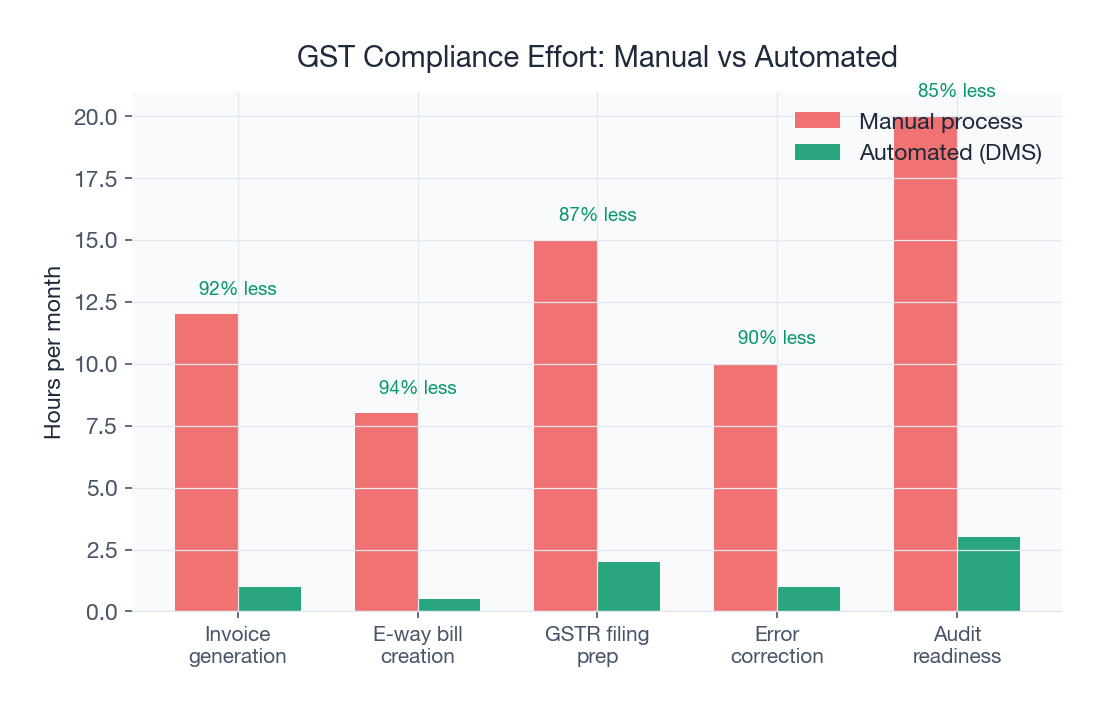
Reconciliation is where most dairy distributors struggle. The three-way match, DMS invoices vs Tally books vs GST portal (GSTR-1/GSTR-2A), must be perfect to avoid ITC mismatches and GST notices.
- Daily: Verify DMS invoice count matches Tally sales voucher count. Flag discrepancies immediately.
- Weekly: Reconcile invoice values, DMS total sales vs Tally total sales vs GSTR-1 uploaded amount. Investigate any variance above Rs 500.
- Monthly (before GSTR-1 filing): Full HSN-wise reconciliation. Ensure every HSN code's total taxable value and tax amount match across DMS, Tally, and the GST portal. This is where rate-related errors surface, e.g., paneer invoiced at 0% in DMS but the branded variant should be 5%.
- Quarterly: GSTR-2A/2B reconciliation, match your purchase invoices (from your suppliers) against what they've reported. Claim ITC only for matched invoices.
- Annually: Full audit reconciliation for GSTR-9 annual return. DMS, Tally, and GST portal must all agree down to the rupee.
Common GST Errors in Dairy Distribution
| Error | Root Cause | Consequence | Prevention |
|---|---|---|---|
| 0% applied to branded packaged curd | Product master not updated post-47th GST Council | Under-reporting of tax; GST notice | Audit product master for branded/unbranded flag |
| 12% applied to butter (should be 5%) | Confusion between butter (0405, 5%) and ghee (0405, 12%) | Over-collection; retailer disputes | HSN-linked rate master; lock manual rate override |
| IGST charged on intra-state supply | Wrong state code in buyer master | Tax credited to wrong head; refund required | GSTIN validation auto-populates state code |
| HSN 0406 used for butter | Manual HSN entry error | HSN mismatch in GSTR-1; notice | Product-HSN mapping locked in DMS |
| Credit note without original invoice ref | Manual credit note process | ITC reversal fails; buyer penalised | DMS enforces original invoice linkage |
| Flavoured milk at 5% instead of 18% | Classified as "milk" rather than "beverage" | Significant under-reporting; SCN risk | Separate HSN 0402 category for flavoured variants |
Setting Up Tally Integration: Step-by-Step
- Map your ledger structure: Create corresponding ledger groups in Tally for sales, purchases, expenses, and party accounts that mirror your DMS structure
- Configure GST details in Tally: Set up GST registration, state, and compliance settings. Enable e-invoicing if applicable
- Map product masters: Ensure every product in your DMS maps to a stock item in Tally with correct HSN, unit of measure, and GST rate
- Map party masters: Sync retailer accounts between DMS and Tally, GSTIN, billing address, state code, credit terms
- Test with historical data: Import one month of past invoices from DMS into Tally. Reconcile totals. Fix mapping errors
- Go live with daily sync: Configure automated XML export from DMS and import into Tally on a daily schedule
- Validate GSTR-1 output: Compare DMS-generated GSTR-1 data with Tally's GST reports. They must match
Beyond Tally: Other Accounting Integrations
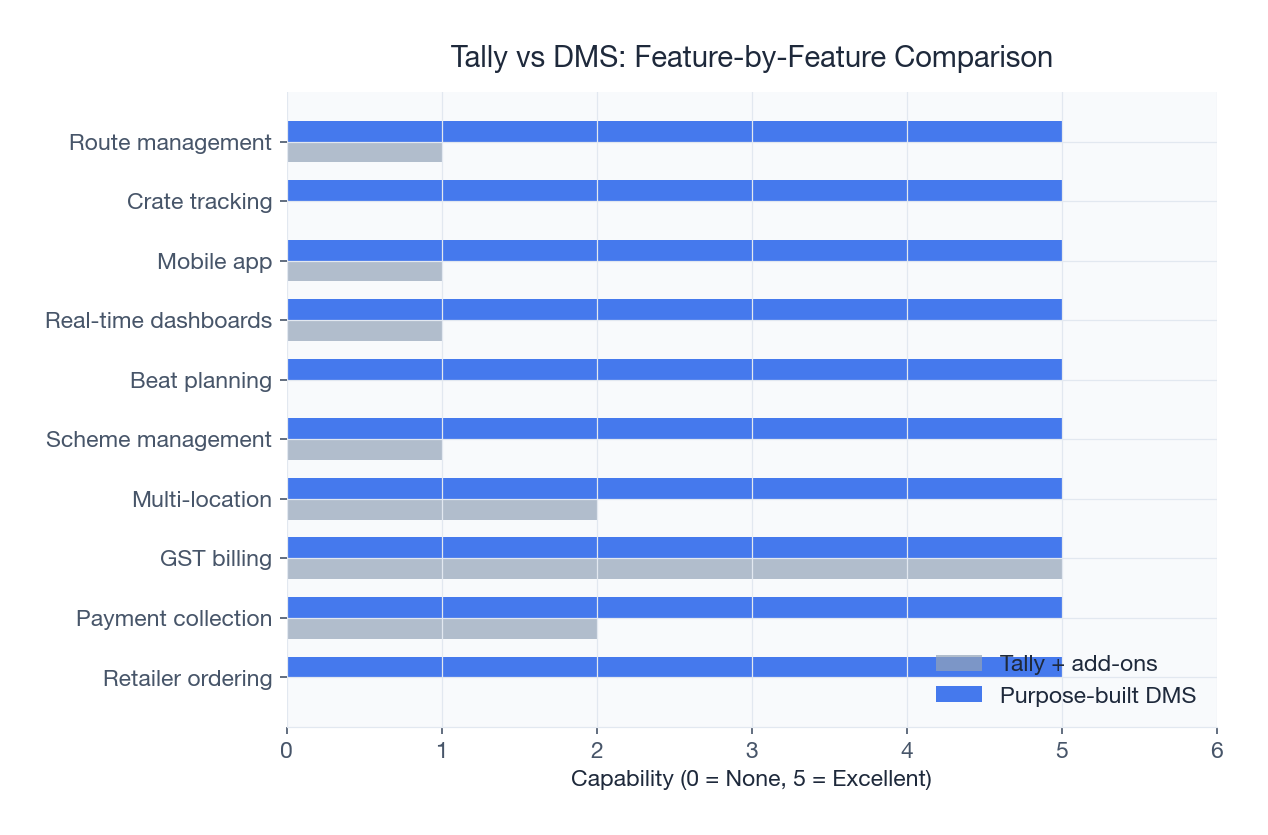
While Tally dominates, some dairy distributors use alternative accounting platforms. SpireStock also supports integration with Busy Accounting (popular in North India), MARG ERP (common in pharmaceutical and FMCG distribution), SAP Business One (for larger enterprises), and Zoho Books (for cloud-first businesses). The integration approach is similar, XML or API-based bidirectional sync. Read our SpireStock vs Tally comparison for a detailed analysis of where each platform fits.
Conclusion
Dairy distribution's multi-rate GST structure makes accurate billing a daily challenge. The combination of branded vs unbranded distinctions, six HSN code groups, four tax slabs, and the e-invoicing mandate creates a compliance surface that manual processes cannot reliably cover. Purpose-built dairy distribution software with GST integration eliminates rate errors, automates Tally synchronization, and keeps your books audit-ready at all times. If you're currently entering dairy invoices manually or fighting reconciliation mismatches monthly, schedule a demo to see how automated GST and Tally integration works in practice.
This guide covers one part of the picture. For the category as a whole — what a DMS does, the modules that matter, how it differs from ERP and SFA, and what it costs in India — see our distributor management system guide.
Sources & References
- GST Council, Goods and Services Tax Council
- NDDB, National Dairy Development Board
- FSSAI, Food Safety and Standards Authority of India
Frequently Asked Questions
Fresh, unbranded, loose milk is GST-exempt (0%). Pre-packaged and labelled (branded) milk attracts 5% GST under HSN 0401. Flavoured milk falls under HSN 0402 and is taxed at 18% GST. Milk powder and condensed milk attract 5% under HSN 0402.
Unbranded loose paneer and curd are GST-exempt (0%). Pre-packaged branded paneer (HSN 0406) and curd (HSN 0403) attract 5% GST. Butter (HSN 0405) is taxed at 5%. Ghee (HSN 0405) attracts 12% GST. Cheese (HSN 0406) is taxed at 12%.
Dairy products fall under Chapter 04 of the HSN classification: 0401 (fresh milk, cream), 0402 (milk powder, condensed milk, flavoured milk), 0403 (curd, yoghurt, buttermilk, lassi), 0404 (whey), 0405 (butter, ghee), and 0406 (cheese, paneer, chhena).
Integration typically uses Tally's XML import/export capability. The DMS exports sales vouchers, receipt vouchers, credit notes, and journal vouchers in Tally-compatible XML format. Tally exports payment confirmations and opening balances back to the DMS. Some platforms offer real-time API-based sync.
Dairy products span four GST slabs (0%, 5%, 12%, 18%) and six HSN groups, far more complex than most FMCG categories. The branded vs unbranded distinction (introduced in the 47th GST Council meeting) adds another layer of complexity. A single mixed-product dairy invoice can contain items at every rate, making manual compliance error-prone.
Related SpireStock Features
Related Solutions
Track distributor and retailer payments. Cash, UPI, cheque collection with reconciliation, ageing reports, and credit limit management.
Manage your entire distributor network digitally. Onboarding, credit limits, outstanding tracking, and performance analytics. Start free trial.
Related Entities
Ready to Streamline Your Distribution?
Start your free 14-day trial and see how SpireStock can transform your dairy, FMCG or consumer-goods distribution operation, from order capture to crate recovery.

SpireStock Team
Distribution Technology Experts
SpireStock Team writes for SpireStock on distribution management, supply-chain optimisation and field operations for Indian dairy and FMCG brands.