The Free Software Temptation
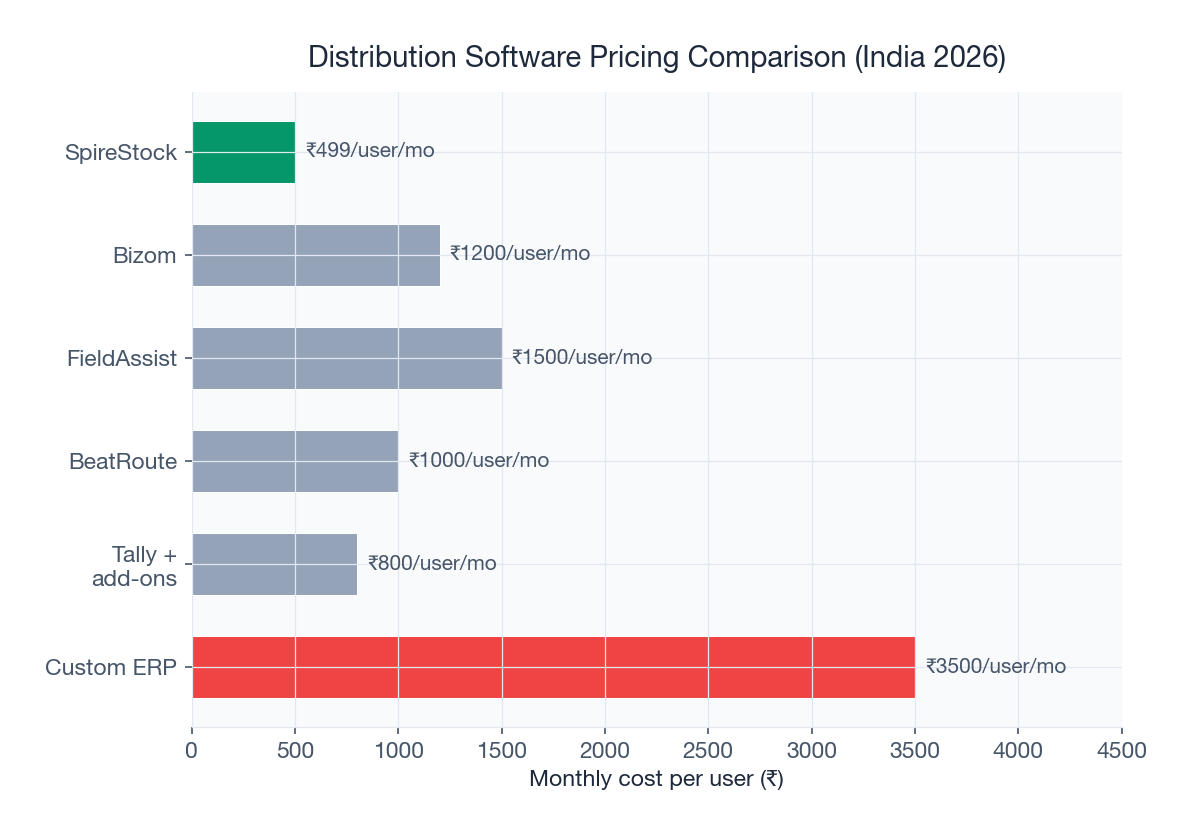
Every Indian distributor has asked the question: “Do I really need to pay for distribution management software?” It is a fair question. When your margins are tight and cash flow unpredictable, spending Rs 2,000–5,000 per user per month on software feels like a luxury. Especially when Tally Free Edition, Google Sheets, and WhatsApp seem to get the job done.
The truth is nuanced. Free tools genuinely work for some businesses, and pushing a small distributor toward expensive software they do not need is irresponsible advice. But free tools also have clear breaking points, and ignoring those breaking points costs businesses far more than a paid subscription ever would. This guide draws the honest line between where free is enough and where paid becomes essential.
India’s distribution landscape serves over 12 million retail outlets, according to data from the India Brand Equity Foundation (IBEF). The complexity of managing even a fraction of this network increases exponentially with scale, and the tools you use must scale with you.
What Free Tools Actually Offer
Google Sheets / Excel
The most common “DMS” in India is a collection of spreadsheets. Product catalogs in one sheet, retailer lists in another, daily orders in a third, and outstanding payments in a fourth. It is free, flexible, and familiar. For a distributor managing 20–30 retailers with one delivery vehicle, spreadsheets are functional.
The problems emerge at scale: version conflicts when multiple people edit simultaneously, no mobile-friendly order capture, no automation, no GPS tracking, and no integration with billing. When your field team is copying order data from WhatsApp messages into Google Sheets and then re-entering it into Tally for invoicing, you are paying for the “free” tool with wasted human hours.
Tally Free Edition (TallyPrime Free)
TallyPrime Free allows single-company accounting with basic inventory management. It handles GST-compliant invoicing, stock tracking, and financial reporting. For pure accounting needs, it is excellent. The limitation is that Tally Free is restricted to one company, single-user access, and does not include advanced inventory or distribution features.
WhatsApp-Based Ordering
WhatsApp has become India’s de facto business communication tool. Many distributors take orders via WhatsApp messages and groups. It is free and requires zero training. But WhatsApp is a messaging app, not an order management system. There is no structured data capture, no automated billing, no inventory linkage, and no analytics. Processing 50+ daily orders from WhatsApp messages is a full-time job.
Basic Inventory Apps
The Google Play Store has dozens of free inventory management apps. Most offer basic stock-in/stock-out tracking and simple reporting. They work for tracking inventory in a single warehouse but lack multi-location support, delivery management, and integration with billing systems.
Feature Matrix: Free vs Paid
| Feature | Google Sheets | Tally Free | Paid DMS (Mid-Range) | |
|---|---|---|---|---|
| Cost | Rs 0 | Rs 0 | Rs 0 | Rs 2,000–5,000/user/mo |
| Order management | Manual entry | Basic | Unstructured | Automated with templates |
| Mobile app for field staff | Sheets app (limited) | No | Yes (messaging only) | Full-featured with offline |
| GPS tracking | No | No | Location sharing (manual) | Automatic with geo-fencing |
| GST invoicing | Manual formulas | Yes (single company) | No | Automated multi-rate GST |
| E-invoicing compliance | No | Yes (paid version only) | No | Yes (auto-generated) |
| Route optimization | No | No | No | AI-powered |
| Scheme management | Manual calculation | Basic | No | Automated multi-scheme |
| Beat planning | Manual | No | No | Automated with GPS adherence |
| Crate tracking | Manual (error-prone) | No | No | Full lifecycle tracking |
| Analytics and reporting | Pivot tables | Financial reports | No | Real-time dashboards |
| Multi-user access | Yes (with conflicts) | Single user | Group-based | Role-based access control |
| Scalability | Breaks at 50+ retailers | Limited | Chaos at scale | 50 to 5,000+ retailers |
When Free Tools Are Genuinely Enough
Free tools work when all of the following conditions are true:
- You manage fewer than 50 retail outlets — At this scale, one person can realistically handle order taking, billing, and dispatch tracking without software automation.
- You have one delivery route or vehicle — Route optimization provides no value when there is only one route to run.
- Your product catalog has fewer than 100 SKUs — A small catalog can be managed mentally or with simple spreadsheets.
- You do not handle perishable goods — Non-perishable inventory is forgiving of delays and errors that would destroy dairy or fresh food products.
- You have no field sales team — If you operate from a single location and retailers come to you or call in orders, you do not need mobile field force tools.
- Your trade schemes are simple — A flat 5% discount is easy to manage manually. Multi-slab, product-specific, and retailer-segment schemes are not.
- You do not handle returnable assets — Crate and returnable asset tracking is nearly impossible to manage accurately with spreadsheets beyond 20–30 retailers.
If all seven conditions apply, save your money. Google Sheets and Tally Free will serve you well. Invest in paid software when any of these conditions change.
When Free Tools Break: The Five Tipping Points
Free tools do not fail gradually. They hit specific tipping points where the cost of manual workarounds exceeds the cost of paid software. Here are the five most common:
Tipping Point 1: Crossing 50 Retailers
At 50+ retailers, order management via phone/WhatsApp becomes a full-time job. Errors multiply. A billing clerk spending 3 hours daily on manual order entry costs Rs 10,000–15,000/month in loaded wages. A paid DMS that automates this process costs Rs 4,000–8,000/month but handles 10x the volume with fewer errors.
Tipping Point 2: Adding a Second Delivery Route
Multiple routes require coordination — which orders go on which vehicle, in what sequence, with what load. Spreadsheets cannot optimize this. Route optimization software typically saves 20–30% on delivery costs, which for a two-vehicle operation translates to Rs 3–5 lakh annual savings.
Tipping Point 3: Managing Trade Schemes
Indian FMCG distribution runs on schemes — buy-10-get-1-free, slab-based discounts, seasonal promotions, and retailer-specific pricing. Managing multiple concurrent schemes manually leads to 5–12% leakage (according to industry estimates). For a distributor processing Rs 50 lakh monthly, that is Rs 2.5–6 lakh lost annually to scheme errors. A scheme management engine eliminates this leakage. For more detail, see our FMCG scheme management guide.
Tipping Point 4: Handling Perishable Inventory
Dairy products, fresh baked goods, and short-shelf-life FMCG items require FIFO (first-in-first-out) enforcement, expiry tracking, and demand-based ordering. Manual systems lead to 3–8% product wastage for perishable distributors. At dairy distribution scale, that wastage adds up to lakhs annually. FSSAI regulations (Food Safety and Standards Act, 2006) hold distributors accountable for selling expired products, adding regulatory risk to financial loss.
Tipping Point 5: Expanding to Multiple Cities
Operating across Mumbai, Pune, and Nashik simultaneously? Free tools cannot provide the centralized visibility, standardized processes, and territory-level analytics that multi-city operations demand. This is where a proper distributor management system becomes non-negotiable.
The Hidden Costs of “Free”
Free software has real costs that do not appear on any invoice:
- Labour cost of manual processes — A billing clerk spending 4 hours daily on manual order entry and invoicing costs Rs 12,000–18,000/month. Paid DMS eliminates 60–70% of this work.
- Error correction cost — Manual data entry has a 2–5% error rate. Each billing error costs Rs 200–500 to investigate and correct, plus potential customer relationship damage.
- Lost sales from stockouts — Without demand forecasting and automated reordering, stockouts are inevitable. Industry data suggests stockouts cost Indian FMCG distributors 3–7% of potential revenue.
- Crate and asset losses — Manual crate tracking results in 8–15% annual loss rate. For a distributor with Rs 5 lakh in crate inventory, that is Rs 40,000–75,000 lost annually.
- Opportunity cost — Time spent on manual data entry, error correction, and fire-fighting is time not spent on sales growth, relationship building, and strategic planning.
Making the Switch: Practical Advice
If you have identified that free tools are no longer adequate, here is how to transition without disrupting your operations:
- Start with your biggest pain point. If billing errors are your primary problem, implement invoicing automation first. If field tracking is the issue, start with a mobile SFA module.
- Run a 30-day pilot with 10–20 retailers before full rollout. Every reputable DMS vendor offers pilot programs.
- Keep Tally for accounting and integrate it with your DMS. You do not need to replace Tally — you need to augment it.
- Budget for the transition dip. Productivity will drop 15–20% for the first month as staff learn the new system. Plan for this.
- Measure before and after. Track key metrics (orders per day, billing errors, delivery cost per drop, collection days) for 30 days before implementation so you can quantify improvement.
For dairy and perishable distribution specifically, explore SpireStock’s distributor management solution which is designed for the unique challenges of perishable supply chains. Book a free demo to see if it fits your needs, or check our pricing page for transparent rate cards.
This guide covers one part of the picture. For the category as a whole — what a DMS does, the modules that matter, how it differs from ERP and SFA, and what it costs in India — see our distributor management system guide.
Sources & References
Frequently Asked Questions
Yes, for very small operations. Google Sheets works for distributors managing fewer than 50 retail outlets with simple product catalogs, a single delivery route, and no perishable inventory. Beyond this scale, the manual overhead and error rates make spreadsheets more expensive than paid software.
Tally Free (TallyPrime Free) handles single-company accounting with basic inventory and GST compliance. It is not a distribution management system — it lacks mobile apps, GPS tracking, route optimization, scheme management, and multi-user access. Suitable for small distributors who primarily need billing.
Switch when you cross any of these tipping points: managing 50+ retail outlets, operating multiple delivery routes, handling complex trade schemes, managing perishable inventory, or expanding to multiple cities. At any of these points, the cost of manual workarounds exceeds paid software costs.
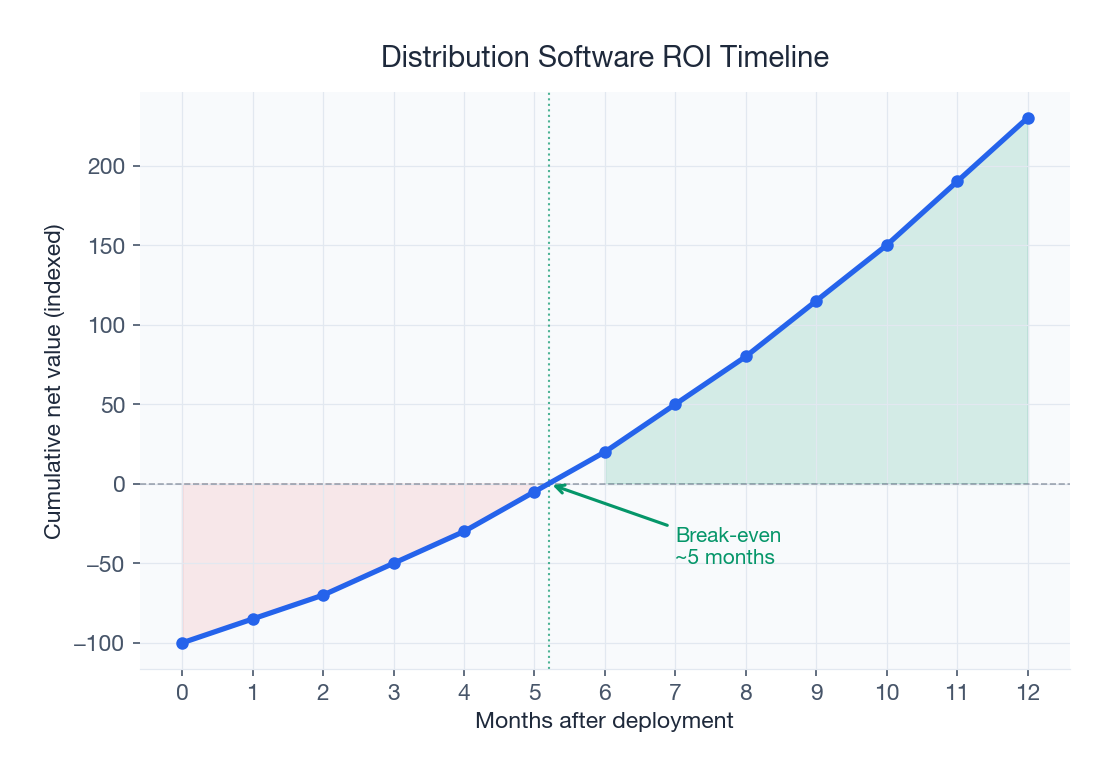
Mid-range cloud-based DMS platforms cost Rs 2,000–5,000 per user per month in India. For a team of 10 users, annual cost is Rs 4–8 lakh including implementation and training. This typically delivers Rs 15–30 lakh in annual savings through automation, route optimization, and error reduction.
The biggest risk is undetected errors compounding over time. Manual data entry errors (2–5% rate), untracked crate losses (8–15% annually), scheme leakage (5–12% of scheme budget), and stockouts (3–7% revenue loss) add up silently. By the time you notice the cumulative impact, the damage can run into lakhs.
Related SpireStock Features
End-to-end order lifecycle from placement to delivery with multi-level approval workflows.
Powerful dashboards with sales trends, MIS reports, and distribution analytics.
Real-time GPS tracking of vehicles and drivers with route optimization for faster deliveries.
Related Industries
Streamline FMCG distribution with order management, beat planning, retailer tracking, and GST billing. Built for Indian FMCG supply chains.
End-to-end dairy distribution software for milk, curd, paneer, and ghee brands. Manage orders, crates, cold chain, and GST billing in one platform.
Related Solutions
Manage your entire distributor network digitally. Onboarding, credit limits, outstanding tracking, and performance analytics. Start free trial.
Boost field sales team productivity with beat planning, GPS attendance, order capture, and performance analytics. Built for Indian FMCG teams.
Related Entities
Ready to Streamline Your Distribution?
Start your free 14-day trial and see how SpireStock can transform your dairy, FMCG or consumer-goods distribution operation, from order capture to crate recovery.

SpireStock Team
Product & Industry Insights
SpireStock Team leads product at SpireStock, where the team ships distribution management software for India's dairy, FMCG and consumer-goods brands.