The Secondary Sales Visibility Gap
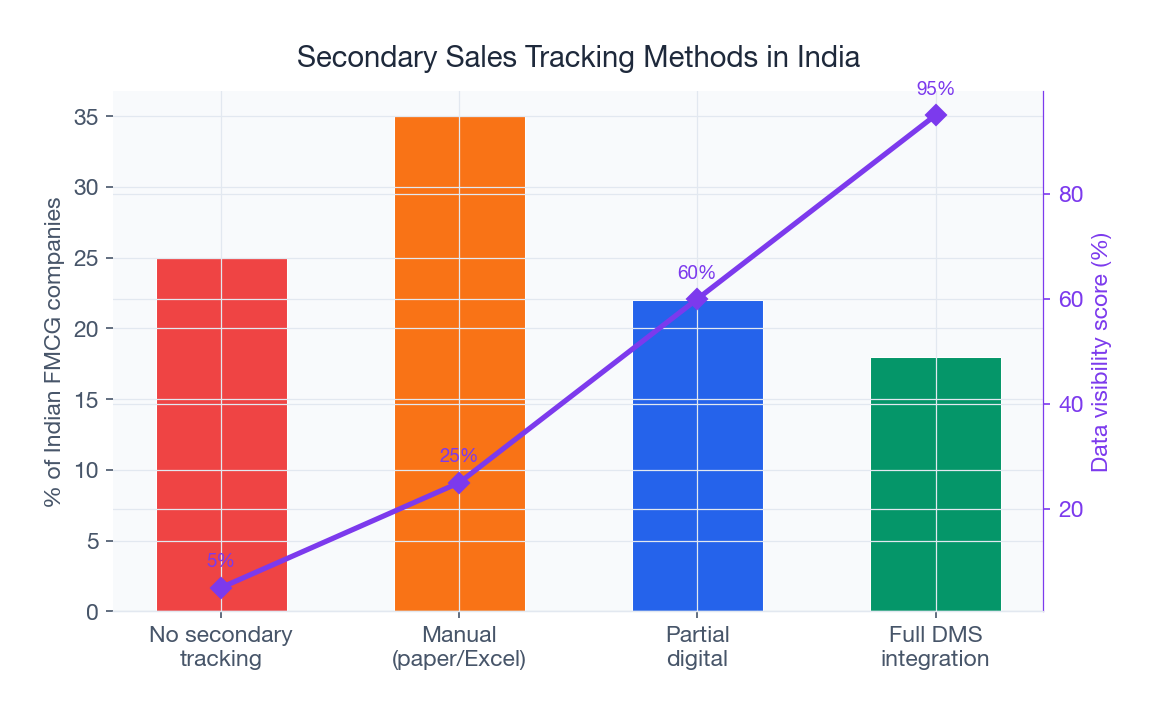
Most dairy and FMCG companies have excellent visibility into primary sales, what they ship to distributors. But what happens after that? How much is the distributor selling to retailers? Which products are flying off shelves in a Bengaluru kirana and which are gathering dust in a Lucknow warehouse? What is the actual consumer demand versus distributor pipeline stuffing at the end of a quarter?
This gap in secondary sales visibility is one of the biggest blind spots in Indian FMCG distribution. Companies that close this gap gain a massive competitive advantage through better demand forecasting, targeted trade promotion, and optimized inventory management. Brands like Britannia, Amul, and Nandini that have invested in real-time secondary sales capture typically report 15-20% lower stockout rates and 25% lower spoilage versus peers who rely on monthly distributor claims.
This guide explains what secondary sales really means, why it matters across dairy, beverages, bakery, and broader consumer goods, and the step-by-step path to building a data capture system that delivers trustworthy numbers every single day.
Primary vs Secondary vs Tertiary Sales
A quick glossary before we dive in, these terms are used loosely in India and cause endless confusion in sales review meetings:
| Stage | Flow | Who Owns the Data | Biggest Gotcha |
|---|---|---|---|
| Primary sales | Brand to distributor | Brand ERP | Inflated by quarter-end loading |
| Secondary sales | Distributor to retailer | Distributor billing system | Often manual, delayed, incomplete |
| Tertiary sales | Retailer to consumer | Retailer POS or estimation | Nearly invisible in general trade |
Why Secondary Sales Tracking Matters
1. Real Demand vs Pipeline Filling
Primary sales can be inflated by scheme-driven stockpiling, end-of-quarter loading, and distributor order patterns that don't reflect actual consumer demand. Secondary sales data shows true sell-through rates, giving you an accurate picture of market demand in each pin code you serve.
2. Inventory Health
Without secondary sales data, you cannot calculate days of inventory at the distributor level. This leads to two problems: over-stocked distributors who face expiry risk (critical for dairy and bakery), and under-stocked distributors who miss sales opportunities. Analytics dashboards that combine primary and secondary data provide accurate inventory health metrics within multi-tenant workspaces for each territory.
3. Scheme Effectiveness
Trade schemes should drive sell-through, not just sell-in. Secondary sales tracking tells you whether scheme-driven primary sales translate to actual retailer purchases or just distributor warehouse buildup, the difference between a Rs 2 crore scheme that generates Rs 5 crore of real consumer offtake and a Rs 2 crore scheme that moves Rs 2 crore of stock into a godown.
4. Territory Intelligence
Secondary sales data at the retailer level reveals which territories are thriving and which are underperforming, which product categories are growing, and where competitor pressure is strongest. This intelligence drives smarter territory management decisions and feeds retailer tracking initiatives in cities like Hyderabad and Chennai.
5. Forecasting and Production Planning
Dairy production in particular cannot flex instantly, milk collection is largely fixed, and processing schedules are locked 24-48 hours ahead. Secondary sales data feeds statistical models that predict true demand, reducing both write-offs from excess production and lost sales from shortfalls.
Methods for Tracking Secondary Sales
Method 1: Distributor Billing Data
Capture invoice data from distributors to retailers. This is the most reliable secondary sales data source:
- Integrate with distributor billing systems to capture invoices automatically
- Use SpireStock's order management where distributors process retailer orders through the platform
- Daily or weekly data upload from distributor billing software (Tally, Marg, Busy, or custom ERPs)
Method 2: Field Force Order Capture
Sales representatives capture retailer orders during market visits using the distribution mobile app. These orders, placed through the distribution platform, automatically generate secondary sales data tied to specific retailers, products, and territories. Coupled with attendance tracking, you also verify that the salesperson was physically present when the order was booked.
Method 3: Retailer Self-Ordering
Enable retailers to place orders directly through a retailer app. Each order becomes a secondary sales data point. This approach also improves order accuracy and reduces dependency on sales staff visits, increasingly important as field-force costs rise in metros like Mumbai.
Key Secondary Sales Metrics to Track
- Sell-through rate, Secondary sales as a percentage of primary sales. Healthy range: 80-95%.
- Days of inventory (DOI), How many days of sales the distributor's current stock covers. Target: 7-14 days for dairy, 21-30 for ambient FMCG, 5-10 for bakery.
- Numeric distribution, Percentage of target retailers actively buying. Indicates market coverage.
- Weighted distribution, Share of category sales covered by the retailers who stock you.
- Lines per call (LPC), Average number of SKUs ordered per retailer per visit. Higher LPC indicates deeper market penetration.
- Retailer order frequency, How often each retailer orders. Declining frequency signals potential loss.
- Product-wise sell-through, Which products move fastest at the retailer level.
Building a Secondary Sales Tracking System, Step by Step
- Choose your data capture method, Distributor billing integration, field force capture, or retailer self-ordering (ideally all three)
- Set up the technology platform, SpireStock captures secondary sales data through all three methods in an integrated platform
- Define metrics and targets, Establish KPIs for sell-through rate, DOI, numeric distribution, and other secondary metrics
- Build dashboards, Create real-time dashboards that show secondary sales trends by territory, product, and distributor
- Integrate with planning, Use secondary sales data to inform demand forecasting, scheme design, and inventory allocation
- Review regularly, Weekly secondary sales reviews should become a core management rhythm
- Incentivise data quality, Tie a portion of distributor margin or field-force bonus to complete, on-time secondary reporting
Indicative Cost and Timeline
| Phase | Timeline | Cost (INR) | Key Deliverable |
|---|---|---|---|
| Discovery & data audit | Week 1-2 | Internal | Current-state map and baseline |
| Platform setup | Week 3-5 | Rs 50,000-2,00,000 one-time | Distributor + salesforce app live |
| Distributor onboarding (first 20) | Week 5-8 | Rs 25,000-75,000 training | 90%+ secondary coverage |
| Dashboard + review rhythm | Week 8-10 | Rs 10,000-30,000/month SaaS | Weekly ops review live |
| National scale-up | Month 3-6 | Rs 8-15 lakh total programme | All distributors on platform |
Common Challenges and Solutions
- Data quality, Distributor-reported data may be incomplete or delayed. Solution: Use technology-captured data (app-based orders) as the primary source.
- Distributor resistance, Some distributors resist transparency. Solution: Show them the benefits, better inventory management, lower expiry losses, and access to distributor management dashboards.
- Data overload, Too much data without actionable insights. Solution: Focus on 5-6 key metrics and automate exception-based alerts.
- Legacy ERP integration, Old Tally or custom systems lack APIs. Solution: Use the mobile app as the primary capture layer; treat ERP sync as a bonus.
Once secondary sales flow cleanly into your dashboards, the conversation shifts from "how much did we ship?" to "how much did consumers actually buy?" That shift transforms every downstream decision, from production planning to scheme design to field force coaching. If you are ready to plug the secondary sales gap in your business, talk to our team, browse the distribution blog for implementation tips, or review our pricing plans.
Building the Weekly Sales Review Rhythm
Data without a review rhythm is wasted. The most successful FMCG operators run a disciplined weekly secondary sales review with a clear agenda, clear owners, and clear exit criteria. Here is the template we have seen work across dairy, beverages, and bakery brands from Pune to Kolkata:
- Monday morning top-line scan, Last week's primary vs secondary, sell-through ratio, outliers flagged automatically by the analytics dashboard
- Tuesday territory deep dive, RSMs walk through their top-5 and bottom-5 distributors with fresh secondary data and action plans
- Wednesday category review, Brand and category managers look at SKU-level sell-through to adjust production and promo plans
- Thursday field coaching, ASMs coach field officers on retailers flagged as at-risk by the data
- Friday commercial review, Finance and sales align on trade spend and cash cycle
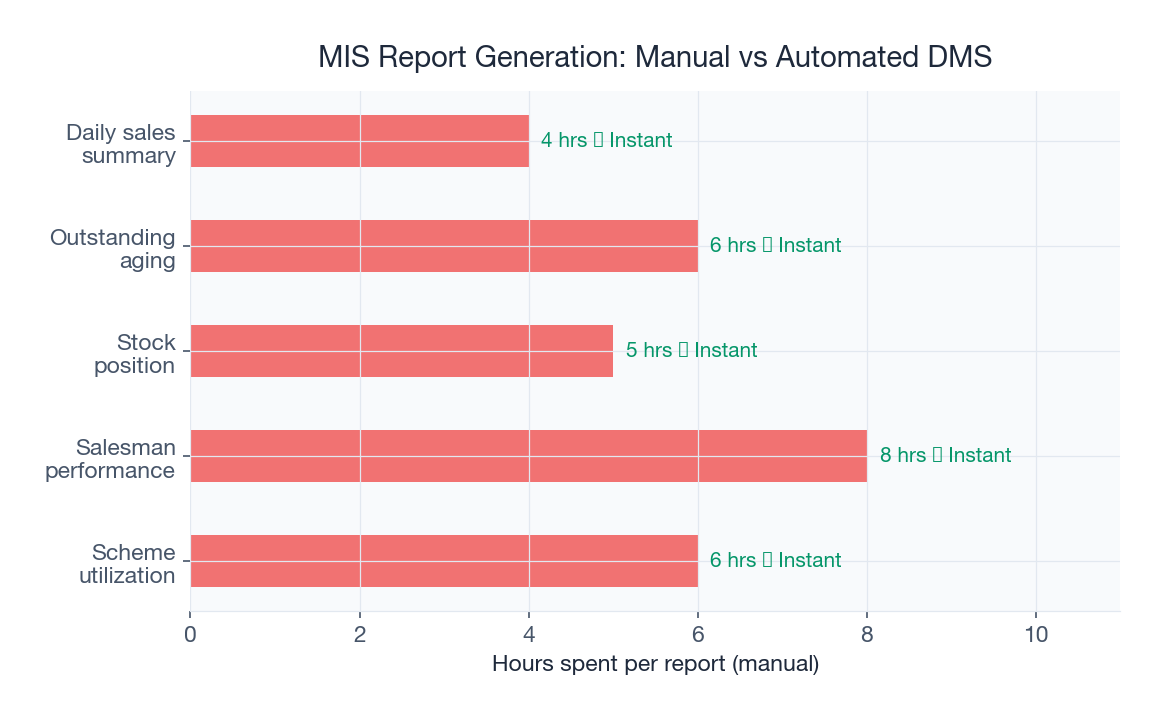
This cadence compresses the feedback loop from "next quarter" to "next day" and is only possible when secondary sales data is captured in real time through order management and the mobile app.
Secondary Sales Data Quality Checklist
Before trusting any downstream model or dashboard, verify that the underlying data passes these tests:
- Is every retailer tagged with a unique, deduplicated ID?
- Is every SKU tagged with the correct category, pack size, and MRP?
- Are returns and damages subtracted cleanly rather than inflating gross numbers?
- Is the data timestamped to the minute the order was captured, not the day it was uploaded?
- Are geo-coordinates from the field app attached to each visit?
- Do primary and secondary totals reconcile within 2% over a 4-week window?
Failing any of these tests usually means a process fix, not a technology fix. Once the underlying data is clean, the analytics layer does the heavy lifting automatically.
Using Secondary Sales for Better Forecasting
The single biggest use case for clean secondary sales data is demand forecasting. Traditional dairy and FMCG forecasting leans on primary sales history and a few macro factors. The result is a forecast that is frequently off by 15-25% at SKU-week-pincode level, leading to either stockouts or expiry write-offs. Secondary sales data, especially when combined with weather, festival calendars, and scheme calendars, reduces forecast error to 7-12% at the same level of granularity.
For a dairy company producing 5 lakh litres a day, a five-point improvement in forecast accuracy can be worth Rs 6-10 crore a year in reduced expiry plus lower lost sales. For beverages and bakery, the savings show up in capacity utilisation and raw material procurement.
Advanced Metrics to Graduate To
Once the basics are running cleanly, consider graduating to a second-generation metric set:
- Net promoter lift, Compare secondary sales lift during scheme vs base weeks
- Retailer cohort retention, What percentage of retailers active in Jan are still active in Jun?
- Velocity index, Sell-through per retailer per SKU, normalised against category benchmark
- Heat-map coverage, Geospatial view of active vs dormant retailers at pincode level
- Return ratio by cause, Expiry, damage, wrong order, linked back to specific routes and vehicles via fleet management
- Payment health, Days sales outstanding per distributor, flagged through payment collection dashboards
Scaling Secondary Sales Across a Multi-Brand Portfolio
Multi-brand FMCG houses face an additional challenge, different brand teams want different metrics and different cadences. The solution is a multi-tenant workspace architecture where each brand gets its own configuration while sharing underlying retailer and distributor master data. Group-level leadership sees the roll-up; brand managers see the detail. This eliminates the painful ritual of monthly spreadsheet wrangling between brand teams and a central BI group.
Large cooperatives like Amul and Nandini have pushed this model even further, their regional depots, private distributors, and cooperative societies all feed into a single secondary sales fabric that spans dairy, consumer goods, and speciality SKUs. Regional dairies and FMCG brands can adopt the same architecture without the implementation burden by starting with a purpose-built SaaS platform.
Common Objections, And Responses
Any secondary sales programme will hit resistance. Here are the objections you will hear and how to handle them:
- "Distributors will not cooperate", Most will, once they see the working capital benefits. A minority will resist; handle them through commercial incentives or replacement.
- "Data entry burden on field team", Modern apps capture orders in under 90 seconds. If your team complains, check the UX, it is probably bloated with irrelevant fields.
- "We already have primary sales data", Primary sales data is inputs; secondary sales data is outputs. Confusing the two is why most brands over-invest in the trade.
- "Too expensive for our scale", Affordable SaaS platforms start at Rs 10,000-30,000 per month. Even small brands can afford them.
Secondary Sales Across Category Types
Secondary sales dynamics vary by category. Dairy has fast turnover and short cycles, secondary data should refresh daily. FMCG staples run weekly cycles. Bakery has short shelf lives and needs near-real-time visibility to avoid expiry. Beverages swing with season and weather, making secondary data essential for production planning. Design your data capture cadence and metrics based on category reality, not a one-size-fits-all template.
Sources & References
Frequently Asked Questions
Secondary sales refers to the sale of products from distributors to retailers. Primary sales is company-to-distributor; secondary sales is distributor-to-retailer. Secondary sales data reveals actual market demand and sell-through, which primary sales alone cannot show.
Secondary sales tracking provides visibility into actual market demand (vs distributor stockpiling), enables accurate inventory management, measures trade promotion effectiveness, and provides territory-level intelligence for better distribution decisions.
Three primary methods: 1) Integrate with distributor billing systems to capture invoice data, 2) Have field force capture retailer orders via mobile app, 3) Enable retailers to self-order through a retailer app. SpireStock supports all three methods.
A healthy sell-through rate (secondary/primary sales) is 80-95%. Below 80% indicates potential stockpiling, while above 95% suggests distributors may be under-stocked. For perishable dairy products, target the higher end (90-95%) to minimize expiry risk.
Yes. SpireStock captures secondary sales data through distributor billing integration, field force order capture, and retailer self-ordering apps. The analytics dashboard provides real-time visibility into sell-through rates, DOI, numeric distribution, and other key secondary metrics.
Related SpireStock Features
Related Industries
Streamline FMCG distribution with order management, beat planning, retailer tracking, and GST billing. Built for Indian FMCG supply chains.
End-to-end dairy distribution software for milk, curd, paneer, and ghee brands. Manage orders, crates, cold chain, and GST billing in one platform.
Related Solutions
Track and manage your retail network. Geo-tag outlets, capture secondary sales, manage beats, and monitor retailer performance. Try SpireStock.
Boost field sales team productivity with beat planning, GPS attendance, order capture, and performance analytics. Built for Indian FMCG teams.
Related Entities
Ready to Streamline Your Distribution?
Start your free 14-day trial and see how SpireStock can transform your dairy, FMCG or consumer-goods distribution operation, from order capture to crate recovery.

SpireStock Team
Distribution Technology Experts
SpireStock Team writes for SpireStock on distribution management, supply-chain optimisation and field operations for Indian dairy and FMCG brands.