What is a Distributor Management System (DMS)?
A Distributor Management System (DMS) is a specialized software platform that digitizes and automates the workflow between a brand (or manufacturer), its distributors, and the retailers they serve. If you've ever wondered how Amul tracks orders from 10,000+ distributors, or how Britannia keeps its biscuit supply chain synchronized across 2 million retail outlets, the answer is DMS.
In simple terms, a DMS is to FMCG distribution what a CRM is to sales, an integrated system of record that captures every order, every invoice, every stock movement, and every rupee collected. Unlike generic ERP software, a DMS is purpose-built for the specific challenges of distribution: daily order cycles, trade schemes, secondary sales tracking, primary vs secondary inventory reconciliation, and retailer-level visibility. If you want to see what a modern DMS looks like, book a free demo to explore the SpireStock platform.
In this definitive 2026 guide, we explain what a DMS actually does, why Indian FMCG brands are rushing to adopt one, the core modules you should expect, and how to evaluate the right platform for your business. Whether you run a mid-size dairy in Ahmedabad, a beverage brand in Hyderabad, or a biscuit company with pan-India reach, this guide is for you.
Why Do Brands Need a DMS?
Consider the scale of Indian FMCG distribution. A typical national brand sells through 400-800 distributors, who collectively serve 500,000 to 2 million retail outlets. Orders are placed daily, invoices are generated in thousands, schemes change every month, payments flow in partial amounts, and inventory moves across state borders subject to GST compliance. Managing this complexity through spreadsheets, WhatsApp messages, and phone calls is not just inefficient, it's impossible at scale.
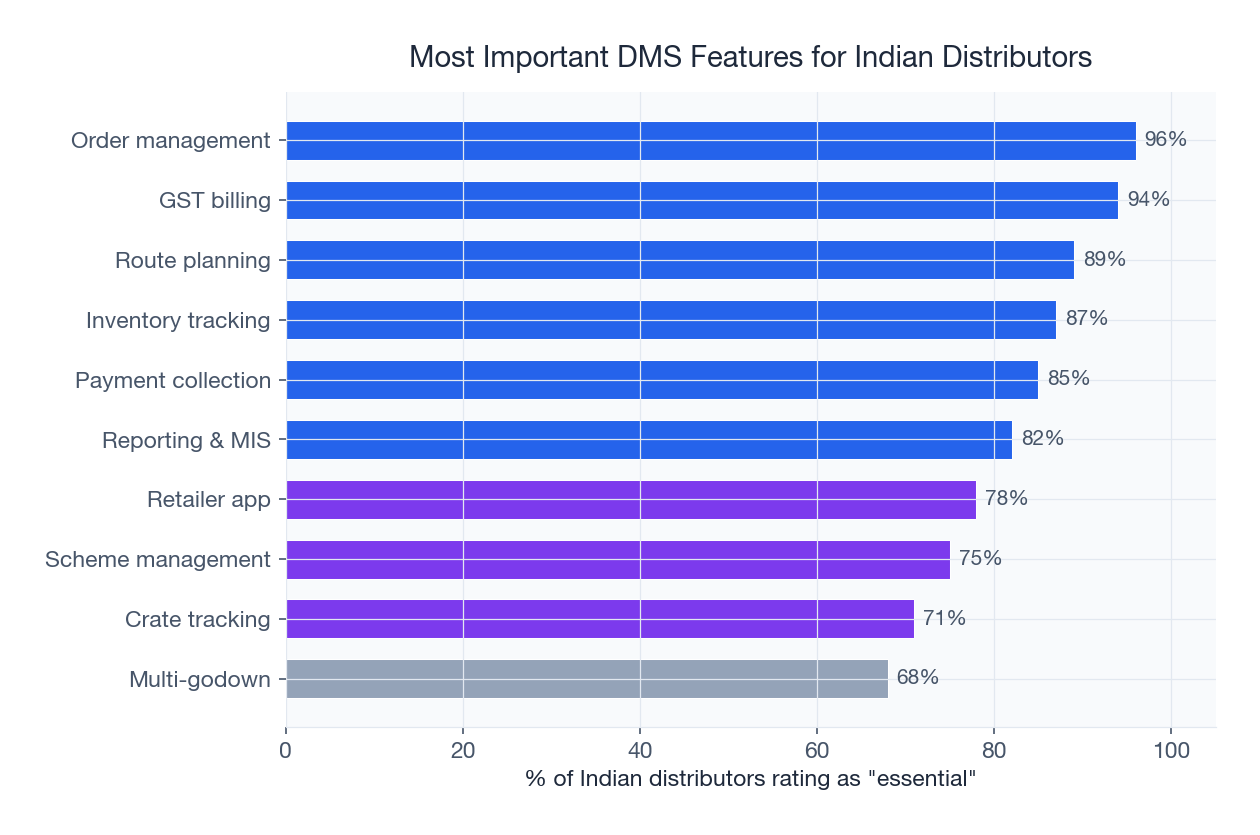
A DMS solves five fundamental problems:
- Visibility gap, brands lose sight of inventory and sales the moment goods leave the factory gate. A DMS restores end-to-end visibility from dispatch to retailer shelf.
- Scheme leakage, manual scheme calculation leads to over-payment, under-payment, and disputes. Read our full breakdown in Scheme Leakage in FMCG Distribution: How to Prevent It.
- Order cycle inefficiency, phone-based ordering wastes 3-4 hours daily per distributor and introduces errors. Digital order management eliminates this.
- Inventory mismatch, without real-time stock sync, brands can't plan production or reorder accurately.
- Collection delays, untracked outstandings grow silently. A DMS flags overdue accounts automatically.
Core Modules of a Modern DMS
1. Order Management
The heart of any DMS is order management. Distributors place orders via a mobile app before the daily cutoff. Orders are validated against stock, credit limits, and schemes, then routed to the appropriate plant or warehouse for fulfillment. Modern DMS platforms support templates, recurring orders, multi-plant routing, and approval workflows, all of which reduce processing time from hours to minutes.
2. Secondary Sales Tracking
A DMS captures not just primary sales (brand to distributor) but also secondary sales (distributor to retailer). This is the holy grail of FMCG, true sell-through visibility. Retailer tracking via field sales mobile apps enables beat-wise order booking and daily secondary sales reports.
3. Scheme Engine
FMCG runs on schemes, flat discounts, slab-based rebates, free goods, target-linked bonuses, and more. A configurable scheme engine applies these rules automatically during invoicing, eliminating manual errors and disputes. The best platforms allow marketing teams to configure schemes through a UI without IT involvement.
4. Invoice and GST Billing
A DMS generates GST-compliant invoices with correct HSN codes, tax rates, and e-invoicing integration. Automated billing reduces errors to near-zero and ensures compliance with India's evolving tax regulations.
5. Inventory and Warehouse Management
Real-time stock tracking across factory, CFAs, super-distributors, and distributors. Batch tracking, expiry management, and automated reorder alerts are standard features.
6. Collection and Payment Management
Payment collection modules track outstandings by distributor, age invoices, send automated reminders, and reconcile partial payments. The best DMS platforms integrate with UPI, bank APIs, and cheque management.
7. Sales Analytics and Reporting
Analytics dashboards surface KPIs like distributor-wise sales, product mix, territory performance, and scheme effectiveness. Data-driven decisions replace gut-feel management.
8. Field Force Tracking
Modern DMS platforms include attendance tracking and GPS-based field force monitoring, ensuring salespeople actually visit their assigned beats. Read more in Beat Planning Software for FMCG in India.
DMS vs ERP vs CRM: What's the Difference?
| System | Primary Purpose | Users | Best For |
|---|---|---|---|
| ERP (SAP, Oracle) | Enterprise-wide resource planning (finance, HR, production) | Internal corporate staff | Large manufacturers |
| CRM (Salesforce, Zoho) | Customer relationship and sales pipeline | Sales teams | B2B sales organizations |
| DMS (SpireStock) | Distributor operations, secondary sales, trade execution | Distributors, field sales, channel teams | FMCG, dairy, beverages |
While ERPs and CRMs have their place, neither handles the distribution side of FMCG well. That's why brands invest in DMS as a complementary system. A typical Indian FMCG company runs Tally or SAP for finance, Salesforce for B2B accounts, and DMS for distribution, with integrations tying them together.
Benefits of Implementing a DMS
The business case for a DMS is overwhelming. Here's what Indian brands typically achieve within 6-12 months of deployment:
- 50-80% reduction in order processing time
- 30-45% faster payment collection cycles
- 100% scheme accuracy (zero leakage)
- 15-25% lift in secondary sales visibility
- 60-70% fewer invoicing errors
- Real-time visibility across the entire distribution network
Ready to see these numbers for your own business? Schedule a demo and we'll walk you through a personalized ROI calculation.
Industries That Use DMS
DMS platforms aren't just for dairy. Any business that distributes through a channel network benefits:
- Dairy distribution, milk, curd, butter, cheese, ice cream
- FMCG distribution, soaps, biscuits, personal care, packaged foods
- Beverage distribution, water, soft drinks, juices, energy drinks
- Bakery and confectionery, bread, buns, cakes, chocolates
- Fresh produce, fruits, vegetables, frozen foods
- Consumer goods, household, stationery, pharma OTC
How Much Does a DMS Cost in India?
DMS pricing in India typically follows a per-user or per-distributor subscription model. Expect to pay between Rs 8,000 and Rs 25,000 per month for small operations (up to 50 distributors), Rs 25,000-75,000 for mid-size brands (50-300 distributors), and custom pricing for enterprise deployments. Implementation costs range from Rs 1-10 lakh depending on customization and integration complexity. See our pricing page for SpireStock's transparent plans.
The ROI is typically achieved within 3-6 months. A mid-size FMCG brand saving Rs 2 lakh per month in scheme leakage alone recoups software costs within the first quarter.
How to Choose the Right DMS
When evaluating DMS platforms, prioritize these criteria:
- Industry fit, does it handle your specific category (perishables, schemes, returnable packaging)?
- Mobile-first design, distributors and field staff work on phones, not laptops. The mobile app must be excellent.
- Offline capability, rural India has poor connectivity. Offline mode is non-negotiable.
- Vernacular support, Hindi, Marathi, Tamil, Telugu, Kannada at minimum
- GST compliance, e-invoicing, e-way bill, automatic tax calculation
- Integration APIs, Tally, SAP, Busy, payment gateways
- Multi-tenant architecture, multi-tenant workspaces for brands managing multiple business units
- Scalability, from 50 to 5,000 distributors without breaking
Real-World Examples
Look at how India's leading FMCG brands use DMS:
- Amul operates one of the world's largest distribution networks, their DMS handles millions of daily transactions across 10,000+ distributors.
- Mother Dairy synchronizes dairy and horticulture distribution through a unified platform.
- Britannia manages biscuit, bread, and dairy distribution across 2 million+ retail outlets.
- Bisleri tracks bottled water distribution and returnable asset management in parallel.
Ready to modernize your distribution? SpireStock is the purpose-built DMS trusted by 500+ Indian FMCG brands. Start your free 14-day trial and see the difference within the first week.
The Future of DMS: AI, IoT, and Real-Time Intelligence
The next wave of DMS innovation is being driven by AI and IoT. Predictive ordering uses historical data to recommend quantities. Computer vision tracks shelf share at retail. IoT sensors monitor cold chain compliance. Real-time dashboards replace weekly reports. Indian brands that adopt next-generation DMS platforms in 2026 will have an unassailable advantage as the industry consolidates around digital leaders.
Conclusion
A Distributor Management System is no longer optional for Indian FMCG brands. It's the foundation on which scalable, efficient, profitable distribution is built. Whether you're just getting started with digitization or looking to upgrade from a legacy platform, investing in a modern DMS is one of the highest-ROI decisions your business can make. Explore our full feature list at distribution tracking and distributor management solutions, or talk to our team today.
This guide covers one part of the picture. For the category as a whole — what a DMS does, the modules that matter, how it differs from ERP and SFA, and what it costs in India — see our distributor management system guide.
Sources & References
Frequently Asked Questions
A DMS is specialized software that digitizes the workflow between brands, distributors, and retailers. It handles order management, secondary sales tracking, scheme execution, GST invoicing, inventory sync, collections, and field force monitoring. It's the operational backbone of modern FMCG distribution.
An ERP (like SAP or Oracle) manages enterprise-wide functions, finance, HR, production, procurement, for internal corporate staff. A DMS is purpose-built for distribution operations: daily orders, trade schemes, secondary sales, and channel execution. Most FMCG brands run both in parallel.
DMS pricing starts around Rs 8,000 per month for small operations (up to 50 distributors), Rs 25,000-75,000 for mid-size brands, with custom pricing for enterprise deployments. Implementation costs Rs 1-10 lakh. ROI is typically achieved within 3-6 months.
DMS is used by any business that distributes through a channel network: dairy, FMCG, beverages, bakery and confectionery, fresh produce, pharma OTC, and consumer goods. Any brand with distributors and retailers benefits from a DMS.
Yes. Tally handles accounting and basic inventory but lacks the distribution-specific features brands need: secondary sales tracking, scheme engine, beat planning, field force monitoring, and retailer-level visibility. DMS complements Tally rather than replacing it, and they typically integrate via API.
A typical DMS implementation takes 4-8 weeks: 1-2 weeks for configuration, 2-3 weeks for pilot rollout, and 2-3 weeks for full deployment across all distributors. Complex customizations can extend timelines to 12-16 weeks.
Related SpireStock Features
Real-time GPS tracking of vehicles and drivers with route optimization for faster deliveries.
End-to-end order lifecycle from placement to delivery with multi-level approval workflows.
Powerful dashboards with sales trends, MIS reports, and distribution analytics.
Related Industries
Streamline FMCG distribution with order management, beat planning, retailer tracking, and GST billing. Built for Indian FMCG supply chains.
End-to-end dairy distribution software for milk, curd, paneer, and ghee brands. Manage orders, crates, cold chain, and GST billing in one platform.
Related Solutions
Manage your entire distributor network digitally. Onboarding, credit limits, outstanding tracking, and performance analytics. Start free trial.
Boost field sales team productivity with beat planning, GPS attendance, order capture, and performance analytics. Built for Indian FMCG teams.
Related Entities
Ready to Streamline Your Distribution?
Start your free 14-day trial and see how SpireStock can transform your dairy, FMCG or consumer-goods distribution operation, from order capture to crate recovery.

SpireStock Team
Distribution Technology Experts
SpireStock Team writes for SpireStock on distribution management, supply-chain optimisation and field operations for Indian dairy and FMCG brands.