What Is a Godown and Why Do Indian FMCG Distributors Need Multiple Locations?
A godown, the Indian term for a warehouse, is the backbone of every FMCG distribution operation. Unlike the gleaming logistics centres run by e-commerce giants, a typical FMCG distributor's godown is a 500-3,000 sq ft rented space in a commercial or semi-industrial area, often with basic shelving, a loading dock, and products stacked on pallets or directly on the floor. As a distributor's business grows beyond Rs 50 lakh monthly turnover, a single godown is never enough. Space constraints, delivery radius limitations, and the need for faster last-mile service push distributors to operate across multiple locations.
A distributor in Mumbai might have their main godown in Bhiwandi (cheap rent, large space for bulk storage), a market godown in Dadar (close to hundreds of kirana stores), another market godown in Andheri (serving the western suburbs), and 6-8 delivery vans carrying stock daily. A distributor in Delhi could have a main godown in Okhla, market godowns in Karol Bagh and Laxmi Nagar, and transit stock coming from C&F agents in Manesar. Each of these locations holds inventory that must be tracked, reconciled, and managed as a unified operation.
The challenge is not having multiple locations. The challenge is knowing exactly what stock is where at any given moment. When a salesman gets an urgent order for 50 cases of a fast-moving SKU, they need to know instantly: is it at the main godown, the Lajpat Nagar market godown, already loaded on Van 3, or still in transit from the C&F agent? Without this visibility, you either lose the sale or spend 30 minutes on phone calls trying to locate stock.
Typical Multi-Godown Setup for Indian FMCG Distributors
Understanding the typical multi-location inventory architecture helps frame the management challenge. Here is what most mid-sized FMCG distributors operate across tier-1 and tier-2 cities:
- Main godown (central warehouse): The primary receiving and bulk storage location. All goods from C&F agents, super-stockists, and brand principals arrive here. Usually situated in an industrial or semi-commercial area with lower rent, typically Rs 15-25 per sq ft in cities like Ahmedabad or Pune. Houses 60-70% of total inventory.
- Market godowns (branch warehouses): Smaller locations of 500-1,500 sq ft positioned closer to dense retail clusters. Pre-positioned stock for faster delivery to nearby kirana stores. A distributor may operate 1-3 market godowns depending on the city's geography. Rent is higher (Rs 30-60 per sq ft) but delivery speed improves dramatically.
- Van stock (mobile inventory): Inventory loaded onto delivery vehicles each morning. Each van becomes a moving warehouse carrying Rs 1-3 lakh worth of products. A distributor with 8 vans has 8 additional inventory locations that change throughout the day.
- Transit stock: Goods dispatched from the C&F agent or brand warehouse but not yet received at the main godown. Can represent 2-5 days of inventory value, often Rs 10-30 lakh for a mid-sized operation.
- Return stock: Products returned by retailers due to damage, near-expiry, or order errors, pending inspection, credit note issuance, or return to the brand. Typically 1-3% of total inventory but disproportionately problematic if not tracked properly.
A mid-sized FMCG distributor thus operates across 8-15 distinct inventory locations simultaneously. Managing this without digital tools is like running a bank without a ledger system.
Stock Categories and Challenges Across Locations
| Location Type | Stock Category | Typical Volume | Primary Challenge | Financial Risk |
|---|---|---|---|---|
| Main godown | Bulk storage | 60-70% of total inventory | Space optimization, FEFO compliance | Expiry write-offs if rotation fails |
| Market godown | Fast-moving SKUs | 10-20% of total | Replenishment timing and frequency | Stockouts losing Rs 2-5 lakh/month in sales |
| Van stock | Daily delivery load | 5-15% of total | Real-time reconciliation | Pilferage, unaccounted sales |
| Transit stock | Incoming goods | 5-10% of total | Visibility before physical receipt | Over-ordering due to blind spots |
| Return stock | Damaged/expired | 1-3% of total | Timely processing and disposal | Delayed credit notes, retailer disputes |
Why Stock Visibility Fails Without Digital Tools
The Register-and-Tally Gap
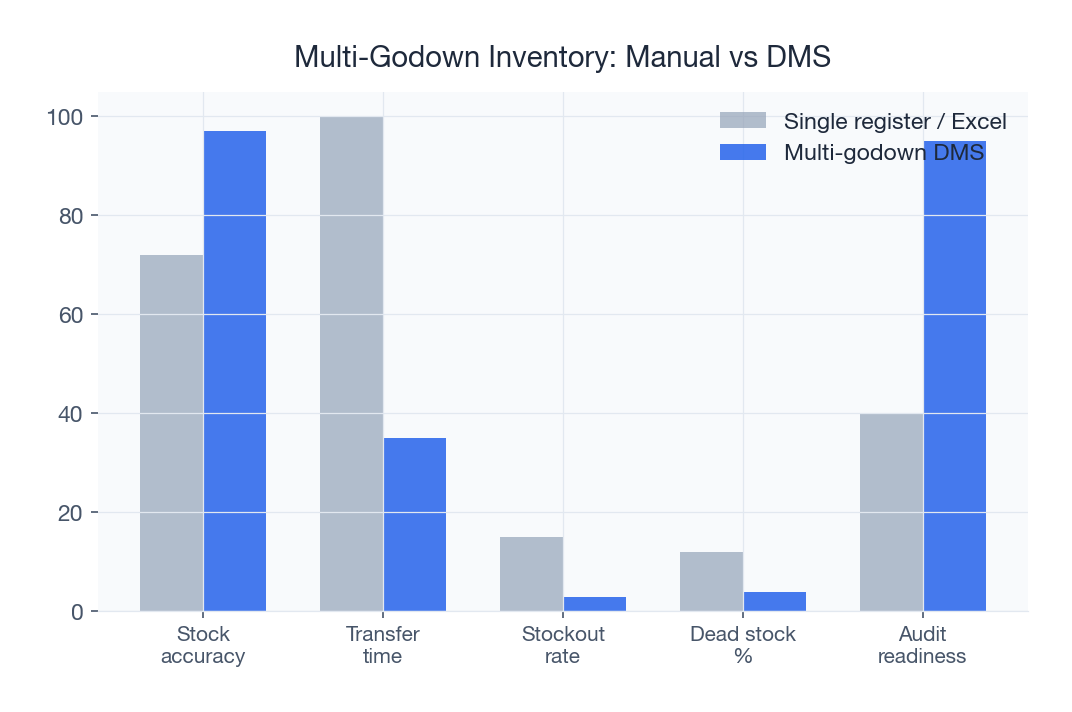
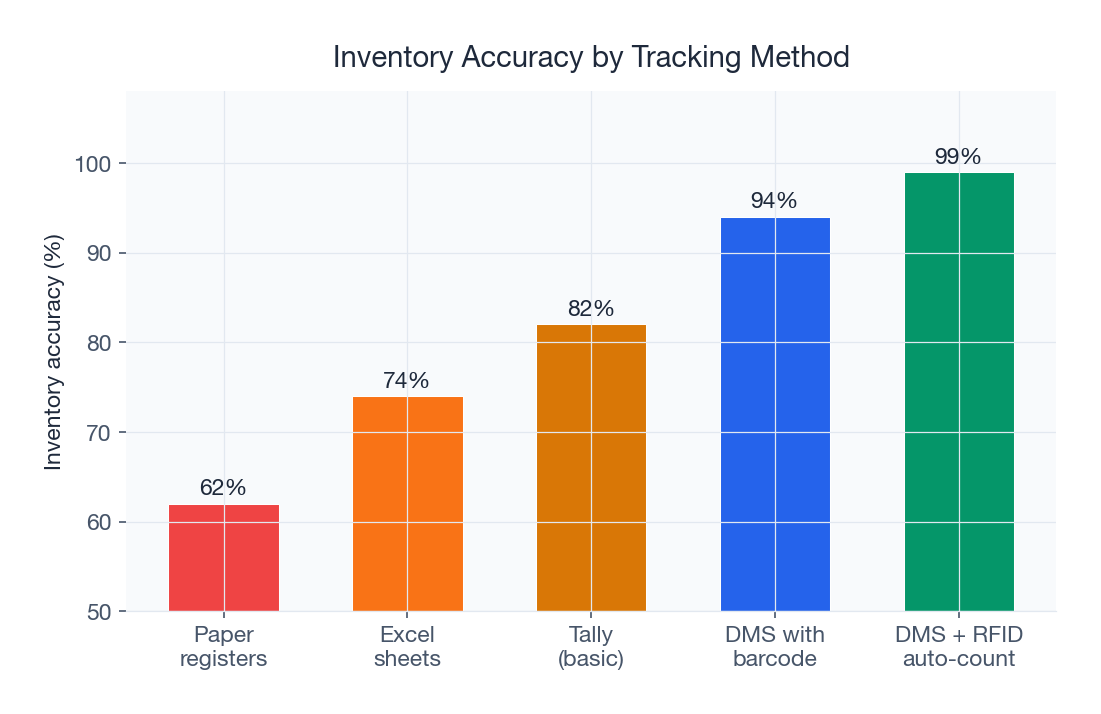
Most distributors maintain a physical stock register at each godown and a Tally instance at the main office. The register records goods in and out at the godown level, while Tally tracks the financial transactions. These two records rarely match because: register entries happen in real time but Tally entries happen end-of-day or next day; physical discrepancies are discovered late; and inter-godown transfers may be recorded at the sending end but not the receiving end for hours or days. A 2025 CII study found that the average stock variance between physical registers and accounting software for Indian FMCG distributors was 8-12%, meaning at any given time, the system is wrong about roughly 1 in 10 units of inventory.
The Van Stock Black Hole
Van stock is the single biggest visibility gap in distributor operations. A delivery van is loaded with Rs 1-3 lakh worth of products each morning based on a loading sheet. During the day, the driver delivers some products, collects some returns, receives some cash payments, and might make unplanned deliveries or swaps. Until the van returns in the evening and the driver submits his paperwork, the distributor has zero visibility into what has been sold, what has been returned, what cash has been collected, and what stock remains on the van. For a distributor with 8 vans, this means Rs 8-24 lakh of inventory is in a black hole for 8-10 hours every day. Explore our distribution tracking module to see how real-time van tracking eliminates this gap.
Inter-Godown Transfer Chaos
When the market godown in South Mumbai runs low on a fast-moving SKU, someone at the main godown in Bhiwandi loads a few cases onto the next available vehicle. This transfer is documented on a paper challan (delivery note), but the receiving godown may not update their register until the next day. Meanwhile, both godowns show incorrect stock levels. The main godown still shows the transferred stock as available, and the market godown does not show the incoming stock. If a salesman checks availability during this window, they get wrong information. Multiply this by 3-5 daily inter-godown transfers, and the stock records are perpetually inaccurate.
Expiry Tracking Across Locations
A batch of curd with a 10-day shelf life might be split across the main godown, two market godowns, and three vans. Without digital tracking, no one knows the total quantity of that batch across all locations or whether units at a market godown are closer to expiry than the ones at the main godown. FEFO (First Expiry, First Out) logic cannot function without unified multi-location visibility. The result is predictable: newer stock gets dispatched while older stock sits at a remote godown until it expires. Read our detailed guide on expiry management for dairy distribution for batch-level tracking strategies.
Digital Multi-Godown Management: How It Works
A modern distribution management system provides real-time inventory tracking across all locations through several integrated mechanisms:
Unified Stock Dashboard
The analytics dashboard displays total inventory across all locations with drill-down capability to any specific godown, van, or transit shipment. When a salesman checks stock availability through the mobile app, they see the combined available quantity across all locations, with location-wise breakdowns and expected replenishment dates for out-of-stock items. This single view replaces dozens of daily phone calls between salesmen, godown managers, and the back office.
Digital Transfer Challans
Inter-godown transfers are initiated, approved, and confirmed digitally. When the main godown dispatches stock to a market godown, the sending godown's inventory is reduced immediately, transit stock is created as a separate virtual location, and the receiving godown's inventory is updated upon confirmation of receipt via the mobile app. No paper challans, no register mismatches, no timing gaps. The transfer trail includes timestamps, quantities, batch numbers, and the responsible persons at both ends, creating an indisputable audit trail.
Real-Time Van Loading and Reconciliation
Van loading is done through the mobile app. Each item loaded onto the van is scanned or confirmed, creating a digital loading sheet. During the day, every delivery updates van stock in real time via the driver's mobile app. The distributor can see at any moment exactly what stock each van is carrying, what has been delivered, and what remains. At day end, the return stock is reconciled against the morning loading sheet plus any additions or returns during the day. Discrepancies are flagged immediately, not discovered days later during a physical audit.
Automated Replenishment Between Locations
When market godown stock drops below a configured threshold for any SKU, the system triggers a replenishment request to the main godown. The order management module can auto-generate internal transfer orders based on sell-through rates at each location, ensuring market godowns are always stocked with the right products in the right quantities. This eliminates the reactive, phone-call-driven replenishment that leads to stockouts at market godowns while the main godown has surplus stock sitting idle.
Cross-Location Batch and Expiry Tracking
Every batch is tracked across all locations from the moment it enters the main godown. The system knows exactly how many units of Batch A are at each godown and each van, with expiry dates visible at every level. FEFO logic works across the entire multi-location network, not just within a single godown. When dispatching from the main godown, the system picks the batch closest to expiry across all available stock, regardless of which shelf or zone it sits in.
GST Compliance for Inter-Godown Transfers
Under Indian GST law, inter-godown transfers require different documentation depending on the transfer type:
| Transfer Type | Document Required | Tax Treatment | E-Way Bill Needed? |
|---|---|---|---|
| Same state, same GSTIN | Delivery challan | No tax invoice required | Only if value exceeds Rs 50,000 |
| Same state, different GSTIN (branch transfer) | Tax invoice | CGST + SGST applicable | Yes, if value exceeds Rs 50,000 |
| Different states | Tax invoice | IGST applicable | Mandatory regardless of value |
A DMS generates the appropriate documents automatically based on godown locations and GSTIN registrations, eliminating the compliance risk of using wrong documentation for transfers. For more on GST compliance in distribution, read our GST billing guide for dairy distribution and our e-way bill compliance guide.
Godown-Wise Profitability Analysis
With digital multi-godown management, distributors gain the ability to analyze profitability per location, a capability that is simply impossible with paper-based tracking. Every godown has fixed costs (rent, electricity, staff salaries) and variable costs (handling, damage, shrinkage). By tracking revenue and costs per location, you can make data-driven decisions about your distribution network.
A market godown in Bangalore that costs Rs 35,000 monthly rent but serves 80 retailers with Rs 15 lakh monthly sales and 2% handling cost is clearly profitable. Another market godown with the same rent serving only 25 retailers with Rs 4 lakh monthly sales may need to be closed or relocated. Without location-level data, these decisions are made on gut feel rather than facts. The sales analytics module provides godown-wise P&L statements that make these decisions straightforward.
Location-Based Order Fulfillment
Smart order fulfillment routes each order to the optimal godown based on multiple factors: proximity to the retailer, stock availability, batch expiry dates, and vehicle loading efficiency. When a retailer in Koramangala, Bangalore places an order, the system checks the nearest market godown first. If stock is available and the batch has acceptable shelf life remaining, it fulfills from there. If not, it falls back to the main godown or another market godown, always optimizing for delivery speed and freshness.
This location-based fulfillment, powered by route optimization algorithms, reduces delivery time by 30-40% compared to fulfilling everything from the main godown, while ensuring better product freshness at the retailer's shelf.
Stock Audit Across Multiple Locations
Physical stock audits across multiple godowns are a logistical nightmare when done manually. With digital multi-godown management, cycle counting becomes practical. Each godown conducts rolling audits of a subset of SKUs daily, with the mobile app guiding the count and flagging discrepancies in real time. A complete audit of all SKUs across all locations can be completed within a month without disrupting daily operations.
The system maintains a complete audit trail showing when each SKU was last counted, what discrepancies were found, and what corrective actions were taken. This is invaluable during annual audits and tax assessments, especially for distributors in cities like Hyderabad and Chennai where GST authorities are increasingly requesting digital stock records.
Case Study: Mumbai FMCG Distributor with 5 Godowns
A multi-brand FMCG distributor in Mumbai operating 1 main godown in Bhiwandi, 3 market godowns across Dadar, Andheri, and Vashi, and 8 delivery vans implemented SpireStock's multi-location inventory module. The distributor handles FMCG products across 1,200 SKUs with a monthly turnover of Rs 1.8 crore. Results after 6 months:
| Metric | Before SpireStock | After SpireStock | Improvement |
|---|---|---|---|
| Monthly stock variance (value) | Rs 2.5 lakh | Rs 18,000 | 93% reduction |
| Van reconciliation time | 45 min per van per day | 8 min per van per day | 82% faster |
| Inter-godown transfer lead time | Next day at best | 2-3 hours same day | Same-day fulfillment |
| Stockout rate at market godowns | 12-15% of SKUs daily | 3-4% of SKUs daily | 73% reduction |
| Expiry-related write-offs | Rs 1.8 lakh/month | Rs 35,000/month | 81% reduction |
| First-year ROI | - | 6.7x | Software paid for itself in 9 weeks |
Implementation Phases for Multi-Godown Tracking
- Phase 1 (Week 1-2): Foundation setup. Configure godown locations, van identifiers, and stock opening balances per location. Map product categories and batch structures. Train godown managers on the mobile app for receiving and dispatch confirmation.
- Phase 2 (Week 3-4): Digital transfers and van management. Implement digital transfer challans for all inter-godown movements. Activate van loading and real-time delivery tracking. Train delivery drivers on mobile-based loading confirmation and delivery recording.
- Phase 3 (Week 5-6): Automation and batch tracking. Activate automated replenishment rules based on sell-through rates. Enable cross-location batch and expiry tracking with FEFO enforcement. Configure cycle counting schedules for each godown.
- Phase 4 (Week 7-8): Analytics and optimization. Enable godown-wise profitability reporting. Activate location-based order fulfillment logic. Review and optimize godown network based on data-driven insights from the analytics dashboard.
Multi-Godown Tracking vs Enterprise WMS: What Indian Distributors Actually Need
Enterprise WMS (Warehouse Management Systems) from SAP, Oracle, or Manhattan Associates cost Rs 50 lakh to Rs 2 crore to implement. They are designed for massive 50,000+ sq ft warehouses with conveyor systems, pick-pack-ship operations, wave planning, and complex put-away logic. Indian FMCG distributors do not need any of this. They need simple, mobile-first multi-location inventory tracking that works in a 1,000 sq ft godown operated by 2-3 workers who may not be comfortable with desktop software.
| Capability | Enterprise WMS | DMS Multi-Godown Module |
|---|---|---|
| Implementation cost | Rs 50 lakh - 2 crore | Rs 50,000 - 3 lakh/year |
| Implementation time | 6-18 months | 4-8 weeks |
| User interface | Desktop-heavy, complex | Mobile-first, simple |
| Multi-location tracking | Yes (designed for large warehouses) | Yes (designed for small godowns + vans) |
| Van stock management | Not standard | Core feature |
| Indian GST compliance | Requires customization | Built-in |
| Offline capability | Rarely | Standard (essential for tier-2/3 cities) |
| Training required | Weeks | Days |
SpireStock's multi-godown module provides exactly what Indian distributors need at a fraction of the WMS cost. Whether you operate in Kolkata, Lucknow, or Surat, the system adapts to your godown structure and grows with your business. Explore our complete crate and asset management solution for tracking returnable assets across your multi-godown network.
Common Mistakes in Multi-Godown Operations
- Not assigning clear ownership per godown: Every godown needs a designated manager accountable for stock accuracy, even if it is a small market godown with one person. Without ownership, discrepancies go uninvestigated.
- Treating van stock as a single pool: Each van must be tracked as an independent inventory location. Aggregating van stock into one pool makes reconciliation impossible and hides pilferage.
- Ignoring transit stock: Goods in transit between C&F and your godown are your inventory. Not tracking them leads to duplicate ordering and cash flow problems.
- Manual replenishment decisions: Relying on phone calls from market godown managers to request replenishment leads to reactive, crisis-driven transfers instead of proactive, data-driven stocking.
- No cross-location expiry view: Looking at expiry only within a single godown misses the fact that the same batch exists across multiple locations with varying remaining shelf life.
Integrate Multi-Godown Management with Your Distribution Workflow
Multi-godown stock management does not exist in isolation. It connects to every part of your distribution operation. Order management determines which godown fulfills each order. Route optimization plans delivery routes from the optimal godown. Invoice billing generates location-specific documentation. Scheme management applies promotions correctly regardless of fulfillment location. And payment collection reconciles cash against deliveries from any location.
This integration is what separates a purpose-built distribution management platform from cobbled-together spreadsheets and Tally entries. Every transaction, whether it is a sale, a transfer, a return, or a payment, updates the unified inventory picture across all locations in real time.
Losing track of stock across godowns and vans? SpireStock's multi-location inventory tracking gives you real-time visibility across every godown, van, and transit shipment, reducing stock variance by 93% and eliminating inter-godown transfer confusion. Distributors across dairy, beverage, and consumer goods distribution are already benefiting. Start your free trial today or view pricing plans to find the right fit for your operation.
Sources & References
Frequently Asked Questions
A godown is the Indian term for a warehouse or storage facility. In FMCG distribution, godowns are typically 500-3,000 sq ft rented spaces used to store and distribute products. Most distributors operate multiple godowns: a main godown for bulk storage and smaller market godowns closer to retail concentrations for faster delivery.
A small distributor typically operates 1-2 godowns plus 2-3 delivery vans. Medium distributors have 2-4 godowns plus 4-8 vans. Large distributors may have 4-6 godowns plus 10+ vans. The total number of inventory locations (godowns + vans + transit) can easily reach 10-15 for a mid-sized operation.
For transfers between godowns within the same state under the same GSTIN, a delivery challan is sufficient (no tax invoice needed) and e-way bill is not required for consignment value under Rs 50,000. For inter-state transfers between different GSTINs, a tax invoice with IGST and e-way bill are required regardless of value.
The mobile app on the delivery van driver's phone tracks real-time van stock. Each delivery reduces van stock, each return adds to it. GPS tracking shows the van's location. At any point during the day, the distributor can see exactly what stock is on each van, what has been delivered, and what is yet to be delivered.
Yes, SpireStock supports temperature-critical inventory management. Products tagged as requiring cold storage are tracked with temperature requirements, and the system alerts if cold-chain products are assigned to non-cold storage locations. For dairy distributors with walk-in cold rooms, the system ensures FEFO compliance across temperature zones.
WMS (Warehouse Management Systems) are designed for large warehouses with complex pick-pack-ship operations, zone management, and conveyor integration. Multi-godown tracking in a DMS is designed for FMCG distributors with multiple small locations and delivery vans. It is simpler, mobile-first, and costs 10-20x less than enterprise WMS.
Related SpireStock Features
Related Industries
Streamline FMCG distribution with order management, beat planning, retailer tracking, and GST billing. Built for Indian FMCG supply chains.
End-to-end dairy distribution software for milk, curd, paneer, and ghee brands. Manage orders, crates, cold chain, and GST billing in one platform.
Manage beverage distribution with cold chain tracking, crate management, route optimization, and real-time delivery monitoring. Try SpireStock free.
Distribution management for consumer goods brands. Manage distributors, retailers, schemes, and sales analytics across India. Start free trial.
Related Solutions
Manage your entire distributor network digitally. Onboarding, credit limits, outstanding tracking, and performance analytics. Start free trial.
GPS fleet tracking, driver management, and route optimization for dairy and FMCG delivery vehicles. Reduce fuel costs by 25%. Try SpireStock.
Manage distribution across multiple production units and plants. Centralized control with plant-level autonomy for dairy and FMCG brands.
Related Entities
Ready to Streamline Your Distribution?
Start your free 14-day trial and see how SpireStock can transform your dairy, FMCG or consumer-goods distribution operation, from order capture to crate recovery.

SpireStock Team
Distribution Technology Experts
SpireStock Team writes for SpireStock on distribution management, supply-chain optimisation and field operations for Indian dairy and FMCG brands.