What is Van Sales?
Van sales is a distribution model where a delivery vehicle doubles as a mobile retail outlet. A van is loaded with pre-selected SKUs, driven to a series of retail outlets, and the driver/salesman sells on the spot, taking orders, delivering stock, generating invoices, and collecting payments in one visit. It is the dominant channel for FMCG categories where retailers want immediate stock rather than placing orders in advance: beverages, snacks, biscuits, tobacco, personal care, and confectionery.
Van sales is especially dominant in tier-2 and tier-3 Indian markets, where retailers are small, orders are small, and distribution visits must be highly efficient. According to NielsenIQ India, van sales accounts for approximately 30-40% of all FMCG secondary distribution in urban India, and upwards of 60% in semi-urban and rural markets. A typical FMCG van covers 40-80 outlets daily and generates Rs 50,000-2 lakh in same-day sales. Multiply that across hundreds of vans and thousands of vehicles, and van sales becomes a multi-thousand-crore operational category that desperately needs digitization.
The India Brand Equity Foundation (IBEF) estimates that the Indian FMCG sector will reach $220 billion by 2025, with rural consumption growing at 1.5x the urban rate. This growth is fueled directly by van-based distribution reaching deeper into India's 600,000+ villages.
Van sales management software is purpose-built technology for this workflow. If you run vans in Hyderabad, Chennai, Pune, Mumbai, Delhi, or Ahmedabad, read on. Or book a demo to see SpireStock's van sales module.
Why Van Sales Needs Specialized Software
1. On-the-Spot Selling
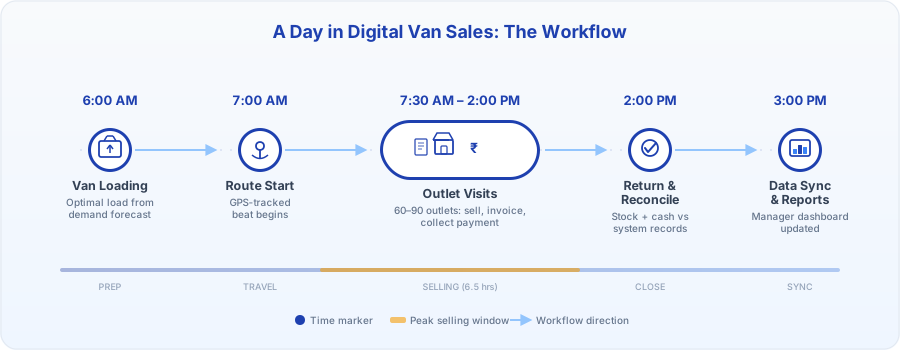
Van sales staff do not place orders that will be fulfilled later. They sell from van inventory immediately. This requires real-time stock visibility on the salesman's mobile device, immediate invoice generation, and instant stock deduction. Generic order management systems designed for pre-sales workflows cannot handle this real-time inventory depletion model.
2. Cash and Credit Management
Most van sales are cash or UPI transactions. Some retailers have credit limits. The system must track cash in hand for each salesman, capture payment mode at each sale, and reconcile daily cash with sales at end-of-day. According to a McKinsey India report on retail digitization, cash handling remains the single largest source of leakage in Indian FMCG distribution, accounting for 3-8% revenue loss at the distributor level.
3. Stock Reconciliation
Each van starts the day with a loaded inventory (a "van load") and ends with remaining stock + sales + returns. Mismatches indicate theft, damage, or errors. Automated reconciliation is essential. Without software, this process takes 1-2 hours per van per day and is error-prone.
4. Beat Adherence
Vans follow fixed beats. Software tracks GPS to verify the salesman is actually visiting assigned retailers, not just marking fake visits. Read more about beat planning software for FMCG and what beat planning means in FMCG.
5. Mobile App and Offline Mode
Van sales happens in remote markets with patchy connectivity. The mobile app must work offline and sync when connectivity returns. This is non-negotiable: a van salesman visiting 60-80 outlets daily cannot afford to lose transactions because of a network drop in a rural area.
Van Sales vs Pre-Sales vs Hybrid Models: A Comprehensive Comparison
Before choosing van sales software, Indian distributors must understand where van sales fits within the broader distribution model landscape. Three primary models dominate Indian FMCG distribution, and many brands use a combination.
How Each Model Works
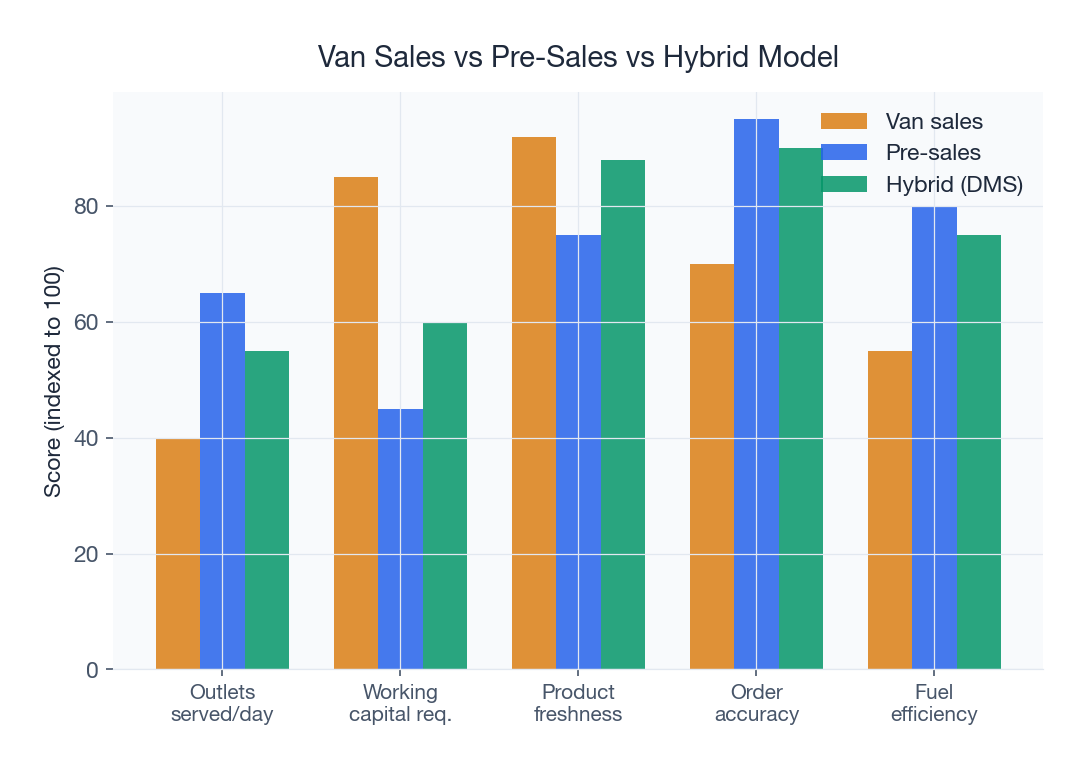
Van Sales (Cash-and-Carry): The salesman loads the van with products at the start of the day, visits retailers on a fixed route, sells from van stock on the spot, generates invoices, collects payment, and returns with remaining stock and cash. The entire sales cycle, from order to delivery to payment, happens in a single visit.
Pre-Sales (Order Booking): A dedicated sales representative visits retailers, takes orders on a handheld device or paper, and submits them to the depot. A separate delivery team fulfills those orders 24-48 hours later. The salesman and delivery person are different people on different vehicles.
Hybrid Model: Combines both approaches. Typically, van sales is used for high-frequency, small-ticket categories (biscuits, chips, beverages) where retailers want immediate stock, while pre-sales is used for larger, planned orders (cooking oil, detergent, rice). Many large Indian brands like Parle, Britannia, and ITC run hybrid models across their distributor networks.
| Parameter | Van Sales | Pre-Sales | Hybrid |
|---|---|---|---|
| Order-to-delivery time | Immediate (same visit) | 24-48 hours | Varies by SKU |
| Salesman role | Sells + delivers + collects | Takes orders only | Both depending on category |
| Vehicle utilization | Medium (carries unsold stock) | High (delivers confirmed orders) | Optimized per channel |
| Cash handling risk | High (daily cash collection) | Lower (separate billing) | Medium |
| Best for categories | Beverages, snacks, biscuits, dairy | Cooking oil, detergent, staples | Multi-category distributors |
| SKU range per visit | 50-150 SKUs on van | Full catalog (order from catalog) | Van SKUs + catalog for rest |
| Retailer preference | Small kirana, immediate need | Organized retail, planned purchase | Mixed market towns |
| Cost per outlet visit | Rs 15-30 | Rs 8-15 (order) + Rs 10-20 (delivery) | Rs 12-25 blended |
| Technology requirement | Mobile POS + thermal printer | Order booking app + DMS | Full DMS + van sales module |
| Suitable geography | Rural, semi-urban, tier-3/4 | Urban, metro, organized trade | Tier-2 cities with mixed retail |
According to RedSeer Consulting, approximately 55% of Indian FMCG distributors now use some form of hybrid model, up from 30% five years ago. The shift is driven by brands pushing deeper into rural markets (requiring van sales) while simultaneously servicing modern trade (requiring pre-sales). SpireStock supports all three models through its integrated distributor management and mobile app platforms.
When to Use Which Model
- Pure van sales: When your retailers are small (monthly purchase under Rs 5,000), expect same-day delivery, and are in areas with limited organized logistics. Common in rural India, small towns, and for impulse-purchase categories.
- Pure pre-sales: When servicing modern trade chains, large kiranas with planned ordering, or categories with large order values. Common in metros and tier-1 cities.
- Hybrid: When your distributor covers a mixed market with both small and large retailers, or when you distribute multiple categories with different ordering patterns. This is the most common model for distributors in Bangalore, Chennai, and Pune.
Core Features of Van Sales Management Software
1. Van Load Management
Each morning, the system generates a van load, the quantity of each SKU to be loaded based on historical sales, current stock, and upcoming orders. Loading is captured digitally; opening stock is locked. This is the foundation of the entire van sales workflow, and errors here cascade through the entire day.
2. On-the-Spot Invoicing
At each outlet, the salesman records what the retailer buys, the system auto-applies schemes, and generates a GST-compliant invoice, printed on a thermal printer or shared digitally. Learn more in our invoice billing guide.
3. Mobile POS and Payment Capture
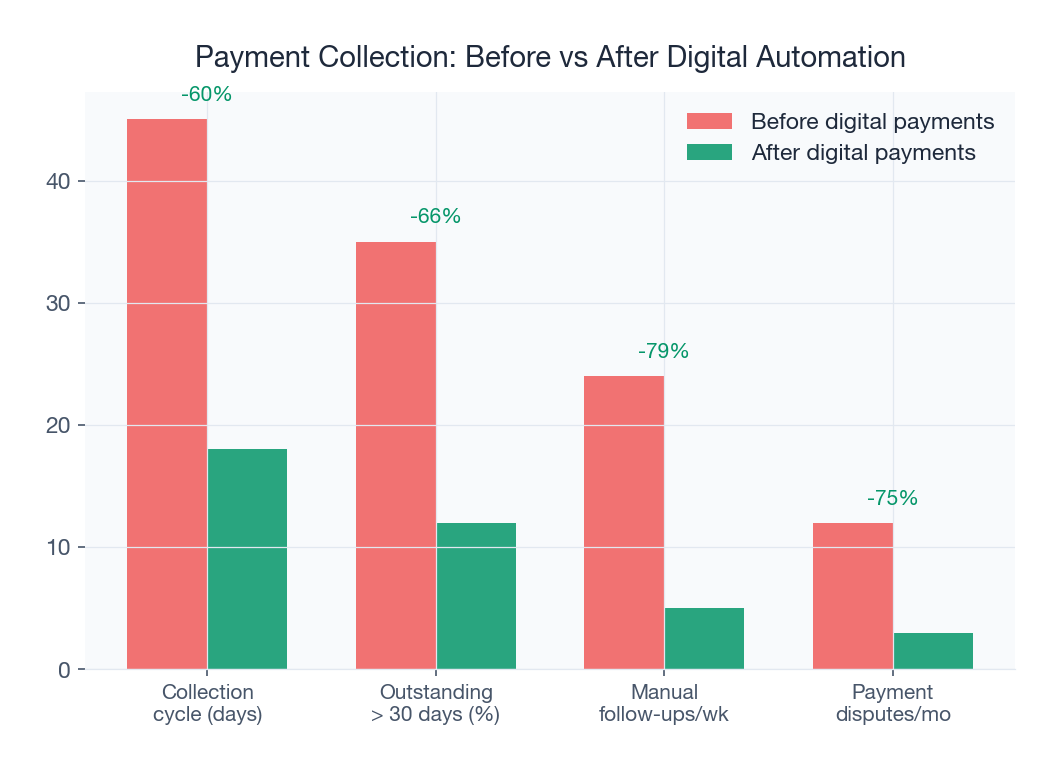
Cash, UPI, card, all payment modes supported. UPI integration enables direct payment at the retailer's counter. Receipts are generated automatically. With digital payment collection, cash handling drops by 40-60% in the first three months.
4. Scheme Engine on Mobile
Trade schemes apply automatically during sale. A scheme engine that works on mobile (even offline) eliminates manual errors. This is critical because scheme leakage in FMCG can erode 5-15% of trade promotion budgets when schemes are applied manually.
5. GPS Tracking and Beat Adherence
GPS-based attendance and beat tracking verifies that the van is following its assigned route and visiting the right outlets. Combined with distribution tracking, this gives managers complete visibility into field operations.
6. Stock Reconciliation and Cash Closing
At end-of-day, the salesman uploads remaining van stock and cash collected. The system reconciles: opening stock = sold stock + remaining stock + returns. Cash collected = invoice total + UPI + card. Discrepancies are flagged automatically.
7. Route and Beat Planning
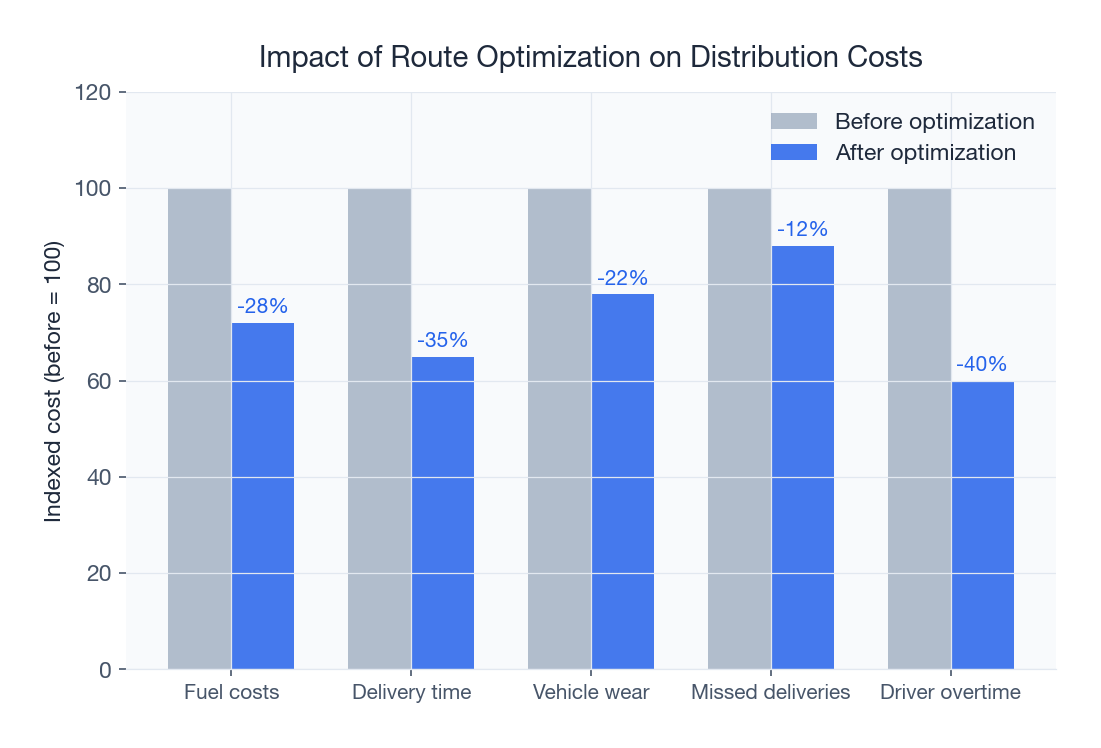
Route optimization ensures vans cover the maximum number of retailers in minimum time, reducing fuel costs and increasing productivity. For a deeper dive, read our beat planning software guide.
8. Analytics Dashboard
Analytics dashboards show daily sales by van, salesman productivity, scheme effectiveness, and beat coverage. Managers in Mumbai or Delhi headquarters can monitor van operations across the country in real time.
The Hardware Stack for Van Sales
A common question from distributors evaluating van sales software is: what hardware do I actually need? The good news is that the total hardware investment per van is remarkably low, typically Rs 15,000-25,000, which pays for itself within the first month of digital operations.
Essential Hardware
| Device | Purpose | Budget Range | Recommended Options |
|---|---|---|---|
| Android smartphone | Primary sales device: order capture, invoicing, GPS, payment | Rs 8,000-15,000 | Samsung Galaxy M14, Redmi Note 12, Realme Narzo 60. Minimum 4GB RAM, Android 12+ |
| Thermal printer (Bluetooth) | On-the-spot invoice printing at retailer counter | Rs 3,000-8,000 | 58mm for small bills, 80mm for detailed invoices. Battery-operated, 8-hour life |
| UPI QR stand | Digital payment collection at retailer counter | Rs 200-500 | Laminated QR with stand. Link to salesman's UPI ID or company account |
| Phone car mount | GPS navigation while driving between outlets | Rs 300-600 | Magnetic or suction mount for dashboard |
| Power bank | Full-day battery backup for phone and printer | Rs 800-1,500 | 10,000-20,000 mAh. Essential for 10-12 hour van routes |
Optional Hardware for Larger Operations
- Tablet (Rs 12,000-20,000): For vans carrying 200+ SKUs, a tablet provides a larger catalog view. Useful for confectionery and personal care distributors with wide product ranges.
- GPS tracker for van (Rs 2,000-5,000): Separate GPS tracker installed on the vehicle for fleet management, fuel monitoring, and theft prevention. Provides vehicle-level tracking independent of the salesman's phone. Integrates with fleet management solutions.
- Card reader (Rs 1,500-3,000): For areas with credit/debit card adoption. Pine Labs or Paytm Soundbox devices that announce payment confirmations.
- Rugged phone case (Rs 500-1,000): Van salesmen work in harsh conditions. A rugged case protects the primary sales device from drops, dust, and rain.
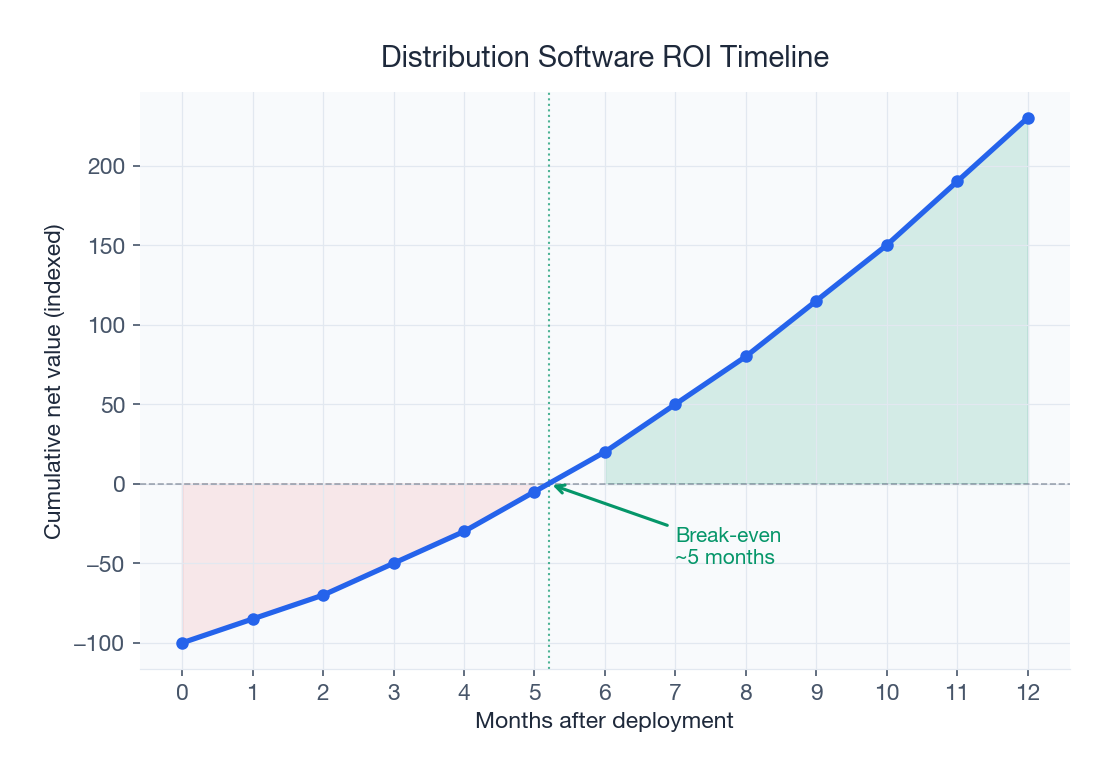
Total investment per van: Rs 15,000-25,000. For a 20-van operation, the total hardware outlay is Rs 3-5 lakh, a one-time investment that delivers monthly savings of Rs 8-15 lakh through reduced leakage, faster operations, and better coverage. The ROI timeline is typically 30-45 days.
Van Load Optimization: The Daily Planning Challenge
Every morning, someone at the distributor's warehouse decides what goes into each van. This decision determines the day's revenue ceiling. Under-load the van and the salesman runs out of popular SKUs by 2 PM, losing afternoon sales. Over-load the van and unsold stock returns at end-of-day, tying up working capital and creating wastage risk (especially for perishables like dairy and bakery products).
The Manual Approach (and Why It Fails)
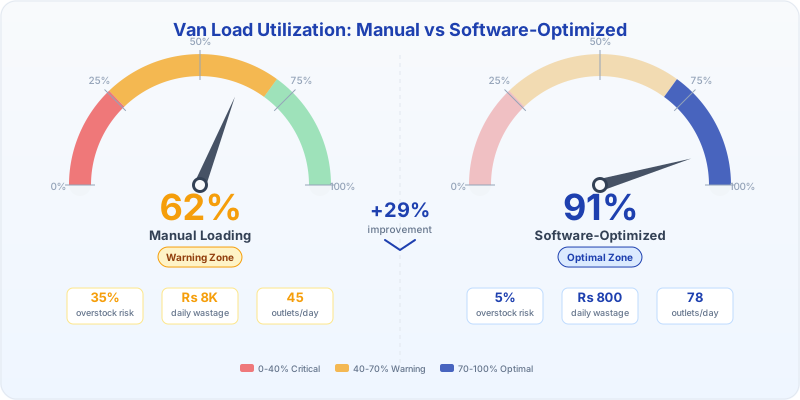
In manual operations, the van load is decided by the supervisor or salesman based on "gut feel" and yesterday's leftovers. The typical process: the salesman arrives at the depot, looks at what is available, loads what he thinks he will sell, and leaves. This approach results in 60-70% load utilization, meaning 30-40% of van capacity is either wasted on slow-moving SKUs or left empty.
Software-Driven Load Optimization
Van sales management software automates load planning using multiple data inputs:
- Historical sales data: What each outlet bought in the last 4, 8, and 12 weeks. Weighted averages account for recent trends.
- Day-of-week patterns: Monday sales differ from Saturday sales. Festival weeks differ from normal weeks.
- Seasonal adjustments: Beverage sales spike 40-60% in summer. Confectionery demand peaks during Diwali. The system adjusts automatically.
- Scheme-driven demand: When a new "buy 2 get 1" scheme launches, the system predicts increased demand and adjusts loads upward.
- Outlet-level forecasting: Each outlet has its own purchase pattern. A large kirana buys 2 cases of biscuits weekly; a small paan shop buys 6 packets. The system loads van stock outlet by outlet.
- Van capacity constraints: Physical space, weight limits, and cold storage compartment sizes are factored into the load plan.
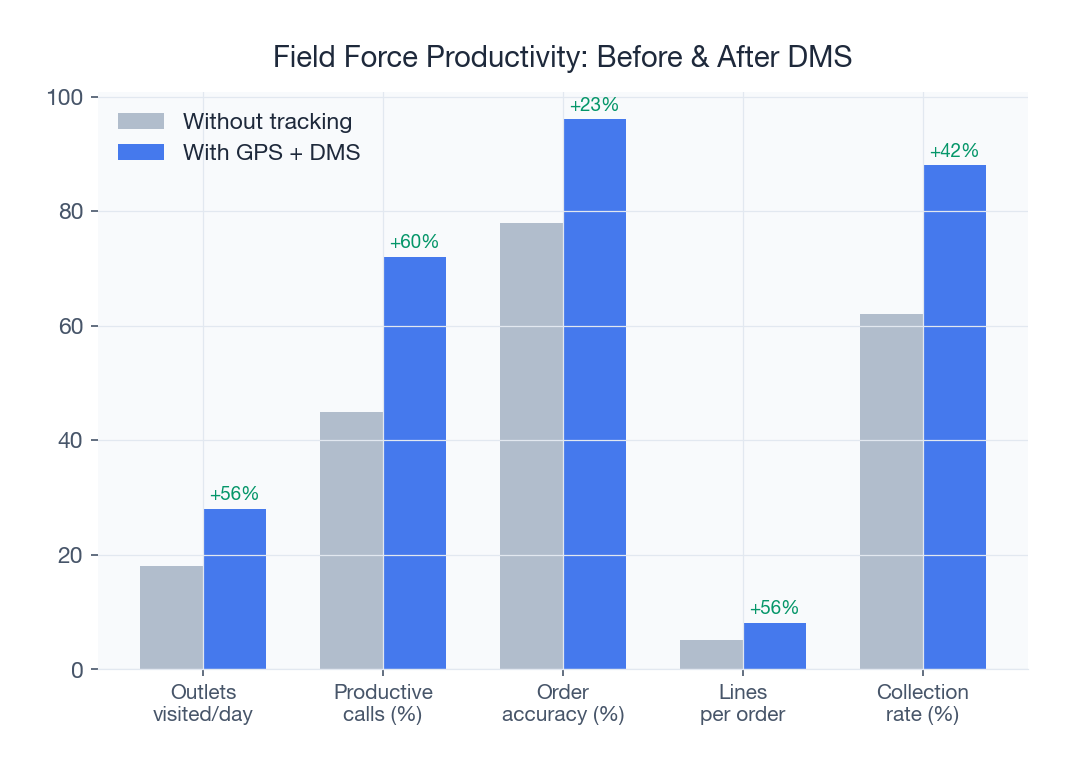
The result: 85-95% load utilization, meaning almost everything on the van gets sold. Returns drop from 8-12% to 2-4%. Stock-outs at individual outlets drop by 45-60%. Daily revenue per van increases 15-25% simply because the right products are on the right van.
Van Sales KPIs: Before vs After Software
| KPI | Manual Van Sales | With Software | Improvement |
|---|---|---|---|
| Outlets per day | 30-50 | 60-90 | 60-80% higher |
| Invoice time per outlet | 8-12 minutes | 2-3 minutes | 75% faster |
| Scheme errors | 10-15% | 0% | Zero leakage |
| Cash reconciliation time | 1-2 hours/day | 5-10 minutes | 90% faster |
| Stock shrinkage | 3-5% | 0.5-1% | 80% lower |
| Beat adherence | 75-85% | 95-98% | 15 pts higher |
| Load utilization | 60-70% | 85-95% | 25-35% higher |
| Daily revenue per van | Rs 50K-80K | Rs 80K-1.5L | 40-80% higher |
Cash Management and Fraud Prevention
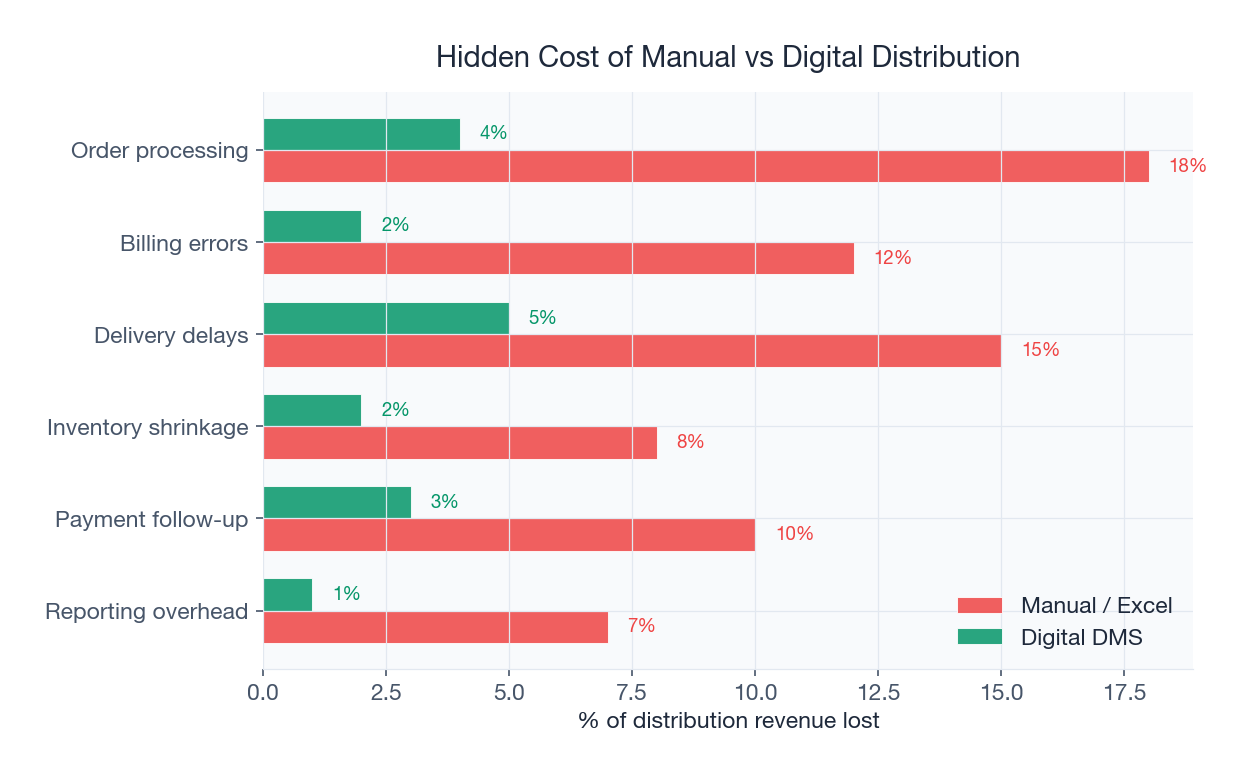
Cash leakage is the number one operational challenge in van sales. When a salesman handles Rs 50,000-2,00,000 in daily cash transactions across 60-80 outlets, the opportunities for leakage are enormous. Industry estimates suggest that undigitized van sales operations lose 3-8% of revenue to various forms of cash-related fraud and errors. For a 20-van operation generating Rs 20 lakh daily, that is Rs 60,000-1,60,000 lost every single day.
Types of Cash Leakage in Van Sales
| Leakage Type | How It Happens | How Software Prevents It |
|---|---|---|
| Skimming | Salesman collects Rs 1,000 but records Rs 800. Pockets the difference. | Digital invoicing locks the bill amount. UPI payments bypass cash entirely. GPS verifies the visit happened. |
| Fake discounts | Salesman gives unauthorized discounts to favored retailers and splits the savings. | Scheme engine controls all discounts. No manual overrides allowed without supervisor approval. |
| Under-billing | Salesman delivers 10 units but invoices 8. The remaining 2 are sold off-book. | Opening stock is locked digitally. Closing stock + sales + returns must equal opening stock. Mismatches trigger alerts. |
| Phantom visits | Salesman marks a visit as "shop closed" but never went. Keeps the time for personal errands. | GPS-verified visits with geo-fenced check-ins. Photo capture at each outlet. Attendance tracking ensures accountability. |
| Returns fraud | Salesman records fake returns to explain missing stock, then sells the "returned" stock to non-network outlets. | Returns require photo evidence, retailer confirmation, and supervisor approval. Return patterns are tracked and anomalies flagged. |
| Cash delay | Salesman deposits Monday's cash on Wednesday, using the float for personal loans or short-term investment. | Daily cash closing is mandatory. Deposits are tracked against collection. Delays beyond 24 hours trigger escalation. |
UPI Adoption: The Game Changer
The fastest way to reduce cash leakage is to reduce cash itself. UPI adoption among kirana retailers has surged from 15% in 2020 to over 65% in 2025, according to NPCI data. Van sales software with integrated UPI collection enables instant, verified, tamper-proof payments. For distributors in Bangalore and Mumbai, UPI now accounts for 40-50% of van sales collections. In tier-3 markets, it is growing at 25-30% quarter-on-quarter.
SpireStock's payment collection module supports UPI, cash, credit, and card payments with automatic reconciliation across all modes.
Categories That Use Van Sales
- Beverages: water, soft drinks, juices, energy drinks, buttermilk
- Biscuits, confectionery, snacks: chips, namkeen, chocolates, sweets
- Personal care, home care, packaged foods: shampoo, soap, detergent, noodles
- Dairy: curd, butter, cheese, paneer, flavored milk
- Tobacco, pan masala, and allied categories
- Stationery and small household items (in semi-urban markets)
Van Sales Software Pricing in India
Van sales management software typically charges per van per month. Expect Rs 500-1,500 per van per month for basic plans, Rs 1,500-3,000 for advanced plans with GPS, scheme engine, and analytics. Enterprise plans with custom integrations are priced individually. See our pricing page.
Integration with DMS and ERP
Van sales modules should integrate with your main distribution management system (DMS) and ERP. Daily sales data flows to accounting, inventory syncs with warehouse management, and schemes come from the central scheme engine. Standalone van sales apps without integration create data silos and reconciliation nightmares. SpireStock's van sales module integrates natively with the full DMS stack, including analytics, crate management, and route optimization.
Case Study: A Beverage Distributor in Pune
A mid-size beverage distributor in Pune operates 12 vans covering 4,800 retailers across the city. Before implementing van sales software, they faced 8-10% cash shrinkage monthly, 25-30% scheme calculation errors, and 3-4 hours daily spent on end-of-day reconciliation. After deploying SpireStock's van sales module:
- Cash shrinkage dropped to under 1%
- Scheme errors hit zero
- Reconciliation time dropped to 15 minutes per van
- Outlets covered per day increased from 45 to 78
- Monthly savings exceeded Rs 4.5 lakh
Want similar results for your operation? Talk to our team.
Case Study: A Snacks Brand Across Rajasthan
A regional namkeen and snacks brand based in Jodhpur operates 35 vans covering 6 districts across Rajasthan: Jodhpur, Jaipur, Udaipur, Bikaner, Kota, and Ajmer. Their product range includes 120+ SKUs of bhujia, mixtures, chips, and packaged sweets. Before digitization, their primary challenges were:
- Each van carried a "standard load" regardless of route, leading to 15-20% returns daily on slow-moving SKUs
- Cash reconciliation across 35 vans took 3 dedicated accountants working until 10 PM every night
- Scheme compliance was inconsistent: salesmen applied discounts selectively based on retailer relationships
- No visibility into which SKUs were selling in which districts, making production planning guesswork
After implementing SpireStock's van sales platform with route-wise load optimization:
- Returns dropped from 18% to 3.5% through data-driven van loading
- Cash reconciliation was completed by 7 PM daily with 1 accountant reviewing system-generated reports
- Scheme compliance hit 100% as the scheme engine applied discounts automatically
- District-wise SKU performance data enabled the company to launch 3 region-specific products that generated Rs 15 lakh/month in incremental revenue
- Overall sales per van increased 28% in the first quarter
Case Study: A Personal Care Distributor in Kerala (Hybrid Model)
A personal care products distributor in Kochi operates a hybrid van sales and pre-sales model across Kerala. They distribute soaps, shampoos, hair oils, and skincare products from 8 national and regional brands. Their operation:
- Van sales (18 vans): Covers 6,000+ small kiranas across rural Kerala, primarily selling high-frequency sachets and small packs. Average order: Rs 400-800.
- Pre-sales (12 reps + 6 delivery vehicles): Services 400+ organized retail outlets and large kiranas in Kochi, Trivandrum, and Calicut. Average order: Rs 3,000-8,000.
The challenge was running both models on a single platform. Previously, van sales ran on paper-based billing while pre-sales used a basic order management app, creating two separate data silos. After migrating to SpireStock:
- Unified dashboard showing all 6,400+ outlets across both channels
- Van salesmen use the mobile app for instant billing in Malayalam interface
- Pre-sales reps use the same app for order booking, with fulfillment routed to delivery vehicles
- Combined analytics revealed that 200+ outlets were being double-visited by both van and pre-sales teams, saving Rs 2.5 lakh/month in redundant visits
- Total coverage increased 22% as optimized routes freed up capacity for new outlet acquisition
Scaling Van Sales Operations
The operational complexity of van sales does not scale linearly. Going from 5 vans to 50 vans is not 10x the same problem; it is a fundamentally different operational challenge. Understanding what changes at each scale is critical for distributors planning growth.
5-10 Vans: The Founder-Managed Stage
At this scale, the distributor or owner personally knows every salesman, every major retailer, and every route. Load planning is done in a morning meeting. Cash is counted by the owner at night. Problems are solved by phone call. Software at this stage primarily replaces paper: digital invoicing, basic GPS tracking, and simple stock reconciliation. The ROI is immediate but modest (Rs 50,000-1 lakh/month savings).
10-25 Vans: The Supervisor Layer
The owner can no longer personally manage every van. Area supervisors are needed, typically 1 supervisor per 8-10 vans. At this stage, the critical software features are: supervisor dashboards, exception-based management (only flagging vans with problems), automated scheme compliance, and multi-van cash reconciliation. Without software, adding supervisors just adds cost without proportional control.
25-100 Vans: The Systems-Driven Stage
At this scale, the operation must run on systems, not people. Key requirements include: automated load optimization (no supervisor can manually plan loads for 50+ vans), real-time dashboards for the operations head, salesman performance rankings, SKU-level profitability analysis, and integration with ERP for automated accounting. Brands like regional FMCG players typically hit this scale across 2-3 states.
100-500+ Vans: Enterprise Scale
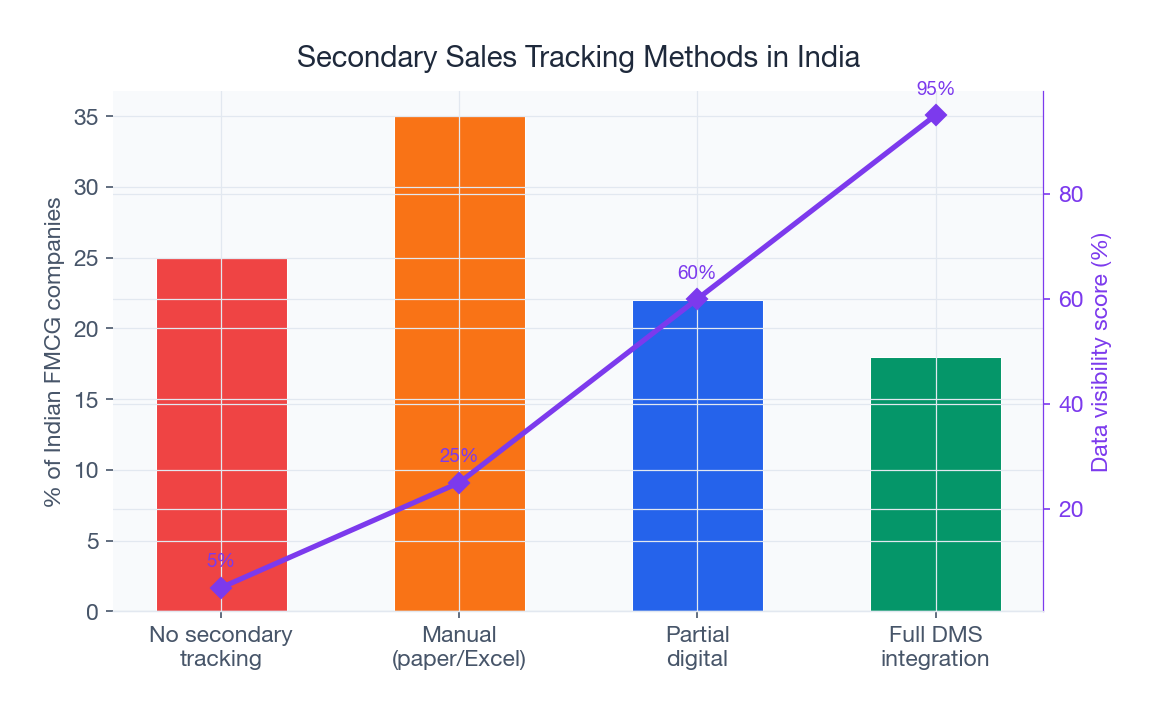
At this scale, operated by national brands like Parle, Britannia, and Haldiram's, the requirements shift to: multi-depot coordination, distributor-wise performance benchmarking, territory-level demand forecasting, automated re-distribution of beats based on salesman turnover, and integration with secondary sales tracking systems. According to industry estimates, Parle alone operates 1,500+ vans across India through its distributor network. ITC's distribution network covers 6 million+ outlets with a combination of van sales and pre-sales, requiring enterprise-grade distributor management technology.
Training and Change Management for Van Sales Teams
The biggest risk in deploying van sales software is not the technology; it is adoption. Van salesmen in India are typically 10th or 12th pass, aged 22-45, comfortable with WhatsApp and YouTube on their personal phones but resistant to "company apps" that they perceive as surveillance tools. Successful deployment requires thoughtful change management.
The Adoption Challenge
Common resistance patterns from van sales teams:
- "This app will get me fired": Salesmen fear that GPS tracking and digital reconciliation will expose inefficiencies they have been hiding. Address this by positioning the app as a tool that helps them earn more (productivity bonuses) rather than one that monitors them.
- "I cannot type in English": Many van salesmen are uncomfortable with English interfaces. The SpireStock mobile app supports Hindi, Tamil, Telugu, Marathi, Kannada, Malayalam, and Gujarati interfaces. Vernacular UI is non-negotiable for adoption.
- "My phone is too slow": The app must run smoothly on Rs 8,000 Android phones with 3-4 GB RAM. Apps designed for flagship phones will fail in the field. Performance optimization for budget devices is a core requirement.
- "It takes too long at each shop": If the digital process is slower than the paper process, salesmen will resist. The app must make billing faster than paper (target: under 2 minutes per outlet vs 8-12 minutes with paper).
Training Best Practices
- Train in batches of 5-8: Small groups allow hands-on practice. Each salesman must complete 10 mock transactions before going live.
- Shadow period: For the first 3 days, a trainer rides with each van. The salesman does paper billing in parallel with app billing. By day 3, the salesman sees that the app is faster and more accurate.
- Gamification: Leaderboards showing "outlets visited today," "fastest billing time," and "zero-error days" drive competitive adoption. Weekly prizes (Rs 500-1,000 phone recharge) for top performers accelerate buy-in.
- Video tutorials in vernacular: 2-minute WhatsApp-friendly videos covering each app function. Salesmen watch these repeatedly and share with peers.
- Buddy system: Pair a tech-comfortable salesman with a resistant one. Peer training is more effective than top-down instruction.
Success Metrics for Adoption
| Metric | Target | Typical Timeline |
|---|---|---|
| Time to basic proficiency | 3-5 days | Week 1 |
| Time to full proficiency | 2-3 weeks | Month 1 |
| Billing error rate (post-training) | Under 2% | Month 1 |
| Billing error rate (steady state) | Under 0.5% | Month 3 |
| App usage compliance | 95%+ of transactions on app | Month 2 |
| Salesman retention (post-deployment) | 90%+ (vs 85% pre-deployment) | Month 6 |
The counterintuitive finding: salesman retention actually improves after software deployment. Salesmen who initially resist the app end up preferring it because it reduces their administrative burden (no more manual cash counting, no more scheme calculation arguments with retailers, no more end-of-day reconciliation stress).
Van Sales in Emerging Channels
The van sales model, traditionally associated with kirana distribution, is evolving rapidly as new retail channels emerge in India. Forward-looking distributors are adapting van sales for modern trade, HoReCa, e-commerce last-mile, and D2C sampling.
Modern Trade Restocking
While modern trade chains (DMart, Reliance Retail, Spencer's) primarily use warehouse-to-store logistics, smaller modern trade outlets and regional chains increasingly rely on van-based restocking for fast-moving categories. A beverage distributor might use vans to restock 50-60 small supermarkets daily with water, juices, and soft drinks, complementing the planned weekly deliveries from the warehouse.
HoReCa (Hotels, Restaurants, Cafes)
The HoReCa channel in India is growing at 15-20% annually, according to NASSCOM and RedSeer estimates. Restaurants and cafes need daily deliveries of beverages, sauces, dairy products, and cleaning supplies. Van sales is ideal for this channel because orders are small, frequent, and time-sensitive. A cafe that runs out of milk at 10 AM cannot wait for a next-day delivery. Van-based HoReCa distribution is growing rapidly in Bangalore, Mumbai, and Delhi.
Quick Commerce Restocking
Quick commerce companies (Blinkit, Zepto, Swiggy Instamart) operate dark stores that need frequent restocking of fast-moving SKUs. Many FMCG distributors now use vans to restock dark stores 2-3 times daily, especially for beverages and snacks. This is essentially a B2B van sales operation where the "retailer" is a dark store. The van sales software requirements are similar but with higher urgency and tighter delivery windows.
D2C Brands and Sampling
Direct-to-consumer brands entering offline distribution use vans for market seeding and sampling. A new health beverage brand might deploy 5-10 vans across a city for 3-6 months, visiting kiranas to place initial stock, offer sampling, and build retailer relationships. Van sales software tracks not just sales but also sampling quantity, retailer feedback, and reorder rates, data that D2C brands use to decide which markets to scale.
Choosing the Right Van Sales Software
- Offline first: Must work without connectivity. Test by putting the phone in airplane mode and completing a full sales cycle.
- Fast on budget phones: Your salesmen use Rs 8,000-12,000 Androids, not iPhones. The app must load in under 3 seconds and never crash on 3-4 GB RAM devices.
- Vernacular UI: Hindi, Marathi, Tamil, Telugu, Kannada, Malayalam at minimum. The salesman should never need to read English to complete a transaction.
- Thermal printer support: For invoice printing at retailer counters. Both 58mm and 80mm Bluetooth printers must be supported.
- UPI integration: For instant payment capture with automatic reconciliation.
- Robust stock reconciliation: The single biggest source of leakage. The system must enforce opening stock = closing stock + sales + returns with zero tolerance for unexplained gaps.
- Integrated DMS: Standalone van sales apps create data silos. Choose a platform that integrates van sales with your full distribution management system.
- Scalability: Can the platform handle your growth from 10 vans to 100? Check for multi-depot support, supervisor hierarchies, and enterprise reporting.
Digitize your van sales with SpireStock. Trusted by beverage, biscuit, snacks, and FMCG brands across India. Whether you run 5 vans or 500, our platform scales with you. Book a demo to see the van sales module in action.
The Future of Van Sales
The next evolution of van sales combines AI-driven load optimization, computer-vision stock counting, and predictive reordering. Vans will become intelligent mobile retail outlets, optimizing their own routes and loads in real time. Emerging technologies include:
- AI-powered demand forecasting: Machine learning models trained on 2-3 years of van sales data can predict outlet-level demand with 85-90% accuracy, compared to 60-65% accuracy with manual estimation.
- Computer vision for shelf auditing: The salesman takes a photo of the retailer's shelf; AI identifies which products are out of stock, which competitor products are present, and what share of shelf the brand holds.
- Dynamic route optimization: Real-time traffic data, retailer availability signals, and priority-based routing adjust the van's route during the day, not just at the start.
- Voice-based data entry: For salesmen uncomfortable with typing, voice commands in vernacular languages enable hands-free billing and order capture.
- IoT-enabled cold chain: For dairy and beverage vans, temperature sensors provide continuous cold chain monitoring with automatic alerts for breaches.
Brands that adopt modern van sales software today will be ready for this AI-powered future. The data collected today, outlet-level sales patterns, route efficiency metrics, salesman productivity data, becomes the training data for tomorrow's AI optimization.
Conclusion
Van sales is a cornerstone of Indian FMCG distribution, and the model is not going away. If anything, it is growing as brands push deeper into tier-3 and tier-4 markets, as quick commerce creates new B2B restocking demand, and as the HoReCa channel expands. Digitizing van sales with purpose-built software eliminates cash leakage (saving 3-8% of revenue), scheme errors (saving 5-15% of trade promotion budgets), and reconciliation pain (saving 1-2 hours per van per day) while boosting salesman productivity by 60-80%.
Whether you are a distributor running 5 vans in a single city or a brand managing 500+ vans across multiple states, the fundamentals are the same: load the right products, route efficiently, sell and bill digitally, collect payments transparently, and reconcile automatically. The right van sales management software makes all of this possible from day one.
Explore our sales productivity solutions, distribution tracking features, fleet management platform, or read our comprehensive distribution software guide for more. Ready to transform your van sales operations? Contact SpireStock or visit our pricing page to get started.
Sources & References
Frequently Asked Questions
Van sales management software is a purpose-built platform for managing mobile FMCG sales operations. It handles van load planning, on-the-spot invoicing, payment collection, scheme application, GPS tracking, and end-of-day stock reconciliation, all via a mobile app used by the salesman.
In van sales, the salesman sells from vehicle stock on the spot, retailer orders, salesman delivers, invoice generated, payment collected, all in one visit. In pre-sales, orders are booked for later fulfillment by a separate delivery vehicle. Van sales is common in small-ticket FMCG; pre-sales is common in organized retail.
Yes. The best van sales platforms offer full offline functionality. The salesman can capture orders, generate invoices, apply schemes, and collect payments even without connectivity. Data syncs automatically when connectivity returns.
Van sales software typically costs Rs 500-3,000 per van per month depending on features. Basic plans start at Rs 500-1,500; advanced plans with GPS, scheme engine, and analytics range from Rs 1,500-3,000. Enterprise pricing is custom.
Yes. At end-of-day, the system reconciles opening stock, sales, returns, remaining stock, and cash collected. Discrepancies are flagged automatically, eliminating manual reconciliation and reducing cash shrinkage by 80%+.
Van sales is widely used in beverages, biscuits, confectionery, snacks, personal care, dairy (curd/butter), tobacco, and packaged foods, especially in tier-2 and tier-3 Indian markets where retailer order sizes are small and immediate delivery is preferred.
Related SpireStock Features
Related Industries
Related Solutions
GPS fleet tracking, driver management, and route optimization for dairy and FMCG delivery vehicles. Reduce fuel costs by 25%. Try SpireStock.
Boost field sales team productivity with beat planning, GPS attendance, order capture, and performance analytics. Built for Indian FMCG teams.
Related Entities
Ready to Streamline Your Distribution?
Start your free 14-day trial and see how SpireStock can transform your dairy, FMCG or consumer-goods distribution operation, from order capture to crate recovery.

SpireStock Team
Distribution Technology Experts
SpireStock Team writes for SpireStock on distribution management, supply-chain optimisation and field operations for Indian dairy and FMCG brands.