Why Batch Tracking Is Non-Negotiable for Indian Dairy Distribution
India is the world's largest milk producer, processing over 230 million tonnes annually through a distribution network that stretches from automated plants to neighbourhood kirana stores. Every litre of milk, every pack of paneer, every cup of curd passes through this chain carrying a critical but often invisible attribute: its batch identity. That identity, linking the product to its exact production run, plant, date, and quality parameters, is what enables traceability.
For decades, Indian dairy distributors managed batch information informally, scribbling production dates on paper challans and relying on visual inspection for FIFO rotation. But two forces are changing this. First, FSSAI's traceability mandates now carry real teeth, with penalties up to Rs 25 lakh and license suspension for non-compliance. Second, the business case for batch tracking has become undeniable, with distributors who implement it seeing 40-60% reductions in spoilage losses and near-zero recall response times.
This guide covers everything Indian dairy distributors need to know about batch tracking, from FSSAI requirements and implementation approaches to technology solutions and measurable outcomes. If you are new to dairy distribution technology, start with our complete guide to dairy distribution software in India.
FSSAI Traceability Requirements for Dairy in India
The Food Safety and Standards Act 2006, along with its subsequent amendments and regulations, establishes traceability as a legal obligation for all food business operators (FBOs) in India. For dairy distributors, the key requirements are:
One-Up-One-Down Traceability
Every dairy distributor must maintain records that identify their immediate supplier (the dairy plant or super-stockist) and immediate customer (the retailer or sub-distributor) for every product batch handled. This means for every batch of milk, curd, paneer, or cheese in your warehouse, you must be able to answer: Where did this come from? Where did it go?
This is not optional paperwork. During FSSAI inspections, which have intensified across Mumbai, Delhi, Chennai, and other major cities since the 2024 enforcement drive, inspectors specifically request traceability records. Distributors who cannot produce them face immediate notice. For a comprehensive look at FSSAI compliance obligations, see our FSSAI compliance guide for dairy distributors.
Food Recall Readiness
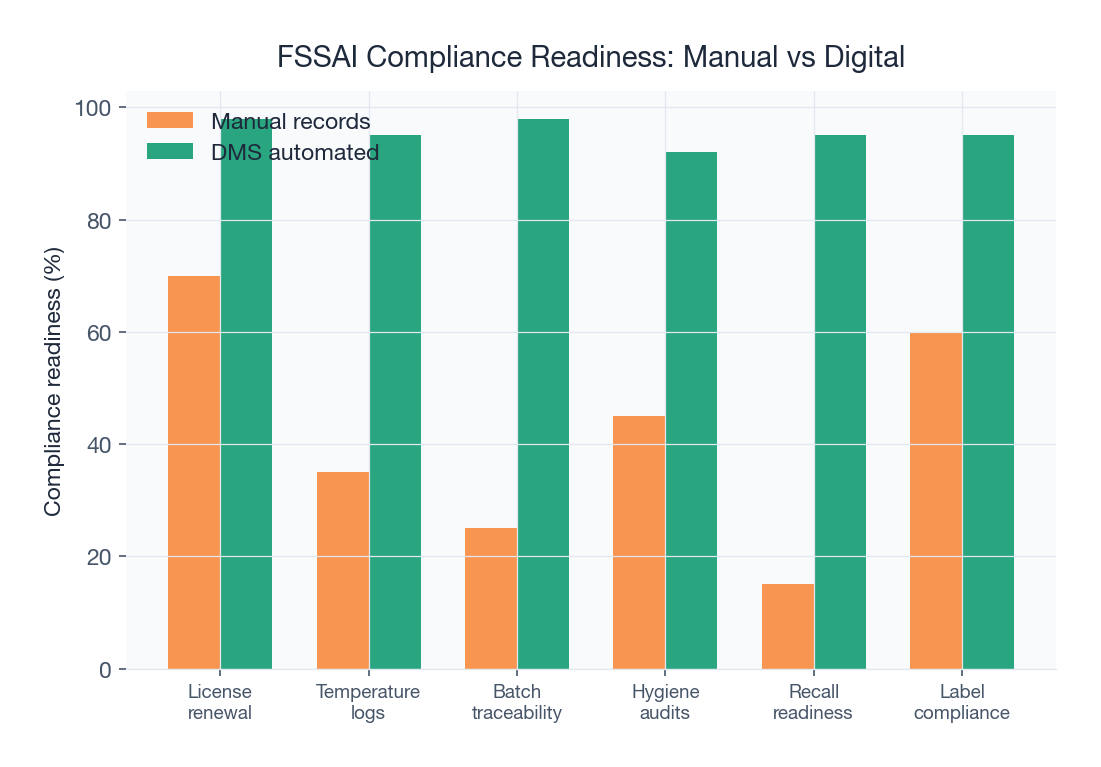
FSSAI's Food Recall Procedure Regulations 2017 require food businesses to have a documented recall plan and the ability to execute it within defined timelines. Class I recalls (serious health risk) require action within 24-48 hours. Without batch-level traceability, identifying which retailers received the affected batch is practically impossible within this window.
Consider a scenario: a dairy plant discovers contamination in a specific production run. They notify distributors with the batch number. If you are managing stock as aggregate quantities (common in manual systems), you have no way to know which of your 500 retailers received products from that specific batch. With batch-level tracking, you can generate the list in minutes.
Record Retention
FSSAI requires traceability records to be maintained for the shelf life of the product plus one year, or a minimum of two years, whichever is longer. For dairy products with short shelf lives, this effectively means two years of batch-level transaction records must be maintained and retrievable during audits.
Understanding Batch-Level Inventory Management
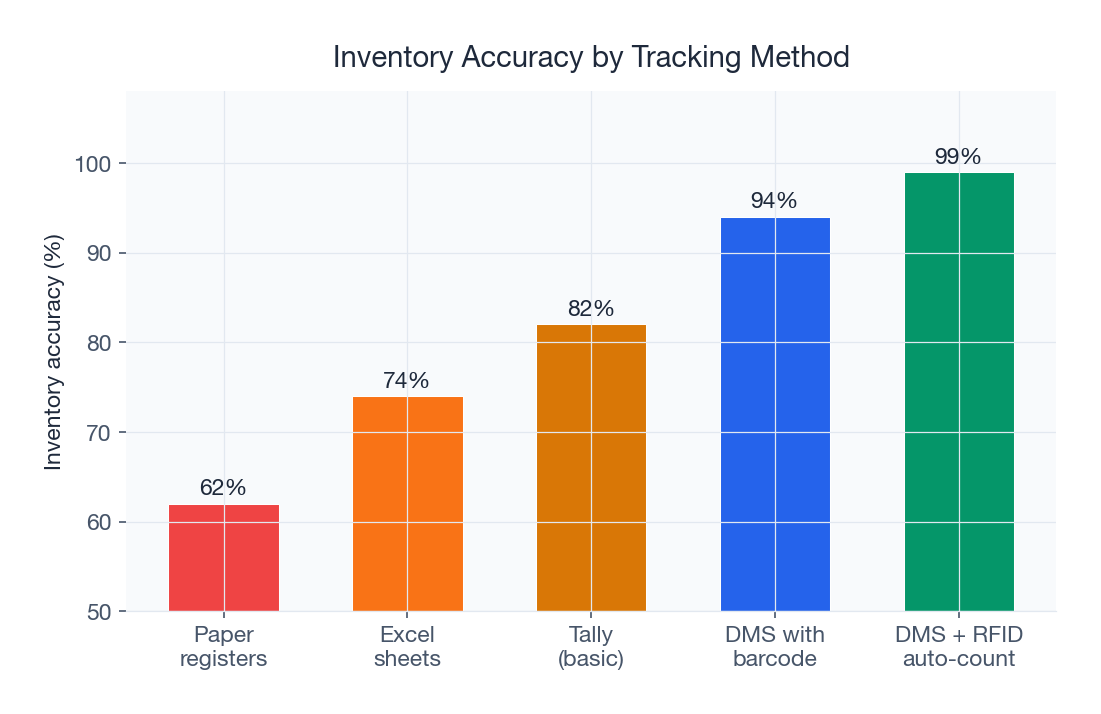
Traditional inventory management tracks stock as aggregate quantities: you have 500 litres of toned milk. Batch-level management tracks the same stock as distinct lots: you have 200 litres from Batch A (produced April 15, expires April 18) and 300 litres from Batch B (produced April 16, expires April 19).
This granularity enables capabilities that aggregate tracking simply cannot provide:
Strict FIFO Enforcement
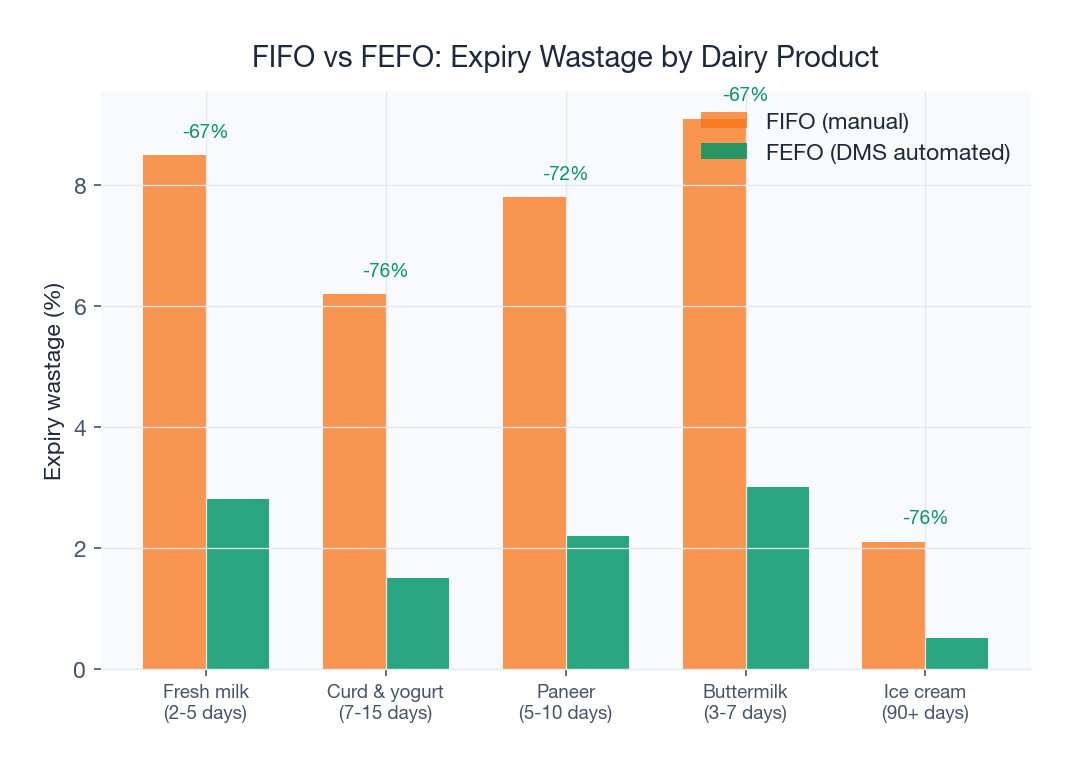
First In, First Out is the golden rule for perishable distribution, but it is surprisingly hard to enforce manually. Warehouse loaders naturally pick from the most accessible pallet, not the oldest batch. With batch-level tracking in a distribution tracking system, the dispatch system generates pick lists that specify exact batch numbers, forcing FIFO compliance.
A dairy distributor in Pune reduced expiry-related returns from Rs 8.5 lakh to Rs 2.1 lakh annually after implementing batch-level FIFO enforcement, a 75% reduction. For a detailed look at expiry management strategies, read expiry management for dairy distribution in India.
Shelf-Life Visibility
When you know the exact production date and expiry of every batch in your warehouse, you gain predictive visibility. The system can alert you when batches are approaching 50% shelf life (time to prioritize dispatch), 75% shelf life (trigger discounted sale or redistribution), and 90% shelf life (flag for potential write-off). This proactive approach replaces the reactive discovery of expired products that costs Indian dairy distributors an estimated Rs 2,000-3,000 crore annually across the industry.
Batch-Level Cost Tracking
Different batches may carry different costs due to procurement price variations, transportation costs, or quality grades. Batch-level tracking enables accurate FIFO or weighted average cost calculations for invoicing and profitability analysis.
QR Code and Barcode-Based Batch Tracking
Technology has made batch tracking operationally feasible even for mid-sized distributors. The most common approach uses QR codes or barcodes encoded with batch information.
How QR Code Batch Tracking Works
The dairy plant prints QR codes on packaging that encode batch number, production date and time, expiry date, plant identifier, product SKU, and quality grade. At each handling point (distributor receipt, warehouse storage, dispatch, retailer delivery), the QR code is scanned using a smartphone or handheld scanner. Each scan creates a timestamped, geo-tagged record in the traceability chain.
For distributors using SpireStock's mobile app, scanning is integrated into the normal receipt and dispatch workflows. The salesman or delivery executive scans the batch QR code during proof of delivery, and the traceability record is complete without any additional steps.
Benefits Beyond Compliance
QR code tracking delivers value beyond regulatory compliance:
- Consumer transparency: End consumers can scan the QR to verify product authenticity, production origin, and freshness, building brand trust
- Anti-counterfeiting: Unique QR codes make it harder for counterfeit products to enter the supply chain, a growing concern in premium dairy segments
- Analytics: Batch-level tracking generates data that reveals quality patterns, identifying production runs with higher return rates, transportation routes with more damage, and retailers with storage issues
Implementing a Recall Management System
A batch tracking system is only as good as its recall capabilities. When a food safety issue arises, the system must answer three questions instantly: Which batches are affected? Where are those batches now? How do we communicate and execute the recall?
Recall Workflow in a Modern DMS
Here is how a technology-enabled recall works for a dairy distributor:
- Step 1: Alert received. The dairy plant or FSSAI notifies you of a batch-level issue, specifying the affected batch number(s).
- Step 2: Impact assessment (5-10 minutes). The DMS instantly queries the batch against all dispatch records and shows exactly which retailers received products from those batches, with quantities, dates, and delivery confirmation status.
- Step 3: Communication (within 1 hour). The system generates recall notifications to affected retailers with product details, return instructions, and credit note commitments. Notifications go out via SMS, app notification, and WhatsApp simultaneously.
- Step 4: Collection and quarantine. Recalled products are collected using fleet management routes optimized for recall pickups. Returned stock is quarantined separately in the system, preventing accidental re-dispatch.
- Step 5: Documentation. The entire recall is documented with timestamps, quantities, and retailer acknowledgments, creating the compliance record that FSSAI requires.
Without batch tracking, this process takes days of phone calls, manual ledger searches, and guesswork. With it, a Class I recall can be fully initiated within 2-4 hours.
Recall Cost Comparison
| Recall Aspect | Without Batch Tracking | With Batch Tracking |
|---|---|---|
| Time to identify affected outlets | 2-5 days | 10-30 minutes |
| Recall scope accuracy | Broad (entire product line recalled) | Precise (only affected batches) |
| Products recalled unnecessarily | 60-80% of recalled stock is unaffected | <5% over-recall |
| Financial impact per recall | Rs 5-20 lakh | Rs 1-4 lakh |
| FSSAI compliance documentation | Incomplete, risky | Complete, audit-ready |
The precision of batch-level recall is its biggest financial benefit. Without it, distributors must recall entire product lines to be safe, destroying far more stock than necessary. With batch tracking, only the specific affected lots are recalled, reducing waste and cost by 60-80%.
Temperature and Cold Chain Integration
For dairy products, traceability is incomplete without temperature data. A batch of paneer may leave the plant in perfect condition but arrive at the retailer compromised because the delivery vehicle's refrigeration failed for 90 minutes mid-route.
Modern batch tracking systems can integrate with IoT temperature sensors in vehicles and cold storage facilities. Temperature readings are logged against batch numbers, creating a continuous cold chain record. If a batch experiences temperature excursion beyond safe limits, the system flags it for inspection or disposal before it reaches consumers.
Distributors operating in hot climates across Hyderabad, Ahmedabad, and Chennai find cold chain monitoring particularly valuable during summer months when ambient temperatures exceed 40 degrees Celsius and cold chain failures are more frequent.
Batch Tracking for Different Dairy Product Categories
Not all dairy products have the same traceability requirements. Here is how tracking needs vary:
| Product Category | Typical Shelf Life | Tracking Priority | Key Concern |
|---|---|---|---|
| Fresh milk (pouch/bottle) | 2-5 days | Critical | Expiry, temperature |
| Curd/yogurt | 7-15 days | High | Expiry, storage temperature |
| Paneer | 5-10 days | High | Temperature abuse, cross-contamination |
| Cheese | 3-6 months | Medium | Batch quality variation |
| Butter/ghee | 6-12 months | Medium | Batch-level quality, adulteration |
| UHT milk | 3-6 months | Medium | Storage conditions, expiry rotation |
| Ice cream | 6-12 months | Medium | Cold chain integrity |
| Milk powder/infant formula | 12-24 months | Critical | Recall readiness, regulatory scrutiny |
Short shelf-life products like fresh milk and paneer demand the most rigorous batch tracking because the window for error is measured in hours, not weeks. These are also the products where dairy distribution software delivers the most dramatic waste reduction.
Implementation Guide for Indian Dairy Distributors
Implementing batch tracking does not require enterprise-grade infrastructure. Here is a practical roadmap for mid-sized dairy distributors:
Phase 1: Digital Foundation (Weeks 1-3)
Deploy a distribution tracking system with batch-level inventory support. Configure product master data with batch fields: batch number, production date, expiry date, and plant origin. Train warehouse staff on batch-wise receipt logging.
Phase 2: Batch-Wise Operations (Weeks 3-6)
Implement batch-wise dispatch through order management. The system generates pick lists specifying which batches to pick (FIFO order). Delivery staff scan or manually enter batch numbers during dispatch confirmation.
Phase 3: QR/Barcode Integration (Weeks 6-10)
Coordinate with your dairy plant supplier(s) to align QR code or barcode formats. Integrate scanning into the mobile app workflow for receipt and delivery. At this point, traceability becomes largely automated.
Phase 4: Analytics and Recall Readiness (Weeks 10-14)
Configure batch-level analytics: return rates by batch, shelf-life utilization, FIFO compliance scores. Build and test the recall workflow with a simulated recall drill. Document the process for FSSAI audit readiness.
Batch Tracking for Multi-Plant Operations
Distributors handling products from multiple dairy plants face additional complexity. Each plant has its own batch numbering scheme, quality parameters, and production schedules. A distributor in Bangalore sourcing from three plants might receive Batch AM-2024-0415 from one plant and Batch 240415-TN from another on the same day.
A multi-plant distribution system normalizes these differences, mapping each plant's batch format into a unified tracking system. This ensures that traceability works consistently regardless of the source plant, and that recall queries can search across all origins simultaneously.
The Business Case: Beyond Compliance
While FSSAI compliance is the regulatory driver, the business benefits of batch tracking often exceed the compliance value:
- Spoilage reduction: 40-60% lower expiry losses from FIFO enforcement and proactive shelf-life management, saving Rs 5-15 lakh annually for mid-sized distributors
- Recall cost minimization: 60-80% lower recall costs from precise batch identification versus broad product recalls
- Quality insights: Batch-level return data identifies production quality issues, problematic transportation routes, and retailer storage problems
- Customer confidence: Brands increasingly require distributors to demonstrate traceability capability as a condition for appointment
- Premium market access: Organized retail chains (D-Mart, Reliance, BigBasket) require batch-level traceability as a listing condition for dairy products
- Insurance and liability: Documented traceability reduces liability exposure and can lower product liability insurance premiums
For distributors serving fresh produce and beverages alongside dairy, batch tracking capabilities extend to these categories as well, with the same compliance and business benefits.
Getting Started with Batch Tracking
The gap between manual register-based tracking and automated batch traceability is not as wide as it seems. Modern distribution management platforms include batch tracking as a core capability, not an expensive add-on. The implementation effort is measured in weeks, not months, and the ROI from spoilage reduction alone typically covers the investment within the first quarter.
If you are a dairy distributor still managing batches through paper registers or basic Excel sheets, the regulatory and business case for upgrading is compelling. Contact SpireStock for a demo of batch-level traceability, or explore our pricing plans to understand the investment. You can also learn more about related capabilities like e-way bill management and inventory management for distributors that complement batch tracking in a complete distribution management solution.
Sources & References
Frequently Asked Questions
One-up-one-down traceability means every participant in the dairy supply chain must be able to identify their immediate supplier (one-up) and their immediate customer (one-down) for every batch of product handled. For a distributor, this means knowing which plant/batch each product came from (one-up) and which retailer/outlet each batch was delivered to (one-down). FSSAI mandates this as the minimum traceability standard for all food businesses in India.
FSSAI penalties for traceability non-compliance range from Rs 5 lakh for first-time violations to Rs 25 lakh for repeated offences under the FSS Act 2006. In severe cases, such as during a food safety incident where traceability records are missing, FSSAI can suspend or cancel the food business license entirely. The 2024 amendments have strengthened enforcement, with more frequent audits especially for dairy and perishable food distributors.
Batch tracking enables strict FIFO (First In, First Out) enforcement at the warehouse level. Without batch visibility, warehouse staff often dispatch the most accessible stock rather than the oldest, leading to expiry of older batches. With batch-level tracking, the system flags the oldest batches for dispatch first, tracks remaining shelf life in real time, and alerts when any batch approaches expiry. Indian dairy distributors implementing batch tracking typically see 40-60% reduction in spoilage-related losses.
Yes, QR codes are increasingly used for dairy batch tracking in India. Each product batch can be assigned a unique QR code that encodes batch number, production date, expiry date, plant of origin, and product details. Distributors and retailers scan QR codes during receipt and dispatch, automatically updating the traceability chain. Consumers can also scan QR codes to verify product authenticity and freshness, a feature gaining importance for premium dairy brands.
FSSAI's Food Recall Procedure Regulations 2017 categorize recalls into Class I (serious health risk, 24-48 hour response), Class II (moderate risk, 72-hour response), and Class III (minor risk, 7-day response). With batch-level traceability in a DMS, a distributor should be able to identify all affected retail outlets within 1-2 hours and initiate recall communication within 4 hours, well within regulatory timelines.
FSSAI traceability requirements apply to all food business operators in India, not just dairy. However, dairy products face stricter scrutiny because of their perishable nature and higher food safety risk. Products like milk, curd, paneer, and cheese require tighter batch tracking with temperature monitoring and shorter shelf-life management compared to packaged FMCG goods with longer shelf lives.
Related SpireStock Features
Real-time GPS tracking of vehicles and drivers with route optimization for faster deliveries.
End-to-end order lifecycle from placement to delivery with multi-level approval workflows.
GST-compliant invoicing with HSN codes, gate passes, and financial ledger.
Related Industries
End-to-end dairy distribution software for milk, curd, paneer, and ghee brands. Manage orders, crates, cold chain, and GST billing in one platform.
Distribution management for fruits, vegetables, and perishable goods. Cold chain tracking, wastage reduction, and daily order management. Try free.
Manage beverage distribution with cold chain tracking, crate management, route optimization, and real-time delivery monitoring. Try SpireStock free.
Related Solutions
Manage your entire distributor network digitally. Onboarding, credit limits, outstanding tracking, and performance analytics. Start free trial.
GPS fleet tracking, driver management, and route optimization for dairy and FMCG delivery vehicles. Reduce fuel costs by 25%. Try SpireStock.
Related Entities
Ready to Streamline Your Distribution?
Start your free 14-day trial and see how SpireStock can transform your dairy, FMCG or consumer-goods distribution operation, from order capture to crate recovery.

SpireStock Team
Distribution Technology Experts
SpireStock Team writes for SpireStock on distribution management, supply-chain optimisation and field operations for Indian dairy and FMCG brands.