The Kirana Store: India's Distribution Foundation
Despite the growth of modern trade and e-commerce, kirana stores account for 80%+ of India's FMCG retail sales. These 12 million small, neighbourhood shops are the backbone of India's consumer goods distribution, and they will remain so for the foreseeable future. No distribution strategy for India can succeed without effectively serving the kirana channel, whether you are selling dairy in Lucknow, biscuits in Kolkata, or beverages in Chennai.
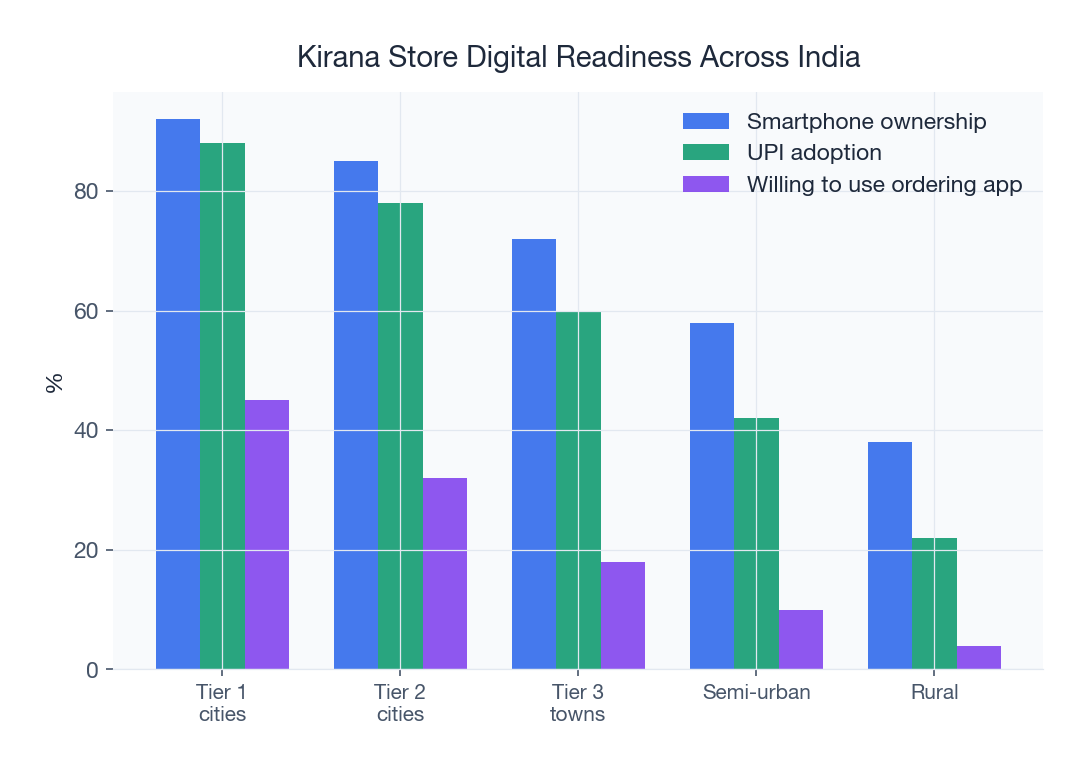
Yet the interface between brands/distributors and kirana stores remains largely manual: salesmen visit, take orders on paper, and distributors deliver based on handwritten lists. Technology is changing this fundamental interaction, creating efficiency for both sides, and the pace of change accelerated sharply post-2023 as UPI adoption crossed 450 million users and low-cost smartphones reached nearly every shopkeeper.
Current Challenges in Kirana Distribution
1. Manual Ordering Inefficiency
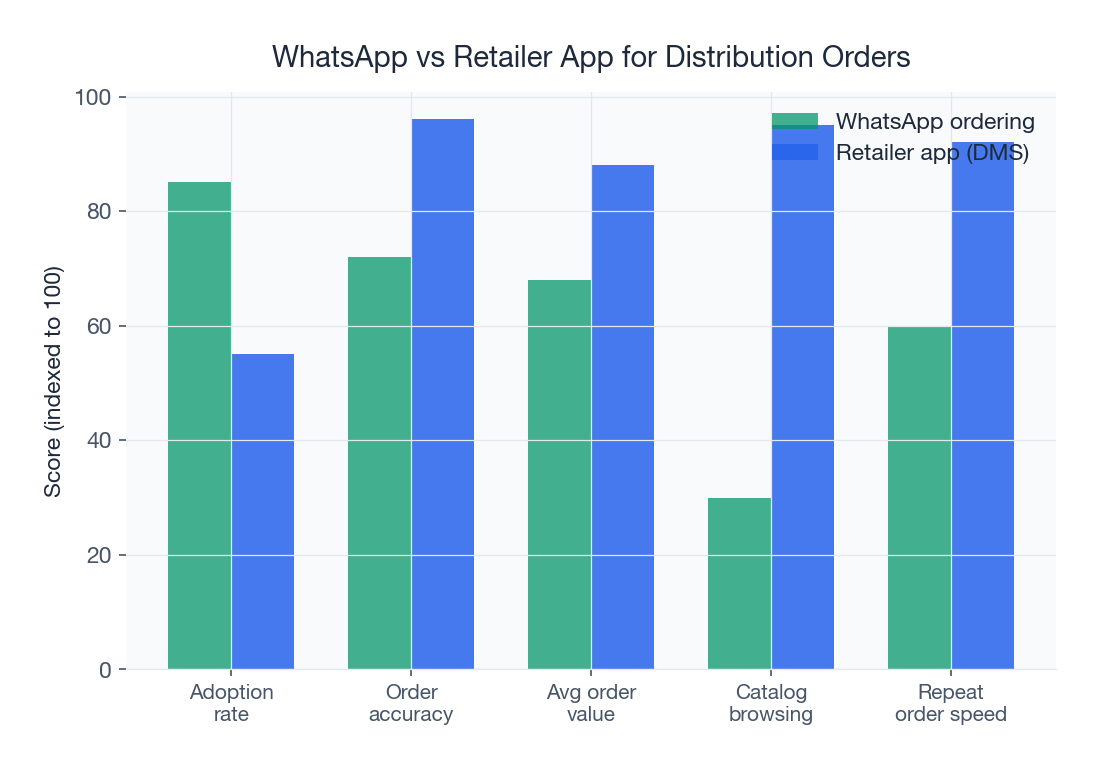
Kirana owners typically place orders through visiting salesmen, phone calls, or WhatsApp messages. This process is time-consuming for both parties, error-prone, and generates no useful data. Digital ordering platforms can transform this interaction.
2. Poor Demand Visibility
Brands have limited visibility into what kiranas actually sell. Primary sales data shows what distributors buy, but not what reaches the consumer. Without secondary sales analytics, demand planning is based on guesswork.
3. Scheme Leakage
Trade promotions intended for kiranas often get absorbed by intermediaries. Without a digital scheme engine, brands cannot verify that kirana owners receive the intended benefits.
4. Credit and Payment Issues
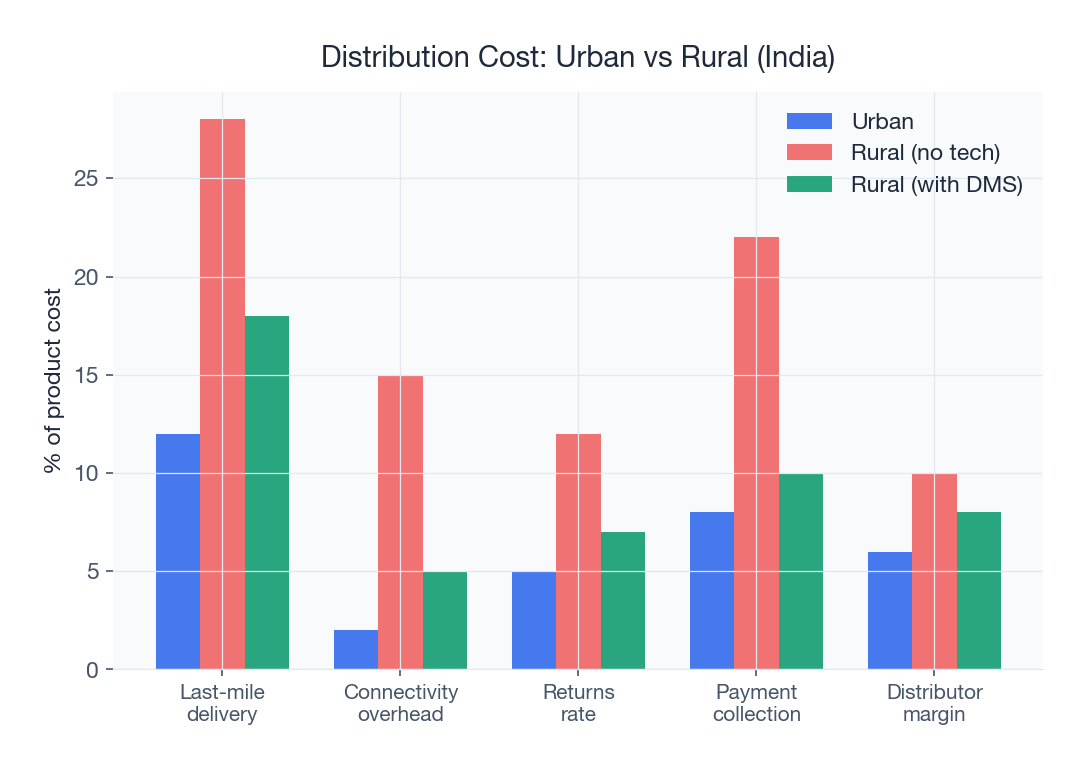
Cash-based transactions and informal credit create payment disputes and collection challenges. Digital payment collection and automated ledger management reduce friction and improve cash flow for both distributors and kiranas.
5. Logistics Complexity
Serving thousands of small outlets with diverse order sizes across dense urban areas requires sophisticated route planning that manual processes cannot deliver efficiently.
Traditional vs Digital Kirana Distribution: A Feature Matrix
| Capability | Traditional Model | Digital Model | Winner |
|---|---|---|---|
| Order capture | Paper / WhatsApp | Retailer app | Digital |
| Pricing accuracy | Memorised / guesswork | Centrally controlled catalog | Digital |
| Scheme delivery | Verbal / leaflet | Auto-applied at billing | Digital |
| Payment | Cash, cheque, credit | UPI + digital ledger | Digital |
| Delivery tracking | None | GPS + ETA | Digital |
| Returns & damages | Manual note | Photo + workflow | Digital |
| Relationship | Salesman rapport | Salesman + app | Hybrid |
| Setup cost | Nil | Rs 2-5 lakh | Traditional |
Technology Solutions for Kirana Distribution
Retailer Ordering Apps
Simple, vernacular-language apps that allow kirana owners to:
- Browse product catalogs with prices and offers
- Place orders with a few taps
- Track order status and expected delivery time
- View their purchase history and payment status
- Access applicable schemes and promotions
The key is simplicity. Kirana apps must work on basic smartphones, support Hindi and regional languages, and require minimal training to use. Some brands follow the Britannia model of combining app-based ordering with retailer tracking scorecards that reward loyal kiranas.
Automated Distribution Management
On the distributor and brand side, FMCG distribution platforms automate the entire kirana-serving workflow:
- Order aggregation from multiple kiranas into optimized delivery routes
- Route planning for efficient multi-stop delivery across dense kirana networks
- Automated billing with GST compliance
- Real-time delivery tracking and proof of delivery
Data Analytics for Kirana Insights
Analytics dashboards that aggregate kirana-level data provide unprecedented visibility:
- Product-wise sales trends by locality and kirana segment
- Order frequency patterns that reveal loyalty and engagement
- Scheme uptake rates that measure promotion effectiveness
- Coverage metrics that identify underpenetrated areas
Benefits for Kirana Owners
- Faster ordering, Place orders anytime, not just when the salesman visits
- Better prices, Direct access to schemes and promotions
- Reliable delivery, Track when orders will arrive
- Credit visibility, Always know outstanding balance and payment status
- Product discovery, Browse full catalog including new products
- Access to multiple brands, Distributors serving dairy, beverages, and bakery can offer a unified catalog
Benefits for Brands and Distributors
- Higher order frequency, Digital ordering removes the friction of waiting for salesman visits
- Better demand data, Every digital order is a data point for demand planning
- Scheme control, Digital tracking ensures promotions reach intended recipients
- Operational efficiency, Automated processes serve more kiranas with fewer resources
- Market intelligence, Real-time visibility into kirana-level sales patterns
- Lower fraud, GPS check-ins combined with attendance tracking eliminate ghost orders
Adoption Strategies, Step by Step
- Segment your kiranas, Rank by monthly value, order frequency, and category share
- Start with the top 20%, Onboard top kiranas that generate 80% of revenue first
- Offer incentives, Provide digital ordering discounts or exclusive offers to drive app adoption
- Train at the store, Have field staff demonstrate the app during regular visits
- Support in local languages, Hindi, Tamil, Gujarati, Marathi, whatever the local language is
- Maintain salesman visits, Digital ordering supplements, not replaces, relationship-driven sales initially
- Measure and iterate, Weekly app-adoption scorecard by territory
Digital Kirana Success Metrics
Track these KPIs to measure whether your kirana digitization programme is working:
- Percentage of target kiranas actively using the app each month
- Share of orders coming through the app vs salesman
- Average order value and order frequency uplift
- Scheme redemption rate (app vs manual)
- Payment cycle time reduction
- Return and damage rate improvement
Within 6-12 months of a well-executed programme, brands typically see app-based orders move from zero to 40-60% of kirana volume, and unlock the data and efficiency that unlocks every downstream trend. Book a kirana digitization workshop, check SpireStock plans, or explore related content on the blog.
The Kirana-Distributor-Brand Value Triangle
Kirana digitisation is never a single-player game. Each corner of the triangle, kirana owner, distributor, brand, has to see value or the programme stalls. Here is the short version of what each party wants:
What Kiranas Want
- Lower prices and better schemes
- Consistent delivery so they never run out of fast movers
- Flexible credit and easy reconciliation
- Access to new SKUs and category knowledge
- Minimum friction in their daily ordering routine
What Distributors Want
- Higher order value per retailer visit
- Fewer disputes over schemes and payments
- Better route productivity through route optimization
- Lower returns and damages
- Faster working capital cycles via digital collection
What Brands Want
- Visibility into secondary sales in every pin code
- Proof that scheme spend is actually landing with retailers
- Ability to launch new products and track adoption
- Early-warning indicators for competitor moves
- Cost-effective coverage of long-tail outlets
A kirana programme that addresses all three corners at once wins. One that privileges brand visibility at the expense of kirana convenience fails within months.
City-Level Playbooks
Kirana dynamics vary significantly by city. Here is a rough guide:
- Mumbai & Pune, High kirana density, strong brand competition, modern trade pressure. Digital adoption is faster here because shopkeepers already use UPI heavily.
- Delhi NCR, Diverse ownership types, strong wholesale markets like Sadar Bazaar, kirana diversity requires flexible app design.
- Bangalore & Hyderabad, Tech-forward kiranas with younger owners; great first-wave digitisation markets.
- Chennai, Tamil-language support is mandatory. Kirana owners prefer voice-based demos over text training.
- Kolkata, Traditional relationships dominate; digital ordering works best when introduced alongside existing salesman relationships.
- Jaipur, Ahmedabad, Lucknow, Tier 2 cities with strong regional brand loyalty; app adoption slower but sticky once established.
Handling Common Objections from Kirana Owners
Field teams regularly hear the same objections when introducing kirana apps. Here is how to respond:
- "I don't have time for this", Show them how a 90-second order replaces a 10-minute phone call with the salesman.
- "My salesman knows what I need", Position the app as a tool for the salesman to do more, not less.
- "What if I make a mistake?", Show the order confirmation screen and 30-minute edit window.
- "My phone is too old", Ensure your app works on Rs 8,000 Android phones. If it doesn't, fix the app.
- "Who will help me with schemes?", Schemes appear automatically in the app; no more guessing.
- "I don't trust digital payment for wholesale", Start with cash-on-delivery while the retailer builds trust; gradually introduce UPI.
Beyond Ordering: What Kirana Apps Can Become
The first version of a kirana app is usually a simple ordering tool. Version 2 layers on credit insights, scheme tracking, and inventory recommendations. Version 3 starts to offer financial services, bill payment, recharge, and even micro-lending to the shopkeeper. Version 4 turns the app into the kirana owner's primary operating system. Indian fintech and FMCG players are converging on this future, the question is who owns the last-mile relationship.
Case Study: A Dairy Brand in South India
A regional dairy brand with Rs 150 crore revenue in Tamil Nadu and Karnataka rolled out a kirana app to 4,200 outlets over 9 months. Results after 12 months:
- 68% of target kiranas placed at least one order via app in the last 30 days
- App-based orders contributed 53% of volume from those kiranas
- Average order frequency rose from 2.1 to 3.4 orders per week
- Scheme redemption climbed from 41% to 87%
- Payment cycle shortened from 18 days to 11 days
- Field officer productivity improved by 35%, allowing expansion to 1,200 new kiranas without headcount growth
The lesson: kirana digitisation is not just about technology. It is about redesigning the entire distribution operating model around a simpler, faster interaction with India's 12 million-strong retail backbone.
Pitfalls That Sink Kirana Programmes
For every successful kirana digitisation programme, two or three stall out. The most common reasons:
- Building for brands, not kiranas, Features that matter to marketing teams (banner ads, product carousels) crowd out the core ordering flow. Retailers get frustrated and abandon the app.
- Mandating without incentivising, Telling distributors to push the app without offering clear commercial upside to kiranas. Adoption hovers at 10-15% and never takes off.
- Skipping vernacular, English-only interfaces fail in most of India outside metro cores.
- Ignoring basic connectivity issues, Heavy-data apps that crash on 2G networks. Test every screen on the worst Android device you can find.
- Breaking distributor economics, If app orders cut into distributor margins without compensating mechanisms, distributors will sabotage rollout.
Integrating With the Wider Distribution Stack
A kirana app is not a standalone product. To deliver real business impact, it must integrate with:
- Order management for upstream aggregation and fulfilment
- Route optimization so orders translate into efficient delivery
- Billing for GST-compliant invoices
- Crate tracking so returnables reconcile automatically
- Scheme engine for automatic promotion application
- Sales analytics for brand-level visibility
- Payment collection for UPI-linked receivables
When all seven components share the same data fabric, the entire distribution system lifts. Bolt-on kirana apps that sit outside the broader stack tend to plateau after 12-18 months.
How to Pilot a Kirana Programme in 90 Days
If you want to run a lean kirana pilot before committing to a full rollout, this 90-day plan works well:
- Days 1-15: Identify 100-150 target kiranas in one territory. Segment them by value, order frequency, and relationship strength.
- Days 16-30: Customise the app catalogue, schemes, and vernacular content for the territory. Train distributor and field team.
- Days 31-60: Onboard target kiranas in batches of 20. Daily standups with the pilot team to catch issues early.
- Days 61-90: Review KPIs, refine the playbook, prepare scale-up plan. Aim for at least 50% app-order share by day 90.
The pilot approach de-risks the rollout and creates an internal proof point that makes scale-up much easier.
The Role of Credit and Working Capital
Kirana owners operate on tight working capital. Their ability to buy from your brand depends on how quickly their own sales convert into cash. Any kirana digitisation programme should therefore include a working capital angle:
- Early-payment discounts for UPI-linked settlements
- Invoice-financing partnerships with fintech lenders
- Dynamic credit limits based on payment collection history
- Flexible payment terms for high-performing kiranas
- Optional deferred payment on slow-moving SKUs with proven demand
Brands that solve the working capital problem become preferred partners for kiranas, unlocking larger order sizes and longer-term loyalty.
Looking Beyond 2026
The kirana channel will not disappear, but it will evolve rapidly. Expect more digital natives running kiranas (younger owners), more hybrid commerce (kirana + quick commerce), and more data-driven category management (kiranas using analytics to optimise their own shelves). Brands that invest in the kirana relationship now will find themselves irreplaceable partners to India's most important retail channel in the years ahead.
Sources & References
Frequently Asked Questions
Kirana stores account for over 80% of India's FMCG retail sales. With 12 million+ stores across the country, the kirana channel remains the most critical distribution channel for any FMCG or dairy brand operating in India.
Yes, with the right design. Kirana ordering apps must be simple, work on basic smartphones, support regional languages, and require minimal training. India's rapidly growing smartphone penetration and UPI familiarity make kirana digitization increasingly feasible.
Technology enables digital ordering (replacing manual processes), automated route optimization for efficient delivery, real-time tracking, automated billing, scheme management, and data analytics, improving efficiency for both distributors and kirana owners.
Not in the foreseeable future. While modern trade and e-commerce are growing, kirana stores' unmatched reach (every neighbourhood), personal relationships, credit flexibility, and convenience ensure their continued dominance in Indian FMCG distribution.
Yes. SpireStock supports retailer-level ordering apps, multi-stop route optimization for kirana delivery, automated billing, and analytics that provide visibility into kirana-level sales patterns and trends.
Related SpireStock Features
Real-time GPS tracking of vehicles and drivers with route optimization for faster deliveries.
Mobile app for distributors, retailers, and delivery teams.
End-to-end order lifecycle from placement to delivery with multi-level approval workflows.
Related Industries
Related Solutions
Track and manage your retail network. Geo-tag outlets, capture secondary sales, manage beats, and monitor retailer performance. Try SpireStock.
Boost field sales team productivity with beat planning, GPS attendance, order capture, and performance analytics. Built for Indian FMCG teams.
Related Entities
Ready to Streamline Your Distribution?
Start your free 14-day trial and see how SpireStock can transform your dairy, FMCG or consumer-goods distribution operation, from order capture to crate recovery.

SpireStock Team
Distribution Technology Experts
SpireStock Team writes for SpireStock on distribution management, supply-chain optimisation and field operations for Indian dairy and FMCG brands.