WhatsApp Is India's Unofficial Order Management System
No business software company planned it this way, but WhatsApp has become the single largest order channel for Indian FMCG and dairy distribution. A 2024 survey by RedSeer Strategy Consultants estimated that over 65% of secondary sales orders from kirana stores to distributors in India flow through WhatsApp messages, voice notes, text lists, and forwarded photos of handwritten orders. That's more than any ERP, any DMS, any order portal, and any app, combined.
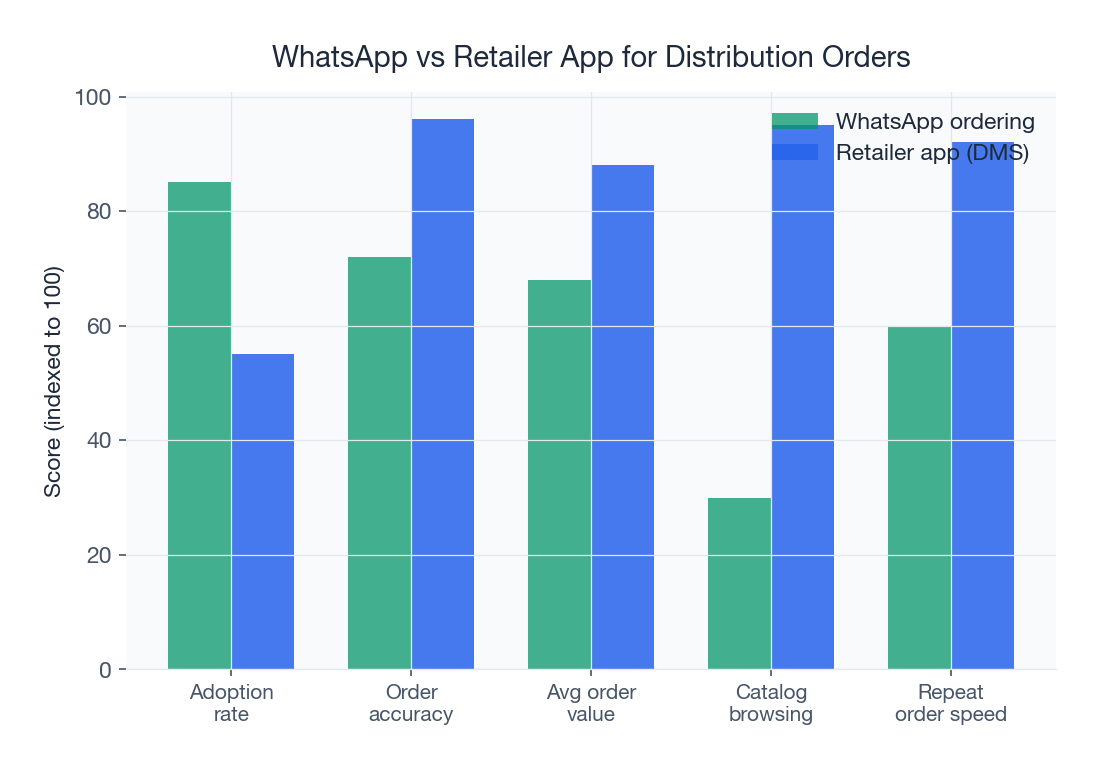
The reason is simple: WhatsApp is already on every retailer's phone. There's no app to install, no login to remember, no training required. A kirana store owner in Pune sends "20 Amul butter 500g, 10 curd 400g, 5 paneer" to their distributor's sales number at 9 PM, and expects delivery by 7 AM. This workflow has worked for years, and retailers fiercely resist anything that replaces it.
Yet this convenience comes at a staggering hidden cost. This article examines why WhatsApp dominates, quantifies the cost of WhatsApp-based ordering, and shows how to upgrade to structured order management without abandoning the channel your retailers love. For context on order management systems in general, see our dairy order management guide.
Why WhatsApp Became India's #1 Order Channel
- Universal adoption: India has over 500 million WhatsApp users (Meta, 2024). Every retailer, salesman, and distributor is already on the platform.
- Zero onboarding: Unlike a DMS app, WhatsApp requires no training, no new account, and no change in behaviour.
- Asynchronous ordering: Retailers place orders at their convenience, late night, early morning, during breaks, not during fixed ordering windows.
- Rich media: Photos of empty shelves, voice notes explaining requirements, and forwarded supplier catalogues work within the existing WhatsApp interface.
- Trust and familiarity: WhatsApp groups build personal relationships between distributors and retailers that formal systems cannot replicate.
The Hidden Cost of WhatsApp Chaos
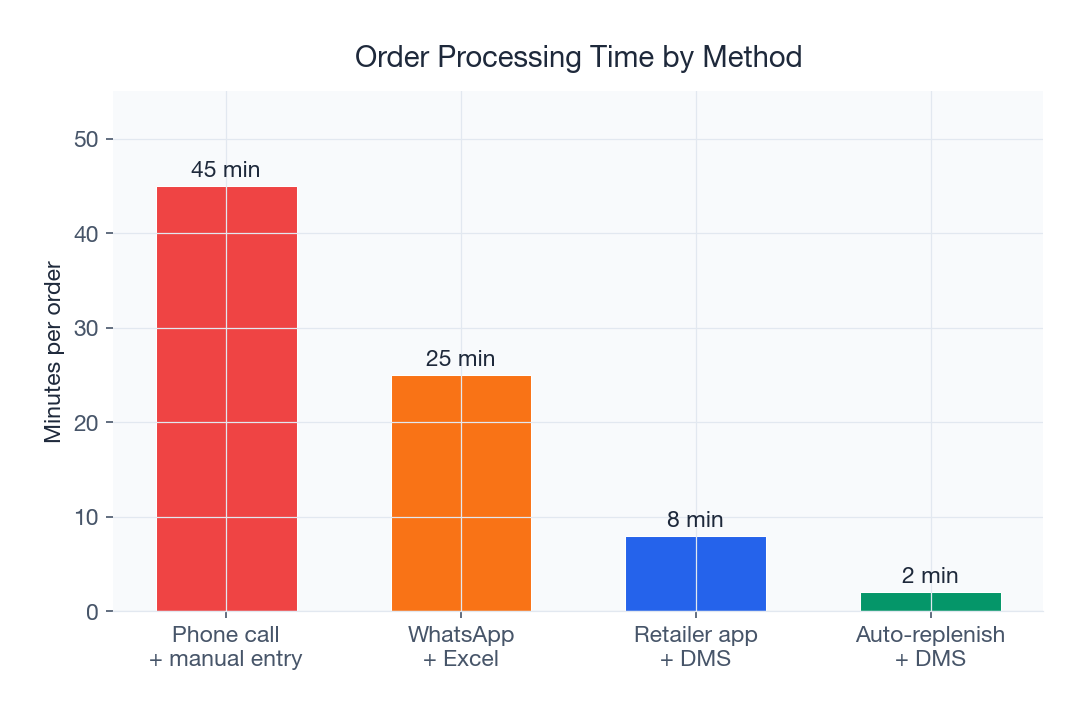
Despite its convenience, WhatsApp-based ordering creates serious operational problems that worsen as you scale. Let's quantify the cost for a mid-sized distributor handling 200 orders per day across 5 salesmen.
Cost Calculation: WhatsApp Order Chaos (Per Month)
| Problem | Frequency | Cost Per Incident | Monthly Cost (INR) |
|---|---|---|---|
| Missed orders (buried in chat) | 8-12 per day | Rs 800 avg. order value | Rs 1,92,000-2,88,000 |
| Duplicate orders (same message forwarded twice) | 3-5 per day | Rs 400 return/restock cost | Rs 36,000-60,000 |
| Wrong SKU (misread abbreviation) | 5-8 per day | Rs 250 correction cost | Rs 37,500-60,000 |
| Scheme disputes (no proof of order terms) | 15-20 per month | Rs 1,500 avg. credit note | Rs 22,500-30,000 |
| Manual data entry into DMS/Tally | 200 orders × 5 min each | Rs 150/hour staff cost | Rs 75,000 |
| Payment reconciliation errors | 10-15 per month | Rs 2,000 avg. discrepancy | Rs 20,000-30,000 |
Total estimated monthly cost: Rs 3.8-5.4 lakh, for a single mid-sized distributor. Scale this across a brand's 500-distributor network and the annual cost of WhatsApp chaos exceeds Rs 200 crore. According to a 2023 CII-KPMG report on Indian distribution efficiency, unstructured ordering is the second-largest source of distributor profitability leakage after scheme miscalculation.
The Five Core Problems with WhatsApp Orders
1. No Structured Data
WhatsApp messages are free text. "10 taza 500" could mean 10 units of Taza milk 500ml, 10 cases of Taza curd 500g, or something else entirely. Without structured product codes, quantities are ambiguous, units are assumed, and schemes cannot be auto-applied. Every order requires human interpretation, which introduces errors that cascade through billing, dispatch, and delivery.
2. No Audit Trail
When a retailer disputes an order, claiming they ordered 20 units, not 10, the only "proof" is a WhatsApp chat that may have been edited, deleted, or buried under 200 subsequent messages. This creates endless he-said-she-said disputes that drain management time and erode trust. A proper order management system timestamps every action with user identity, creating an indisputable record.
3. No Inventory Visibility
When a retailer orders via WhatsApp, they have no idea whether the product is in stock. The salesman may not know either. This leads to partial fulfillment, back-orders, and disappointed retailers who eventually switch to competitors.
4. No Scheme Application
Indian FMCG distribution runs on complex trade schemes, buy 10 get 1 free, slab-based discounts, seasonal promotions, retailer-tier-specific pricing. WhatsApp orders cannot trigger scheme logic. Schemes are applied manually (or forgotten), leading to either scheme leakage or retailer dissatisfaction when promised discounts don't appear on the invoice.
5. No Demand Forecasting
WhatsApp orders are invisible to analytics engines. You cannot forecast demand, identify ordering patterns, spot declining retailers, or optimize inventory across warehouses when your order data lives in 50 different WhatsApp conversations that no system can parse.
The Hybrid Approach: WhatsApp as Front-End, DMS as Back-End
The solution isn't to kill WhatsApp, your retailers will revolt. The solution is to keep WhatsApp as the ordering interface while routing messages into a structured order management system automatically. Here's how the hybrid approach works:
- Retailer sends order via WhatsApp, exactly as they do today, to the same number
- WhatsApp Business API captures the message, using an official API integration (not screen scraping)
- AI/NLP engine parses the message, extracting product names, quantities, and units from unstructured text
- Parsed order appears in the DMS, as a structured, editable order with correct SKU codes and scheme logic pre-applied
- Salesman reviews and confirms, fixing any parsing errors before the order enters the fulfillment pipeline
- Confirmation sent back to retailer via WhatsApp, with order summary, applied schemes, expected delivery time
- Order flows into dispatch, billing, delivery, fully tracked, auditable, and reportable
This approach preserves retailer convenience while giving distributors structured data, audit trails, scheme automation, and analytics. The retailer experiences zero change. The distributor gains complete operational control.
What to Look for in a WhatsApp-to-DMS Integration
Not all integrations are equal. The key differentiators are:
- Official WhatsApp Business API, not grey-market scraping solutions that violate Meta's terms and risk number bans
- NLP accuracy above 90%, the parsing engine must handle Hindi, Marathi, Tamil, and English mixed-language messages
- Human-in-the-loop, always allow a salesman to review parsed orders before confirmation
- Two-way communication, retailers should receive order confirmations, delivery updates, and payment receipts via WhatsApp
- Catalogue sharing, push product catalogues with current prices and schemes to retailer WhatsApp groups
SpireStock's order management module supports WhatsApp Business API integration, allowing retailers to continue ordering the way they always have while your back-office gets clean, structured, actionable data. Explore the full multi-plant distribution workflow for brands managing multiple production units.
Migration Roadmap: From WhatsApp Chaos to Hybrid Order Management
- Week 1-2: Audit current WhatsApp ordering volume, count daily messages, categorize by retailer, identify the 20% of retailers generating 80% of order volume
- Week 3: Set up WhatsApp Business API with your DMS provider. Map product aliases (the informal names retailers use) to actual SKU codes
- Week 4: Run parallel processing, orders come via WhatsApp AND get parsed into the DMS. Salesmen verify accuracy. Measure parsing success rate
- Week 5-6: Enable auto-confirmation for high-confidence orders (parsing confidence > 95%). Manual review for low-confidence orders
- Week 7-8: Roll out retailer-facing features, order confirmations, delivery ETA, payment receipts via WhatsApp. Measure retailer satisfaction
Conclusion
WhatsApp isn't going away as India's primary order channel, and it shouldn't. Retailers love its simplicity, and any solution that forces them to change behavior will fail. The smart approach is a hybrid system that preserves WhatsApp as the front-end while routing orders into a structured distributor management system that handles scheme logic, inventory checks, billing, and analytics automatically. The distributors who get this right will serve their retailers better, lose fewer orders, and make significantly more money. Contact us to explore WhatsApp integration with SpireStock.
Sources & References
Frequently Asked Questions
WhatsApp handles over 65% of secondary sales orders in Indian FMCG distribution because it requires zero onboarding, is already on every retailer's phone, supports asynchronous ordering at any time, and enables rich media communication. Retailers resist switching to unfamiliar apps, making WhatsApp the path of least resistance for order placement.
A mid-sized distributor handling 200 orders/day can lose Rs 3.8-5.4 lakh per month from missed orders, duplicate orders, wrong SKUs, scheme disputes, manual data entry, and payment reconciliation errors caused by unstructured WhatsApp ordering. Across a 500-distributor brand network, this can exceed Rs 200 crore annually.
A WhatsApp-to-DMS integration uses the official WhatsApp Business API to capture retailer order messages, parse them using AI/NLP into structured data (product codes, quantities, schemes), and feed them into a distributor management system for processing, billing, and delivery. Retailers continue ordering via WhatsApp while the distributor gets clean, auditable, actionable data.
Modern NLP engines achieve 85-95% accuracy parsing WhatsApp orders in Hindi, Marathi, Tamil, and mixed-language messages. A human-in-the-loop review step catches the remaining errors. Accuracy improves over time as the system learns retailer-specific product aliases and ordering patterns.
A typical WhatsApp-to-DMS integration takes 6-8 weeks: 2 weeks for auditing current WhatsApp volume and product alias mapping, 1 week for API setup, 2 weeks for parallel run and accuracy tuning, and 2 weeks for retailer-facing feature rollout (confirmations, delivery updates, receipts via WhatsApp).
No. The hybrid approach preserves the existing WhatsApp ordering experience completely. Retailers send orders exactly as they do today, via text, voice notes, or photos. The automation happens on the distributor side, where messages are parsed into structured orders. Retailers may notice improvements like order confirmations and delivery updates arriving via WhatsApp.
Related SpireStock Features
Related Industries
Streamline FMCG distribution with order management, beat planning, retailer tracking, and GST billing. Built for Indian FMCG supply chains.
End-to-end dairy distribution software for milk, curd, paneer, and ghee brands. Manage orders, crates, cold chain, and GST billing in one platform.
Related Solutions
Manage your entire distributor network digitally. Onboarding, credit limits, outstanding tracking, and performance analytics. Start free trial.
Boost field sales team productivity with beat planning, GPS attendance, order capture, and performance analytics. Built for Indian FMCG teams.
Related Entities
Ready to Streamline Your Distribution?
Start your free 14-day trial and see how SpireStock can transform your dairy, FMCG or consumer-goods distribution operation, from order capture to crate recovery.

SpireStock Team
Distribution Technology Experts
SpireStock Team writes for SpireStock on distribution management, supply-chain optimisation and field operations for Indian dairy and FMCG brands.