The Transformation of Indian FMCG Distribution
India's FMCG distribution industry, valued at over Rs 8 lakh crore and growing at 8-10% annually, is experiencing its most significant transformation in decades. The convergence of technology, changing consumer expectations, regulatory shifts like GST e-invoicing and EPR, and competitive pressures is reshaping how products move from factory to consumer across Mumbai, Delhi, Bangalore, and thousands of tier 2-3 towns. Companies that understand and adapt to these trends will thrive; those that don't will be disrupted.
This trend report goes deep on the seven most important shifts for 2026, with market data, timelines, and concrete examples from dairy, beverages, bakery, and broader consumer goods.
Market Snapshot: Indian FMCG Distribution 2026
| Metric | 2023 | 2026 (est.) | 2028 (forecast) |
|---|---|---|---|
| Total FMCG market (INR crore) | 6,50,000 | 8,20,000 | 10,50,000 |
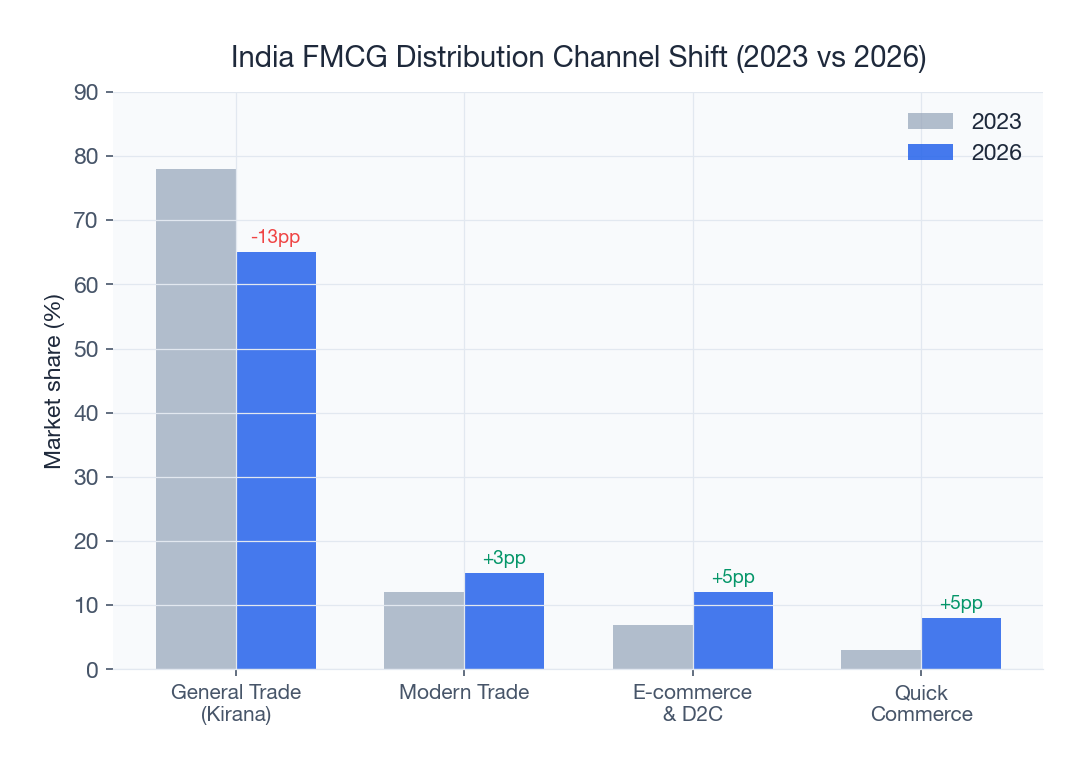
| Kirana share of FMCG sales | 85% | 80% | 76% |
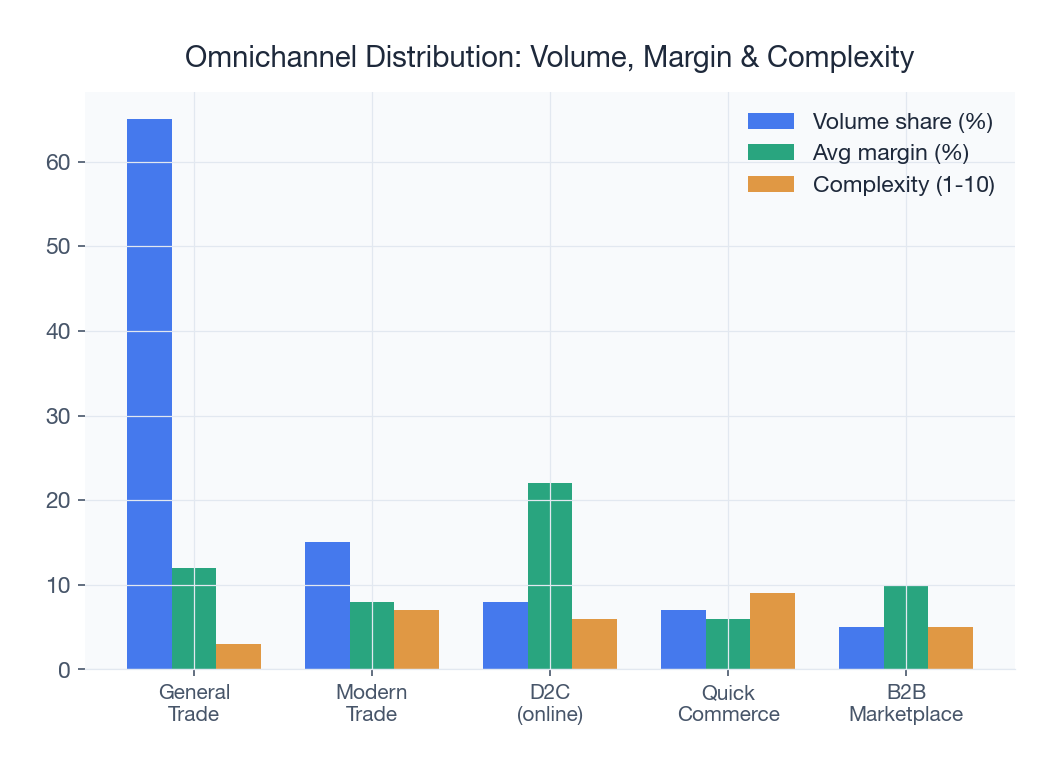
| Quick commerce share | 2% | 7% | 12% |
| Distributors on digital platforms | 25% | 55% | 80% |
| Orders placed via mobile app | 40% | 90% | 98% |
| EV share of urban last-mile fleet | 1% | 8% | 22% |
Trend 1: AI-Powered Distribution Intelligence
Artificial intelligence is moving from buzzword to practical tool in FMCG distribution. In 2026, AI is being used for:
- Demand forecasting, AI models that predict retailer-level demand with 85-90% accuracy, reducing both stockouts and excess inventory
- Dynamic route optimization, Route algorithms that learn from historical patterns and adapt to real-time conditions
- Anomaly detection, Identifying unusual patterns in orders, returns, and payments that may indicate fraud or operational issues
- Pricing optimization, AI-driven pricing that considers competition, demand elasticity, and inventory levels
For dairy distributors, AI-powered demand forecasting is particularly valuable given the perishable nature of products, over-forecasting means spoilage, under-forecasting means lost sales. Amul, Mother Dairy, and Country Delight have all publicly disclosed AI-led forecasting initiatives.
Trend 2: Direct-to-Retail (D2R) Models
Traditional FMCG distribution involves multiple intermediaries: company → C&F agent → super stockist → distributor → retailer. The D2R model compresses this chain, enabling brands to reach retailers more directly. Technology platforms make D2R viable by:
- Enabling retailers to order directly through apps
- Optimizing logistics for direct delivery from warehouses to retail
- Providing real-time visibility into sales and inventory at every level
- Managing multi-plant fulfilment through multi-plant distribution capabilities
While traditional distribution isn't disappearing, the D2R trend is forcing distributors to add more value beyond simple product forwarding.
Trend 3: Mobile-First Distribution Operations
The smartphone has become the primary tool for distribution operations in India. In 2026:
- 90%+ of distributor orders are placed via mobile app
- Field force management is entirely app-based with GPS tracking and digital attendance
- Delivery confirmation, payment collection, and crate management happen on mobile
- Distributors access real-time dashboards and reports on their smartphones
The shift to mobile isn't just about convenience, it generates the data that powers AI, analytics, and optimization.
Trend 4: Sustainability and Regulatory Tightening
Environmental sustainability is emerging as a distribution consideration, driven by consumer awareness and regulatory direction, particularly the revised Plastic Waste Management Rules and Extended Producer Responsibility (EPR) obligations:
- Route optimization reduces fuel consumption and carbon emissions
- Returnable packaging systems tracked through asset management platforms reduce single-use packaging waste
- Electric delivery vehicles are being piloted in urban distribution networks, especially in Delhi, Bangalore, and Pune
- Optimized inventory reduces food waste from unsold perishable products
Trend 5: Data-Driven Distributor Management
The era of managing distributors by gut feel is ending. In 2026, leading FMCG companies:
- Use digital scorecards to evaluate distributor performance objectively
- Tie scheme eligibility to data-verified performance metrics
- Make territory expansion decisions based on analytics, not politics
- Identify at-risk distributors through early warning indicators before relationships deteriorate
Trend 6: Quick Commerce Impact
Quick commerce platforms (Blinkit, Zepto, Instamart, BBNow) are reshaping urban FMCG distribution. Their impact on traditional distribution includes:
- Pressure on kirana stores, forcing distributors to help retailers compete on convenience
- New distribution channels that require different fulfillment capabilities
- Expectation of faster, more frequent deliveries across all channels
- Opportunity for brands to use both traditional and quick commerce channels
- New dark-store operating models in Hyderabad, Chennai, and Kolkata
Trend 7: Multi-Tenant, Multi-Plant Platforms
Large brands no longer run one ERP per region. They use multi-tenant workspaces that give corporate a top-down view while letting each plant and depot run its own beverage, bakery, or dairy operation independently. This architecture is becoming table-stakes for any brand with more than three plants or five regional warehouses.
Technology Shift Timeline
| Year | Mainstream Tech | Early-Adopter Tech |
|---|---|---|
| 2023 | ERP + Excel | Mobile salesforce apps |
| 2024 | Mobile salesforce apps | Route optimisation, IoT temp sensors |
| 2025 | Route optimisation, IoT temp sensors | AI forecasting, scheme engines |
| 2026 | AI forecasting, scheme engines | LLM-driven retailer assistants |
| 2027 | LLM-driven retailer assistants | Autonomous last-mile, EV fleets |
What This Means for Dairy and FMCG Distributors
The common thread across all these trends is technology. Every major shift in FMCG distribution is enabled or accelerated by digital tools. Distributors and brands that invest in distribution technology platforms now will be positioned to ride these trends rather than be disrupted by them. Brands like Britannia and Bisleri have already demonstrated the commercial upside in their FY25 investor calls.
The good news: you don't need to build all these capabilities from scratch. Purpose-built platforms like SpireStock already incorporate many of these trend-driven features, from AI-powered route optimization to mobile-first operations and data-driven distributor management. Book a demo, review plans, or read adjacent trend coverage on the SpireStock blog.
Regulatory Shifts to Watch in 2026-2028
Indian FMCG distribution is heavily shaped by regulation. Here is what is on the horizon and how it will reshape distribution operations:
GST 2.0 and E-Invoicing Expansion
The e-invoicing threshold has progressively dropped from Rs 500 crore in 2020 to Rs 5 crore in 2023, and is expected to cover all B2B transactions by 2027. For distributors, this means every single invoice must flow through a government-certified system. Distribution platforms with integrated e-invoice capability will be essential.
Extended Producer Responsibility (EPR)
The Plastic Waste Management Rules and Ministry of Environment EPR framework require brands to either recycle their packaging waste or buy credits from recyclers. The financial impact is material, for a Rs 200 crore FMCG brand, EPR liability can run Rs 80 lakh to Rs 2 crore a year. Returnable packaging and digital asset tracking materially reduce this liability.
FSSAI Traceability and Recall Rules
FSSAI is moving toward mandatory traceability for dairy, packaged water, and ready-to-eat foods. Distributors will need to retrieve, within 24 hours, the complete chain of custody for any batch that requires a recall. Paper-based systems simply cannot meet this requirement.
Consumer Affairs Ministry Digital Billing
Draft rules from the Ministry of Consumer Affairs would require all FMCG invoices to be digitally verifiable via QR code. Early adopters of digital order management are already compliant; laggards face a scramble in 2026-27.
Winners and Losers: Who Benefits From These Trends?
Not everyone wins in a distribution transformation. Here is who tends to thrive and who tends to struggle:
Winners
- Brands with strong data practices and willingness to invest in technology
- Distributors who embrace digital operations and treat the platform as their operating system, not just a reporting tool
- Tech-enabled cooperatives that can combine scale with nimble regional operations
- Quick commerce native brands that treat every order as a data point
- Regional players who focus on specific cities (Pune, Chennai, Kolkata) and win on hyper-local understanding
Strugglers
- Distributors who rely on informal networks and manual processes
- Brands that treat technology as a finance-department expense rather than a commercial capability
- Legacy cooperatives that resist governance changes
- Players who try to do everything themselves rather than plugging into proven platforms
Case Study: How a Mid-Sized FMCG Brand Leapfrogged
A Rs 400 crore Pune-based snacks brand had 120 distributors spread across Maharashtra, Gujarat, and Karnataka. Their operations ran on Tally, WhatsApp, and memory. When quick commerce started hitting their kirana sales, leadership faced a choice, either transform quickly or watch margins erode. Over 10 months they rolled out a single FMCG distribution platform covering order management, route optimisation, scheme engine, and secondary sales tracking. The results: primary-to-secondary ratio stabilised at 94%, trade spend ROI improved from 1.3x to 2.1x, and route costs dropped by Rs 60 lakh a year. They also launched a retailer app that now carries 55% of orders. The transformation is ongoing but the commercial momentum is undeniable.
Implementation Playbook for 2026
If you are reading this and thinking "we are behind", here is a pragmatic 12-month rollout:
- Month 1: Baseline audit and selection of core platform
- Month 2: Pilot in one city (say Pune) with 10-15 distributors
- Month 3-4: Evaluate pilot, refine configuration
- Month 5-6: Expand to second region with 30-50 distributors
- Month 7-9: National rollout with standardised processes
- Month 10-12: Layer advanced capabilities, AI forecasting, scheme engine analytics, retailer self-serve
Looking Beyond 2026
The FMCG distribution world of 2028 will look very different from 2023. Retail points of sale will split between kiranas, quick commerce, and modern trade. Distribution platforms will carry AI copilots for every role, from field officer to finance head. EV fleets will be the default in metros. EPR compliance will be non-negotiable. Brands that treat this transformation as a ten-year commitment, not a three-month IT project, will own the future of Indian FMCG.
Category Deep Dives: Where the Trends Bite Hardest
Dairy
Dairy feels every trend at maximum intensity because of short shelf life and cold chain fragility. AI forecasting matters more here because over-production turns into spoilage within 48 hours. Subscription D2C models cannibalise cooperative revenue in metros but expand the overall category. Cold chain data is already the single biggest discriminator between winners and losers in urban dairy.
Beverages
Beverage distributors are navigating seasonal volatility, intense summer peaks, and modern trade pressure. Route optimisation and dynamic scheme management deliver outsized gains here because volume swings are so extreme. Bisleri reportedly achieved Rs 100 crore in annual route cost savings after digitising its beverage distribution network.
Bakery and Confectionery
Bakery faces a uniquely challenging combination, short shelf life, high breakage risk, and temperature sensitivity during summer. Digital distribution tools that combine route optimization with temperature-aware loading have delivered 15-20% reductions in returns for mid-sized bakery operators.
Fresh Produce
Fresh produce distribution is still one of the least-digitised segments of Indian FMCG, but this is changing quickly. Platforms like SpireStock for fresh produce bring the same discipline to fruits and vegetables that dairy players adopted five years ago.
The Technology Partner Decision
Choosing the right technology partner is the single most important decision a brand will make in its distribution transformation. Look for:
- Proven deployments at similar scale
- Purpose-built for Indian distribution (not a generic ERP)
- Strong mobile-first field capabilities
- Multi-tenant architecture for multi-brand scenarios
- Active product development, not a frozen codebase
- Implementation partners who understand distribution operations
- Transparent pricing without hidden fees
Distribution is too important to gamble on a point solution or a generic ERP bolt-on. Pick a partner who lives and breathes FMCG distribution.
Investor Perspective: What Capital Markets Reward
Public and private investors are increasingly scrutinising FMCG distribution economics. Companies that demonstrate structured digital operations, real-time secondary sales visibility, measurable scheme ROI, low expiry rates, command premium valuation multiples. In contrast, companies that rely on opaque distributor relationships trade at discounts because the market cannot assess downside risk. This valuation gap is likely to widen through 2026-2028 as analysts and rating agencies bake distribution technology maturity into their models. For leadership teams, this is a direct strategic argument: invest in distribution tech not just to save cost, but to create shareholder value.
The Human Side of Transformation
Every transformation report focuses on technology. The human dimension is equally important. Field officers need reassurance that digital tools will not replace their roles. Distributors need to see commercial upside before they embrace new workflows. Retailers need confidence that old relationships still matter even as new channels open up. Successful FMCG leaders spend as much time on change management, workshops, vernacular video content, recognition programmes, internal newsletters, as they do on system configuration. The technology is the easy part; aligning 10,000 people across a distribution network is the hard part.
Sources & References
Frequently Asked Questions
Key trends include AI-powered distribution intelligence, direct-to-retail models, mobile-first operations, sustainability-focused distribution, data-driven distributor management, and the impact of quick commerce on traditional distribution channels.
AI is being used for demand forecasting (85-90% accuracy), dynamic route optimization, anomaly detection in orders and payments, and pricing optimization. These applications reduce waste, improve efficiency, and enable better decision-making.
Yes, but it will evolve. India's 12 million+ kirana stores and diverse geography make traditional distribution essential. However, distributors must add more value through technology adoption, better service, and data-driven operations to remain relevant.
Quick commerce is creating new distribution channels in urban India but primarily affects metro markets. Dairy distributors need to serve both traditional and emerging channels. The key is having technology that manages multi-channel distribution efficiently.
Invest in: 1) Distribution management technology (order management, route optimization, analytics), 2) Mobile-first tools for field operations, 3) Data analytics capability for demand forecasting and performance management, 4) Cold chain technology for perishable products.
Related SpireStock Features
Powerful dashboards with sales trends, MIS reports, and distribution analytics.
Real-time GPS tracking of vehicles and drivers with route optimization for faster deliveries.
Zone, town, and route-based delivery management with optimization.
Related Industries
Related Solutions
Manage your entire distributor network digitally. Onboarding, credit limits, outstanding tracking, and performance analytics. Start free trial.
Track and manage your retail network. Geo-tag outlets, capture secondary sales, manage beats, and monitor retailer performance. Try SpireStock.
Related Entities
Ready to Streamline Your Distribution?
Start your free 14-day trial and see how SpireStock can transform your dairy, FMCG or consumer-goods distribution operation, from order capture to crate recovery.

SpireStock Team
Distribution Technology Experts
SpireStock Team writes for SpireStock on distribution management, supply-chain optimisation and field operations for Indian dairy and FMCG brands.