Understanding GST in Dairy Distribution
The Goods and Services Tax regime has added significant complexity to dairy distribution billing. Unlike many FMCG categories with uniform tax rates, dairy products span multiple GST slabs, from 0% (unprocessed milk) to 5% (packaged products like curd, lassi, buttermilk) to 12% or 18% (processed items like flavoured milk, ice cream). Getting this right across thousands of daily invoices is both critical and challenging.
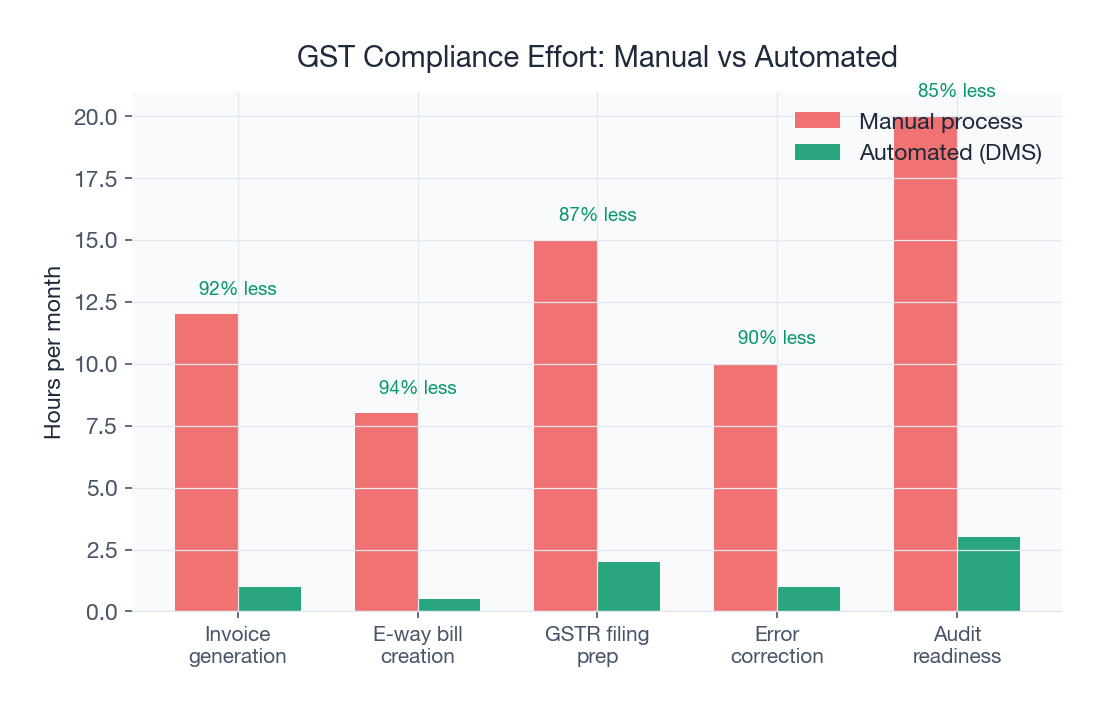
For dairy distributors handling hundreds of invoices daily with multiple product categories, manual GST calculation is a recipe for errors, compliance risk, and endless reconciliation headaches. Whether you distribute Amul products in Surat or manage a multi-brand dairy operation across Gujarat, automated GST billing is no longer optional. Start your free 14-day trial and let the system handle your GST compliance from day one.
GST Rates for Common Dairy and FMCG Products
Understanding the GST landscape for dairy and related products is the foundation of accurate billing. Here is the current rate structure:
| GST Rate | Dairy Products | HSN Codes |
|---|---|---|
| 0% (Exempt) | Fresh milk (not in unit container), natural curd, lassi, buttermilk (unbranded) | 0401, 0403 |
| 5% | Milk in unit containers (pouches, bottles, tetra packs), UHT milk, condensed milk, branded curd, paneer, ghee | 0401, 0402, 0405, 0406 |
| 12% | Butter, cheese, flavoured milk, milk-based beverages, whey protein | 0405, 0406, 2202 |
| 18% | Ice cream, frozen desserts, protein-enriched milk products, casein | 2105, 3501 |
Note: GST rates are subject to periodic revision by the GST Council. The rates above reflect the position as of March 2026. Always verify current rates before implementation.
This multi-slab structure means that a single dairy distributor's invoice can contain products across all four GST rates, making manual calculation impractical at any meaningful scale.
The Real Cost of GST Billing Errors
GST billing errors in dairy distribution are not just accounting inconveniences, they carry real financial consequences:
- Under-billing GST, you absorb the tax difference, directly eroding margins. A 5% under-billing on Rs 1 crore monthly turnover costs Rs 5 lakh per year.
- Over-billing GST, distributors dispute invoices, delay payments, and lose trust in your billing accuracy
- GSTIN mismatch, invoices with incorrect GSTINs are rejected during return filing, requiring time-consuming corrections
- HSN code errors, incorrect HSN codes trigger scrutiny during assessments and can result in penalties
- Late e-invoicing, failure to generate e-invoices within the prescribed timeframe for qualifying transactions attracts penalties of Rs 50 per invoice per day
- ITC reversal, errors in your outward supply data cause ITC problems for your distributors, damaging the business relationship
A study by the Confederation of Indian Industry found that FMCG companies spend an average of Rs 3-5 lakh annually on rectifying GST billing errors, in addition to penalties and the opportunity cost of staff time diverted to compliance firefighting.
Automating GST Billing with SpireStock
HSN Code Mapping
SpireStock's invoicing module automatically maps each product to its correct HSN (Harmonized System of Nomenclature) code and applicable GST rate. When you add a product to your catalog, you assign its HSN code once, the system handles all calculations from that point forward. With over 50 dairy-specific HSN codes pre-configured, setup is faster than building from scratch.
Automatic Tax Calculation
Every invoice automatically calculates CGST, SGST (for intra-state transactions), and IGST (for inter-state transactions) based on the seller and buyer GSTINs. The system handles mixed-rate invoices where different line items attract different GST rates, a common scenario in dairy distribution where fresh milk (0%), packaged curd (5%), butter (12%), and ice cream (18%) may all appear on the same invoice.
E-Invoicing Compliance
India's e-invoicing mandate requires businesses above the Rs 5 crore annual turnover threshold to generate invoices through the NIC portal. SpireStock integrates directly with the e-invoicing system, generating Invoice Reference Numbers (IRNs) and QR codes automatically for every qualifying invoice. The integration is seamless, no manual portal visits, no file uploads, no delays. Each invoice is submitted to NIC in real time as it is generated.
Credit Note and Debit Note Management
Returns, damages, and rate differences generate credit notes that must follow the same GST compliance rules as invoices. The system auto-generates compliant credit/debit notes linked to the original invoice, ensuring proper tax adjustment in your returns. For dairy distribution, where product returns due to shelf-life expiry or cold chain breaks are a regular occurrence, automated credit note generation saves hours of manual work daily.
Crate Deposit and Security Billing
Crate deposits collected from distributors have specific GST treatment. The crate management module integrates with billing to ensure deposits are correctly invoiced (as advances or security deposits) and refunds are processed with proper GST adjustments.
Integration with Order and Delivery Workflows
Billing does not exist in isolation. When an order flows from the order management system through delivery confirmation, the invoice is generated automatically with all the correct details, products, quantities, scheme deductions, crate charges, and applicable taxes. No manual data re-entry. No discrepancies between what was ordered, delivered, and billed.
Integration with scheme management ensures that trade discounts are properly reflected in invoices with correct GST treatment. Different scheme types have different GST implications:
- Trade discount, deducted from the taxable value before GST calculation
- Cash discount, may require separate credit note treatment
- Free goods (buy-X-get-Y), require specific GST treatment as per Section 17(5)(h) of CGST Act
- Incentive payments, may attract reverse charge GST in certain scenarios
The system handles each correctly, ensuring your scheme economics do not inadvertently create compliance issues.
GST Billing Across Industry Segments
While dairy has the most complex multi-rate GST structure, adjacent industries face their own billing challenges:
- Beverage distribution, 12-28% GST rates for aerated drinks, juices, and water, with additional cess on certain categories
- Bakery and confectionery, 5-18% rates varying by product type (bread at 0-5%, biscuits at 18%, cakes at 18%)
- General FMCG, wide range of rates across product categories requiring accurate HSN mapping
- Fresh produce, mostly exempt but processed products attract GST, requiring careful classification
SpireStock's billing engine supports all these categories, making it the right choice for multi-category distributors.
GSTR Report Generation
Filing GST returns requires detailed transaction data organized in the prescribed formats. SpireStock generates export-ready reports for:
- GSTR-1, outward supply details with invoice-wise and rate-wise breakdowns, B2B and B2C segregation
- GSTR-3B, summary of outward and inward supplies for monthly filing, with auto-populated figures
- GSTR-2A/2B reconciliation, matching your purchase records with supplier-filed data to identify ITC mismatches before filing
- HSN summary, product category-wise tax summary as required in returns
- GSTR-9/9C (Annual Return), consolidated annual data for return filing and reconciliation statement
Sales analytics dashboards provide a tax-focused view of your billing data, GST collected vs. paid, rate-wise revenue breakdowns, and compliance health indicators that flag potential issues before they reach your CA's desk.
Common GST Billing Challenges in Dairy Distribution
Mixed-Rate Invoices
A single order from a distributor in Nagpur may contain fresh milk (0%), toned milk pouches (5%), butter (12%), and kulfi (18%). The system handles multi-rate invoices seamlessly, showing clear rate-wise breakdowns on every invoice, with separate tax calculations for each line item.
Place of Supply Issues
Distributors near state borders may receive supplies from plants in different states. A dairy plant in Maharashtra supplying distributors in Karnataka must apply IGST, while the same plant supplying Maharashtra distributors applies CGST+SGST. Correct determination of place of supply is critical and is automated based on GSTIN analysis.
Reverse Charge Scenarios
Certain transactions in the dairy supply chain, like purchases from unregistered suppliers, goods transport agency services, and raw milk procurement from farmers, may trigger reverse charge mechanisms requiring special invoice treatment and separate reporting.
Rate Change Transitions
When the GST Council revises rates, as it has done multiple times for dairy products, the transition creates billing complexity. Invoices generated before the effective date must use the old rate, while those after must use the new rate. The system handles this automatically based on the invoice date and configured effective dates.
Struggling with GST compliance? SpireStock automates the entire billing-to-return cycle for dairy and FMCG distributors. Book a free demo to see how it handles your specific GST scenarios. Check our pricing for plans that include full billing automation.
Best Practices for GST Compliance in Distribution
- Verify GSTIN of all channel partners, ensure distributor GSTINs are active and correctly mapped. Use the GST portal's GSTIN verification API to automate this.
- Reconcile monthly, match your billing data with GSTR-2A/2B regularly, not just at filing time. Catching mismatches early is far easier than resolving them during annual returns.
- Keep HSN mapping updated, when the GST Council revises rates or HSN classifications, update your product catalog immediately
- Archive digital copies, maintain compliant digital records of all invoices for the mandatory 6-year retention period
- Separate exempt and taxable supplies, ensure your billing system correctly distinguishes between exempt dairy products (fresh milk) and taxable ones (packaged milk)
- Monitor e-invoicing thresholds, as the government progressively lowers the turnover threshold for mandatory e-invoicing, smaller distributors need to prepare
For dairy businesses operating across the dairy distribution value chain, automated GST billing is not just convenient, it is essential for compliance and operational efficiency. For related insights, read our articles on order management systems for dairy and dairy distribution ERP vs CRM.
Real-World Implementation Scenarios
GST complexity bites distributors across every category. Three illustrative deployments show how automated GST billing changes the calculus.
Case Study 1: Tamil Nadu Dairy Combine, Chennai
Tamil Nadu Dairy Combine operates 240 distributors in Chennai, Madurai, and Tiruchirappalli, modelled on Aavin's distribution footprint. Their product mix spans fresh milk (GST-exempt), curd, paneer, ice cream (18%), and packaged beverages. Before automation, their billing team of 5 produced 1,200 invoices daily with an 8% error rate, generating Rs 14 lakh annually in write-offs and Rs 6 lakh in GST penalties. After deploying SpireStock's GST-aware billing with payment collection solution, error rates fell below 0.2%, and the billing team was reduced to 2 people. Year-1 savings: Rs 29 lakh.
Case Study 2: Gujarat Dairy Mart, Ahmedabad
Gujarat Dairy Mart handles products similar to Amul through 180 distributors in Ahmedabad and Rajkot. Their challenge was multi-state billing with IGST/CGST+SGST determination. Automated GSTIN verification and state-aware tax logic eliminated the 45 minutes per day their senior accountant spent fixing tax determination errors. E-invoicing IRN generation moved from a 2-hour daily batch to real-time. Year-1 benefit: Rs 18 lakh in FTE savings plus Rs 7 lakh in compliance penalty avoidance.
Case Study 3: Central India Beverages, Nagpur
Central India Beverages distributes packaged water products (think Bisleri) plus dairy across 160 routes in Nagpur and Raipur. Their scheme-heavy selling model created constant post-facto GST calculation disputes. SpireStock's scheme-aware tax engine eliminated these disputes entirely, saving Rs 11 lakh in recalculation work and preventing Rs 4 lakh in bad-debt write-offs.
Cost & ROI Analysis
GST billing automation delivers benefits that go well beyond compliance. Here is the typical return profile:
| Benefit Category | Annual Value (INR) | Notes |
|---|---|---|
| Billing FTE rationalization | Rs 8-18 lakh | Reduction of 2-3 staff roles |
| Tax penalty avoidance | Rs 4-15 lakh | Zero compliance errors |
| Error write-off reduction | Rs 6-14 lakh | 99.7%+ billing accuracy |
| E-invoicing compliance costs | Rs 3-8 lakh | Native IRN generation |
| GSTR reconciliation time | Rs 2-5 lakh | Automated GSTR-1/3B reports |
| Credit note processing | Rs 2-4 lakh | Automated workflow |
| SpireStock cost (annual) | (Rs 4-8 lakh) | SaaS subscription |
| Net Year-1 benefit | Rs 21-56 lakh | Payback: 8-14 weeks |
Because GST logic applies uniformly across dairy, beverages, bakery, fresh produce, and general consumer goods, multi-category distributors realize consolidated benefits. For related reading, see our FMCG distribution challenges guide.
This page covers one angle. For the broader treatment, see our complete dairy GST billing guide.
Sources & References
- GST Council, Goods and Services Tax Council
- FSSAI, Food Safety and Standards Authority of India
- IBEF, India Brand Equity Foundation, FMCG Sector
Frequently Asked Questions
Fresh, unprocessed milk not in unit containers is exempt (0% GST). Milk in unit containers (pouches, bottles, tetra packs) attracts 5% GST. Processed dairy products like flavoured milk attract 12%, and ice cream attracts 18%. Rates are subject to change by the GST Council.
E-invoicing is mandatory for businesses with annual turnover exceeding the threshold set by the government (currently Rs 5 crore). Most established dairy distributors fall above this threshold and must generate e-invoices through the NIC portal for every B2B transaction.
When the seller and buyer are in different states, the system automatically applies IGST instead of CGST+SGST. This is determined by comparing the GSTINs of both parties, ensuring correct tax treatment without manual intervention.
SpireStock generates export-ready data in GSTR-1 and GSTR-3B formats that can be directly uploaded to the GST portal or imported into your tax filing software. This eliminates manual data compilation and reduces filing errors.
When products are returned (due to damage, expiry, or quality issues), the system generates GST-compliant credit notes linked to the original invoice. Tax adjustments are automatically calculated and reflected in your GST return data.
Common HSN codes include 0401 (milk), 0403 (curd, buttermilk), 0405 (butter, ghee), 0406 (cheese, paneer), 2105 (ice cream). Each product in your catalog should be mapped to its specific HSN code for accurate tax calculation.
Yes, if your dairy distribution involves e-commerce sales or other TCS-applicable scenarios, the system can calculate and account for TCS on qualifying transactions and generate the necessary reporting data.
When the GST Council revises rates, you update the rate in your product catalog and specify the effective date. The system applies the old rate for transactions before the date and the new rate for transactions on or after it, ensuring accurate historical records.
Related SpireStock Features
Related Solutions
Track distributor and retailer payments. Cash, UPI, cheque collection with reconciliation, ageing reports, and credit limit management.
Manage your entire distributor network digitally. Onboarding, credit limits, outstanding tracking, and performance analytics. Start free trial.
Related Entities
Ready to Streamline Your Distribution?
Start your free 14-day trial and see how SpireStock can transform your dairy, FMCG or consumer-goods distribution operation, from order capture to crate recovery.

SpireStock Team
Product & Industry Insights
SpireStock Team leads product at SpireStock, where the team ships distribution management software for India's dairy, FMCG and consumer-goods brands.