Why FMCG Companies in India Need Salesman Tracking Apps
India's FMCG distribution network depends on an army of over 5 million field salesmen who visit retailers daily, take orders, collect payments, and manage trade relationships. Yet most FMCG companies have minimal visibility into what their field force actually does between leaving the office and returning at day's end. A 2025 Nielsen India study found that the average FMCG salesman in India visits only 60-65% of assigned retailers on any given day, with 15-20% of reported visits being "phantom visits" — recorded on paper but never actually made.
A salesman tracking app uses GPS technology, geo-fenced visit verification, and real-time dashboards to give FMCG companies complete visibility into field sales activities. It does not just track location — it measures beat adherence, visit duration, order productivity, and collection efficiency at every retail touchpoint. Whether you manage a team of 10 salesmen in Pune or 500 across multiple states, field force tracking is the single highest-ROI investment you can make in your distribution operation.
If your field team still submits paper DCRs (daily call reports), you are flying blind. Start your free trial and see your entire field force on a live map within 24 hours.
The Hidden Cost of Untracked Field Sales Teams
Before implementing a tracking app, most FMCG distributors underestimate how much productivity they are losing. Here is what the data shows across 300+ Indian distribution companies:
| Problem | Typical Impact | Annual Cost (50-Person Field Team) |
|---|---|---|
| Skipped retail visits | 30-40% of assigned beats not completed | Rs 15-20 lakh in lost sales |
| Phantom visits (fake reporting) | 15-20% of reported visits never happen | Rs 8-12 lakh in wasted salary |
| Inefficient routing | 25-30% extra travel time | Rs 3-5 lakh in fuel and time |
| Late starts and early finishes | Average 45 minutes lost per day per rep | Rs 6-8 lakh in productivity loss |
| No visibility into low performers | Bottom 20% of reps drag team average down | Rs 10-15 lakh in underperformance |
| Uneven territory coverage | High-value outlets visited irregularly | Rs 5-8 lakh in missed revenue potential |
For a distributor in Delhi or Hyderabad with a 50-person field team, untracked field operations cost Rs 45-70 lakh annually — more than 10x the cost of a tracking solution. Read more about the broader ROI in our ROI calculation guide for distribution software.
Core Features of a Salesman Tracking App for FMCG
1. Live GPS Tracking with Route Replay
The foundation of any salesman tracking app is real-time GPS location tracking. Managers see every field rep on a live map with color-coded status indicators — in transit, at a retail outlet, idle, or offline. Route replay lets you view the exact path taken by any salesman on any day, with timestamps at every stop.
SpireStock's attendance and tracking module captures location data every 2 minutes during working hours while consuming minimal battery — a critical design consideration since Indian field reps use mid-range Android smartphones with limited battery capacity. The route replay feature is especially useful for area sales managers reviewing day-end performance: you can see exactly how much time was spent in transit versus at outlets, identify unnecessary detours, and compare the planned route against the actual route taken.
2. Geo-Fenced Visit Verification
GPS coordinates alone do not prove a visit happened. Geo-fencing creates a virtual boundary (typically 50-100 meters) around each retail outlet. A visit is only counted as "verified" when the salesman's GPS coordinates fall within the geo-fence for a minimum duration (usually 3-5 minutes). This eliminates phantom visits entirely.
For FMCG distributors operating in dense urban markets like Mumbai where shops are closely packed, the geo-fence radius can be tightened to 30-50 meters. In rural and semi-urban areas where GPS accuracy is lower, the radius is automatically adjusted to 100-150 meters to prevent false negatives. The system also captures timestamped photos at each visit as additional verification, creating a multi-layered proof system that leaves no room for manipulation.
3. Beat Plan Adherence Monitoring
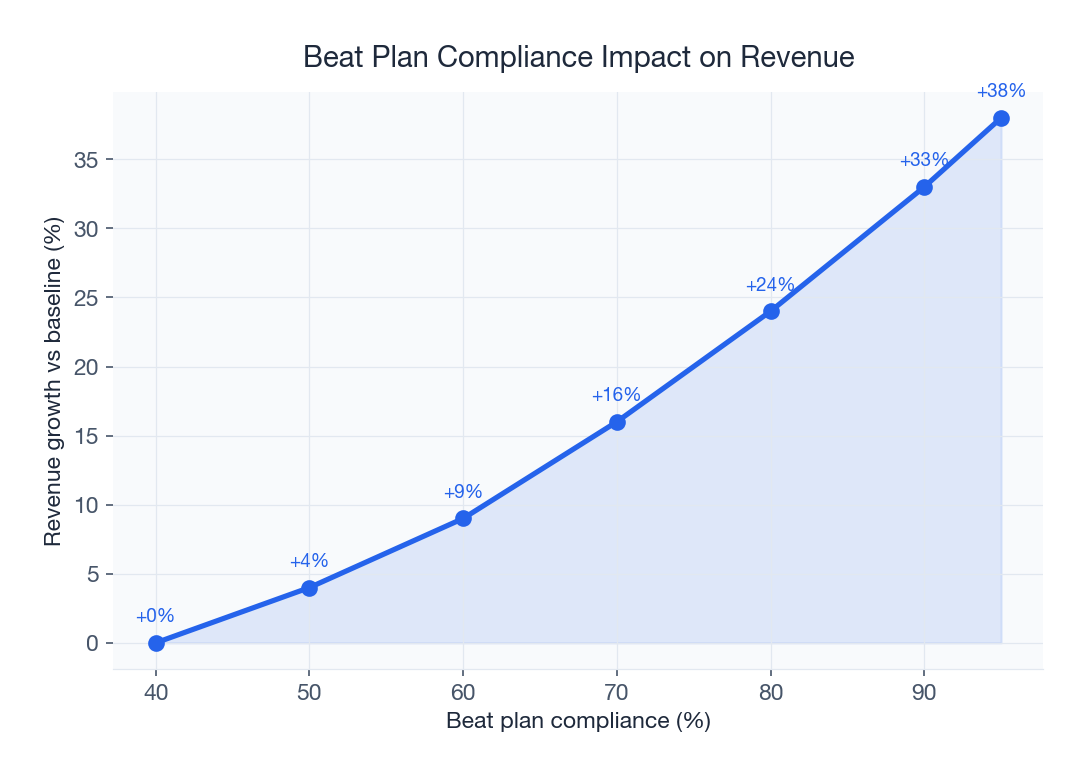
A beat plan defines which retailers a salesman should visit on each day of the week. Beat planning is the backbone of FMCG field operations, but it only works if salesmen actually follow their assigned beats. The tracking app monitors beat adherence in real time, flagging deviations immediately.
Managers see a dashboard showing: planned visits vs. actual visits, sequence adherence (did the rep follow the optimal route?), time spent per visit, and coverage gaps — retailers who have not been visited in their scheduled frequency. This data transforms beat planning from a paper exercise to a living, measurable system. For distributors managing territory coverage across multiple areas of a city, beat adherence data also reveals whether your territory design needs restructuring — if certain beats consistently show low adherence, the issue might be beat size rather than salesman discipline.
4. Attendance Integration with Geo-Stamping
Traditional attendance systems — biometric at the office or manual registers — fail for field staff who start their day directly from home or from the first retail outlet. A salesman tracking app integrates attendance with geo-stamping: the salesman marks "day start" from their mobile app, which records their GPS coordinates, timestamp, and a selfie. The same process applies for "day end."
This eliminates disputes about working hours and provides auditable data for payroll processing. Late starts and early finishes are flagged automatically, and managers can set configurable tolerance thresholds (for example, mark-in allowed between 8:30 AM and 9:15 AM). For companies with field teams across multiple cities — say salesmen in Bangalore, Chennai, and Kolkata — centralized attendance data eliminates the need for city-level attendance coordination and gives HR a single source of truth for payroll calculations.
5. Productivity Dashboards and Leaderboards
Sales analytics integrated with field tracking data creates powerful productivity dashboards. For each salesman, you see: daily visit count, order conversion rate (visits that resulted in orders), average order value, collection amount, time in market vs. time in transit, and lines per call (number of SKUs sold per visit).
Leaderboards create healthy competition within the field team. Top performers are recognized, and bottom performers are identified early for coaching or retraining. A dairy distributor in Kolkata found that simply introducing visible leaderboards improved average daily visit counts by 22% within the first month, without any change in incentive structure. The dashboard also reveals patterns that manual reporting obscures: which day of the week has the lowest productivity, which market areas take the longest transit time relative to revenue generated, and which salesmen excel at order conversion but underperform on collection.
6. Order and Collection Capture at Point of Visit
The best salesman tracking apps do not just track location — they integrate with the order management system so salesmen can place orders and record collections directly from the retail outlet. This links every order to a verified visit location and timestamp, creating an unbreakable chain of accountability.
For distributors managing payment collection, the app records cash collected, cheque details, or UPI transaction references at each visit, with GPS proof that the collection happened at the retailer's location. This integration also enables real-time secondary sales tracking — you see not just where your salesmen went, but what they sold, how much they collected, and which trade schemes were applied at each outlet.
7. Offline Functionality for Tier-2 and Tier-3 Markets
Internet connectivity is unreliable across much of India, especially in the semi-urban and rural markets where FMCG growth is fastest. A salesman tracking app must cache GPS data, visit records, orders, and collections locally when offline, and sync everything automatically when connectivity returns. SpireStock's mobile app stores up to 72 hours of offline data, ensuring zero data loss even in the most connectivity-challenged territories of Lucknow or smaller tier-3 towns.
The offline capability extends beyond just data storage. Salesmen can browse the full product catalog, check retailer-specific pricing and credit limits, view their beat plan, and even place orders — all without an active internet connection. GPS tracking continues to function because satellite signals work independently of cellular connectivity. When the salesman re-enters a coverage zone, all pending data syncs silently in the background without disrupting their workflow.
8. Manager Alerts and Exception Reporting
Real-time tracking generates an enormous volume of data. Effective salesman tracking apps distill this into actionable alerts that demand attention without creating noise. Configurable alerts notify area managers when a salesman has been idle for more than 30 minutes during market hours, deviates significantly from the planned beat, marks attendance from an unexpected location, completes fewer than 50% of planned visits by midday, or attempts to use a mock location app.
Exception-based management is the key to scaling field force oversight. An area manager supervising 50-80 salesmen cannot review every individual's data daily. But they can act on 5-10 exception alerts that surface the specific reps and specific issues that need attention. This approach transforms field management from reactive (reviewing DCRs at end of day) to proactive (intervening in real time when issues are detected).
Salesman Tracking App ROI by Team Size
The return on investment from a salesman tracking app scales with team size, but even small teams see meaningful returns. Here is a realistic ROI model based on Indian FMCG distribution benchmarks:
| Team Size | Annual Software Cost | Productivity Gain (Revenue) | Cost Savings (Fuel, Time) | Net Annual ROI |
|---|---|---|---|---|
| 10 salesmen | Rs 60,000-1,20,000 | Rs 6-10 lakh | Rs 1.5-2.5 lakh | Rs 7-11 lakh |
| 25 salesmen | Rs 1.5-3 lakh | Rs 15-25 lakh | Rs 4-6 lakh | Rs 17-28 lakh |
| 50 salesmen | Rs 3-6 lakh | Rs 30-50 lakh | Rs 8-12 lakh | Rs 35-56 lakh |
| 100+ salesmen | Rs 6-12 lakh | Rs 60-100 lakh | Rs 15-25 lakh | Rs 70-113 lakh |
Productivity gains come from increased visit counts, higher order conversion, and better collection rates. Cost savings come from reduced fuel waste, eliminated phantom visits, and optimized routing. For a detailed payback calculation methodology, see our distribution software ROI guide.
Implementation Best Practices for Indian FMCG Companies
Deploying a salesman tracking app across a field force is as much a change management exercise as a technology rollout. Here are proven practices from 200+ successful deployments across India:
- Communicate the "why" first — Position the app as a productivity tool that helps salesmen earn more incentives, not as a surveillance system. Field teams that understand the benefits adopt faster.
- Start with a pilot — Deploy with one territory or 15-20 salesmen first, work out the kinks, and then scale. Forcing a 500-person rollout on day one creates chaos.
- Ensure device readiness — Verify that every field rep has a smartphone with GPS capability and at least 2GB RAM. Budget Rs 8,000-12,000 per device if company-provided phones are needed.
- Set realistic targets initially — If current beat adherence is 55%, do not set the target at 95% on day one. Incremental targets (70% in month 1, 80% in month 2, 90% by month 3) build momentum without creating resistance.
- Review data daily in the first month — The app is only as useful as the management attention it receives. Area Sales Managers should review dashboards every morning and provide feedback the same day.
- Link to incentives — Tie beat adherence and visit productivity metrics to monthly incentives. Salesmen respond to what gets measured and rewarded. The most successful deployments we have seen add a Rs 2,000-5,000 monthly "productivity bonus" linked to tracking KPIs.
- Address resistance directly — Some salesmen will resist tracking. Have one-on-one conversations with resistors, show them how top-performing colleagues are earning more through the system, and set clear expectations about adoption timelines.
Read our detailed guide on field force tracking for dairy sales for industry-specific deployment strategies.
Choosing Between Standalone Tracking vs. Integrated DMS
The market offers two categories of salesman tracking solutions:
| Feature | Standalone Tracking App | Integrated DMS with Tracking |
|---|---|---|
| GPS tracking | Yes | Yes |
| Visit verification | Basic (GPS only) | Multi-factor (GPS + photo + duration + order) |
| Order capture at visit | No | Yes, linked to inventory and billing |
| Collection recording | No or basic | Full integration with payment module |
| Scheme visibility at outlet | No | Yes, auto-applied during ordering |
| Analytics depth | Location-only metrics | Revenue, SKU, scheme, and collection analytics per visit |
| Cost per user/month | Rs 100-300 | Rs 300-800 |
| ROI multiplier | 3-5x | 8-15x |
For serious FMCG companies, the integrated approach delivers dramatically better ROI because visit data is connected to business outcomes — orders, revenue, collections — not just GPS pins on a map. The sales productivity solution from SpireStock combines tracking with the full suite of distribution tools including order management, billing, scheme management, and distribution tracking, giving you a single platform for all field operations.
Privacy and Compliance Considerations
Salesman tracking raises legitimate privacy concerns that Indian companies must address thoughtfully. Mishandling privacy can create legal exposure, damage employee morale, and undermine adoption. Follow these guidelines:
- Track only during defined working hours — the app must automatically stop recording location data after day-end mark-out
- Disclose tracking policies clearly in employment agreements and provide written acknowledgement
- Allow employees to see their own tracking data — transparency builds trust
- Store location data securely with access restricted to authorized managers only
- Comply with India's Digital Personal Data Protection Act, 2023 requirements for employee data, including purpose limitation and informed consent
- Set data retention policies — location data older than 6-12 months should be automatically purged unless required for specific disputes
Transparency builds trust. When salesmen see that tracking data is used fairly — to reward good work and coach improvement, not to punish — adoption and morale actually improve. Companies that deploy tracking with a "gotcha" mentality see high turnover; companies that deploy it as a productivity enabler see high engagement.
Real-World Impact: Tracking Adoption Across Indian FMCG Operations
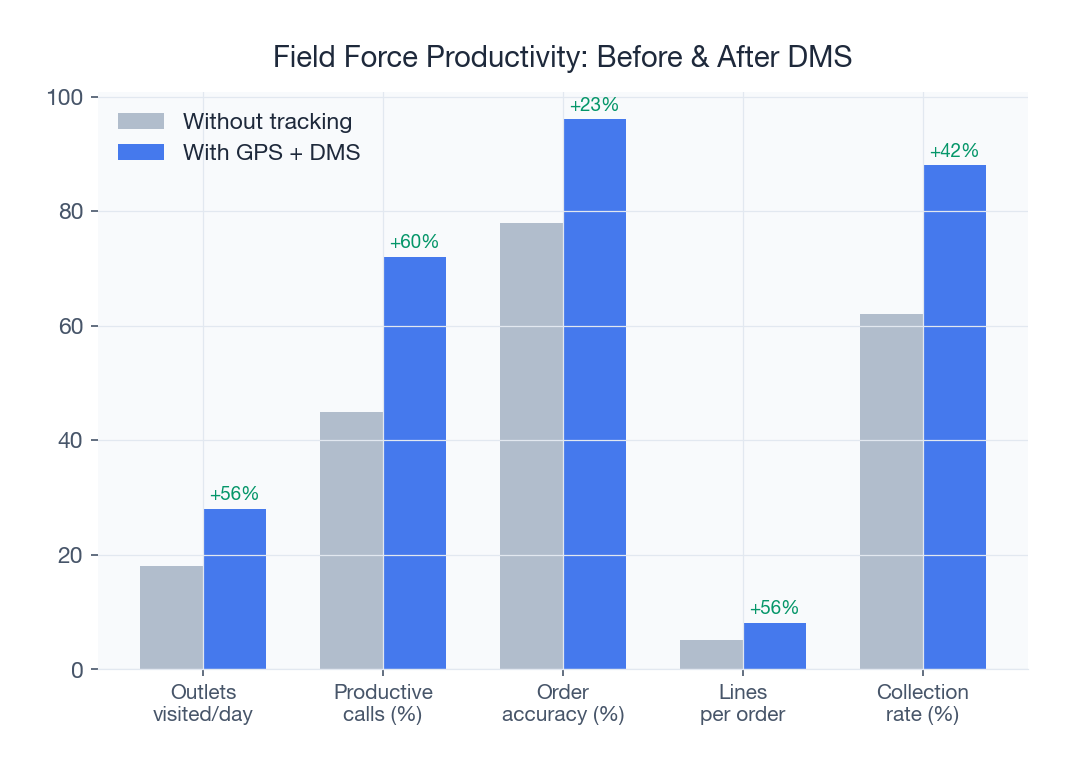
The difference between tracked and untracked field operations becomes starkly visible once companies have 3-6 months of data. A consumer goods distributor in Hyderabad with a 35-person field team saw the following changes within 90 days of deploying SpireStock's tracking module:
- Average daily visits per salesman increased from 18 to 26 — a 44% improvement driven by route optimization and accountability
- Phantom visits dropped to zero — geo-fenced verification eliminated all fake reporting within the first week
- Beat adherence rose from 58% to 87% — incremental targets with incentive linkage drove steady improvement month over month
- Order conversion rate improved from 62% to 78% — salesmen spent more productive time at outlets instead of rushing through visits
- Monthly revenue per salesman increased by Rs 1.2 lakh — a direct result of better coverage and higher conversion
Across tier-2 markets like Surat and Pune, adoption patterns follow a predictable curve: initial resistance in weeks 1-2, gradual acceptance in weeks 3-4 as salesmen see leaderboard recognition and incentive payouts, and full adoption by month 2 when the system becomes part of the daily routine. The critical success factor is consistent management attention to dashboard data during the first 60 days.
For companies considering their first field force technology investment, salesman tracking consistently delivers the fastest ROI among all distribution software modules — typically paying for itself within 4-6 weeks. Combine it with retailer tracking and outlet-wise sales analysis for maximum impact on your distribution productivity.
Frequently Asked Questions
What is a salesman tracking app?
A salesman tracking app is a mobile application that uses GPS technology to monitor field sales staff in real time. It records location, verifies retail visits through geo-fencing, monitors beat plan adherence, captures attendance with geo-stamps, and provides productivity analytics to help FMCG companies maximize field team performance across their distribution network.
Does GPS tracking drain the salesman's phone battery?
Modern tracking apps are optimized for battery efficiency. SpireStock's app uses intelligent location sampling (every 2 minutes during active hours) and switches to low-power mode during idle periods, typically consuming 8-12% of battery over a full working day. This works well even on mid-range smartphones with 4,000-5,000 mAh batteries common among Indian field staff.
Can salesmen fake their GPS location?
Professional tracking apps detect mock location apps and GPS spoofing attempts. SpireStock flags location mocking immediately and alerts the manager. Multi-factor verification (GPS + timestamped photo + minimum visit duration + order data) makes it virtually impossible to fake a retail visit. Even rooted devices and developer-mode GPS spoofing are detected through multiple validation layers.
How does salesman tracking work in areas with poor internet?
The app stores all GPS data, visit records, and orders locally on the device when offline. GPS works independently of internet connectivity — it uses satellite signals. When the salesman enters an area with connectivity, all data syncs automatically to the server. No data is lost during offline periods, making the app fully functional in rural and semi-urban territories across India.
What is beat adherence and why does it matter?
Beat adherence measures the percentage of planned retail visits that a salesman actually completes on schedule. High beat adherence (above 85%) ensures complete market coverage, consistent retailer engagement, and predictable order flow. Low beat adherence leads to stockouts at retail, lost sales, and competitor infiltration. Tracking beat adherence is the most direct way to improve field team productivity in consumer goods distribution.
Is it legal to track salesmen via GPS in India?
Yes, employer GPS tracking of field employees during working hours is legal in India when disclosed in the employment agreement and limited to work hours. Companies must comply with the Digital Personal Data Protection Act, 2023, which requires informed consent, purpose limitation, and reasonable data security measures. Tracking outside working hours without explicit consent is not recommended and may attract legal challenges.
Sources & References
- Nielsen India, FMCG Field Force Productivity Report 2025
- RedSeer Strategy Consultants, India Distribution Workforce Analytics 2025
Frequently Asked Questions
A salesman tracking app is a mobile application that uses GPS technology to monitor field sales staff in real time. It records location, verifies retail visits through geo-fencing, monitors beat plan adherence, captures attendance with geo-stamps, and provides productivity analytics.
Modern tracking apps are optimized for battery efficiency, typically consuming 8-12% of battery over a full working day using intelligent location sampling every 2 minutes during active hours.
Professional tracking apps detect mock location apps and GPS spoofing attempts. Multi-factor verification including GPS, timestamped photos, and minimum visit duration makes it virtually impossible to fake visits.
GPS works independently of internet using satellite signals. The app stores all data locally when offline and syncs automatically when connectivity returns. No data is lost during offline periods.
Beat adherence measures the percentage of planned retail visits actually completed on schedule. High adherence (above 85%) ensures complete market coverage, consistent retailer engagement, and predictable order flow.
Yes, employer GPS tracking of field employees during working hours is legal in India when disclosed in the employment agreement. Companies must comply with the Digital Personal Data Protection Act, 2023.
Related SpireStock Features
Related Industries
Streamline FMCG distribution with order management, beat planning, retailer tracking, and GST billing. Built for Indian FMCG supply chains.
End-to-end dairy distribution software for milk, curd, paneer, and ghee brands. Manage orders, crates, cold chain, and GST billing in one platform.
Distribution management for consumer goods brands. Manage distributors, retailers, schemes, and sales analytics across India. Start free trial.
Related Solutions
Boost field sales team productivity with beat planning, GPS attendance, order capture, and performance analytics. Built for Indian FMCG teams.
Track and manage your retail network. Geo-tag outlets, capture secondary sales, manage beats, and monitor retailer performance. Try SpireStock.
Related Entities
Ready to Streamline Your Distribution?
Start your free 14-day trial and see how SpireStock can transform your dairy, FMCG or consumer-goods distribution operation, from order capture to crate recovery.

SpireStock Team
Distribution Technology Experts
SpireStock Team writes for SpireStock on distribution management, supply-chain optimisation and field operations for Indian dairy and FMCG brands.