The Real Cost of Distribution Management Software in India
When Indian distributors and FMCG brands evaluate distribution management software, the first question is always about price. And the answer is almost always misleading. Vendors quote per-user subscription fees, but the actual cost includes implementation, training, customization, integration, and ongoing support charges that can double or triple the sticker price.
This guide provides transparent pricing data across four tiers of distribution software available in India, identifies the hidden costs that vendors rarely mention upfront, and walks you through a practical ROI calculation framework. We include SpireStock in the comparison — with honest pricing — alongside competitors. For a broader platform comparison, refer to our 2024 Buyer’s Guide.
Four Pricing Tiers in the Indian Market
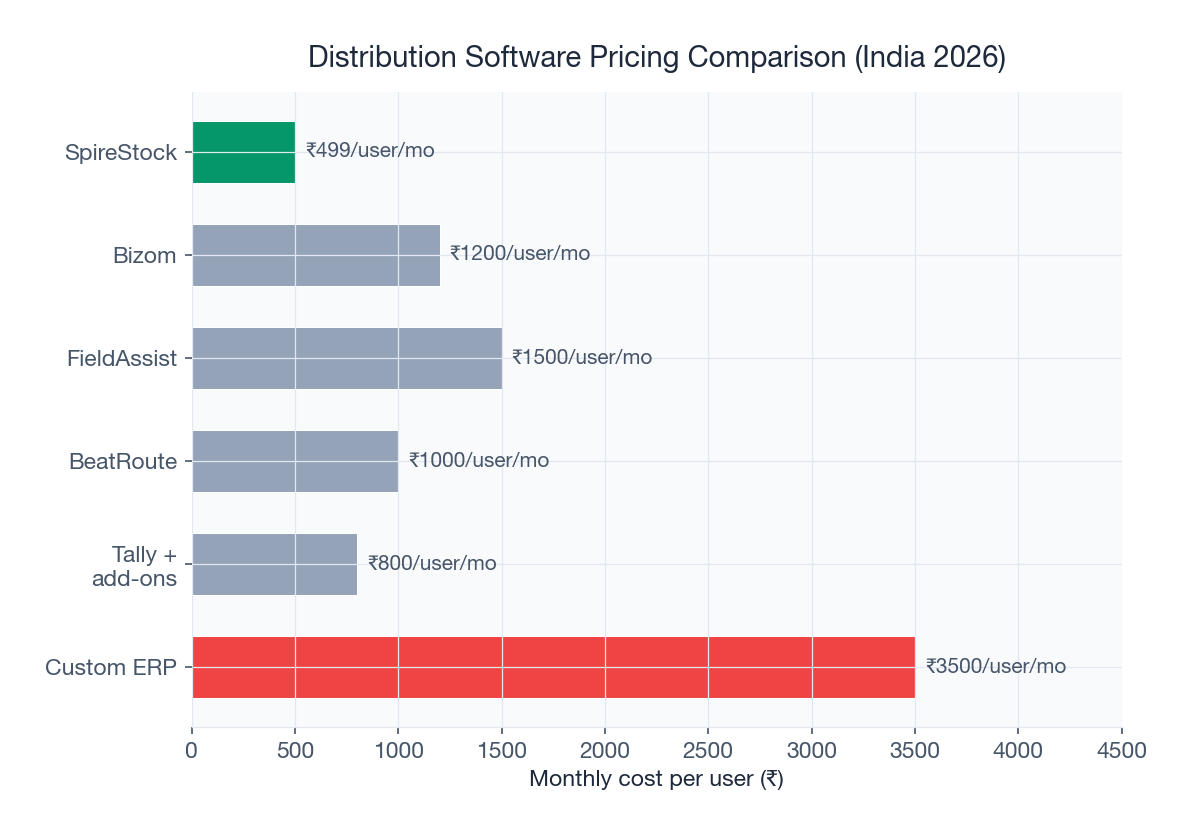
Distribution management software in India falls into four distinct pricing tiers, each serving a different segment of the market. Understanding where your business fits is the first step to budgeting accurately.
Tier 1: Free and Near-Free (Rs 0–500/user/month)
This tier includes Google Sheets, WhatsApp-based ordering, Tally Free Edition, and basic inventory apps. These are not true DMS platforms, but many Indian distributors start here. They cost little or nothing but impose severe limitations: no mobile field apps, no GPS tracking, no automation, and no scalability beyond 20–30 retailers.
For micro-distributors handling fewer than 30 retail outlets in a single city, free tools can work. The moment you cross 50 retailers or add a second delivery route, the manual overhead becomes unsustainable. Read our analysis of free vs paid distribution management software for a detailed breakdown of where free tools break.
Tier 2: Basic (Rs 500–2,000/user/month)
This tier includes Tally with distribution add-ons, Marg ERP, VyaparApp, and similar platforms. You get proper invoicing, basic inventory management, and GST compliance. Some offer rudimentary mobile apps. These platforms are suitable for small distributors (50–200 retailers) who need structured billing and inventory but do not require field force automation.
Tier 3: Mid-Range (Rs 2,000–5,000/user/month)
This is where purpose-built DMS platforms live. SpireStock, FieldAssist, BeatRoute, and similar cloud-native platforms offer mobile-first operations, GPS tracking, scheme management, route optimization, analytics dashboards, and integration with accounting systems. This tier represents the best value for most Indian FMCG distributors and brands.
Tier 4: Enterprise (Rs 5,000–15,000+/user/month)
Enterprise platforms include Bizom, SAP, Oracle NetSuite, and Microsoft Dynamics. These offer AI-powered analytics, deep customization, multi-country support, and enterprise-grade security. They are designed for large FMCG companies with 500+ distributors and dedicated IT departments. The total cost of ownership at this tier typically exceeds Rs 25–50 lakh annually.
Complete Pricing Comparison Table
| Cost Component | Tier 1 (Free) | Tier 2 (Basic) | Tier 3 (Mid-Range) | Tier 4 (Enterprise) |
|---|---|---|---|---|
| Subscription/license | Rs 0 | Rs 500–2,000/user/mo | Rs 2,000–5,000/user/mo | Rs 5,000–15,000/user/mo |
| Implementation | Rs 0 | Rs 10,000–50,000 | Rs 50,000–3 lakh | Rs 5–25 lakh |
| Training | Self-service | Rs 5,000–20,000 | Rs 25,000–1 lakh | Rs 1–5 lakh |
| Customization | N/A | Rs 10,000–50,000 | Rs 50,000–2 lakh | Rs 2–15 lakh |
| Integration (Tally/ERP) | Manual export | Rs 10,000–25,000 | Included or Rs 25,000 | Rs 1–5 lakh |
| Annual support/AMC | None | 15–20% of license | Included in SaaS | 18–22% of license |
| Annual TCO (10 users) | Rs 0–10,000 | Rs 1–4 lakh | Rs 4–8 lakh | Rs 15–40 lakh |
| Annual TCO (50 users) | Impractical | Rs 5–15 lakh | Rs 15–35 lakh | Rs 50 lakh–1.5 crore |
Hidden Costs That Vendors Do Not Mention
The subscription fee is typically only 40–60% of the true first-year cost. Here are the hidden expenses that catch Indian businesses off guard:
- Data migration — Transferring product catalogs, retailer databases, pricing structures, and historical data from your existing system (usually Tally) costs Rs 25,000–2 lakh depending on data volume and cleanup required.
- Hardware upgrades — Field staff may need smartphone upgrades to run modern DMS apps. Budget Rs 8,000–12,000 per device for entry-level smartphones that can handle DMS apps reliably. For a 30-person field team, that is Rs 2.4–3.6 lakh.
- Internet/data costs — Mobile data plans for field staff add Rs 300–500 per person per month. For 30 staff, Rs 1.1–1.8 lakh annually.
- Productivity dip during transition — Expect a 15–25% productivity drop during the first 4–6 weeks as staff learn the new system. This translates to lost revenue that does not appear on any vendor invoice.
- Customization creep — Initial requirements inevitably expand. What starts as a Rs 50,000 customization request often grows to Rs 2–3 lakh as you discover workflow gaps during implementation.
- Renewal price increases — Many vendors offer discounted first-year pricing, then increase by 15–30% at renewal. Negotiate multi-year pricing upfront.
ROI Calculator: Does the Math Work?
The most important question is not “how much does it cost” but “what is the return on investment.” Here is a practical ROI framework for Indian distribution operations. According to the India Brand Equity Foundation (IBEF), the FMCG distribution sector in India adds approximately Rs 2.5 lakh crore in value annually, making efficiency gains through technology particularly impactful.
Step 1: Calculate Your Current Costs
Map your existing distribution costs across these categories:
- Labour cost for manual processes — Order taking (phone/WhatsApp), manual billing, manual dispatch planning, scheme calculation, payment reconciliation. Count FTEs and their loaded cost (salary + benefits).
- Delivery and logistics cost — Fuel, vehicle maintenance, driver wages. Calculate cost per delivery drop.
- Crate and returnable asset losses — Track annual crate losses in rupees. Industry average is 8–15% of crate inventory value per year.
- Scheme leakage — Incorrect scheme application, unauthorized discounts, and scheme fraud. Industry estimates suggest 5–12% of scheme budgets leak in manual systems. See our scheme management guide for context.
- Bad debt and delayed collections — Calculate your average collection period and the working capital cost of delayed payments.
Step 2: Estimate Software-Driven Savings
Based on industry data from implementations across 500+ Indian distribution companies, here are conservative savings estimates:
| Savings Area | Typical Improvement | Example (Rs 50 crore distributor) |
|---|---|---|
| Labour reduction (billing/dispatch) | 40–60% fewer FTEs | Rs 6–10 lakh/year saved |
| Route optimization (fuel savings) | 20–30% lower fuel cost | Rs 4–8 lakh/year saved |
| Crate loss reduction | 70–80% fewer losses | Rs 3–6 lakh/year saved |
| Scheme leakage prevention | 90–95% reduction | Rs 5–12 lakh/year saved |
| Faster collections | 30–45% faster cycle | Rs 2–4 lakh/year (interest savings) |
| Total estimated savings | — | Rs 20–40 lakh/year |
Step 3: Calculate Net ROI
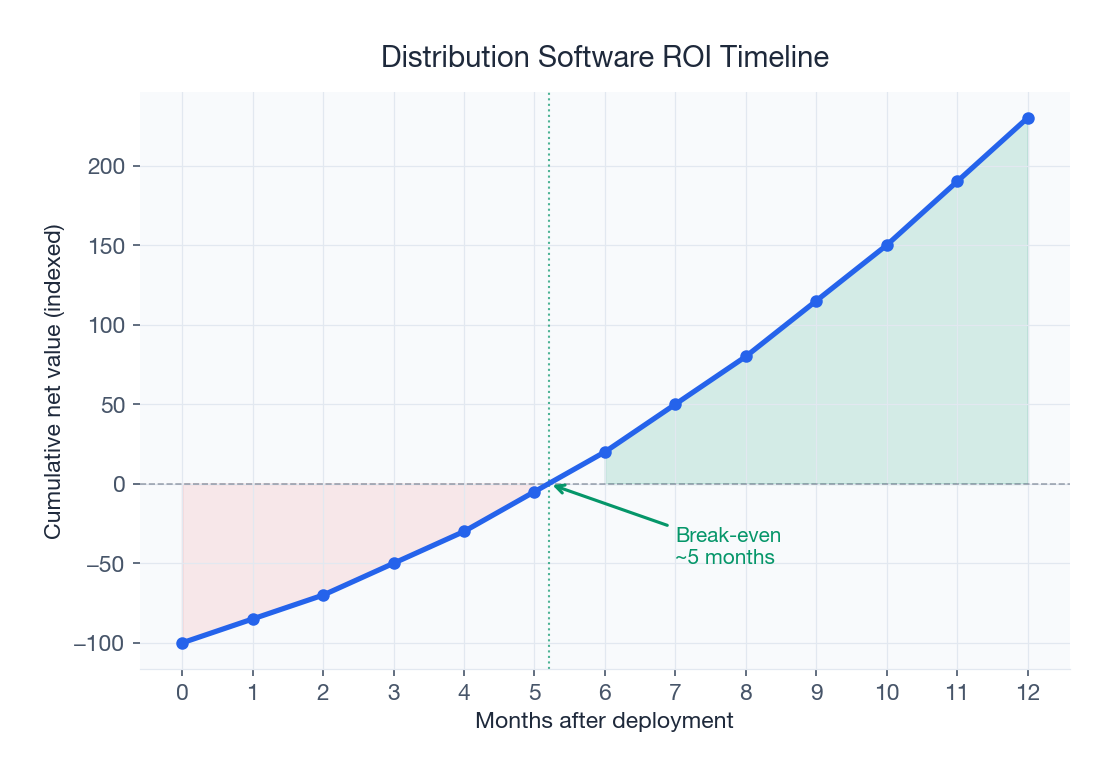
For a mid-range DMS at Rs 6–8 lakh annual cost (including implementation amortized over 3 years), the net ROI for a Rs 50 crore distribution operation is typically 150–400% in the first year. Payback period: 3–6 months.
This math explains why distribution software adoption is accelerating across India. The FSSAI’s increasing emphasis on digital traceability (per the Food Safety and Standards Act amendments) creates an additional compliance driver — companies that delay digitization face both efficiency penalties and regulatory risk.
How to Negotiate Better Pricing
Indian software vendors expect negotiation. Here are practical tactics:
- Request annual billing — Most vendors offer 15–25% discount for annual vs monthly payment.
- Bundle implementation — Negotiate free or discounted implementation with a 2-year commitment.
- Ask for pilot pricing — Start with 10–20 users at a discounted rate before scaling to full deployment.
- Negotiate renewal caps — Get written commitment that renewal price increases will not exceed 10% annually.
- Compare 3 vendors — Get written quotes from at least three platforms. Vendors sharpen pricing when they know you are comparing. Our Tally vs Bizom vs FieldAssist comparison can help structure your evaluation.
When to Invest and When to Wait
Not every distributor needs software today. If you handle fewer than 30 retailers, process under 50 orders per day, and have one delivery route, spreadsheets and Tally may genuinely suffice. The overhead of implementing and maintaining a DMS may not justify the cost at this scale.
However, if you are crossing 100 retailers, managing multiple delivery routes, handling trade schemes, or dealing with perishable inventory, the cost of not having a DMS grows exponentially with scale. For dairy distributors and FMCG operations in particular, the combination of perishable goods, daily order cycles, and complex scheme structures makes manual management untenable beyond a modest size.
Ready to evaluate options? Contact SpireStock for a free demo and get transparent pricing tailored to your operation size. Or check our pricing page for published rate cards.
This guide covers one part of the picture. For the category as a whole — what a DMS does, the modules that matter, how it differs from ERP and SFA, and what it costs in India — see our distributor management system guide.
Sources & References
Frequently Asked Questions
Pricing ranges across four tiers: Free (Google Sheets, Tally Free), Basic (Rs 500–2,000/user/month for Tally/Marg with add-ons), Mid-range (Rs 2,000–5,000/user/month for SpireStock, FieldAssist, BeatRoute), and Enterprise (Rs 5,000–15,000+/user/month for Bizom, SAP, Oracle). Total cost of ownership for 10 users ranges from Rs 1–4 lakh/year (basic) to Rs 15–40 lakh/year (enterprise).
Hidden costs include data migration (Rs 25,000–2 lakh), hardware upgrades for field staff (Rs 8,000–12,000 per device), mobile data plans (Rs 300–500/person/month), productivity dip during transition (15–25% for 4–6 weeks), customization creep, and renewal price increases of 15–30%.
For a Rs 50 crore distribution operation using mid-range DMS (Rs 6–8 lakh/year), typical annual savings are Rs 20–40 lakh from labour reduction, route optimization, crate loss prevention, scheme leakage elimination, and faster collections. ROI is typically 150–400% in the first year with a 3–6 month payback period.
Free tools (Google Sheets, Tally Free Edition) work for micro-distributors with fewer than 30–50 retail outlets and a single delivery route. Beyond this scale, the manual overhead, error rates, and lack of mobile field capabilities make free tools more expensive than paid software when you factor in lost productivity and errors.
Request annual billing (15–25% discount), bundle implementation costs into multi-year deals, start with a discounted pilot of 10–20 users, negotiate renewal caps (max 10% annual increase), and get written quotes from at least 3 vendors to create competitive pressure.
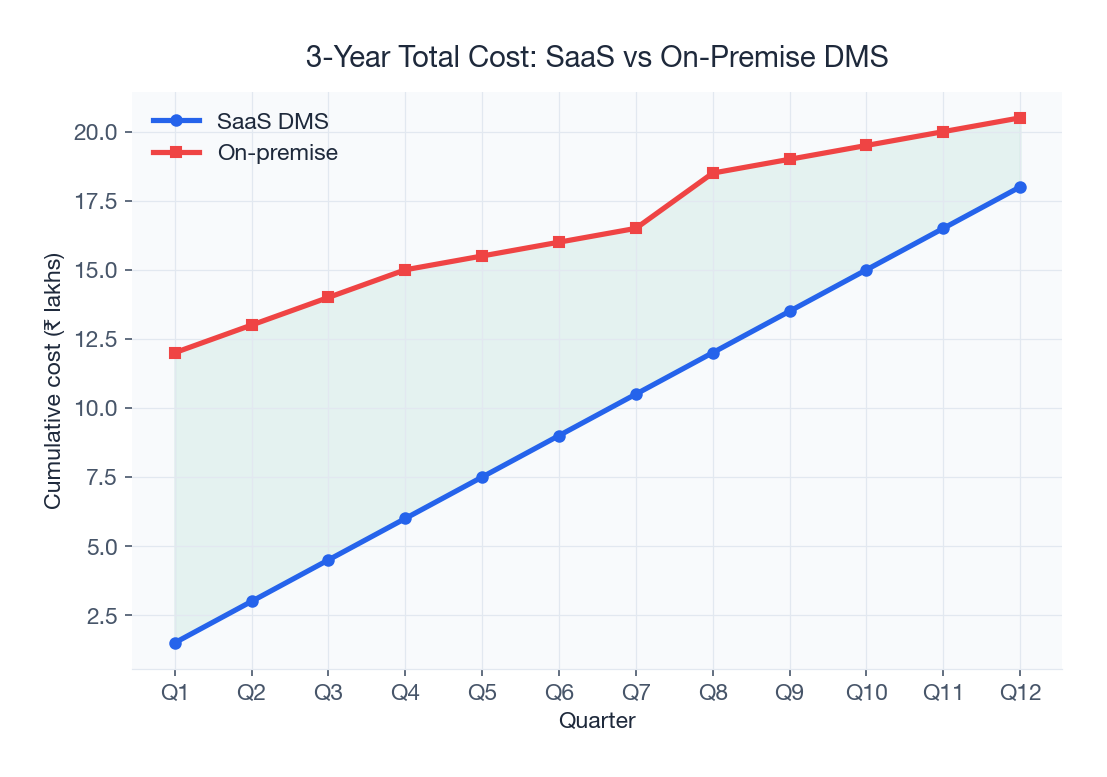
Cloud-based DMS has lower upfront cost (no server hardware, no IT staff for maintenance) and predictable monthly expenses. On-premise may appear cheaper initially but has higher total cost of ownership due to server hardware (Rs 2–5 lakh), IT staff, backup systems, and upgrade costs. For most Indian SMEs, cloud-based is 30–50% cheaper over 3 years.
Related SpireStock Features
Related Industries
Streamline FMCG distribution with order management, beat planning, retailer tracking, and GST billing. Built for Indian FMCG supply chains.
End-to-end dairy distribution software for milk, curd, paneer, and ghee brands. Manage orders, crates, cold chain, and GST billing in one platform.
Related Solutions
Manage your entire distributor network digitally. Onboarding, credit limits, outstanding tracking, and performance analytics. Start free trial.
Boost field sales team productivity with beat planning, GPS attendance, order capture, and performance analytics. Built for Indian FMCG teams.
Related Entities
Ready to Streamline Your Distribution?
Start your free 14-day trial and see how SpireStock can transform your dairy, FMCG or consumer-goods distribution operation, from order capture to crate recovery.

SpireStock Team
Product & Industry Insights
SpireStock Team leads product at SpireStock, where the team ships distribution management software for India's dairy, FMCG and consumer-goods brands.