Why 2026 Is the Right Time to Start a Distribution Business in India
India's FMCG distribution market is projected to reach $220 billion by 2027, driven by rising rural consumption, urbanisation, and an expanding middle class. With over 12 million kirana stores and modern trade outlets hungry for reliable supply, the opportunity for new distributors has never been greater. Yet many aspiring entrepreneurs hesitate — unsure about capital requirements, licensing hurdles, or how to compete against established players.
This guide eliminates the guesswork. Whether you are planning to distribute dairy products in Pune, FMCG goods in Delhi, or beverages across Ahmedabad, you will find a clear, actionable roadmap below. We cover realistic cost breakdowns in INR, licensing requirements, territory planning, staffing strategies, and — critically — how adopting distribution management software from day one can save you lakhs in operational costs every year.
Step 1: Evaluate the Market Opportunity and Choose Your Category
Before investing a single rupee, you need clarity on what you will distribute. The category you choose directly impacts your capital needs, margin potential, and operational complexity.
High-Demand Distribution Categories in India
| Category | Typical Gross Margin | Initial Capital (Rs) | Complexity |
|---|---|---|---|
| Dairy Products | 8-15% | 15-40 lakh | High (cold chain) |
| FMCG Staples | 3-6% | 10-30 lakh | Medium |
| Snacks & Confectionery | 5-10% | 8-25 lakh | Medium |
| Beverages | 6-12% | 12-35 lakh | Medium-High |
| Personal Care | 4-8% | 10-25 lakh | Low-Medium |
| Fresh Produce | 10-20% | 8-20 lakh | Very High (perishable) |
If you are new to distribution, FMCG staples and snacks offer a forgiving learning curve with steady demand. Categories like dairy distribution and fresh produce command higher margins but demand cold-chain infrastructure and faster turnaround times. For a deeper look at margin structures, read our FMCG distributor margin and profit guide.
Key insight: Many first-time distributors make the mistake of chasing high-margin categories without accounting for operational costs. A 12% margin on dairy with 8% spoilage and cold-chain expenses may net less than a 5% margin on packaged staples with negligible waste.
Step 2: Create a Realistic Business Plan and Budget
A distribution business plan is not a formality — it is your financial survival map. Here is a realistic cost breakdown for a mid-sized FMCG distribution setup in a Tier-2 city like Jaipur or Indore.
Capital Requirement Breakdown (Mid-Size FMCG Distributor)
| Expense Head | One-Time Cost (Rs) | Monthly Recurring (Rs) |
|---|---|---|
| Warehouse Rent (1,500-2,000 sq ft) | 1-2 lakh (deposit) | 15,000-30,000 |
| Warehouse Setup (racks, pallets, lighting) | 1.5-3 lakh | — |
| Delivery Vehicles (2-3 tempos/vans) | 4-8 lakh | 15,000-25,000 (fuel + maintenance) |
| Initial Inventory Purchase | 5-15 lakh | Revolving |
| Licensing & Registration | 25,000-50,000 | — |
| Staff Salaries (4-6 people) | — | 80,000-1.5 lakh |
| DMS Software | — | 3,000-8,000 |
| Insurance | 15,000-30,000/year | — |
| Working Capital Buffer | 3-5 lakh | — |
Total estimated startup capital: Rs 15-35 lakh for a Tier-2 city operation. In metros like Mumbai or Bangalore, expect 30-50% higher costs primarily due to warehouse rent and staff salaries.
Working Capital — The Hidden Challenge
Most new distributors underestimate working capital needs. Brands typically offer 7-21 day credit terms to distributors, but retailers often demand 15-30 day credit. This gap means you are financing inventory for 2-4 weeks from your own pocket. For a distributor doing Rs 15 lakh in monthly sales, this translates to Rs 5-8 lakh locked in receivables at any given time.
Smart payment collection systems and disciplined credit policies are essential from day one. Distributors who track receivables manually in registers often discover cash-flow gaps too late.
Step 3: Complete All Licensing and Legal Requirements
Operating without proper licenses can result in hefty fines and business closure. Here is every license you need.
Mandatory Licenses for Distribution Business in India
- GST Registration: Mandatory if annual turnover exceeds Rs 40 lakh (Rs 20 lakh for services). Apply on the GST portal — processing takes 7-15 working days. Our GST billing guide covers compliance requirements for distributors.
- FSSAI License: Required if you distribute any food or beverage products. Basic registration (under Rs 12 lakh turnover) costs Rs 100. State license (Rs 12 lakh to Rs 20 crore) costs Rs 2,000-5,000 annually.
- Trade License: Issued by your local municipal corporation. Costs Rs 500-5,000 depending on the city.
- Shop and Establishment Act Registration: Mandatory in most states. Apply within 30 days of starting operations.
- MSME/Udyam Registration: Free and voluntary, but gives you access to government subsidies, lower interest rates on loans, and priority in government tenders.
- Drug License: Only required if distributing pharmaceutical or certain personal care products.
Key insight: Start the FSSAI license application early — it can take 30-60 days for a state license. Many brands will not appoint you without a valid FSSAI number, so this can delay your launch significantly.
Step 4: Secure the Right Warehouse Location
Your warehouse is the heart of your distribution business. Location matters more than size.
Warehouse Selection Criteria
- Proximity to retail clusters: Ideally within 10-15 km of your densest retail zones to minimise delivery costs and enable same-day fulfillment.
- Road connectivity: Access to main roads and highways. Avoid interior lanes where large vehicles cannot manoeuvre easily.
- Loading/unloading space: At least 500 sq ft of open area outside for vehicle docking. Many distributors overlook this and face daily bottlenecks.
- Power supply: Critical for cold-chain categories. Ensure 3-phase power availability and budget for a generator or inverter backup.
- Ceiling height: Minimum 12 feet for efficient vertical racking. This effectively doubles your storage capacity versus ground-only storage.
For dairy and beverage distribution, cold storage infrastructure adds Rs 3-6 lakh to your setup cost. Consider starting with rented cold rooms rather than building your own to conserve capital.
Warehouse Cost Benchmarks by City Tier
Warehouse rents vary dramatically across India. In South Mumbai or Central Delhi, a 2,000 sq ft godown can cost Rs 60,000-1 lakh per month. In contrast, the same space in Lucknow, Chandigarh, or Indore costs Rs 12,000-25,000. Many experienced distributors deliberately locate warehouses just outside city limits — 5-10 km from the main market — where rents are 40-60% lower while delivery time increases by only 15-20 minutes per trip. This trade-off saves Rs 15,000-30,000 per month in rent, which at startup stage is the difference between survival and shutdown.
Also factor in the warehouse deposit, which typically equals 3-6 months of rent. In a metro city, that is Rs 1.8-6 lakh locked up before you stock a single product. Negotiate hard on the deposit — landlords of commercial godowns are more flexible than residential landlords, especially if you sign a longer lease of 2-3 years.
Step 5: Choose and Secure Brand Partnerships
This is where many aspiring distributors struggle most. Established brands like Amul, Britannia, ITC, and Parle Agro receive dozens of distributor applications for every open territory. You need to stand out.
What Brands Look for in a Distributor
- Financial capacity: Proof of capital (bank statements, property documents). Most national FMCG brands expect Rs 10-15 lakh minimum working capital.
- Infrastructure: Warehouse with adequate space, delivery vehicles, and staff already in place or committed.
- Market knowledge: Familiarity with local retailers, trade dynamics, and consumer preferences in your territory.
- Technology readiness: Increasingly, brands prefer distributors who use distribution management systems for accurate reporting and real-time stock visibility.
- Existing retail network: If you already have relationships with 100+ retailers, you are immediately more attractive than a newcomer with zero connections.
Learn what specific criteria major brands evaluate in our detailed FMCG distributor appointment criteria guide. Also study common pitfalls in our analysis of why FMCG distributors fail in India.
Strategy for New Distributors Without Brand Connections
Start with regional or emerging brands that are actively expanding. Companies like Country Delight and new D2C brands moving into offline retail are often more willing to appoint fresh distributors. Build your track record over 6-12 months, then approach larger brands with proven sales data and a professional setup.
Step 6: Plan Your Territory and Routes
Territory planning determines your revenue ceiling. A poorly planned territory forces your sales team to waste hours in traffic while missing high-potential outlets.
Territory Planning Framework
- Map all retail outlets: Physically survey your territory and categorise retailers by type (kirana, modern trade, HoReCa), size, and potential volume.
- Define beat plans: Divide your territory into daily beats so each salesperson covers 25-35 outlets per day in a logical geographic sequence.
- Estimate demand: Calculate expected monthly volume per outlet based on category, locality demographics, and competitor presence.
- Plan delivery routes: Route optimization can reduce fuel costs by 15-25% and increase daily deliveries by 20-30%. Even a simple optimised route versus ad-hoc delivery saves Rs 3,000-5,000 per vehicle per month.
A territory with 500 active retail outlets can generate Rs 10-25 lakh in monthly revenue for a single FMCG category, depending on the city and product mix. In metro areas like Chennai or Hyderabad, higher outlet density means more revenue per square kilometre but also more competition.
Understanding Beat Plans and Call Frequency
A beat plan is the backbone of your sales operation. Divide your territory into daily routes so each salesman visits a fixed set of outlets on the same day every week. For FMCG staples, a weekly call frequency (visiting each outlet once per week) works well. For dairy and perishables, you may need 3-6 visits per week per outlet. The standard approach is to create 6 daily beats (Monday through Saturday) with 25-35 outlets per beat, giving you coverage of 150-210 outlets per salesperson per week.
Map these beats geographically to minimize backtracking. A common mistake is grouping outlets by size or relationship rather than proximity — this wastes 30-45 minutes per day in unnecessary travel. Use route optimization tools to sequence stops intelligently. Distributors in congested cities like Kolkata or Old Delhi report that optimised beat sequencing alone saves 45-60 minutes per salesperson per day — equivalent to 4-6 additional outlet visits.
Step 7: Hire and Train Your Team
A lean, well-trained team outperforms a large untrained one. Here is the minimum viable team for a new distribution operation.
Recommended Startup Team Structure
| Role | Headcount | Monthly Salary (Rs) | Responsibilities |
|---|---|---|---|
| Sales Executive | 2-3 | 12,000-18,000 each | Retail visits, order booking, relationship management |
| Delivery Driver | 1-2 | 10,000-15,000 each | Product delivery, returns collection |
| Warehouse Helper | 1-2 | 8,000-12,000 each | Loading, unloading, inventory management |
| Accountant (part-time) | 1 | 8,000-12,000 | Billing, GST filing, receivables tracking |
Total monthly staff cost: Rs 70,000-1.2 lakh. Use attendance tracking and mobile app-based order booking to maximise productivity from each team member. Distributors using field-force management tools report 25-40% higher orders per salesperson per day.
Step 8: Set Up Your Technology Stack from Day One
This is where modern distributors gain an insurmountable advantage over traditional operators. The data from our clients is unambiguous — distributors who adopt technology from launch outperform those who start manually and try to digitise later.
Manual Operations vs. DMS Software from Day 1
| Metric | Manual Operations | With DMS Software | Advantage |
|---|---|---|---|
| Order processing time | 15-20 min/order | 2-3 min/order | 85% faster |
| Billing errors | 5-8% of invoices | Under 0.5% | 90% reduction |
| Stock accuracy | 80-85% | 97-99% | 15% improvement |
| Daily delivery capacity | 20-25 stops | 30-40 stops | 40-60% more |
| Payment collection rate | 70-80% on time | 90-95% on time | 15-20% improvement |
| Monthly operational cost | Rs 1.2-1.8 lakh | Rs 0.8-1.2 lakh | Rs 30,000-60,000 saved |
| Brand reporting compliance | Delayed, inaccurate | Real-time, automated | Better brand relationships |
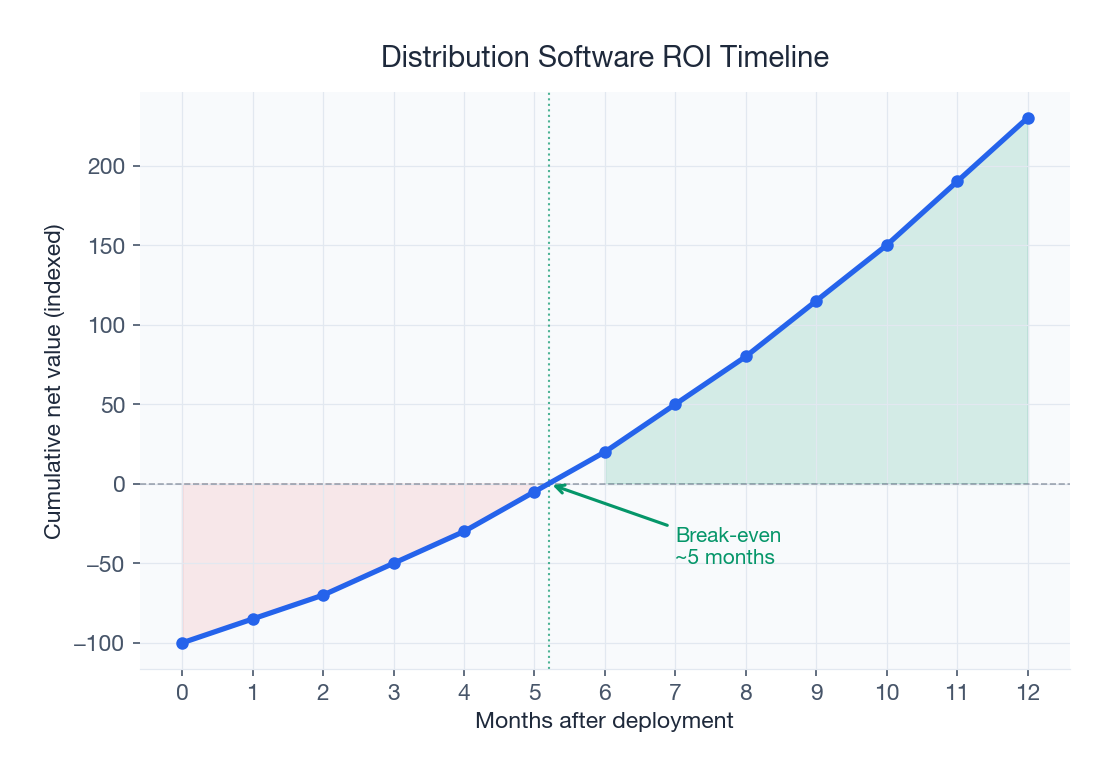
| Break-even timeline | 8-14 months | 5-9 months | 3-5 months faster |
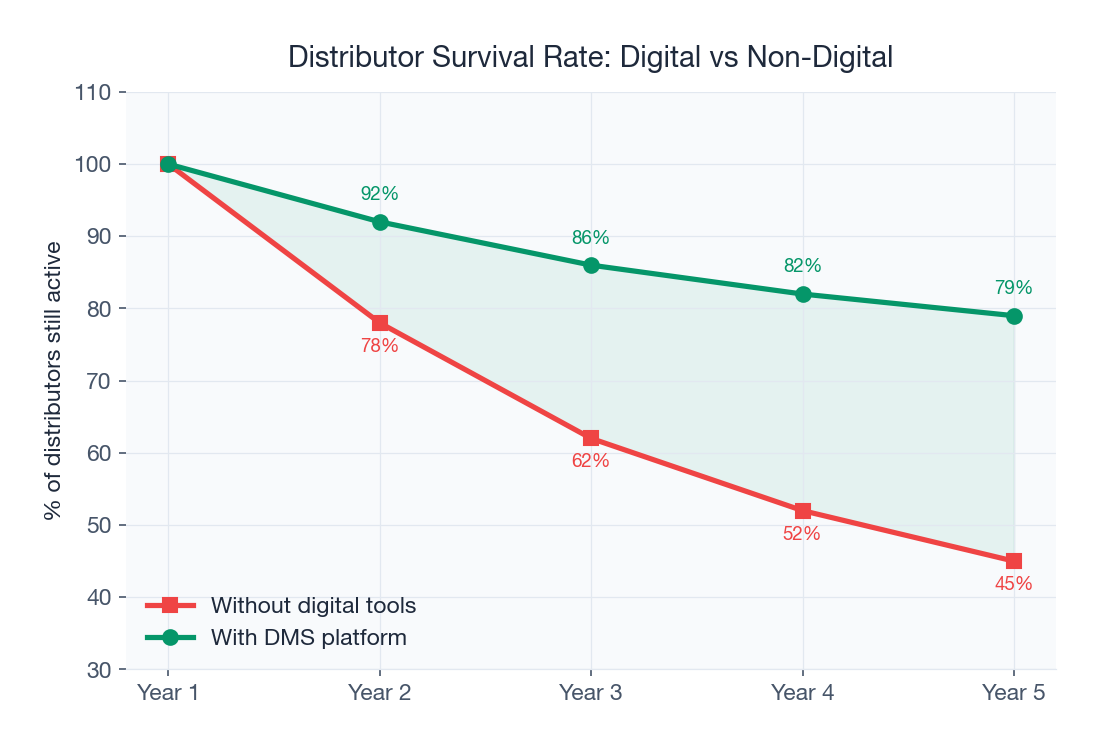
Key insight: The Rs 3,000-8,000 monthly cost of DMS software typically pays for itself within the first month through reduced billing errors, better collection rates, and lower delivery costs alone. Distributors who wait 6-12 months to digitise lose Rs 2-5 lakh in avoidable inefficiencies during that period.
Essential Software Features for New Distributors
- Order Management: Accept orders via mobile app, eliminate paper-based booking, and ensure zero missed orders.
- Invoice & Billing: GST-compliant automated invoicing that saves 2-3 hours daily and eliminates calculation errors.
- Distribution Tracking: Real-time visibility into deliveries, returns, and stock movement across your territory.
- Sales Analytics: Understand which products, outlets, and routes generate the most revenue — data that takes months to gather manually.
- Crate Management: Essential for dairy and beverage distributors to track returnable assets and prevent losses.
Explore the full distribution management software guide for a complete feature comparison. For budget considerations, see our DMS pricing guide.
Step 9: Launch and Scale Your Operations
Your first 90 days determine long-term success. Here is a phased launch plan.
Month 1: Foundation
- Week 1-2: Complete warehouse setup, install DMS software, train staff on technology and processes.
- Week 3-4: Begin retail coverage — target 50-80 outlets in your strongest micro-market. Focus on building relationships and reliable delivery schedules.
Month 2: Expansion
- Expand to 150-200 outlets. Analyse sales data to identify top-performing SKUs and outlets.
- Optimise routes based on actual order patterns rather than initial estimates.
- Review payment collection — tighten credit terms for slow-paying retailers early.
Month 3: Optimisation
- Target 250-350 active outlets. This is the sweet spot for a single-brand operation with 2-3 salespeople.
- Negotiate better terms with your brand based on first-quarter performance data. Proven volume gives you leverage.
- Evaluate adding a second brand in a complementary category to increase revenue per outlet.
Step 10: Avoid the Most Common Mistakes
After working with hundreds of distributors across India, we have identified the patterns that sink new businesses.
- Over-investing in inventory: Start lean. It is better to face a few stockouts than to have Rs 10 lakh locked in slow-moving SKUs. Use sales analytics to let demand data guide replenishment.
- Ignoring credit discipline: Offering 30-day credit to every retailer from day one is a recipe for cash-flow disaster. Start with cash or 7-day terms and extend credit based on payment history.
- Skipping technology: The argument that "we will digitise later when we are bigger" costs distributors lakhs in preventable losses. See our analysis of why distributors still using Excel are falling behind.
- Poor territory planning: Accepting a territory that is too large leads to thin coverage. It is better to dominate a smaller area than to weakly cover a large one. Read more in our distribution network planning guide.
- Neglecting relationships: Distribution is ultimately a people business. Regular retailer visits, prompt complaint resolution, and consistent delivery build loyalty that competitors cannot easily break.
Financial Projections: What to Expect in Year One
Here is a realistic projection for a mid-sized FMCG distributor in a Tier-2 Indian city.
| Quarter | Monthly Revenue | Gross Margin | Net Profit (after all costs) |
|---|---|---|---|
| Q1 (Month 1-3) | Rs 5-10 lakh | Rs 30,000-60,000 | Loss of Rs 20,000-50,000 |
| Q2 (Month 4-6) | Rs 10-18 lakh | Rs 60,000-1.1 lakh | Break-even to Rs 20,000 profit |
| Q3 (Month 7-9) | Rs 15-25 lakh | Rs 90,000-1.5 lakh | Rs 30,000-70,000 profit |
| Q4 (Month 10-12) | Rs 20-30 lakh | Rs 1.2-1.8 lakh | Rs 50,000-1 lakh profit |
By month 10-12, a well-run distribution operation should generate Rs 50,000-1 lakh in monthly net profit. Year-two projections improve dramatically as fixed costs are absorbed over higher volumes and brand incentives kick in. Distributors who leverage technology typically reach profitability 3-5 months faster than those relying on manual processes.
Ready to Launch Your Distribution Business?
Starting a distribution business in India in 2026 is a proven path to building a profitable enterprise — if you approach it with proper planning, adequate capital, and the right technology. The distribution landscape is shifting rapidly toward digital-first operations, and distributors who embrace this shift from day one will build businesses that are more efficient, more profitable, and more attractive to top brands.
SpireStock's distribution management platform is built specifically for Indian distributors — from single-brand startups to multi-brand operations spanning multiple cities. Our software handles order management, GST-compliant billing, route optimization, and sales analytics so you can focus on growing your business rather than wrestling with spreadsheets.
Talk to our distribution experts for a free consultation on setting up your distribution technology stack, or explore our pricing plans designed for businesses at every stage.
Sources & References
Frequently Asked Questions
A mid-sized FMCG distribution business in a Tier-2 city typically requires Rs 15-35 lakh, covering warehouse setup, vehicles, initial inventory, licensing, staff salaries, and working capital. Metro cities like Mumbai or Delhi may require Rs 30-50 lakh due to higher rents and wages.
You need GST registration, FSSAI license (for food products), a trade license from the municipal corporation, and Shop and Establishment Act registration. MSME/Udyam registration is optional but recommended for subsidies and loan benefits.
Most FMCG distributors break even within 5-9 months if they use technology from day one, or 8-14 months with manual operations. The timeline depends on your category, territory size, brand strength, and operational efficiency.
Yes, but start with a less complex category like packaged FMCG staples or snacks. Partner with emerging brands willing to support new distributors. Build 6-12 months of track record before approaching major national brands.
Brands evaluate financial capacity, warehouse infrastructure, delivery vehicles, market knowledge, and technology readiness. Build credibility with smaller brands first, then approach larger companies with documented sales performance and a professional setup.
While not legally required, DMS software saves Rs 30,000-60,000 monthly in operational costs and helps new distributors break even 3-5 months faster. It also makes your business more attractive to brands that expect digital reporting and inventory visibility.
Gross margins range from 3-6% for staples to 8-15% for dairy products. After deducting operational costs, net margins typically settle at 1.5-5%. Technology adoption and efficient operations can improve net margins by an additional 2-4 percentage points.
Start with 50-80 outlets in the first month and scale to 250-350 active outlets by month three. For a single-brand FMCG operation with 2-3 salespeople, this outlet range provides a strong revenue base without overstretching your team.
Related SpireStock Features
End-to-end order lifecycle from placement to delivery with multi-level approval workflows.
GST-compliant invoicing with HSN codes, gate passes, and financial ledger.
Powerful dashboards with sales trends, MIS reports, and distribution analytics.
Related Industries
Related Entities
Ready to Streamline Your Distribution?
Start your free 14-day trial and see how SpireStock can transform your dairy, FMCG or consumer-goods distribution operation, from order capture to crate recovery.

SpireStock Team
Distribution Technology Experts
SpireStock Team writes for SpireStock on distribution management, supply-chain optimisation and field operations for Indian dairy and FMCG brands.