
Delivery Boy Tracking App for Dairy Distribution: The Complete Guide to Fleet Visibility and Proof of Delivery
Dairy distribution is one of the most operationally demanding segments in Indian FMCG. Products are perishable (often with 48-72 hour shelf life for fresh milk and curd), delivery windows are tight (typically 4 AM to 10 AM), and cash collection happens on the spot. In this high-stakes environment, not knowing where your delivery boys are, whether they have completed their routes, or how much cash they are carrying is a recipe for losses.
A delivery boy tracking app solves these problems by giving dairy distributors real-time visibility into every aspect of last-mile delivery — GPS location, proof of delivery, cash reconciliation, and performance metrics. This guide covers everything you need to know about implementing delivery tracking technology for dairy distribution operations across India.
Why Dairy Distribution Needs Specialised Delivery Tracking
Unlike ambient FMCG products where a missed delivery can be rescheduled to the next day, dairy distribution has zero tolerance for delivery failures. A missed milk delivery means a retailer's cooler stays empty during peak morning hours — the customer switches brands immediately. This urgency creates unique tracking requirements.
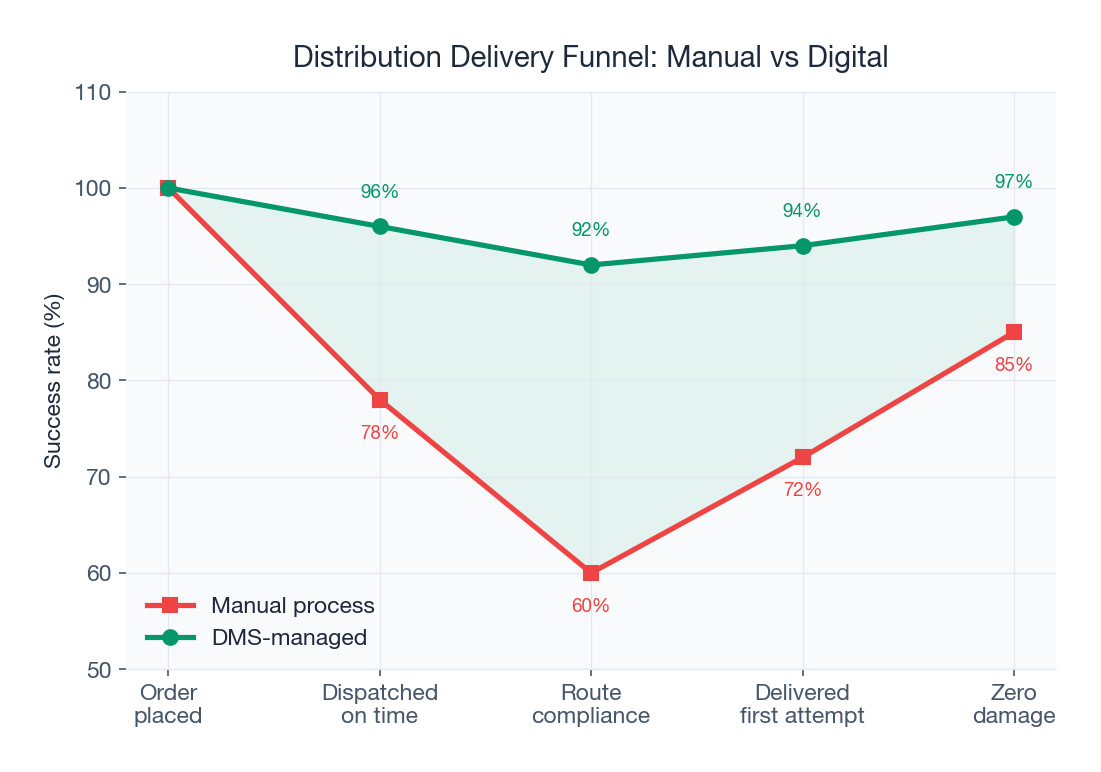
- Pre-dawn operations: Most dairy deliveries start at 3:30-4:00 AM. Without GPS tracking, supervisors have no visibility until the delivery boy returns at 10-11 AM — a 6-7 hour blind spot
- Cold chain integrity: Temperature-sensitive products require time-bound delivery. A tracking app with timestamp logging proves whether deliveries happened within the cold chain window
- Daily cash handling: Dairy delivery boys handle Rs 15,000-50,000 in cash daily. Real-time collection tracking prevents pilferage and speeds up payment reconciliation
- High delivery frequency: Unlike weekly FMCG beats, dairy delivery happens daily. Even a 5-minute per-stop inefficiency compounds to 2+ hours of wasted time across a 25-stop route
- Crate management: Dairy distribution involves constant crate exchange — full crates out, empty crates back. Without digital tracking, crate losses of 8-15% annually are common
Core Features of a Dairy Delivery Tracking App
1. Real-Time GPS Tracking with Geofencing
The foundation of any delivery tracking system is live GPS positioning. For dairy distribution, this means tracking every delivery vehicle (typically two-wheelers and mini-trucks) from the moment they leave the godown until they return.
Geofencing adds intelligence to raw GPS data. You define virtual boundaries around each delivery point (retailer location), the godown, and restricted zones. The system automatically triggers alerts when:
- A delivery boy enters or exits a geofenced retailer location — confirming actual visits
- A vehicle deviates from its assigned route by more than a configured distance (typically 500m)
- A delivery boy remains stationary for longer than expected at any location (potential issue)
- The vehicle enters a restricted zone or moves outside the assigned territory
For Mumbai-based dairy distributors covering areas like Andheri, Borivali, and Thane, geofencing helps distinguish between a delivery boy stuck in traffic versus one who has deviated to handle personal errands. This distinction alone can recover 30-45 minutes of productive time per route per day.
2. Digital Proof of Delivery (POD)
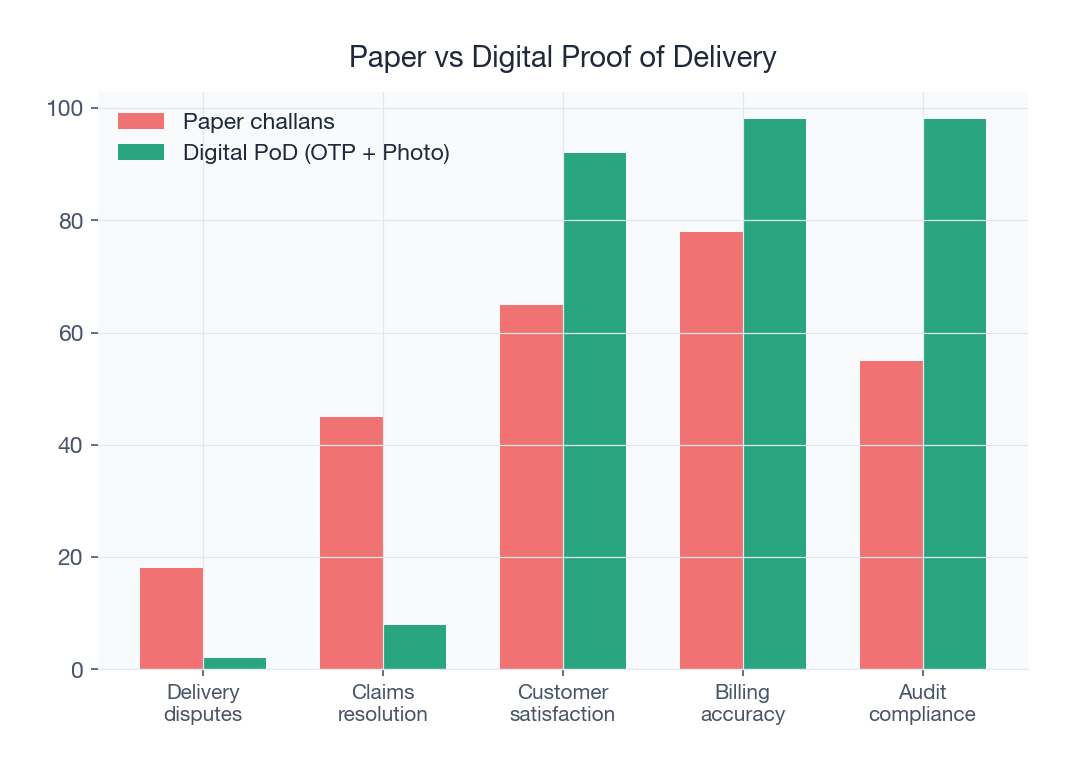
Paper-based delivery records are unreliable, easy to fabricate, and impossible to audit in real-time. A digital proof of delivery system captures multiple verification signals at the point of delivery:
| POD Method | How It Works | Best For | Reliability |
|---|---|---|---|
| OTP Verification | Retailer receives SMS OTP, shares with delivery boy | High-value deliveries, new outlets | Very High |
| Photo Capture | Delivery boy photographs delivered goods at outlet | Bulk deliveries, dispute prevention | High |
| Digital Signature | Retailer signs on delivery boy's phone screen | Invoice-backed deliveries | High |
| QR Code Scan | Retailer scans a unique QR on the delivery challan | Tech-savvy retailers, modern trade | Very High |
| GPS + Timestamp | Automatic logging when device enters geofence | All deliveries (baseline) | Medium |
The most effective approach combines GPS+Timestamp as the baseline with one additional verification method. For dairy distributors in cities like Pune and Bangalore, photo-based POD has proven most practical — delivery boys simply photograph the crates placed at the retailer's shop, providing irrefutable evidence of delivery with minimal friction.
Digital POD also integrates directly with your billing system, automatically marking invoices as delivered and triggering payment collection timelines. This eliminates the manual reconciliation that typically consumes 2-3 hours of back-office time daily.
3. Cash Collection Tracking and Reconciliation
Cash-on-delivery remains the dominant payment mode in Indian dairy distribution, accounting for 65-80% of transactions. A delivery boy on a typical route collects Rs 20,000-45,000 in cash daily. Without real-time tracking, distributors only discover discrepancies when the delivery boy returns to the godown — by which point, resolving shortages becomes a confrontation rather than a correction.
A robust tracking app provides:
- Per-stop collection logging: The delivery boy records the exact amount collected at each outlet, linked to the invoice
- Running balance display: Both the delivery boy and supervisor see the cumulative cash balance in real-time
- Denomination tracking: Optional feature for high-value routes where denomination-level recording prevents disputes
- Auto-reconciliation: The system compares expected collections (based on delivered invoices) against actual collections, flagging mismatches instantly
- UPI/digital payment tagging: When retailers pay via UPI or other digital methods, the app records the transaction reference for reconciliation
Dairy distributors in Ahmedabad and Surat who have implemented real-time cash tracking report a 70-90% reduction in end-of-day collection discrepancies. The transparency alone changes delivery boy behaviour — knowing that every rupee is tracked in real-time eliminates most casual pilferage. For a comprehensive approach to managing distributor finances, see our guide on credit limit management.
4. Daily Route Assignment and Optimisation
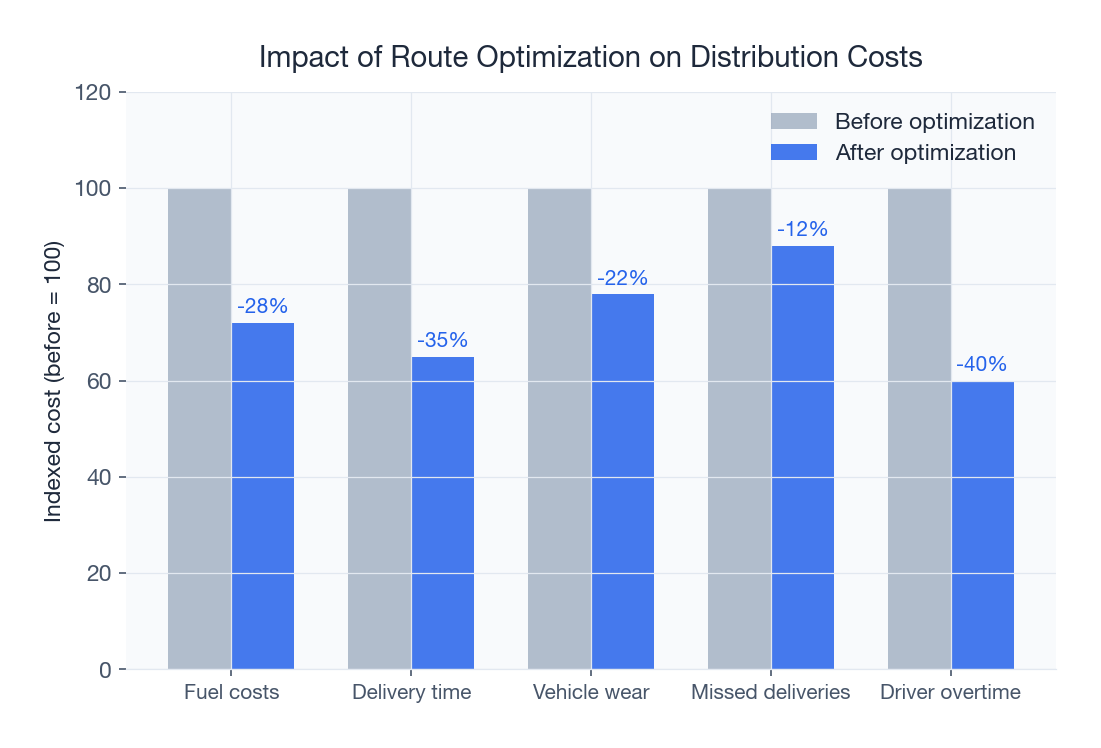
In dairy distribution, routes are typically fixed (the same delivery boy serves the same outlets daily), but the sequence and timing can be optimised significantly. A tracking app with route optimisation capabilities can:
- Resequence stops to minimise total travel distance based on real-time traffic conditions
- Adjust for retailer-specific delivery windows (some outlets want delivery before 6 AM, others after 8 AM)
- Balance loads across delivery boys when one calls in sick or a vehicle breaks down
- Factor in crate pickup requirements — outlets that return large numbers of empty crates should be sequenced to avoid overloading the vehicle mid-route
Route assignment through the app also creates a digital audit trail. The supervisor assigns routes by 3:00 AM (or the previous evening), the delivery boy receives the route on their phone with turn-by-turn navigation, and the system tracks adherence throughout the delivery window. This structured approach is a core part of effective fleet management.
5. Performance Scorecards for Delivery Staff
Data from the tracking app feeds into individual performance scorecards that transform delivery management from subjective supervisor opinions into objective, data-driven assessments.
| Performance Metric | Measurement | Good Benchmark | Action Trigger |
|---|---|---|---|
| On-time delivery % | Deliveries within committed window | >92% | <85% triggers review |
| Route adherence % | Stops completed in assigned sequence | >88% | <80% triggers retraining |
| Cash reconciliation accuracy | Collections matching invoices | 100% | Any mismatch escalated |
| Delivery completion rate | Successful deliveries / Total assigned | >96% | <90% triggers investigation |
| Average time per stop | Time from arrival to departure | 6-10 min | >15 min flagged |
| Crate return rate | Empty crates collected / Expected | >95% | <90% triggers follow-up |
| Customer complaints | Complaints per 100 deliveries | <2 | >5 triggers retraining |
Monthly scorecards tied to incentives drive measurable improvement. Dairy distributors in Hyderabad who implemented performance-linked incentives (Rs 1,500-3,000 monthly bonus for top performers) saw delivery efficiency improve by 22% within three months.
6. Safety Compliance and SOS Features
Dairy delivery boys operate during the most vulnerable hours — pre-dawn darkness, empty roads, and often in unfamiliar areas of the city. A responsible tracking app includes safety features:
- SOS panic button: One-tap alert that sends the delivery boy's live location to supervisors and emergency contacts
- Speed monitoring: Alerts when vehicles exceed safe speed limits (particularly important for two-wheeler riders)
- Fatigue detection: Flags when a delivery boy has been continuously on the road for more than 6 hours without a break
- Night-mode tracking: Enhanced location pinging frequency during pre-dawn hours (every 30 seconds vs. the standard 2-minute interval)
- Insurance documentation: Digital recording of vehicle condition, delivery boy ID verification, and compliance checks at start-of-shift
Beyond the ethical imperative, safety features also reduce liability. When accidents or incidents occur, GPS logs and timestamps provide factual evidence for insurance claims and legal proceedings. This aspect often gets overlooked but can save distributors lakhs in disputed claims.
7. Fleet Visibility Dashboard
The supervisor dashboard is where all tracking data converges into actionable intelligence. A well-designed fleet visibility dashboard for dairy distribution shows:
- Live map view: All delivery vehicles plotted on a map with colour-coded status (en route, at stop, returning, delayed)
- Route progress bars: Visual indication of how far along each delivery boy is on their route — 15 of 28 stops completed, for instance
- Exception alerts: Real-time notifications for route deviations, missed stops, delayed starts, cash discrepancies, and SOS triggers
- Collection summary: Running total of cash and digital payments collected across all routes, with expected vs. actual comparison
- Crate balance: Real-time crate inventory showing dispatched, delivered, and returned counts by route
For distributors operating from multiple locations, the dashboard provides a unified view across all godowns. This is particularly valuable for dairy operations in metro cities where a single distributor might operate 3-5 dispatch points to cover the city. The distribution tracking module ties into the broader operational view including crate asset management and secondary sales.
Implementation Considerations for Indian Dairy Distributors
Smartphone and Connectivity Challenges
A common concern is whether delivery boys — many of whom earn Rs 12,000-18,000 per month — can effectively use a tracking app. The reality in 2026 is that smartphone penetration among delivery staff exceeds 95% in urban India and 80% in semi-urban areas. The real challenge is not device availability but app design.
The app must work reliably on low-end Android devices (2-3 GB RAM), function with intermittent 4G connectivity (common in industrial areas of Delhi and Chennai), and have a simple interface that requires minimal text input. Offline-first architecture — where data syncs when connectivity is available — is not optional; it is essential.
Delivery Staff Adoption
Resistance to tracking technology is natural but manageable. The most effective approach is to position the app as a tool that benefits the delivery boy, not just monitors them. When delivery boys see that the app helps them navigate unfamiliar areas, proves they made a delivery (protecting them from false complaints), and tracks their performance for fair incentive calculation, adoption rates climb from reluctant compliance to genuine engagement.
Cost-Benefit Analysis
| Cost Component | Monthly Cost (10-vehicle fleet) |
|---|---|
| App subscription | Rs 3,000 - 8,000 |
| Data plans for devices | Rs 2,000 - 3,000 |
| Training and support | Rs 1,000 - 2,000 (first 3 months) |
| Total monthly cost | Rs 6,000 - 13,000 |
| Benefit Area | Monthly Savings (10-vehicle fleet) |
|---|---|
| Reduced fuel waste (route optimisation) | Rs 8,000 - 15,000 |
| Lower cash discrepancies | Rs 5,000 - 12,000 |
| Reduced crate losses | Rs 3,000 - 8,000 |
| Fewer delivery disputes/returns | Rs 4,000 - 10,000 |
| Supervisor time saved | Rs 6,000 - 10,000 |
| Total monthly savings | Rs 26,000 - 55,000 |
The ROI calculation is overwhelmingly positive — most dairy distributors recover their investment within 30-45 days. The savings compound as data accumulates and route optimisation algorithms learn your specific delivery patterns.
Real-World Impact: What Changes After Implementation
The benefits of delivery tracking are not theoretical. Dairy distributors across Indian cities who have moved from manual dispatch to app-based tracking report consistent, measurable improvements across their operations.
Operational Improvements Within 90 Days
- Delivery dispute resolution: Drops from 2-3 days (he-said-she-said arguments) to under 10 minutes (check the GPS log and photo POD). This alone saves Rs 15,000-25,000 monthly in credit notes issued to resolve disputes
- Route completion time: Average reduction of 35-50 minutes per route as delivery boys follow optimised sequences instead of habitual patterns. For a 10-vehicle fleet, that is 5-8 hours of recovered productive time daily
- Crate recovery rate: Improves from 85-88% to 95-98% when every crate handover is digitally logged. At Rs 250-400 per crate, recovering even 50 additional crates per month saves Rs 12,500-20,000
- Cash leakage: Near-zero discrepancies when real-time collection tracking is active. Distributors in Kolkata and Lucknow report that simply implementing cash tracking visibility — even before enforcement — reduced shortages by 80%
- Supervisor workload: Supervisors spend 60-70% less time on morning dispatch coordination and end-of-day reconciliation, freeing them for strategic tasks like retailer relationship building and secondary sales planning
The compounding effect matters: better tracking leads to better data, which leads to better route design, which leads to lower costs and higher delivery reliability. Within 6 months, most distributors wonder how they ever operated without it.
Choosing the Right Delivery Tracking Solution
Not all tracking apps are built for the unique demands of dairy distribution. Generic logistics tracking tools lack dairy-specific features like crate management, cold chain logging, and daily route recurrence. When evaluating options, prioritise:
- Industry specificity: Does the app understand dairy distribution workflows — daily deliveries, crate exchange, morning dispatch, FSSAI compliance requirements?
- Integration depth: Does it connect with your order management, billing, and inventory systems, or does it operate in isolation?
- Offline reliability: Will it work in basement godowns and rural delivery areas where connectivity drops?
- Scalability: Can it handle 10 vehicles today and 50 tomorrow without re-platforming?
- Indian language support: Can delivery boys use the app in Hindi, Marathi, Tamil, or Telugu?
The difference between a generic tracker and a purpose-built dairy distribution platform becomes apparent within the first week of use. Generic tools create more data entry work; purpose-built tools eliminate it.
Start Tracking Your Delivery Operations Today
Every day without delivery tracking is a day of blind spots — unverified deliveries, unreconciled cash, and unoptimised routes silently eroding your margins. Indian dairy distributors who have adopted tracking technology consistently report 15-25% improvement in operational efficiency and near-complete elimination of delivery disputes.
SpireStock's delivery tracking module is purpose-built for Indian dairy and FMCG distribution, with real-time GPS, digital POD, cash reconciliation, and performance scorecards — all designed to work on low-end devices in Indian connectivity conditions. Schedule a live demo to see it in action with your routes, or check our pricing to find the plan that fits your fleet size.
Sources & References
Frequently Asked Questions
The app uses the delivery boy's smartphone GPS to track real-time location during delivery routes. It captures proof of delivery via OTP, photo, or digital signature at each stop, records cash and UPI collections, and generates performance reports. All data syncs to a central dashboard for supervisor visibility.
Yes, good delivery tracking apps queue GPS data, delivery confirmations, and payment records locally when offline. The data syncs automatically when the rider enters a coverage area. SpireStock's app is designed for Indian connectivity conditions with full offline support.
Indian dairy distributors typically see 85-95% reduction in cash discrepancies after implementing digital collection tracking. For a 15-route operation, this translates to savings of Rs 4-8 lakh annually in recovered cash leakages.
The app runs on budget Android phones (Android 9 or above) in the Rs 6,000-10,000 range. It requires GPS capability, a camera for proof of delivery photos, and 50-100 MB of storage. Battery-optimized GPS tracking ensures the app runs a full shift on a single charge.
SpireStock's app uses intelligent GPS sampling — tracking at 30-60 second intervals during active routes rather than continuous tracking. This balances location accuracy with battery life, allowing a full 6-8 hour shift on a standard smartphone battery.
Initial resistance is common but resolves quickly when the app is positioned as an empowerment tool. Top-performing riders appreciate that their work is documented, disputes are resolved in their favour with proof of delivery data, and performance bonuses become objective. Transparent communication about data usage is essential.
Related SpireStock Features
Related Industries
End-to-end dairy distribution software for milk, curd, paneer, and ghee brands. Manage orders, crates, cold chain, and GST billing in one platform.
Manage beverage distribution with cold chain tracking, crate management, route optimization, and real-time delivery monitoring. Try SpireStock free.
Distribution management for fruits, vegetables, and perishable goods. Cold chain tracking, wastage reduction, and daily order management. Try free.
Related Solutions
GPS fleet tracking, driver management, and route optimization for dairy and FMCG delivery vehicles. Reduce fuel costs by 25%. Try SpireStock.
Track distributor and retailer payments. Cash, UPI, cheque collection with reconciliation, ageing reports, and credit limit management.
Related Entities
Ready to Streamline Your Distribution?
Start your free 14-day trial and see how SpireStock can transform your dairy, FMCG or consumer-goods distribution operation, from order capture to crate recovery.

SpireStock Team
Distribution Technology Experts
SpireStock Team writes for SpireStock on distribution management, supply-chain optimisation and field operations for Indian dairy and FMCG brands.


