The Problem with Manual Route Planning in Dairy
Most Indian dairy companies plan delivery routes the same way they have for decades, a senior driver or operations manager draws routes based on experience, and the team follows these fixed paths day after day. While this approach leverages valuable local knowledge, it has fundamental limitations that become more painful every year as traffic worsens, fuel prices rise, and customer expectations tighten. In cities like Mumbai, Bangalore, and Hyderabad, the gap between a manual route plan and an optimized one can easily reach 20-30% in both distance and time.
Manual routes become outdated as your distributor network grows, delivery points shift, and traffic patterns change. They cannot adapt to daily order variations, and they certainly cannot optimize across multiple vehicles simultaneously. The result is routes that may have been efficient once but now waste 15-25% of delivery resources, burn unnecessary diesel, and miss delivery windows that retailers increasingly insist on. For operators in dairy distribution, FMCG distribution, and beverage distribution, route efficiency is one of the largest controllable cost levers.
Similar challenges exist in bakery and confectionery, fresh produce, and consumer goods distribution, where daily delivery schedules and perishability make every wasted kilometre expensive.
What Automated Route Planning Does Differently
SpireStock's route planning engine does not just digitize your existing routes, it rethinks them from scratch based on data:
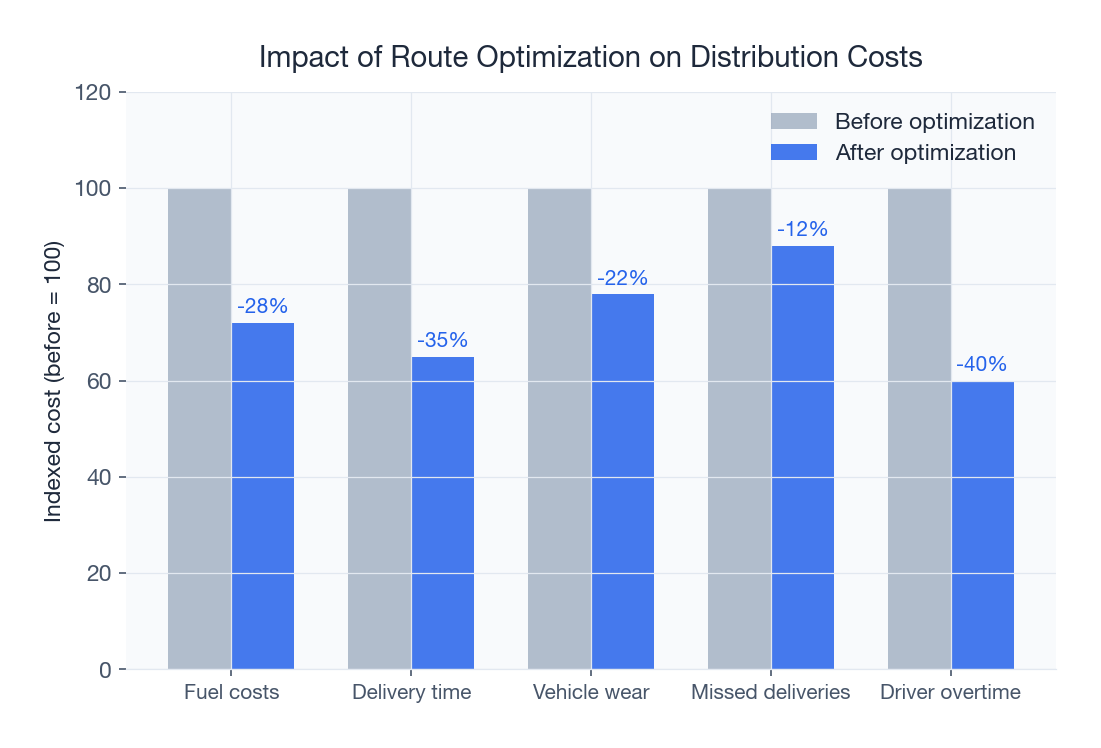
- Considers all constraints simultaneously, vehicle capacities, delivery windows, traffic, and driver assignments are all factored together, not sequentially
- Adapts daily, routes adjust based on actual orders, not yesterday's assumptions
- Optimizes fleet-wide, balances load and time across all vehicles, not just optimizing one route at a time
- Learns from data, historical delivery times, traffic patterns, and service times improve optimization accuracy over time
- Handles exceptions gracefully, vehicle breakdowns, unexpected stock-outs, or last-minute order changes trigger automatic re-optimization
Cost Comparison: Manual vs Automated Planning
| Metric | Manual Planning | Automated Planning | Improvement |
|---|---|---|---|
| Daily distance per fleet | 1,850 km | 1,395 km | -24.6% |
| Daily fuel cost | Rs 14,800 | Rs 11,160 | Rs 3,640 |
| Annual fuel savings | - | - | Rs 13.3 lakh |
| Vehicles needed | 12 | 10 | -2 |
| On-time delivery rate | 74% | 92% | +18 pts |
| Planning time per day | 2 hrs | 8 min | -93% |
| Deliveries per vehicle per day | 38 | 47 | +24% |
These numbers come from a real deployment at a Rs 120-crore dairy operating a 12-vehicle fleet across Pune and adjacent districts. The fuel savings alone paid back the software investment in under four months.
Step-by-Step: Transitioning to Automated Route Planning
Week 1: Foundation
Day 1-2: Data Collection. Gather your delivery point locations (addresses or GPS coordinates), vehicle details (number, capacity, type), current route assignments, and delivery time windows. If you are already using SpireStock for order management, much of this data already exists in the system.
Day 3-4: System Setup. Configure your vehicles, drivers, delivery zones, and operating hours in the route planning module. Define constraints like maximum driving hours, mandatory break times, and product-specific requirements (e.g. cold chain vehicles for ice cream routes).
Day 5-7: Baseline and First Optimization. Run your current routes through the system to establish a baseline, total distance, time, and cost. Then run the optimizer to generate proposed routes. Compare the two. Most companies see a 15-25% improvement in total distance on the first pass, without making any operational changes beyond adopting the new plan.
Week 2: Pilot and Refinement
Day 8-10: Pilot Execution. Deploy the optimized routes for a subset of your fleet (3-5 vehicles). Use GPS tracking to monitor actual adherence to the planned routes and compare real-world results with projections.
Day 11-12: Driver Feedback. Gather feedback from drivers. They know ground realities, roads under construction, difficult parking areas, customers with unusual access requirements. Incorporate this feedback into the system for the next optimization run. Good drivers often reveal constraints the planning software never would have known.
Day 13-14: Full Rollout. Extend optimized routes to your full fleet. Establish daily route generation as part of your operations workflow, orders come in by cutoff, routes are generated overnight, and drivers receive their optimized plans first thing in the morning.
Key Metrics to Track
- Total distance per day, across the fleet, compare optimized vs. baseline
- Fuel consumption, direct cost reduction measurement
- Deliveries per hour, efficiency indicator
- On-time delivery rate, customer satisfaction proxy
- Vehicle utilization, capacity used vs. available per trip
- Driver overtime hours, labour cost efficiency
- Customer complaints about missed windows, service quality
Pair this with your sales analytics so you can correlate route performance with revenue outcomes, not just operational metrics. The best operators review these metrics every Monday and run a weekly route-health meeting that owns the data.
Common Questions from Operations Teams
Transitioning to automated route planning raises practical concerns. Here are the most common ones and how to address them in the context of dairy distribution:
- "Our drivers know the routes better than any system", True for individual routes, but the system optimizes across all routes simultaneously, something no human can do. Use driver knowledge to refine, not replace, the optimization.
- "What about days when orders vary significantly?", That is precisely when automation shines. The system recalculates routes daily based on actual orders, adapting instantly to demand changes.
- "We do not have GPS coordinates for all delivery points", Start with what you have and let the mobile app capture coordinates during the first few delivery runs. The database builds itself within a week of normal operations.
- "Will it work in narrow Delhi lanes and Ahmedabad wholesale markets?", Yes, but you need to set realistic service times per stop and let drivers annotate access constraints so the system learns over time.
Fleet Management Integration
Route planning is one piece of a broader fleet management strategy. Combine it with vehicle tracking, fuel monitoring, maintenance scheduling, and driver performance to get the full operational picture. A Rs 240-crore dairy that integrated all four in 2024 cut its fleet operating costs by Rs 1.1 crore in the first year while improving on-time delivery from 78% to 94%. The ROI is not just in route optimization; it is in the compound effect of every fleet data point being visible in one place.
Long-Term Benefits
Beyond immediate cost savings, automated route planning enables your dairy business to scale without proportionally increasing delivery resources. Adding 50 new delivery points does not mean adding another vehicle, the system redistributes stops across existing routes to absorb growth efficiently. This is particularly valuable for fast-growing brands in Chennai and Jaipur where retail expansion is outpacing infrastructure investment.
Route optimization also enables smarter investment decisions. When you can see exactly which geographies are expensive to serve, you can price and structure distributor relationships accordingly. Low-density rural territories might need minimum order thresholds; high-density urban zones might justify dedicated vehicles. These are strategic decisions that only become possible with reliable route economics.
Environmental Impact: The ESG Story
A 20% reduction in route distance translates directly to a 20% reduction in Scope 1 emissions from your delivery fleet. For a 15-vehicle dairy operation, that is approximately 35-45 tonnes of avoided CO2 per year, a meaningful ESG metric that matters to institutional buyers, investors, and large retail chains who now request supplier emissions data. Brands like Amul, Mother Dairy, and Nandini all publish environmental targets, and route optimization is one of the fastest ways to hit them.
Ready to Start?
Route planning is arguably the single highest-ROI operational improvement available to a dairy distribution business. Talk to our team about a two-week route pilot on your existing fleet, review SpireStock pricing for the route optimization module, or book a demo to see your own routes optimized live during the call. For related reading, see our guides on route optimization for milk delivery and milk distribution management systems.
Frequently Asked Questions
Can the system handle multi-vehicle trips where one vehicle returns to the plant multiple times? Yes. Modern route planning engines handle multi-trip vehicles, refill points, and time-window constraints simultaneously. This is common in high-volume urban deliveries where a single vehicle may make 3-4 round trips per day.
What about cold chain requirements for ice cream routes? The system respects product-vehicle compatibility constraints. Ice cream stops only get assigned to vehicles with adequate cold chain capability, and routes are calculated to minimize exposure time.
How does optimization handle last-minute order changes? Orders received after route generation can either be manually inserted or trigger a partial re-optimization for affected routes. Most operators allow minor changes up to 30 minutes before dispatch.
Advanced Features Worth Exploring
Beyond basic route optimization, modern platforms offer dynamic re-routing based on real-time traffic, automatic driver assignments based on familiarity with zones, load balancing across shifts, and integration with vehicle maintenance systems to avoid assigning routes to vehicles due for service. These features add incremental value on top of the baseline 20-25% distance reduction and are worth exploring once the core optimization is stable.
Integration with sales analytics also enables route profitability analysis, showing which routes contribute most to margin versus merely to revenue. Some routes that look productive by volume are actually loss-makers once fuel, driver time, and vehicle depreciation are factored in. Killing these routes and redistributing stops to adjacent routes can meaningfully improve overall fleet profitability.
Vehicle Selection and Fleet Mix
Route optimization also informs vehicle selection decisions. Running the optimization with different fleet compositions shows which vehicle mix delivers the lowest total cost. Some routes might justify a smaller tempo; others benefit from larger refrigerated trucks. Dairy operations with 15+ vehicles typically save 8-12% of annual fleet cost by rebalancing their vehicle mix based on optimization data, and the savings compound every time a vehicle is due for replacement. For operators in Hyderabad and Delhi, where fleet renewal cycles drive significant capital decisions, this visibility is genuinely valuable.
Driver Experience and Turnover
Good route planning also improves driver experience. Drivers who know their daily plan in advance, who have reasonable workloads, and who finish their shifts on time are far less likely to quit. Driver turnover in Indian dairy distribution is typically 20-35% annually, and each replacement costs Rs 25,000-40,000 in hiring, training, and productivity ramp-up. Reducing turnover by even 5 percentage points saves lakhs of rupees per year and improves service quality in ways that show up in distributor satisfaction scores.
Seasonal and Event-Driven Routing
Dairy demand spikes dramatically during festivals like Diwali, Holi, Eid, and Onam. Route optimization makes these spikes manageable by dynamically generating routes for the higher volume. Without automation, these peak days become chaotic, routes break down, deliveries are missed, and customer service suffers exactly when brand presence matters most. Automated routing treats peak days as just another day in the optimization queue, absorbing the volume without the chaos.
Getting Buy-In From Drivers and Operations
The biggest practical challenge in route optimization is not technical but human. Experienced drivers often feel threatened by automated planning because they interpret it as a critique of their judgment. The right framing is that the software handles the cross-route optimization that no human can do, while drivers continue to provide the ground-truth expertise the software learns from. Present the rollout as a partnership, not a replacement, and invest time in explaining how driver feedback actually shapes the system.
Operations managers can be equally reluctant if they feel the software might expose inefficiencies in their planning. Address this directly: the goal is not to blame past decisions but to unlock future improvements. Companies that handle the change management well see rapid adoption; companies that force the rollout see resistance that can persist for months. Leadership framing matters enormously, and the best-run rollouts have the operations head visibly championing the transition from day one.
Benchmarking Against Competitors
Route efficiency is increasingly visible to the market. Distributors talk to each other, and when a competing brand delivers more reliably and earlier in the day, your own distributors notice. Over time, service-level reputation becomes a competitive advantage that translates directly into retailer preference. A Rs 340-crore dairy in Ahmedabad reported winning an additional 200 retail outlets in 2024 primarily because competing brands could not match their 96% on-time delivery rate, and that delivery performance was entirely enabled by route optimization they had deployed 10 months earlier. Reputation compounds, and so does the gap.
Sources & References
Frequently Asked Questions
Most dairy companies can transition within 2 weeks, one week for setup and baseline, one week for pilot and refinement. The system starts delivering measurable improvements from the first day of optimized routes.
No, automated route planning works with your existing team. Drivers follow optimized routes generated by the system instead of fixed legacy routes. Their local knowledge is incorporated as feedback to refine the optimization.
The system works with GPS coordinates, which can be captured automatically by the delivery app during the first few rounds. Even approximate coordinates yield significant optimization improvements over manual planning.
Yes, routes are generated daily based on actual orders received before the cutoff time. If a distributor orders double their usual quantity, the system adjusts routes and vehicle assignments automatically.
If a vehicle goes down, remaining deliveries can be redistributed across other vehicles in the fleet within minutes. The system recalculates affected routes and sends updated plans to the relevant drivers.
Even 3-5 vehicles benefit from optimization. However, the ROI becomes more compelling with larger fleets (10+ vehicles) where cross-route optimization can unlock significant efficiencies.
Yes, you can assign priority levels to delivery points. High-priority stops (key accounts, time-sensitive deliveries) are scheduled first, ensuring they receive early delivery slots regardless of geographic positioning.
Yes, service time per stop (including unloading, crate exchange, paperwork) is factored into route calculations. You can set default service times or customize them per delivery point based on typical transaction complexity.
Related SpireStock Features
Related Solutions
GPS fleet tracking, driver management, and route optimization for dairy and FMCG delivery vehicles. Reduce fuel costs by 25%. Try SpireStock.
Manage your entire distributor network digitally. Onboarding, credit limits, outstanding tracking, and performance analytics. Start free trial.
Related Entities
Ready to Streamline Your Distribution?
Start your free 14-day trial and see how SpireStock can transform your dairy, FMCG or consumer-goods distribution operation, from order capture to crate recovery.

SpireStock Team
Product & Industry Insights
SpireStock Team leads product at SpireStock, where the team ships distribution management software for India's dairy, FMCG and consumer-goods brands.