Understanding the Two Dominant Distribution Models in India
Every FMCG, dairy, and beverage company in India faces a fundamental distribution design choice: should you deliver products through van sales (where the salesman carries stock and sells directly from the vehicle) or pre-sales (where orders are taken first and fulfilled through a separate delivery run)? The answer shapes your cost structure, inventory exposure, customer experience, and technology requirements.
In India, both models coexist across different product categories, geographies, and company sizes. Amul's milk delivery operates on a pre-sales model with daily recurring orders, while many snack and confectionery brands use van sales for direct store delivery (DSD) in urban markets. Understanding the strengths, limitations, and hybrid possibilities of each model is critical for distribution leaders making strategic decisions. Whether you operate in Mumbai, Delhi, or tier-3 towns, this guide will help you choose the right model for your business.
What Is Van Sales (Direct Store Delivery)?
In the van sales model — also called direct store delivery (DSD) — a salesman drives a loaded vehicle along a defined route, visiting retail outlets and selling products on the spot. The salesman carries a pre-loaded inventory of SKUs, negotiates with retailers, takes immediate orders, and delivers from the van in real time. The entire sales-to-delivery cycle happens in a single visit.

How Van Sales Works in Indian FMCG
- Morning loading — Vehicle loaded at the godown based on estimated demand for the day's route
- Route execution — Salesman visits 25-40 retail outlets per day, selling and delivering simultaneously
- On-the-spot invoicing — Invoice generated via handheld device or mobile app at each outlet
- Cash/payment collection — Payment collected immediately or short credit noted
- Evening return — Unsold stock, cash, and paperwork returned to the godown for reconciliation
Van sales is the dominant model for impulse-purchase categories in India: chips, biscuits, chocolates, soft drinks, and ice cream. Companies like Parle, Haldiram's, and local confectionery brands rely heavily on this model because retailer buying decisions are often made at the point of the salesman's visit.
What Is Pre-Sales Distribution?
In the pre-sales model, order taking and delivery are separated into two distinct activities. A salesman visits retailers to take orders (either in-person or digitally), orders are consolidated at the distribution point, and a separate delivery team fulfils the orders on the next day or later. This is sometimes called the pre-order or indent-based model.
How Pre-Sales Works in Indian Distribution
- Order collection — Salesman visits retailers on a beat schedule, takes orders via order management app, and transmits them to the distribution hub
- Order consolidation — All orders aggregated at the godown by evening, production/procurement planned accordingly
- Next-day dispatch — Delivery vehicles loaded with exact order quantities and dispatched on optimized routes
- Delivery confirmation — Delivery boy confirms delivery with digital proof of delivery
- Billing and collection — Invoices generated centrally, payments collected separately or during subsequent salesman visits
Pre-sales is the standard model for dairy distribution, pharma, and high-value FMCG where production is demand-linked. Companies like Amul in Ahmedabad, Mother Dairy, and most regional dairy brands operate exclusively on pre-sales because production must be planned against confirmed demand.
Detailed Comparison: Van Sales vs Pre-Sales
| Parameter | Van Sales (DSD) | Pre-Sales (Indent) |
|---|---|---|
| Order-to-delivery time | Immediate (same visit) | T+1 day typically |
| Inventory risk | High — unsold stock returns daily | Low — only confirmed orders dispatched |
| Vehicle utilization | 60-75% (carries buffer stock) | 85-95% (exact quantities loaded) |
| Salesman skill required | High — selling + delivery + collection | Moderate — selling focus only |
| Outlets per day | 25-40 outlets | 40-60 outlets (sales) + separate delivery |
| Best for categories | Impulse, snacks, beverages, confectionery | Dairy, pharma, planned-purchase FMCG |
| Cash handling risk | High — salesman handles all cash | Lower — can be separated from sales |
| Wastage/returns | Higher — unsold perishables return | Lower — production matched to demand |
| Technology dependency | Moderate | High — needs integrated order + delivery system |
| Cost per delivery (metro) | Rs 18-30 per outlet | Rs 12-20 per outlet |
Cost Analysis: Which Model Is Cheaper for Indian Distributors?
The cost comparison between van sales and pre-sales depends heavily on product category, geography, and scale. Here's a realistic breakdown for a distributor operating 10 routes in an Indian metro city:
| Cost Element | Van Sales (10 routes) | Pre-Sales (10 routes) |
|---|---|---|
| Salesman salaries | Rs 2.0-2.5 lakh/month (10 salesmen) | Rs 2.0-2.5 lakh/month (10 salesmen) |
| Delivery staff salaries | Included in salesman role | Rs 1.2-1.5 lakh/month (10 delivery boys) |
| Vehicle costs (fuel + maintenance) | Rs 1.8-2.4 lakh/month (larger vehicles) | Rs 1.4-1.8 lakh/month (smaller delivery vehicles) |
| Stock returns and wastage | Rs 40,000-80,000/month | Rs 10,000-20,000/month |
| Cash discrepancy losses | Rs 15,000-30,000/month | Rs 5,000-10,000/month |
| Technology (app + tracking) | Rs 15,000-25,000/month | Rs 25,000-40,000/month |
| Total monthly cost | Rs 4.5-5.8 lakh | Rs 5.0-6.3 lakh |
| Cost per outlet visit | Rs 22-28 | Rs 14-18 |
At first glance, van sales appears cheaper in total monthly outlay because it doesn't require separate delivery staff. However, the cost-per-outlet is higher because van salesmen cover fewer outlets per day (25-40 vs 40-60 for order-taking salesmen). For operations targeting dense coverage with high outlet counts, pre-sales becomes more cost-effective at scale.
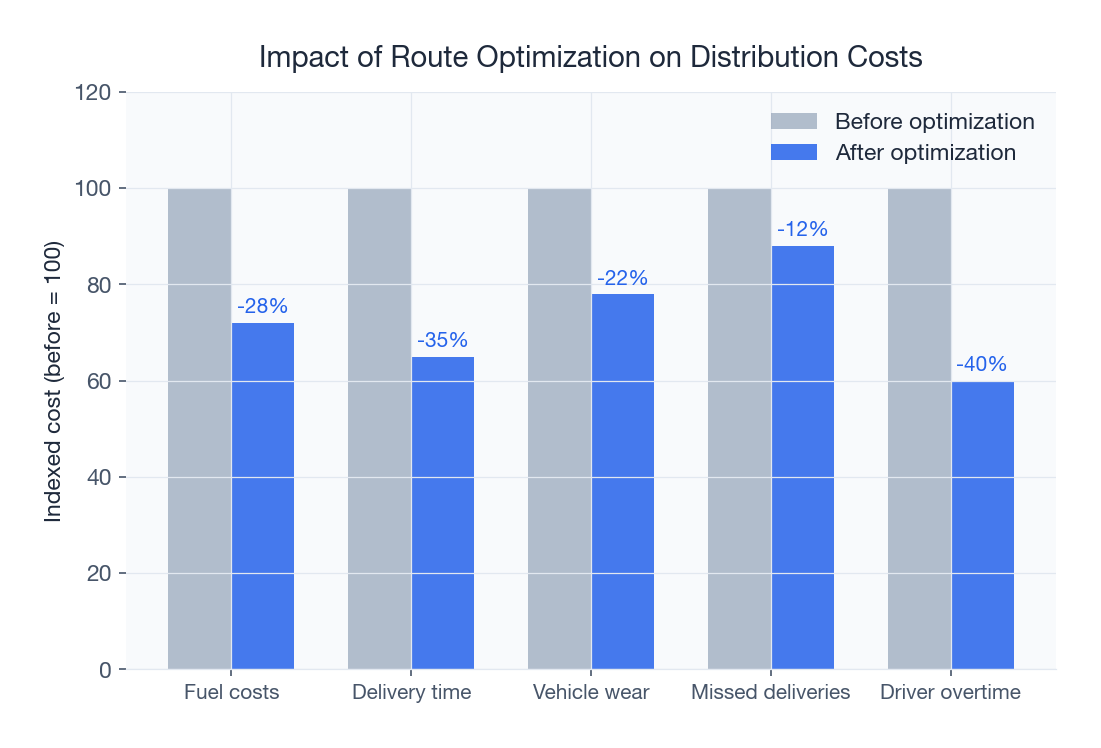
The hidden cost advantage of pre-sales is in working capital efficiency. Van sales requires loading buffer stock daily (typically 20-30% above expected demand), which ties up capital and creates return/wastage risk. Pre-sales dispatches only confirmed orders, reducing inventory exposure by 25-40%. For a distributor with Rs 3 crore monthly turnover, this difference alone frees up Rs 15-25 lakh in working capital. Read more about distribution cost optimization in our guide on reducing distribution costs for FMCG in India.
When to Use Van Sales in India
Van sales is the better model when:
- Impulse purchase categories — Chips, chocolates, ice cream, and cold beverages where the retailer's buying decision is influenced by immediate availability and salesman persuasion
- New product launches — When you need to achieve rapid numeric distribution for a new SKU, van sales allows immediate placement without waiting for order cycles
- Rural and semi-urban markets — In villages and small towns where retailers don't have smartphones or are not accustomed to placing advance orders, van sales works better
- Low-value, high-frequency SKUs — Products with MRP under Rs 20-50 where the ordering overhead of pre-sales doesn't justify the unit economics
- Competitive displacement scenarios — When you need to displace a competitor's shelf space immediately, van sales with attractive trade schemes gives the salesman negotiating leverage on the spot
In Indian cities like Kolkata and Chennai, many consumer goods companies use van sales exclusively for their impulse portfolio while running pre-sales for their planned-purchase products.
When to Use Pre-Sales in India
Pre-sales is the superior model when:
- Perishable products — Dairy, bakery, and fresh produce where production must match demand to avoid wastage. Our guide on route optimization for milk delivery details how pre-sales routes are optimized.
- High-value SKUs — Products above Rs 200-500 MRP where retailers plan their purchases and don't buy impulsively from a van
- Production-linked supply chains — When manufacturing or packing happens after demand aggregation (common in dairy, fresh snacks, and regional brands)
- Large-format retail — Modern trade outlets, supermarkets, and institutional buyers always operate on pre-orders with scheduled delivery windows
- Dense urban territories — In metro cities with heavy traffic, separating sales visits from delivery runs allows salesmen to cover more outlets by travelling light (on two-wheelers) while delivery happens via optimized vehicle routes
- Credit-heavy markets — When most transactions are on credit, the pre-sales model allows better credit limit management by validating outstanding balances before confirming orders
The Hybrid Model: Best of Both Worlds
Increasingly, Indian distributors are adopting hybrid models that combine elements of van sales and pre-sales. The hybrid approach recognizes that different products, channels, and geographies within the same distribution network may need different fulfilment models.
Common Hybrid Configurations in India
- Product-based hybrid — Pre-sales for dairy and staples, van sales for impulse snacks and beverages. A single distributor handles both through different route types.
- Channel-based hybrid — Pre-sales for modern trade and large retailers, van sales for small kirana stores and roadside vendors. Common in Bangalore and Hyderabad where modern trade penetration is high.
- Geography-based hybrid — Pre-sales in dense urban areas where traffic makes loaded vans inefficient, van sales in suburban and rural areas where retailers prefer immediate delivery.
- Day-based hybrid — Pre-sales orders collected 3 days a week with delivery on alternate days, and van sales runs on the remaining days to fill distribution gaps and push new SKUs.
The hybrid model requires more sophisticated technology than either pure model because the system must manage two different fulfilment workflows, track inventory across loaded vans and godown stock simultaneously, and provide unified analytics across both channels. SpireStock's platform supports hybrid configurations natively, allowing distributors to assign routes as van-sales or pre-sales and manage both through a single distributor management system.
Technology Requirements by Distribution Model
The technology stack differs significantly between van sales and pre-sales. Here's what each model requires:
Van Sales Technology Stack
- Mobile POS app — Real-time invoicing from the mobile app with barcode scanning, scheme auto-application, and offline capability
- Vehicle stock management — Track van-level inventory with loading, sales, returns, and closing stock reconciliation daily
- GPS tracking — Monitor van routes and stops using distribution tracking for compliance and optimization
- Cash management — Real-time cash collection tracking with end-of-day reconciliation
- Offline-first design — Van salesmen need full functionality without internet, especially in suburban and rural routes
Pre-Sales Technology Stack
- Order management system — Comprehensive order capture with catalogue browsing, scheme visibility, and credit limit checks
- Route optimization — Separate optimization for salesman beats and delivery routes
- Retailer app — Self-service retailer ordering app to complement salesman visits and capture orders 24/7
- Dispatch and loading — Automated pick-pack-dispatch workflows based on consolidated orders
- Delivery tracking — Delivery boy tracking with proof of delivery, separate from the sales team
- Billing automation — Centralized invoicing with GST compliance and e-invoicing support
For companies exploring both models, choosing a platform that supports both van sales and pre-sales workflows avoids the costly mistake of running parallel systems. Evaluate options using our distribution software features checklist.
Indian Market Suitability by Product Type
Based on how different product categories perform under each model in the Indian market:
| Product Category | Recommended Model | Reason |
|---|---|---|
| Milk and curd | Pre-sales | Daily production-linked, extreme perishability, recurring orders |
| Chips and namkeen | Van sales | Impulse category, shelf presence drives sales, low unit value |
| Soft drinks and juices | Hybrid (van sales summer, pre-sales winter) | Seasonal demand swings, impulse in summer, planned in winter |
| Biscuits and cookies | Hybrid | Part impulse, part planned — depends on SKU value and pack size |
| Ice cream | Van sales | Pure impulse, immediate freezer placement critical |
| Bread and bakery | Pre-sales | Daily production cycle, returns must be minimized |
| Personal care | Pre-sales | Higher value, planned purchase, retailers compare margins |
| Packaged foods (atta, oil) | Pre-sales | Bulk, heavy — impractical for van sales, planned stocking |
| Confectionery (chocolates) | Van sales | Impulse, visual merchandising at point of sale matters |
| Fresh produce and vegetables | Pre-sales | Perishable, demand aggregation prevents wastage |
Many Indian distributors handle multiple categories through the same infrastructure. A distributor in Pune might distribute dairy (pre-sales), bakery (pre-sales), and snacks (van sales) for the same or different principal companies. The sales productivity solution from SpireStock manages this multi-model complexity from a unified platform.
Transitioning Between Models
Companies often need to transition from one model to another as they scale. A startup snack brand might begin with van sales for rapid market penetration and shift to pre-sales as distribution matures and repeat orders stabilize. The transition involves:
- Building a retailer ordering habit — Train retailers to place advance orders via the app or through the salesman's visit. Start with the top 20% of outlets by revenue.
- Separating sales and delivery roles — Gradually move from the salesman-does-everything model to specialized sales and delivery teams.
- Investing in order management technology — The pre-sales model is only efficient with a robust digital order management system. Manual pre-sales (phone calls and paper indents) is worse than van sales.
- Managing the parallel period — During transition, you'll run both models simultaneously for 2-3 months. A fleet management system that handles both route types prevents operational chaos.
Understanding what a DMS is and how it works is essential groundwork before attempting any model transition. For a complete evaluation, review our buyer's guide to distributor management software.
The Role of Territory and Beat Planning
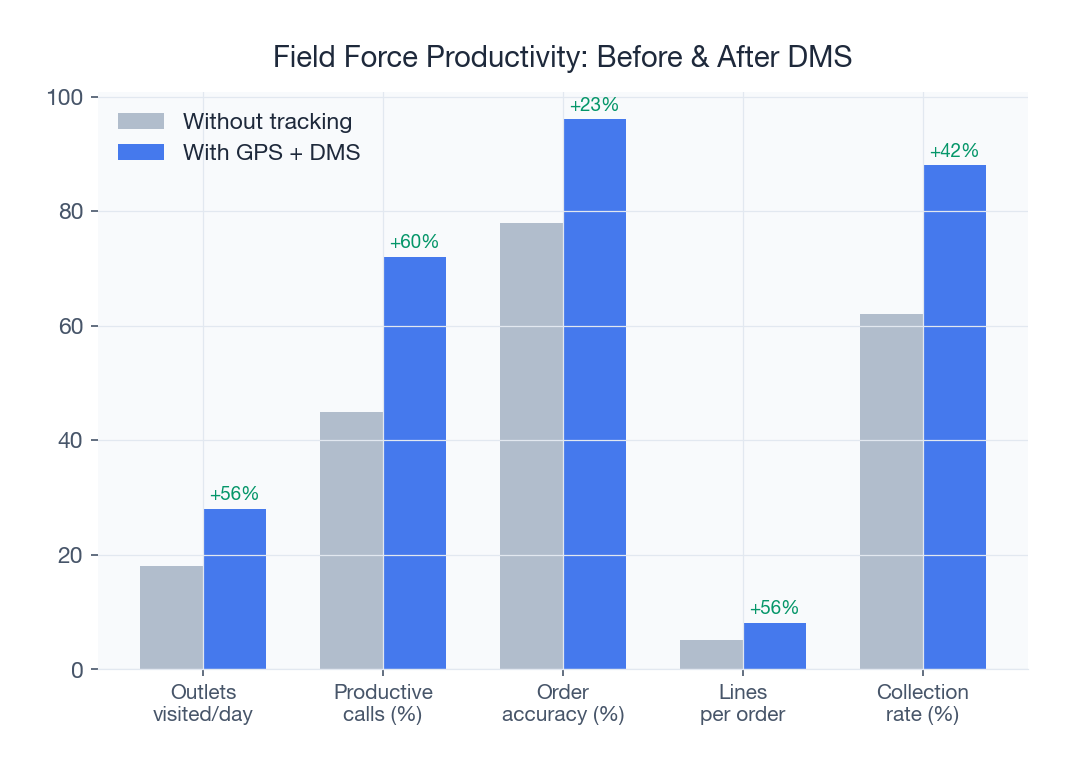
Both van sales and pre-sales rely on effective territory management and beat planning, but the approach differs. Van sales beats are optimized for maximum outlet coverage within a loaded vehicle's capacity and time constraints. Pre-sales beats are optimized for salesman productivity (more outlets per day since they travel light) with delivery routes optimized separately for vehicle efficiency.
In Indian metros, the separation of sales beats and delivery routes in the pre-sales model can increase total outlet coverage by 30-50% compared to van sales, because a salesman on a two-wheeler covers ground much faster than a loaded delivery van stuck in traffic. Learn more in our guide on beat planning software for FMCG in India.
Conclusion: Choose Based on Product, Market, and Scale
There is no universally superior model. Van sales excels for impulse categories, new market penetration, and rural coverage where retailers prefer immediate delivery. Pre-sales wins for perishables, high-value products, dense urban markets, and operations at scale where separating sales and delivery improves both activities. The hybrid approach, increasingly popular among India's most efficient distributors, combines both models based on product, channel, and geography.
Whatever model you choose, the technology foundation must support your approach. SpireStock's platform handles van sales, pre-sales, and hybrid configurations from a single system, giving Indian distributors the flexibility to evolve their distribution model as their business grows. Explore how our distributor management solution adapts to your model, or schedule a consultation with our distribution strategy team to evaluate the best approach for your portfolio.
Sources & References
Frequently Asked Questions
In van sales, the salesman carries stock on a vehicle and sells plus delivers simultaneously at each retail outlet. In pre-sales, orders are collected first (in person or digitally), then consolidated and fulfilled through a separate delivery run, typically the next day.
Van sales has lower total monthly cost but higher cost-per-outlet. Pre-sales has slightly higher fixed costs (separate delivery staff) but lower per-outlet costs and significantly better working capital efficiency due to dispatching only confirmed orders. At scale, pre-sales is typically more cost-effective.
Yes, hybrid models are increasingly common in India. Distributors run pre-sales for dairy and staples while using van sales for impulse categories like snacks. A unified distribution management platform is essential to manage both workflows without operational chaos.
Pre-sales is strongly recommended for dairy distribution because products are highly perishable, production must be planned against confirmed demand, and daily recurring orders make advance ordering natural. Van sales for dairy leads to unacceptable wastage rates.
Pre-sales requires an order management system (mobile and web), route optimization for both salesman beats and delivery routes, a dispatch management module, delivery tracking with proof of delivery, GST-compliant billing automation, and optionally a retailer self-ordering app.
Transition when repeat orders stabilize (retailers order the same products regularly), outlet density justifies separating sales and delivery roles, product perishability demands precise demand matching, or when you need to scale outlet coverage beyond what loaded van routes can handle.
Related SpireStock Features
Related Industries
Streamline FMCG distribution with order management, beat planning, retailer tracking, and GST billing. Built for Indian FMCG supply chains.
End-to-end dairy distribution software for milk, curd, paneer, and ghee brands. Manage orders, crates, cold chain, and GST billing in one platform.
Manage beverage distribution with cold chain tracking, crate management, route optimization, and real-time delivery monitoring. Try SpireStock free.
Related Solutions
GPS fleet tracking, driver management, and route optimization for dairy and FMCG delivery vehicles. Reduce fuel costs by 25%. Try SpireStock.
Manage your entire distributor network digitally. Onboarding, credit limits, outstanding tracking, and performance analytics. Start free trial.
Boost field sales team productivity with beat planning, GPS attendance, order capture, and performance analytics. Built for Indian FMCG teams.
Related Entities
Ready to Streamline Your Distribution?
Start your free 14-day trial and see how SpireStock can transform your dairy, FMCG or consumer-goods distribution operation, from order capture to crate recovery.

SpireStock Team
Distribution Technology Experts
SpireStock Team writes for SpireStock on distribution management, supply-chain optimisation and field operations for Indian dairy and FMCG brands.