The Perishable Goods Distribution Challenge
When you distribute fresh milk, bread, yogurt, curd, eggs, fruits, vegetables, or ready-to-eat meals, every minute matters. A dairy truck delayed two hours in Mumbai traffic means spoilage. A bakery order mis-routed to a distant retailer means returns. A cold chain break of just 30 minutes can ruin an entire refrigerated load. Unlike packaged FMCG where errors can be corrected the next day, perishable goods distribution errors are permanent -- you cannot uncook spoiled food.
This zero-margin-for-error reality makes perishable goods distribution software different from generic DMS platforms. It must track expiry at the batch level, enforce FIFO at dispatch, monitor cold chain compliance, manage daily returns, integrate with temperature-controlled logistics, and operate in real time across every distribution touchpoint. Whether you distribute from Delhi to Noida or from Bangalore to Mysore, perishable distribution has unique requirements that only specialized software can handle. Talk to our team to learn how SpireStock powers perishable distribution for 500+ Indian brands.
The Scale of India's Perishable Supply Chain
India is the world's largest producer of milk (230 million tonnes annually according to ICAR and NDDB data), the second-largest producer of fruits and vegetables (over 100 million tonnes combined as per NABARD estimates), and a fast-growing market for bakery and confectionery products (approximately 50 million tonnes annually). Add to this the expanding ready-to-eat and fresh beverage segments, and you have a perishable supply chain worth over Rs 20 lakh crore.
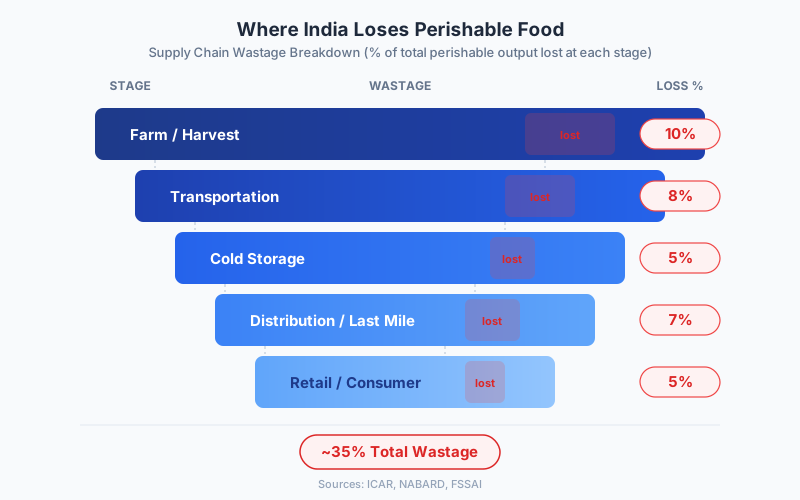
Yet, according to FSSAI and FAO (Food and Agriculture Organization) reports, India wastes 30-40% of its perishable food output -- roughly Rs 1.5 lakh crore worth of food destroyed every year before it reaches consumers. For context, McKinsey has estimated that India's food supply chain inefficiency costs more than the GDP of many small nations. The problem is not production; India produces enough. The problem is distribution.
The key drivers of this wastage are fragmented supply chains with 5-7 intermediaries between farm and consumer, inadequate cold chain infrastructure, poor demand forecasting, manual inventory management, and the absence of real-time visibility into stock freshness and movement. Distribution tracking software that operates in real time is no longer a luxury for perishable businesses -- it is the single largest lever for reducing this national-scale waste.
CRISIL research indicates that organized distribution (where software manages the supply chain end-to-end) reduces perishable wastage from 30-40% down to 5-8%. That gap represents an enormous opportunity for distributors across dairy, bakery, fresh produce, and beverage segments.
What Counts as Perishable Goods?
- Dairy -- milk, curd, butter, cheese, paneer, lassi, ice cream
- Bakery -- bread, buns, cakes, pastries, cream rolls
- Fresh produce -- fruits, vegetables, herbs, mushrooms
- Meat, poultry, seafood -- fresh and frozen
- Ready-to-eat and ready-to-cook meals -- chilled and frozen
- Eggs and egg products
- Some beverages -- fresh juices, cold-pressed drinks
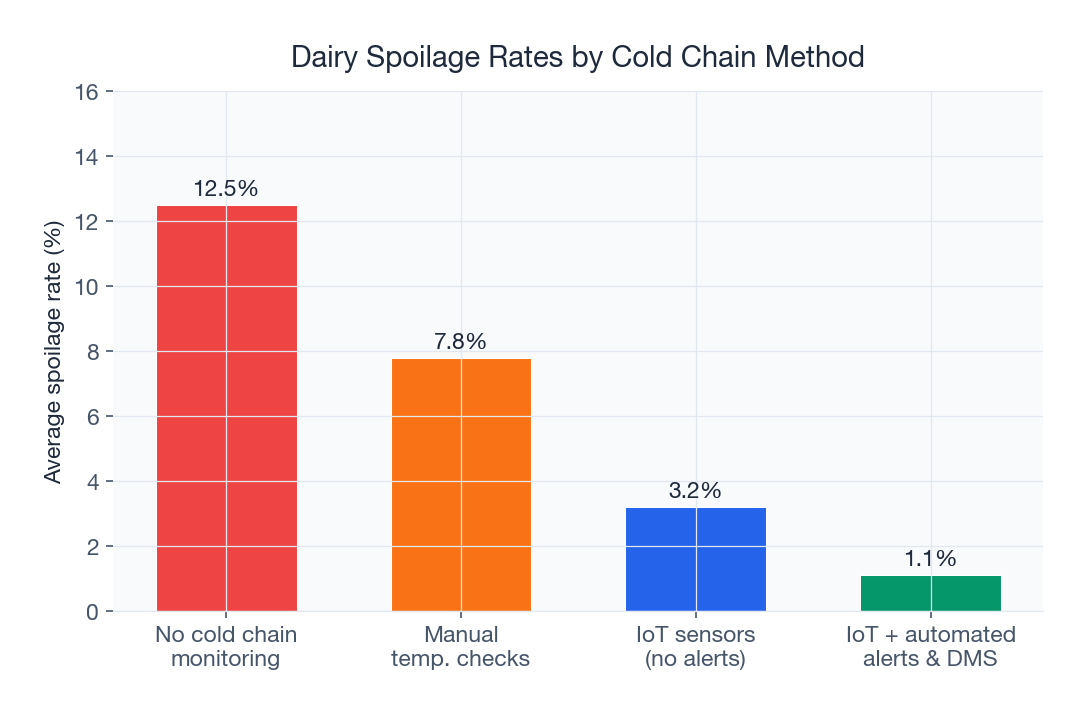
Each category has unique handling requirements, but all share the fundamental challenge of managing time-sensitive inventory at scale. A dairy distribution operation managing 50 SKUs with 3-day shelf life faces the same structural challenge as a bakery distributor managing 200 SKUs with 24-hour shelf life: without automated tracking, wastage is inevitable.
Cold Chain Infrastructure: Where India Stands
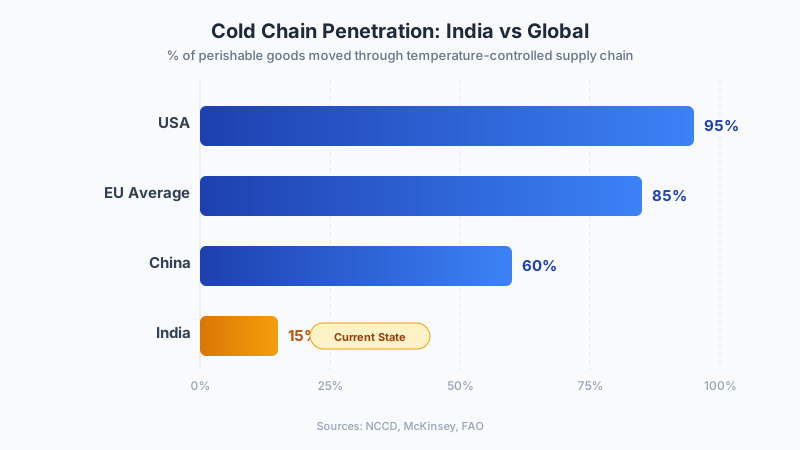
According to the National Centre for Cold Chain Development (NCCD), India has approximately 7,000 cold storage facilities with a combined capacity of about 37 million tonnes. That sounds substantial until you realize two critical facts: first, over 90% of this capacity is single-commodity storage designed for potatoes and a handful of other produce, not for multi-commodity cold chain distribution. Second, India has only about 10,000 refrigerated transport vehicles compared to over 300,000 in the United States and over 200,000 in China.
The Deloitte India cold chain report highlights that India's cold chain capacity meets barely 5-10% of the actual requirement for perishable distribution. The gap is starkest in last-mile delivery: while farm-to-warehouse cold storage has improved, warehouse-to-retailer distribution still relies heavily on unrefrigerated vehicles, insulated boxes with ice packs, and sheer speed of delivery.
This infrastructure gap makes software even more critical. When you cannot guarantee a fully refrigerated chain from production to retail, you need real-time visibility into where cold chain breaks happen, how long products spend outside temperature range, and which routes and vehicles pose the highest risk. Distribution tracking with IoT integration fills this gap by turning a fragmented, partially cold chain into a monitored, managed one.
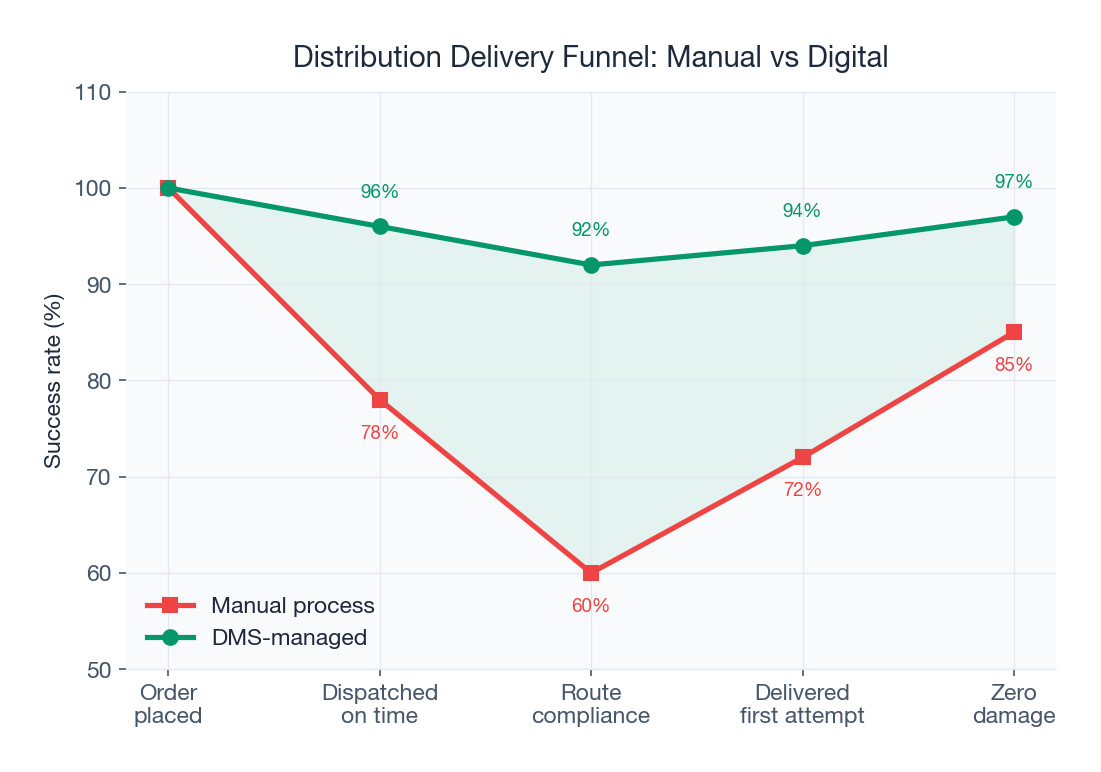
For distributors operating in cities like Chennai, Pune, and Ahmedabad where summer temperatures routinely exceed 40 degrees Celsius, even a 15-minute delay can accelerate spoilage exponentially. Software that monitors vehicle temperature in real time and reroutes deliveries when delays occur is the difference between 2% spoilage and 15% spoilage.
Core Challenges in Perishable Distribution
1. Expiry Management and FIFO Enforcement
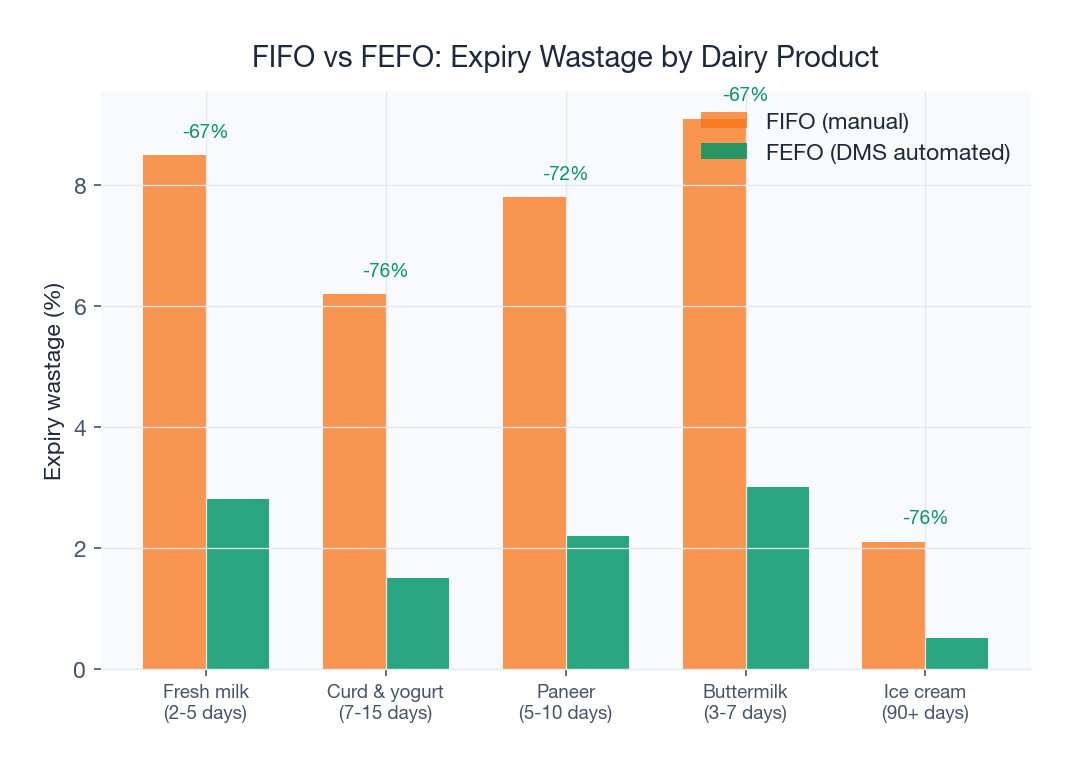
Every unit of perishable product has a production date and expiry date. The system must track these at the batch level, prioritize older stock for dispatch (FIFO), prevent shipment of near-expiry stock to distant locations, and alert teams when products approach end-of-life. Manual FIFO enforcement is nearly impossible beyond a handful of SKUs.
2. Cold Chain Compliance
Chilled and frozen products must stay within specified temperature ranges throughout the supply chain. A 30-minute break in cold chain can compromise quality and safety. Modern software integrates with IoT temperature sensors in cold rooms and refrigerated vehicles to monitor compliance in real time.
3. Daily Order Cycles
Perishable distribution runs on daily orders, not weekly or monthly. Distributors must place orders before a cutoff (often 6 PM or 8 PM the previous day), production happens overnight, and delivery happens by morning. Digital order management with cutoff enforcement is essential.
4. Returns and Shrinkage
Perishable distribution has high return rates (3-15%) and shrinkage risk. Software must capture returns at delivery, auto-generate credit notes, and track shrinkage trends by retailer, route, and product.
5. Multi-Plant Coordination
Brands often operate multiple production units for geographic coverage. Orders must be routed to the nearest plant with available stock. Multi-plant distribution logic is critical.
Essential Features of Perishable Distribution Software
1. Batch and Expiry Tracking
Every inventory unit is tagged with production date, expiry date, and batch number. The system enforces FIFO automatically, alerts on near-expiry stock, and prevents shipment violations. For dairy operations handling products with 2-5 day shelf lives, this feature alone prevents thousands of rupees in daily wastage.
2. Real-Time Cold Chain Monitoring
IoT sensor integration tracks temperature in cold storage and vehicles. Alerts fire on breaches, and compliance reports are generated for audit. The best systems do not just log temperature -- they trigger automated workflows when breaches occur, such as rerouting a vehicle to a closer delivery point or flagging affected batches for inspection.
3. Daily Order Management
Order management with recurring templates, daily cutoffs, and automatic aggregation per production unit. For perishable operations, the mobile app allows field teams to place orders directly from retailer locations, ensuring real-time demand capture.
4. Route Optimization for Time Windows
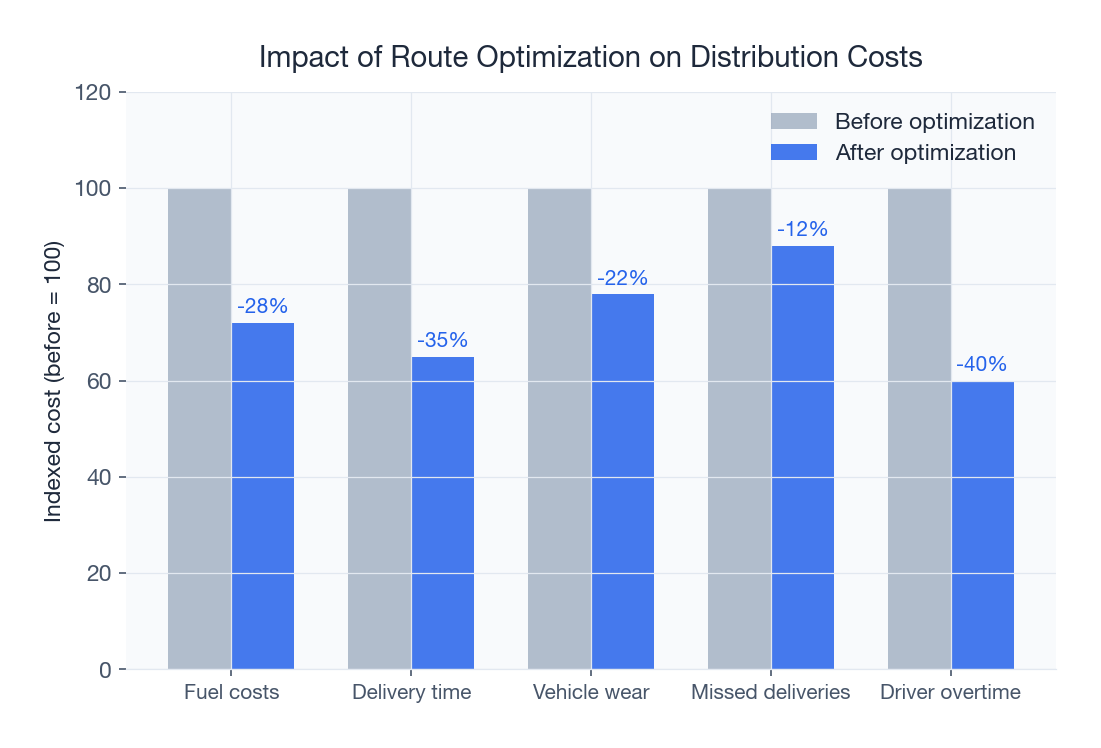
Route optimization that respects delivery time windows, temperature requirements, and vehicle capacity. For a 500-route dairy operation in Mumbai, even a 10% improvement in route efficiency translates to 50 fewer vehicle-hours daily and significantly less time products spend in transit. Read our deep dive on route optimization for milk delivery.
5. Returns Management at POD
The mobile app captures returns at the point of delivery with reason codes, auto-generates credit notes, and updates distributor ledgers in real time. This is particularly critical for bakery distribution where daily return rates can reach 10-15%.
6. Crate and Cold Chain Asset Tracking
Crate management for returnable assets like milk crates, yogurt trays, and insulated boxes. In dairy distribution alone, crate losses cost the industry an estimated Rs 500 crore annually. Real-time crate tracking with retailer-level accountability eliminates this leakage.
7. Quality and Compliance Records
FSSAI compliance, batch-level quality checks, recall management, and audit-ready documentation. Automated compliance documentation reduces audit preparation from weeks to hours.
8. Analytics on Perishable KPIs
Analytics tracking sell-through, return rates, shrinkage, cold chain compliance, and beat efficiency. The best analytics systems identify problem patterns before they become crises -- for example, flagging a retailer whose return rate has spiked from 5% to 12% over two weeks, signaling either a demand mismatch or a cold storage issue at their end.
Perishable Distribution KPIs
| KPI | Without Software | With Software | Impact |
|---|---|---|---|
| Shrinkage rate | 4-8% | 1-2% | 75% reduction |
| Return rate | 8-15% | 4-6% | 50% lower |
| On-time delivery | 78-85% | 95-98% | 15 pts higher |
| Cold chain compliance | 82-90% verifiable | 99%+ auditable | 10 pts higher |
| Order to delivery cycle | 12-18 hours | 6-10 hours | 40% faster |
| FIFO enforcement | Manual, ~70% | Automated, 100% | Complete |
Regulatory Framework: FSSAI and BIS Compliance
India's regulatory environment for perishable food distribution has tightened significantly over the past five years. FSSAI (Food Safety and Standards Authority of India) now mandates comprehensive traceability for all perishable food products, meaning every unit must be traceable from production to point of sale. The Food Safety and Standards (Food Recall Procedure) Regulations require businesses to maintain batch-level records that can support a recall within 24-48 hours.
Key FSSAI requirements that perishable distribution software must address include:
- Traceability records -- every batch must have documented chain of custody from production unit to retailer
- Temperature logging -- FSSAI's Schedule 4 mandates temperature records during storage and transport of chilled and frozen foods
- Expiry date compliance -- products cannot be sold within a defined window of their expiry date (varies by product category)
- Recall readiness -- businesses must demonstrate the ability to execute a product recall within specified timeframes
- Hygiene and handling documentation -- records of vehicle cleaning, cold room maintenance, and handler training
BIS (Bureau of Indian Standards) standards add another layer, particularly for packaging. IS 15495 covers requirements for insulated packaging used in cold chain transport, while IS 14543 addresses packaging for perishable agricultural commodities. Distribution software that generates BIS-compliant packaging labels and maintains records of packaging integrity checks reduces the compliance burden significantly.
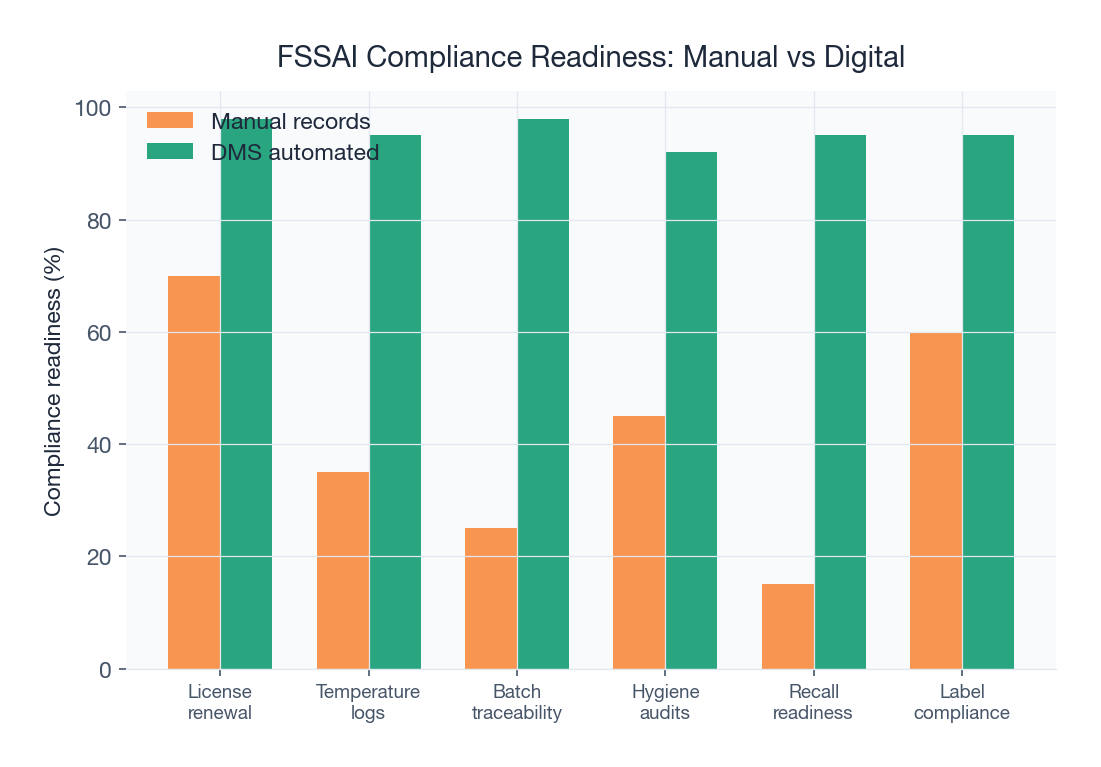
The practical impact: during an FSSAI audit, a distributor using SpireStock can pull up complete batch traceability, temperature logs, and chain-of-custody records in minutes. A distributor relying on paper registers and Excel sheets typically needs 2-3 weeks to compile the same information -- and often cannot produce complete records at all. Automated invoice and billing with GST-compliant documentation further simplifies the audit trail.
Technology Stack: IoT, RFID, and GPS Integration
Modern perishable distribution software does not operate in isolation. It serves as the central nervous system that integrates with a range of hardware technologies to create complete supply chain visibility.
Temperature Sensors (IoT)
Wireless temperature sensors installed in cold rooms, refrigerated vehicles, and insulated delivery containers transmit readings every 60-120 seconds. The software aggregates this data, displays it on real-time dashboards, and triggers alerts when temperatures deviate from acceptable ranges. For dairy products requiring 2-4 degrees Celsius storage, even a brief excursion to 8 degrees during a vehicle breakdown can compromise an entire load. IoT integration means the operations team knows about the breach within seconds, not hours.
RFID for Crate and Asset Tracking
RFID (Radio Frequency Identification) tags attached to milk crates, yogurt trays, insulated boxes, and other returnable assets enable automated tracking without manual scanning. When a delivery vehicle is loaded, RFID readers at the warehouse gate log every crate leaving the facility. When the vehicle returns, the system automatically reconciles what went out versus what came back. Crate management powered by RFID has reduced crate losses by 70-85% for SpireStock customers.
GPS for Fleet Monitoring
GPS trackers on delivery vehicles feed into fleet management modules, providing real-time location data. Combined with route optimization, this enables dynamic rerouting when traffic conditions change, monitoring of planned versus actual routes, geo-fenced delivery confirmations, and accurate ETA predictions for retailers. For perishable distribution in congested cities like Mumbai, Delhi, and Bangalore, GPS-enabled route management is not optional.
Real-Time Alert Systems
The true value of hardware integration is the alert system that ties it all together. When a cold room compressor fails at 2 AM, the system alerts the warehouse manager via SMS and app notification. When a delivery vehicle deviates from its planned route by more than 2 km, the operations team gets an alert. When a crate count at a retailer does not match the expected return, field team tracking flags the discrepancy for investigation. These alerts transform reactive fire-fighting into proactive management.
Industries Served
- Dairy distribution -- milk, curd, butter, cheese, paneer
- Bakery and confectionery -- bread, buns, cakes
- Fresh produce -- fruits, vegetables, herbs
- Fresh beverages -- juices, smoothies
- FMCG categories with chilled or frozen products
- Consumer goods with temperature-sensitive packaging or ingredients
ROI Analysis by Business Size
One of the most common questions from perishable distributors is: "Will the software pay for itself?" The answer depends on your scale, but for every segment -- small, mid-size, and large -- the math is compelling.
| Parameter | Small (50 distributors) | Mid (200 distributors) | Large (500+ distributors) |
|---|---|---|---|
| Monthly revenue managed | Rs 2-5 crore | Rs 15-40 crore | Rs 80-200 crore |
| Monthly software investment | Rs 15,000-30,000 | Rs 75,000-1.5 lakh | Rs 2.5-5 lakh |
| Shrinkage savings (monthly) | Rs 3-6 lakh | Rs 20-50 lakh | Rs 80 lakh-2 crore |
| Route optimization savings | Rs 1-2 lakh | Rs 8-15 lakh | Rs 30-60 lakh |
| Returns reduction savings | Rs 2-4 lakh | Rs 12-25 lakh | Rs 50 lakh-1.2 crore |
| Net monthly ROI | Rs 5-10 lakh | Rs 35-80 lakh | Rs 1.5-3.5 crore |
| Payback period | 6-10 weeks | 4-8 weeks | 3-6 weeks |
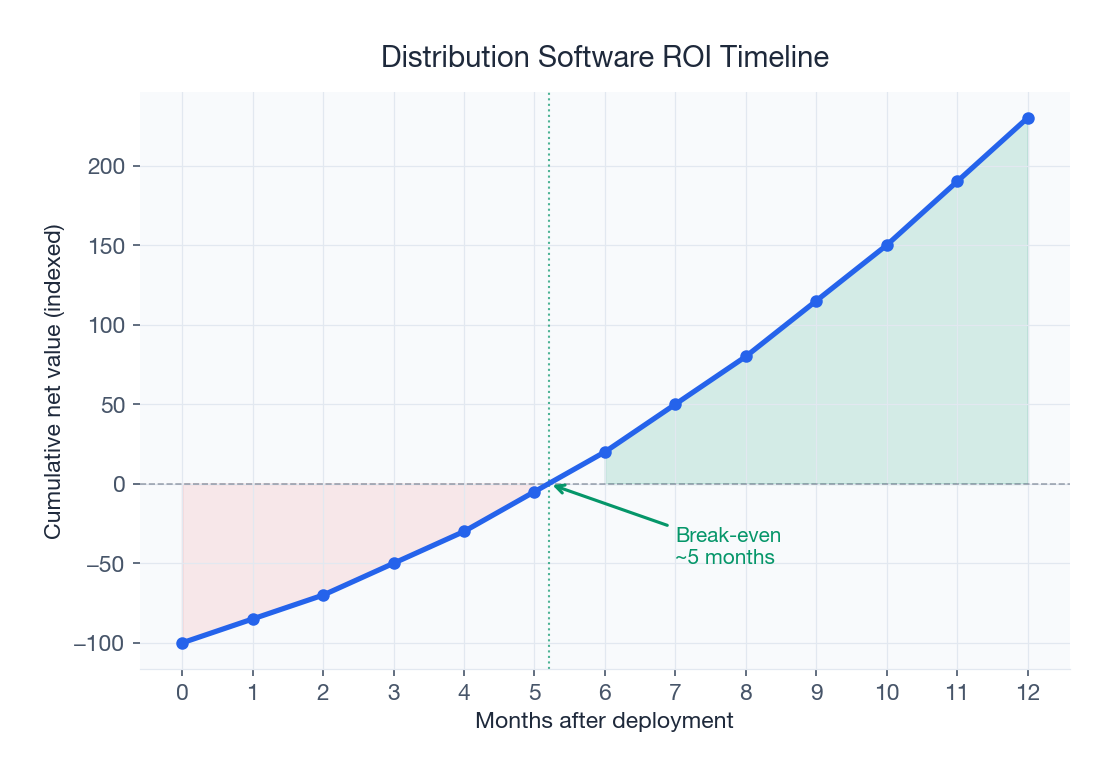
These figures are based on aggregated data from SpireStock implementations. The largest savings come from shrinkage reduction (which is proportional to volume) and route optimization (which compounds as network size grows). Even for a small dairy distributor managing 50 routes from Pune, the software investment is typically recovered within two months from shrinkage savings alone. Explore our pricing plans to find the right fit for your operation.
Case Study: A Fresh Produce Distributor in Bangalore
A Bangalore-based fresh produce company supplies fruits and vegetables to 1,200 modern trade outlets and 400 HoReCa (hotel, restaurant, cafe) customers. Before implementing perishable distribution software, they faced 12% shrinkage, 40% manual reconciliation errors, and 2-3 daily cold chain complaints. After deploying SpireStock:
- Shrinkage dropped from 12% to 3%, saving Rs 2.8 crore annually
- Cold chain compliance hit 99.2% with IoT sensor integration
- Customer complaints dropped by 85%
- ROI achieved in 9 weeks
Case Study: A Mumbai Dairy Distributor with 500 Routes
A leading Mumbai-based dairy brand operates 500 delivery routes serving over 15,000 retail outlets across Mumbai, Thane, Navi Mumbai, and Pune. Their product range includes fresh milk (6-hour delivery window), curd and buttermilk (48-hour shelf life), paneer (72-hour shelf life), and ice cream (frozen, -18 degrees Celsius required). Before adopting SpireStock, the operation relied on paper-based route sheets, manual FIFO at the warehouse, phone-based order collection, and periodic (not continuous) temperature checks.
The key problems were acute. Milk returns averaged 8% because delivery timing was inconsistent -- retailers refused deliveries arriving after 7:30 AM when consumers had already left for work. Paneer spoilage ran at 6% due to cold chain breaks during the last mile. Crate losses exceeded Rs 40 lakh annually because there was no systematic tracking of which retailer held how many crates.
After implementing SpireStock with full IoT integration:
- Milk returns dropped from 8% to 2.5% -- route optimization ensured 94% of deliveries arrived before 7:00 AM
- Paneer spoilage fell from 6% to 1.2% -- real-time temperature monitoring flagged cold chain breaks within 3 minutes, enabling immediate corrective action
- Crate losses reduced by 78% -- RFID-based crate tracking provided retailer-level accountability
- Order processing time cut by 65% -- digital order management via mobile app replaced 500 daily phone calls
- Annual savings: Rs 7.2 crore across wastage reduction, route efficiency, and crate recovery
The operations director noted: "We went from managing by phone and instinct to managing by data. The biggest surprise was crate tracking -- we had no idea we were losing Rs 40 lakh a year in crates until the system showed us exactly where they were going."
Case Study: A Hyderabad Meat and Poultry Cold Chain Operator
A Hyderabad-based meat and poultry distributor handles 12 tonnes of fresh chicken, mutton, and fish daily, supplying 800 retail outlets, 200 restaurant kitchens, and 50 institutional buyers across Telangana. Meat distribution is among the most demanding perishable segments: products require continuous cold chain at 0-4 degrees Celsius, shelf life is measured in hours not days, and FSSAI traceability requirements are stringent.
Before SpireStock, the company operated with spreadsheet-based inventory, manual temperature checks three times daily, and no batch-level traceability. When an FSSAI inspector requested traceability records for a specific batch of chicken supplied to a restaurant chain, the team needed four days to compile partial records from paper invoices. The inspector issued a warning notice.
Post-implementation results over six months:
- Complete batch traceability -- any product traceable from processing plant to retailer in under 60 seconds
- Spoilage reduced from 9% to 2.3% -- continuous IoT temperature monitoring eliminated undetected cold chain breaks
- FSSAI audit preparation time reduced from 4 days to 2 hours -- all records generated automatically
- Delivery freshness improved -- optimized routing reduced average delivery time from 4.5 hours to 2.8 hours post-dispatch
- Retailer satisfaction scores increased by 40% -- consistent product quality and on-time delivery
- Annual savings: Rs 3.5 crore from spoilage reduction and operational efficiency
This case demonstrates that even in the most challenging perishable segments, software-driven distribution management delivers measurable ROI. The FSSAI compliance benefit alone justified the investment for this operator.
The Perishable Distribution Maturity Model
Based on work with hundreds of perishable distributors across India, we have identified five maturity levels. Understanding where your operation sits helps prioritize investments and set realistic improvement targets.
| Level | Name | Characteristics | Typical Wastage |
|---|---|---|---|
| 1 | Manual | Paper-based orders, manual FIFO, no cold chain monitoring, phone-based communication, Excel billing | 15-30% |
| 2 | Basic Digital | Basic billing software, partial digital orders, manual temperature checks, GPS on some vehicles | 10-18% |
| 3 | Connected | Full DMS with order management, batch tracking, IoT temperature sensors, digital POD, basic analytics | 4-8% |
| 4 | Intelligent | AI-assisted demand forecasting, automated route optimization, predictive spoilage alerts, real-time compliance dashboards, scheme automation | 2-4% |
| 5 | Autonomous | Fully autonomous dispatch decisions, machine learning-driven FEFO, predictive maintenance for cold chain equipment, blockchain traceability | Under 2% |
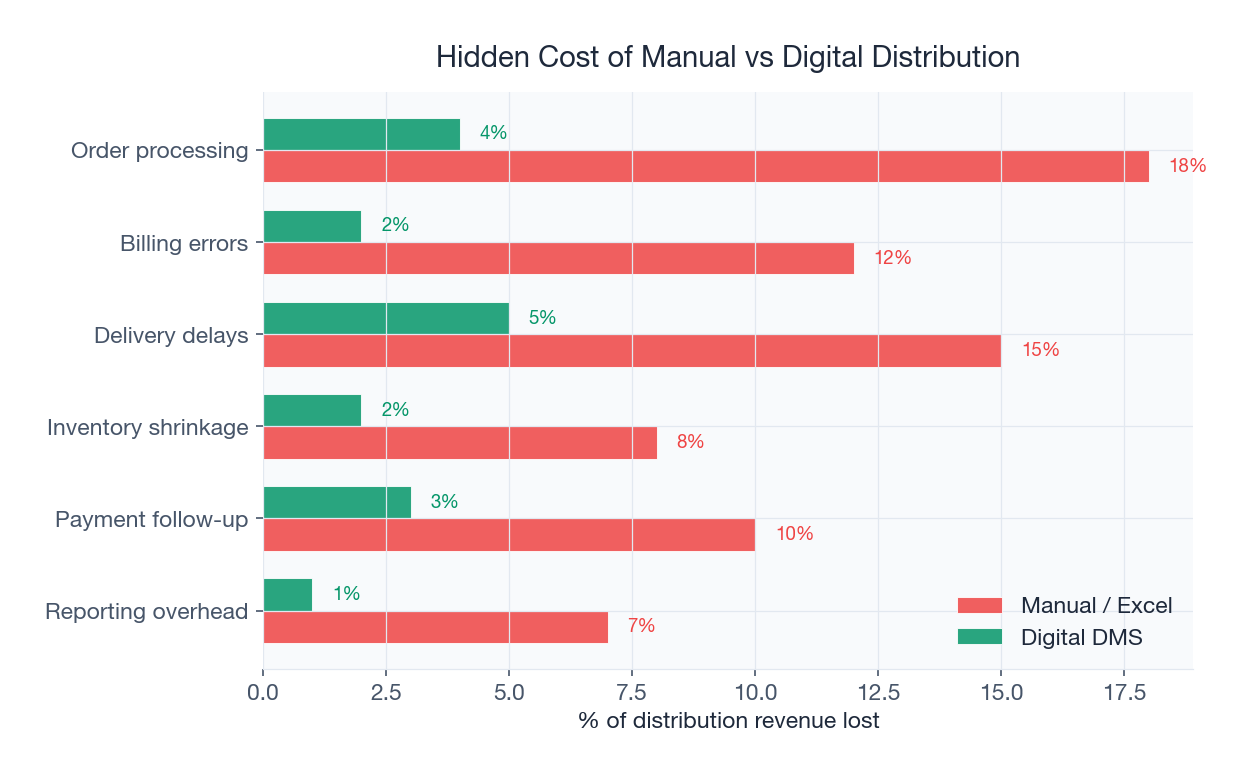
According to our assessment, approximately 60% of Indian perishable distributors operate at Level 1 (fully manual), 25% at Level 2 (basic digital), 10% at Level 3 (connected), and less than 5% at Level 4 or above. The gap between Level 1 and Level 3 represents 10-20 percentage points of wastage reduction -- worth crores annually for even mid-size operations.
Most businesses should target Level 3 as their immediate goal: a connected operation with digital order management, distribution tracking, batch-level expiry management, and IoT cold chain monitoring. Moving from Level 3 to Level 4 requires integrating advanced analytics, automated scheme management, and AI-powered forecasting -- capabilities that SpireStock provides out of the box.
Protect your perishable supply chain with SpireStock. From dairy to fresh produce to meat and poultry, we power India's most demanding distribution operations. Request a demo today.
Emerging Trends in Perishable Distribution Technology
The perishable distribution landscape in India is evolving rapidly. Several emerging technologies are beginning to reshape how perishable goods move from production to consumption.
Blockchain Traceability
Blockchain provides an immutable, distributed ledger for tracking product provenance. For perishable goods, this means every touchpoint -- from farm to processing plant to warehouse to retailer -- is recorded in a tamper-proof chain. FSSAI has expressed interest in blockchain-based traceability for high-risk perishable categories. While full blockchain adoption is still early in India, forward-thinking distributors are beginning pilot programs, particularly in organic produce and premium dairy segments where provenance adds brand value.
Drone Delivery for Last Mile
The last mile is the most expensive and time-sensitive segment of perishable distribution. DGCA (Directorate General of Civil Aviation) has begun granting experimental drone delivery permits, and several companies are testing drone delivery for perishable goods in semi-urban and rural areas. For a dairy distributor serving villages within 15 km of a processing plant, drone delivery could reduce last-mile delivery time from 2 hours to 15 minutes, dramatically improving product freshness. While commercial-scale drone delivery is still 3-5 years away, the software infrastructure for managing drone fleets is being built today.
AI-Powered Demand Forecasting for Perishables
Traditional demand forecasting uses historical sales data. AI-powered forecasting adds weather data, festival calendars, local event schedules, and even social media sentiment to predict demand with greater accuracy. For perishable goods, a 10% improvement in forecast accuracy translates directly to 10% less overproduction and 10% fewer stockouts. McKinsey estimates that AI-driven demand forecasting can reduce perishable food waste by 20-30% in developed markets, and the impact in India, where baseline forecasting is less mature, could be even larger.
Dark Stores for Instant Delivery
The rise of quick-commerce (10-30 minute delivery) is creating a new distribution model for perishables: dark stores. These are small, neighborhood-level cold storage facilities that serve as forward distribution points. Perishable distribution software must evolve to manage not just traditional distributor-to-retailer flows but also hub-to-dark-store-to-consumer flows. The inventory management challenges are different: smaller quantities, faster turnover, higher frequency of replenishment, and zero tolerance for stockouts. SpireStock's distributor management platform is designed to handle both traditional and modern distribution models.
Predictive Cold Chain Maintenance
Instead of scheduled maintenance for cold rooms and refrigerated vehicles, IoT sensors combined with machine learning can predict equipment failures before they occur. A compressor showing gradually increasing power consumption or slightly rising temperatures may be weeks away from failure. Predictive maintenance catches these patterns early, preventing the catastrophic cold chain breaks that destroy entire loads of perishable inventory.
Choosing the Right Perishable Distribution Software
Not all distribution management software is built for perishable goods. When evaluating platforms, look for these non-negotiable capabilities:
- Batch-level tracking with FIFO/FEFO enforcement -- the system must track every unit by production and expiry date and enforce first-expiry-first-out logic automatically
- IoT integration -- native support for temperature sensors, not just a promise of "future integration"
- Daily order cycle support -- designed for daily ordering rhythms, not weekly or monthly cycles typical of dry FMCG
- Returns management at point of delivery -- mobile app with offline capability for capturing returns with reason codes
- Cold chain compliance reporting -- automated reports that satisfy FSSAI audit requirements
- Crate and asset tracking -- especially critical for dairy and fresh produce operations
- Scalability -- the platform must work for 50 routes as efficiently as for 5,000 routes
- India-specific features -- GST-compliant invoicing, multi-language mobile app support, offline functionality for areas with poor connectivity
SpireStock is purpose-built for the Indian perishable distribution market, supporting dairy, bakery, fresh produce, beverages, and consumer goods segments with all of the above capabilities.
Conclusion
India's perishable goods distribution sector represents both an enormous challenge and a massive opportunity. With 30-40% of perishable produce wasted annually, the potential for improvement is measured in lakh crores of rupees. The technology exists today -- batch tracking, cold chain IoT, route optimization, real-time analytics, and automated compliance -- to reduce wastage to under 5% and transform perishable distribution from a high-loss, high-stress operation into a profitable, efficient, and compliant supply chain.
Whether you operate a 50-route dairy distribution network in Pune or a 500-route multi-commodity perishable operation spanning Mumbai to Delhi, the fundamentals are the same: invest in purpose-built software, integrate IoT hardware, enforce automated compliance, and move from reactive to predictive management. The distributors who make this transition now will dominate their markets. Those who wait will continue losing 15-30% of their inventory to preventable spoilage.
Explore SpireStock's distribution tracking, distributor management, and fleet management capabilities, or visit our pricing page to find a plan that fits your operation. Ready to see it in action? Request a demo and let us show you how perishable distribution should work.
This guide covers one part of the picture. For the category as a whole — what a DMS does, the modules that matter, how it differs from ERP and SFA, and what it costs in India — see our distributor management system guide.
Sources & References
Frequently Asked Questions
Perishable goods distribution software is a specialized platform that manages the distribution of time-sensitive products like dairy, bakery, fresh produce, and meat. It handles batch-level expiry tracking, FIFO enforcement, cold chain monitoring, daily order cycles, returns management, and FSSAI compliance.
Modern software integrates with IoT temperature sensors in cold storage and refrigerated vehicles, monitoring compliance in real time. Deviation alerts trigger immediate action, and historical data supports quality audits and regulatory compliance.
Dairy, bakery, fresh produce, meat and seafood, ready-to-eat meals, fresh beverages, and any FMCG category with chilled or frozen products. Any business where product shelf life is measured in days rather than months benefits from specialized software.
By enforcing FIFO automatically, preventing shipment of near-expiry stock to distant retailers, alerting on expiry risks, capturing returns digitally, and monitoring cold chain compliance. Typical shrinkage reduction is 60-75%, often saving crores annually.
FSSAI mandates cold chain documentation and traceability for regulated perishable foods. While specific requirements vary by product category, any business distributing perishable goods benefits from auditable cold chain records. Modern software automates this documentation.
Yes. Cloud-based platforms offer affordable starter plans suitable for small dairies, bakeries, and fresh produce distributors. Starting costs are Rs 5,000-15,000 per month, with full ROI usually achieved within 3-6 months through shrinkage reduction alone.
Related SpireStock Features
Real-time GPS tracking of vehicles and drivers with route optimization for faster deliveries.
Zone, town, and route-based delivery management with optimization.
End-to-end order lifecycle from placement to delivery with multi-level approval workflows.
Related Industries
End-to-end dairy distribution software for milk, curd, paneer, and ghee brands. Manage orders, crates, cold chain, and GST billing in one platform.
Distribution management for fruits, vegetables, and perishable goods. Cold chain tracking, wastage reduction, and daily order management. Try free.
Related Solutions
GPS fleet tracking, driver management, and route optimization for dairy and FMCG delivery vehicles. Reduce fuel costs by 25%. Try SpireStock.
Manage your entire distributor network digitally. Onboarding, credit limits, outstanding tracking, and performance analytics. Start free trial.
Related Entities
Ready to Streamline Your Distribution?
Start your free 14-day trial and see how SpireStock can transform your dairy, FMCG or consumer-goods distribution operation, from order capture to crate recovery.

SpireStock Team
Distribution Technology Experts
SpireStock Team writes for SpireStock on distribution management, supply-chain optimisation and field operations for Indian dairy and FMCG brands.