ERP vs DMS: The Distinction Every Distributor Should Understand
Enterprise Resource Planning (ERP) systems and Distribution Management Software (DMS) are often discussed as if they're the same thing. They're not. Confusing the two has cost Indian distributors crores in failed implementations, bloated budgets and missed operational goals. This post clarifies what each tool does, where they overlap, and how to decide which (or both) your business needs.
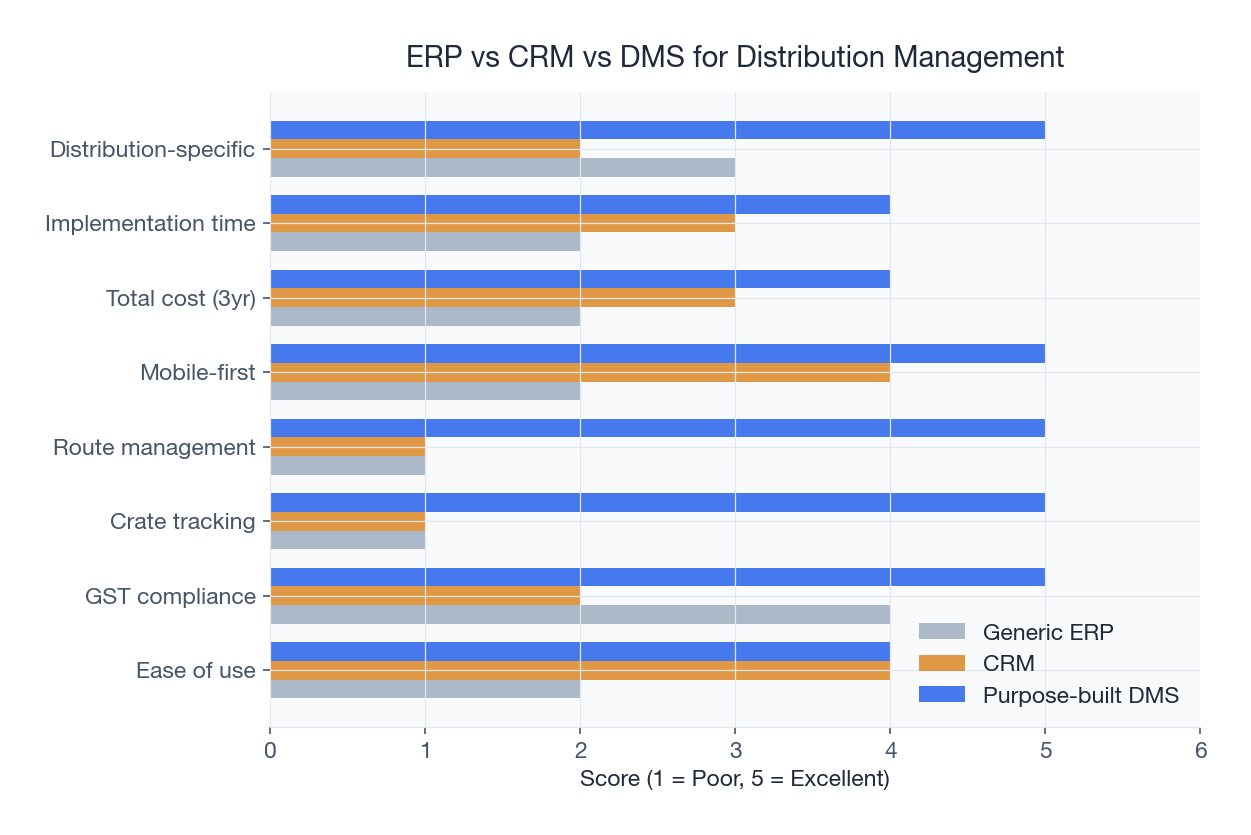
The short version: ERP is the backbone, it handles financial accounting, inventory, procurement, HR and broad enterprise workflows. DMS is the forward-facing operational engine for distribution, it handles beats, routes, field force, schemes, crates and secondary sales. The biggest, fastest-growing distributors in India use both, integrated via APIs.
Side-by-Side Comparison
| Capability | ERP | DMS |
|---|---|---|
| Financial accounting | Yes, deep | No (or basic) |
| Inventory management | Yes, plant-level | Yes, distribution-level |
| Procurement / P2P | Yes | No |
| Manufacturing / production | Yes | No |
| HR and payroll | Yes | No |
| Secondary sales tracking | Limited | Yes, native |
| Beat planning and routes | No | Yes |
| Field force mobile app | Limited | Yes, offline-capable |
| Scheme automation | Limited | Yes |
| Crate/returnable tracking | No | Yes |
| GPS attendance | No | Yes |
| Real-time distribution visibility | Batch reports | Live dashboards |
| Implementation time | 6-18 months | 2-6 weeks |
| Typical cost | Rs 50 lakh - 10 crore | Rs 50,000 - 50 lakh/year |
| Best for | Enterprise backbone | Distribution execution |
What ERP Does Well
1. Financial Depth
ERP systems like SAP, Oracle and Microsoft Dynamics handle general ledger, accounts receivable, accounts payable, cost accounting, tax management and statutory reporting at a level DMS platforms don't attempt. For publicly listed or audited companies, ERP is essentially mandatory.
2. Manufacturing and Procurement
ERP shines when you run factories, manage bill-of-materials, plan production schedules and coordinate procurement. Dairy processors running multiple plants need ERP for BOM and MRP.
3. Compliance and Audit Trails
ERP systems maintain deep audit logs that satisfy SOX, internal audit and regulatory compliance requirements. This matters more as a company grows beyond a few hundred crore in revenue.
4. Integration with Global Systems
If you trade internationally or consolidate financials across countries, ERP handles multi-currency, multi-entity, multi-language requirements natively.
What DMS Does Well
1. Secondary Sales Execution
DMS platforms like SpireStock track every outlet visit, every order placed, every delivery completed and every scheme applied, in real time. ERP systems can't do this without massive customisation.
2. Route Optimisation and Delivery Visibility
DMS route optimisation engines sequence drops, monitor delivery progress, re-route during disruptions and measure beat adherence. This is fundamentally outside ERP scope.
3. Mobile Field Force Tools
A capable DMS mobile app runs offline, captures orders in 30 seconds, geo-tags visits and tracks field force attendance via GPS. ERP mobile apps exist but are typically cumbersome and rarely adopted.
4. Scheme Engine
Trade schemes, consumer promotions, slab-based offers and display incentives, DMS platforms automate the entire calculation and settlement lifecycle. Scheme engines are a core DMS capability, rarely found in ERP.
5. Crate and Returnable Asset Tracking
DMS crate management with QR-based tracking, deposit ledgers and daily reconciliation is purpose-built for dairy and FMCG distributors. ERP systems don't handle this at all.
Pros and Cons
ERP Pros
- Complete financial and operational backbone
- Regulatory and audit-ready
- Scales globally
- Integrates manufacturing, procurement, HR
ERP Cons
- Very expensive (Rs 50 lakh to 10 crore)
- Long implementation (6-18 months)
- Poor fit for secondary distribution execution
- Requires dedicated IT teams
- Rigid customisation process
DMS Pros
- Purpose-built for distribution workflows
- Fast deployment (2-6 weeks)
- Mobile-first, offline-capable
- Real-time analytics dashboards
- Subscription pricing, low upfront
DMS Cons
- Not a full accounting backbone
- Needs integration with ERP or Tally for financials
- Focused scope, doesn't handle manufacturing
Pricing Ranges
- SAP S/4HANA: Rs 5 lakh+ per month (plus implementation)
- Oracle NetSuite: Rs 1 lakh+ per month
- Microsoft Dynamics 365 BC: Rs 40,000+ per month
- Marg ERP: Rs 1,500+ per month (SME tier)
- SpireStock DMS: Rs 4,000-1,50,000 per month depending on tier (see pricing)
Decision Framework
Choose ERP When...
- You run manufacturing plants with BOM and production scheduling
- Annual revenue exceeds Rs 500 crore
- You need consolidated multi-entity financials
- Compliance and audit requirements are heavy
- You have dedicated IT staff to manage the system
Choose DMS When...
- Your core business is secondary distribution
- You need to track beats, routes and field force
- You run schemes regularly
- You want fast deployment and mobile-first execution
- Budget is constrained (subscription over upfront)
Choose Both When...
- You run a large manufacturing operation AND a distribution network
- You want ERP for financials and DMS for execution
- You have the API maturity to integrate them
Case Study: A Dairy Cooperative's Dual-Stack
A Gujarat-based dairy cooperative runs SAP for its 3 processing plants, procurement from 180,000 farmers and global financial consolidation. It runs SpireStock for distributor management, route optimisation, scheme execution and crate tracking across 2,400 outlets. The two systems integrate via API, with SpireStock pushing sales data into SAP every 15 minutes. The cooperative calls this "the right tool for each job" approach the best strategic decision it has made in a decade.
Next Steps
If your distribution operation has outgrown spreadsheets but you're not ready to commit to a full ERP, a dedicated DMS is often the right first move. Explore our 2026 DMS rankings, read the SpireStock vs Tally comparison, or talk to our team about integrating SpireStock with your existing ERP.
Real-World Integration Architectures
In the largest Indian distribution operations, ERP and DMS rarely live alone. The typical architecture uses ERP as the enterprise backbone and DMS as the forward-facing operational layer. The two are connected by APIs or middleware, with data flowing in both directions.
Architecture A: SAP + SpireStock
SAP handles procurement, manufacturing, financial accounting, HR and global consolidation. SpireStock handles distribution, field force, schemes and crate management. Sync happens via SAP Process Integration (PI) middleware, typically on a 15-minute cycle for sales transactions and a daily cycle for master data updates. This architecture is used by multiple large Indian dairy cooperatives and consumer goods companies.
Architecture B: NetSuite + SpireStock
NetSuite handles cloud ERP, global financial consolidation and multi-currency operations. SpireStock handles India-specific distribution execution. Sync happens via NetSuite's SuiteCloud APIs. Popular with mid-market global brands entering the Indian market.
Architecture C: Tally + SpireStock
Tally handles accounting, GST filing and audit. SpireStock handles distribution. Sync happens via Tally's XML API. This is the most common architecture for Indian SME distributors. Simple, cost-effective, battle-tested.
Architecture D: Dynamics 365 BC + SpireStock
Microsoft Dynamics handles ERP, financials and manufacturing. SpireStock handles distribution. Sync happens via D365 BC's APIs. Used by brands deep in the Microsoft ecosystem.
Who Should Start with ERP First?
If you run:
- A manufacturing plant with BOM and production planning
- Multi-country operations
- Publicly listed or audited entity
- Annual revenue above Rs 500 crore
Then starting with ERP is the right move. The ERP becomes your enterprise backbone, and you layer DMS on top when distribution execution becomes a bottleneck.
Who Should Start with DMS First?
If you run:
- A pure distribution operation (not manufacturing)
- A regional brand in early growth phase
- A cooperative with strong procurement systems already in place
- A D2C subscription service
Then starting with DMS (like SpireStock) is faster, cheaper and delivers quicker ROI. You can always add ERP later.
Common Mistakes When Choosing Between ERP and DMS
Mistake 1: Buying ERP Thinking It Will Handle Distribution
Many distributors spend 6-18 months deploying SAP or Oracle, only to discover that their field force still can't capture orders offline, their scheme calculations still leak revenue, and their crate tracking is still on paper. The ERP project then gets blamed for failure, when the real issue was misalignment, ERP was never the right tool for those specific workflows.
Mistake 2: Buying DMS Thinking It Will Replace Accounting
Some distributors try to run their entire financial backbone on a DMS. This works for very small operations but quickly fails as audit, consolidation and tax complexity grow. DMS was never designed for deep general ledger work.
Mistake 3: Running Both Without Integration
Deploying ERP and DMS separately without API integration leads to double data entry, mismatched reports and finance vs operations conflicts. Integration must be planned from day one.
Mistake 4: Over-Customising ERP for Distribution
Some distributors spend crores customising SAP or Oracle to handle distribution workflows that SpireStock does natively. This is the most expensive path to the wrong answer.
Total Cost of Ownership Comparison (5-Year View)
| Configuration | 5-Year Total Cost | Key Benefit |
|---|---|---|
| SAP only | Rs 3-8 crore | Enterprise backbone |
| SAP + SpireStock | Rs 3.5-9 crore | Backbone + execution |
| NetSuite only | Rs 1-3 crore | Cloud ERP |
| NetSuite + SpireStock | Rs 1.5-3.5 crore | Cloud + execution |
| D365 BC + SpireStock | Rs 60 lakh - 1.5 crore | Mid-market + execution |
| Tally + SpireStock | Rs 10-35 lakh | SME sweet spot |
| SpireStock only | Rs 8-25 lakh | Pure distribution |
Decision Matrix Quick Reference
Revenue under Rs 50 crore
Go with SpireStock + Tally. The combined cost is under Rs 5 lakh per year and covers 95% of operational needs.
Revenue Rs 50-500 crore
Go with SpireStock + Dynamics 365 BC or NetSuite. The mid-market ERP handles financials without SAP-level complexity.
Revenue above Rs 500 crore
Consider SAP or Oracle for ERP, with SpireStock layered on for distribution. Budget for 6-12 months of implementation.
How to Start Evaluating
- Map your current workflows end-to-end
- Identify pain points, manufacturing, distribution, accounting, field force
- Score each pain point by cost and frequency
- Match pain points to tool categories (ERP vs DMS)
- Shortlist 2-3 tools per category
- Run pilots for 4-6 weeks
- Make a data-driven decision
The Verdict
ERP and DMS are not in competition. They solve different problems. Use them together when you need both, or focus on one when your pain points are concentrated. The worst choice is to buy one thinking it will do the other's job. For more context, explore our 2026 rankings, the SpireStock vs Tally comparison, or the features checklist. Ready to scope a deployment? Talk to our integration specialists.
Technology Stack Patterns by Business Size
The right ERP + DMS pattern depends on business size and complexity.
Small Distribution Business (under Rs 10 crore)
SpireStock + Tally. This stack handles everything under Rs 10 lakh per year in software cost. Quick to deploy, low maintenance, solid ROI.
Growing Mid-Market (Rs 10-100 crore)
SpireStock + Tally or SpireStock + Zoho Books. The same fundamental pattern with slightly more advanced accounting as complexity grows.
Regional Enterprise (Rs 100-500 crore)
SpireStock + Microsoft Dynamics 365 BC or NetSuite. Enterprise accounting without SAP-level complexity or cost.
Large Enterprise (Rs 500 crore+)
SpireStock + SAP or Oracle. Deep enterprise backbone with DMS as the operational execution layer.
Common Misconceptions
"ERP Does Everything"
ERP systems are broad but not deep in distribution. Secondary sales, field force mobility and scheme automation are rarely handled well by generic ERP.
"DMS Replaces ERP"
DMS handles distribution execution but not financial accounting, manufacturing, procurement or HR. You need both if your business has those functions.
"We'll Build a Custom System"
Custom systems take years and lakhs of rupees. Commercial DMS and ERP platforms deliver 80% of the functionality at 20% of the cost. Custom only makes sense for truly unique requirements.
Integration Architecture Best Practices
When running SpireStock and an ERP in parallel:
- Define a single source of truth for each data type (customers, SKUs, GST rates)
- Use API-based sync, not file-based imports
- Build reconciliation dashboards for finance visibility
- Set clear ownership, which team maintains each system
- Version-control configuration changes
- Test integration updates in a staging environment first
Budget Planning for ERP + DMS Deployments
A typical 3-year budget for ERP + DMS in an Rs 100-500 crore distribution business:
- Software licenses / subscriptions: Rs 50 lakh - 1.5 crore
- Implementation and customisation: Rs 30 lakh - 1 crore
- Training and change management: Rs 10-30 lakh
- Ongoing support and upgrades: Rs 15-40 lakh
- Integration development: Rs 10-25 lakh
- Total 3-year TCO: Rs 1.15 - 3.2 crore
Against the productivity gains and revenue protection delivered, this is usually a compelling investment.
For the complete picture, see our distributor management system guide.
Sources & References
Frequently Asked Questions
ERP (Enterprise Resource Planning) manages broad business functions, finance, manufacturing, HR, procurement. DMS (Distribution Management Software) specializes in distribution operations, orders, routes, deliveries, crate tracking, and field force management. ERP is wide but shallow for distribution; DMS is focused and deep.
Basic ERP distribution modules handle generic order-to-delivery workflows. However, dairy-specific requirements like crate tracking, production-unit-based scheduling, cold chain monitoring, and mobile-first field operations typically require expensive customization or separate tools.
Significantly. A DMS like SpireStock can be implemented in 4-8 weeks at a fraction of ERP cost. ERP implementations for distribution typically cost Rs 50 lakh to Rs 2 crore and take 6-18 months. DMS delivers faster ROI with lower upfront and ongoing costs.
Yes. Modern DMS platforms like SpireStock offer API-based integration with SAP, Oracle, Tally, and other ERP/accounting systems. Transaction data flows from DMS to ERP for financial consolidation, eliminating double entry.
For most dairy companies, the best approach is DMS for distribution operations + ERP (or Tally) for finance and accounting. This gives you best-in-class distribution capability without expensive ERP customization, with the two systems integrated for seamless data flow.
Related SpireStock Features
End-to-end order lifecycle from placement to delivery with multi-level approval workflows.
Real-time GPS tracking of vehicles and drivers with route optimization for faster deliveries.
Powerful dashboards with sales trends, MIS reports, and distribution analytics.
Related Industries
End-to-end dairy distribution software for milk, curd, paneer, and ghee brands. Manage orders, crates, cold chain, and GST billing in one platform.
Streamline FMCG distribution with order management, beat planning, retailer tracking, and GST billing. Built for Indian FMCG supply chains.
Related Solutions
Manage your entire distributor network digitally. Onboarding, credit limits, outstanding tracking, and performance analytics. Start free trial.
Boost field sales team productivity with beat planning, GPS attendance, order capture, and performance analytics. Built for Indian FMCG teams.
Related Entities
Ready to Streamline Your Distribution?
Start your free 14-day trial and see how SpireStock can transform your dairy, FMCG or consumer-goods distribution operation, from order capture to crate recovery.

SpireStock Team
Distribution Technology Experts
SpireStock Team writes for SpireStock on distribution management, supply-chain optimisation and field operations for Indian dairy and FMCG brands.