The Definitive Distribution Management Software Checklist
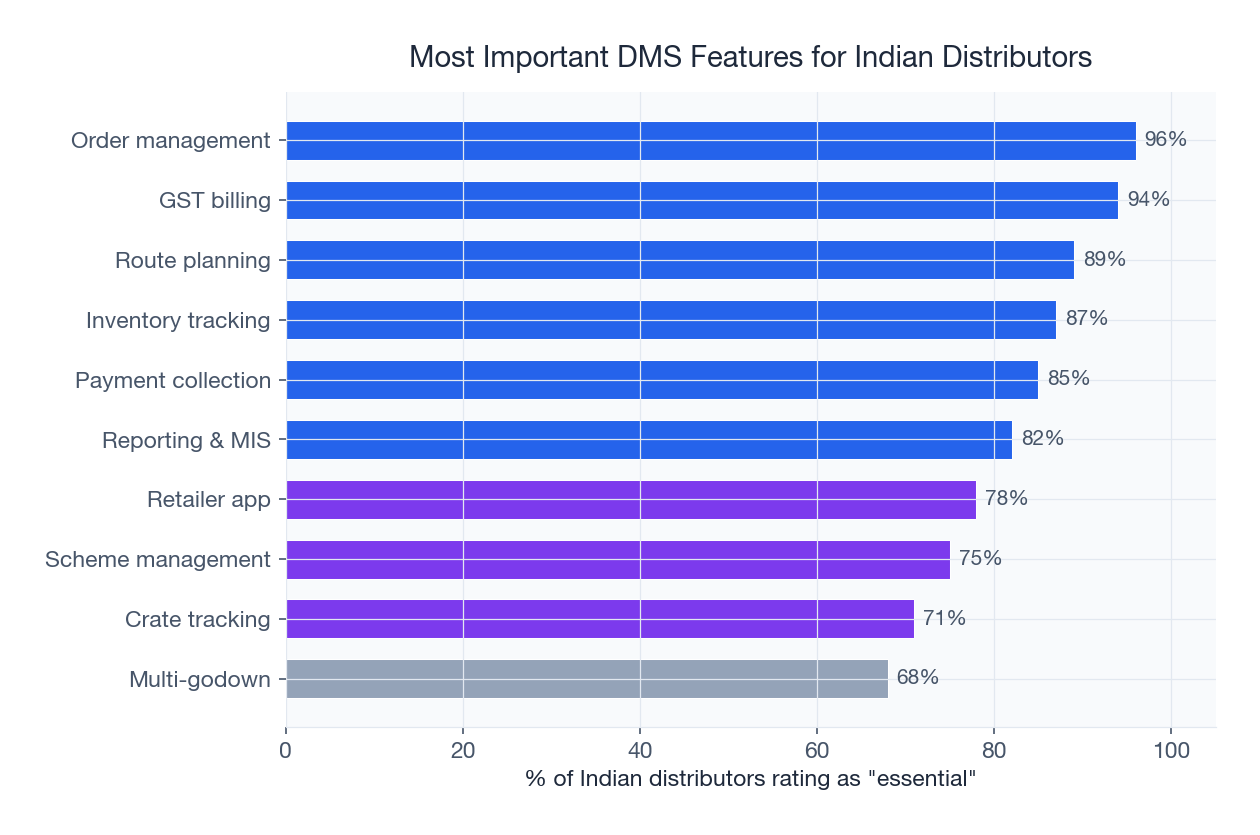
Choosing a Distribution Management System (DMS) is harder than it should be. Vendors pile feature lists, marketing departments invent buzzwords and buyers struggle to tell what actually matters. This post cuts through the noise with a pragmatic, experience-driven checklist of the features an Indian distribution operator should absolutely demand in 2026. Use it as a scoring rubric when you run demos, negotiate pricing and plan implementation.
The checklist is organised by category: core operations, field force, analytics, compliance, integration, deployment and support. Each category has "must-have" items (walk away if missing) and "nice-to-have" items (differentiators). Use it in conjunction with our 2026 DMS rankings and ERP vs DMS comparison for context.
Feature Matrix Overview
| Category | Must-Have | Nice-to-Have |
|---|---|---|
| Order management | Retailer app, recurring orders, approval workflows | AI demand forecasting |
| Route optimisation | GPS routing, traffic awareness, multi-drop sequencing | Weather-aware rerouting |
| Crate / asset tracking | QR-based tracking, deposit ledgers, daily reconciliation | RFID integration |
| Scheme engine | Trade schemes, consumer offers, auto-calculation | A/B testing of schemes |
| Field force mobile app | Offline mode, GPS attendance, beat adherence | Photo-based planogram audit |
| Distribution tracking | Real-time GPS, delivery status, exception alerts | Customer-facing tracking page |
| Invoice and billing | GST-compliant, e-invoicing, multi-GSTIN | Multi-currency |
| Payment collection | UPI, POS, cheque tracking | BNPL / credit insurance |
| Analytics and dashboards | Real-time KPIs, beat-level drilldown, downloadable reports | Predictive analytics |
| Integration | API with Tally/ERP, webhooks, SSO | SAP / Oracle connectors |
| Deployment | Cloud-native, multi-tenant, role-based access | On-prem option |
| Support | Onboarding team, SLA, training content | Dedicated CSM |
Detailed Feature Checklist
1. Order Management
A capable DMS must let retailers place orders via mobile app, support recurring orders for subscription-style businesses, handle approval workflows for credit accounts and allow back-end edits with full audit trails. Look for order management that scales to thousands of orders per hour without performance degradation.
2. Route Optimisation
Routes should be optimised daily based on orders, traffic conditions and vehicle constraints. Route optimisation must handle multi-drop sequencing, time windows, vehicle capacity limits and driver constraints. Bonus points for weather-aware rerouting and alternative route suggestions during disruptions.
3. Crate and Returnable Asset Tracking
Every crate, bottle or returnable container should be tracked with QR codes or barcodes, linked to a retailer's deposit ledger and reconciled daily. Crate management is often the single largest savings lever for dairy and beverage distributors.
4. Scheme Engine
Trade schemes, consumer offers, slab discounts, free goods, combo offers and display incentives must all be handled automatically. A capable scheme engine applies eligibility at the point of invoicing and calculates settlement without human intervention.
5. Field Force Mobile App
The mobile app must work offline. Must support GPS attendance, beat adherence tracking, order capture, photo proof of visit and retailer feedback collection. Check that it works on 3-year-old Android devices, not just flagship phones.
6. Real-Time Distribution Tracking
Live GPS tracking of vehicles and drops should be visible on a single dashboard. Exception alerts should fire the moment a delivery is delayed, rerouted or cancelled.
7. Attendance Tracking
GPS-based attendance with geo-fenced check-ins, selfie verification and integration with payroll is now considered table stakes for professional distribution operations.
8. GST-Compliant Invoicing
Invoicing must handle e-invoicing (mandatory above Rs 5 crore turnover), multi-GSTIN setups, e-way bill generation and credit notes. Ensure the platform keeps up with GST Council changes automatically.
9. Payment Collection
Payment collection should support UPI, cash, cheque, POS and NEFT/RTGS. Automated reconciliation against outstanding invoices is critical for shortening the cash cycle.
10. Sales Analytics and Dashboards
Analytics dashboards should surface beat-level, SKU-level, distributor-level and scheme-level performance in real time. Exportable reports and custom dashboards are essential for reviews with senior management.
11. Distributor and Retailer Management
Distributor management and retailer tracking must handle onboarding, KYC, credit limits, territory assignment and performance scoring.
12. Integration Ecosystem
APIs for Tally, SAP, Oracle, Zoho Books and custom webhooks are mandatory. Without integration, DMS becomes a data silo and its value drops sharply.
Red Flags to Watch For
- No offline mobile app. Field staff will lose orders in low-connectivity zones.
- No native scheme engine. You'll re-enter schemes manually, and errors will eat margin.
- No crate tracking. You'll continue losing 5-8% of containers annually.
- Slow implementation (6+ months). You'll pay through the nose without ROI for half a year.
- No GST compliance updates. You'll spend CA time fixing broken invoices.
- No API access. Your data will be trapped in the platform.
Pricing Expectations
- Small distributor (1-5 routes): Rs 4,000-12,000/month
- Mid-sized (5-25 routes): Rs 15,000-40,000/month
- Large (25-100+ routes): Rs 40,000-1,50,000/month
- Enterprise multi-plant: Rs 1,50,000+/month
See SpireStock pricing for transparent tier breakdown.
Implementation Timeline Benchmark
- Week 1: Discovery, scoping, master data prep
- Week 2: Configuration, user setup
- Week 3: Training for dispatchers and field force
- Week 4: Pilot with 1-2 beats
- Week 5-6: Full rollout
- Week 7+: Optimisation, analytics reviews, ROI measurement
Putting the Checklist to Work
Print this checklist. Take it to every vendor demo. Score each platform across the 12 categories. Don't fall for feature counts, focus on whether the basics are solid and whether the vendor can demonstrate them in a live environment. For a head-start, review our 2026 DMS rankings, read the manual vs digital comparison, or book a SpireStock demo where we'll walk you through every checklist item live.
Vendor Demo Scoring Framework
The best way to use this checklist is as a live scoring rubric during vendor demos. Bring a printed or digital copy to every demo, score each feature on a 0-3 scale, and compile the totals at the end.
| Score | Meaning |
|---|---|
| 0 | Feature missing entirely |
| 1 | Feature present but incomplete or buggy |
| 2 | Feature meets industry standard |
| 3 | Feature exceeds industry standard |
A platform scoring 80+ out of 100 across all categories is generally a strong choice. A platform scoring under 60 is probably not ready for serious distribution operations.
Category Deep Dives
Order Management, Beyond the Basics
Good order management doesn't just let retailers place orders. It supports:
- Recurring order templates for standing customers
- Minimum order value enforcement
- Credit-limit-aware order blocking
- Scheme-aware order validation (auto-adjusting for offers)
- Multi-SKU bundling and display pack handling
- Approval workflows for out-of-policy orders
- Real-time order status visibility for retailer
- Automated reorder suggestions based on consumption patterns
Route Optimisation, What Makes It Smart
Basic route optimisation sequences drops geographically. Smart route optimisation considers:
- Real-time traffic conditions
- Historical congestion patterns by day and time
- Vehicle capacity (volume, weight, temperature zones)
- Time windows per customer
- Driver skill and beat familiarity
- Fuel economy
- Return leg sequencing for empty collection
- Multi-day route learning via machine learning
Platforms that check all these boxes typically cut delivery cost per outlet by 25-35%.
Crate Management, The Hidden Profit Centre
As covered in our crate loss guide, digital crate management is one of the highest-ROI features in any DMS. Key capabilities to verify during demos:
- QR / barcode-based crate tracking
- Per-retailer deposit ledger
- Automatic enforcement of deposit limits
- Photo-proof empties pickup
- Daily reconciliation reports
- Driver-level crate accountability metrics
Scheme Engine, Where Revenue Leaks Hide
A robust scheme engine must handle:
- Multiple concurrent schemes per SKU
- Slab-based discounts
- Free goods offers
- Bundle offers (buy X get Y)
- Cumulative and non-cumulative schemes
- Channel-specific scheme eligibility
- Settlement workflows (automated claims)
- Scheme expiry and grace period handling
Mobile App, Field Force Reality Check
Demand a field demo with an actual low-end Android device and intentionally bad connectivity. The mobile app should:
- Capture orders offline
- Sync automatically when connectivity returns
- Log GPS attendance with geo-fence validation
- Capture photos with timestamps
- Work in Hindi, Tamil, Telugu and regional languages
- Perform well on RAM-constrained devices
- Not drain battery faster than 5% per hour
Analytics and Dashboards
The best sales analytics platforms surface:
- Real-time beat-level performance
- SKU-level profitability
- Distributor-level scorecards
- Scheme ROI per campaign
- Cash flow and DSO trends
- Customer-level consumption patterns
- Weekly and monthly trend comparisons
- Custom dashboard creation without IT help
Integration Testing Checklist
Before signing, verify the platform can integrate with your existing stack:
- Tally Prime via XML / API
- SAP via RESTful APIs or middleware
- Dynamics 365 BC via APIs
- Zoho Books via connectors
- Custom ERP via webhooks
- Payment gateways (UPI, Razorpay, PayU)
- Google Maps and Here Maps for routing
- WhatsApp Business API for notifications
- E-invoicing portal for GST compliance
Contractual Must-Haves
Beyond features, ensure the contract covers:
- Uptime SLA, 99.5% minimum, with penalties for breach
- Data ownership, Clear clause that your data remains yours
- Export rights, Ability to export all data in standard formats
- Exit clause, No long-term lock-in; 30-60 day notice period
- Support SLA, Response times for critical / high / low issues
- Onboarding commitment, Fixed go-live timeline with milestones
- Pricing predictability, Limits on annual price increases
Post-Go-Live Review Cadence
After go-live, measure progress weekly for the first month and monthly thereafter. Track:
- Adoption rate (% of staff actively using the platform)
- Order accuracy
- Scheme compliance
- Crate loss rate
- DSO
- Field force productivity
- Customer complaints
- System uptime
The Final Litmus Test
Before finalising any platform, ask the vendor: "Can I talk to three of your customers who run operations similar to mine?" If the vendor can't or won't provide references, walk away. Reference conversations reveal what marketing pitches hide: real performance, real support quality, real ROI.
Closing Recommendations
Choosing a DMS is a multi-year commitment. Take the time, use the checklist, run pilots, talk to references and score honestly. The right platform can transform your distribution operation, the wrong one can set you back years. For more guidance, read our 2026 rankings, the manual vs digital comparison, or book a live SpireStock demo to experience every checklist item in action.
Implementation Readiness Assessment
Before signing any contract, assess your organisation's readiness on four dimensions:
Dimension 1: Data Readiness
Do you have clean master data for customers, SKUs, territories and pricing? If not, budget 2-3 weeks for data cleanup before migration.
Dimension 2: Process Readiness
Are your workflows documented? Can you articulate how orders flow from capture to fulfilment? If not, start with process mapping before selecting a platform.
Dimension 3: Team Readiness
Is your team willing to adopt new tools? Is there an executive sponsor? Change management often matters more than the software itself.
Dimension 4: Infrastructure Readiness
Do your field staff have smartphones? Do your warehouses have reliable internet? Do dispatchers have computers? Address basic infrastructure gaps before rollout.
Training and Rollout Strategy
Successful DMS rollouts follow a phased approach:
- Executive briefing (1 day): Leadership alignment on goals and success metrics
- Core user training (2 days): Dispatchers, supervisors, finance team
- Field force training (2 days): Sales officers, delivery drivers
- Pilot period (2 weeks): Limited rollout with close monitoring
- Full rollout (2 weeks): Complete deployment across all distributors
- Stabilisation (4 weeks): Support, refinement, adoption monitoring
Avoiding Failed Implementations
Failed DMS implementations share common patterns:
- No executive sponsor, projects stall when priorities shift
- Poor data migration, dirty data undermines confidence
- Underestimating training, field force can't use what they don't understand
- Over-customisation, deviating from standard workflows creates maintenance nightmares
- No performance measurement, teams don't know if they're improving
- Inadequate change management, old habits die hard without active guidance
Avoid these and your implementation has a 90%+ chance of success.
Post-Implementation Optimisation
The best outcomes come from continuous optimisation after go-live:
- Weekly performance reviews for the first 3 months
- Monthly distributor scorecards
- Quarterly process refinements
- Semi-annual platform upgrades
- Annual strategic review against business goals
The Long-Term View
A DMS is not a one-time purchase, it's a multi-year platform that evolves with your business. Choose a vendor committed to continuous improvement and regular feature releases. Review the vendor's roadmap before signing, and ensure there's alignment between their plans and your long-term goals.
Hidden Feature Gaps to Watch For
Beyond the obvious feature checklist, several hidden gaps can derail implementations. Watch for these: inability to handle multi-UOM SKUs (piece vs case vs pallet), lack of tax-inclusive vs tax-exclusive pricing toggles, missing support for negative inventory adjustments, inadequate audit trail capabilities, and absence of bulk data update tools for master data management. Any of these gaps can force expensive workarounds that undermine the platform's value.
Evaluating Support Quality
Feature richness means little if support is poor. Before signing, ask vendors: what is the response time for critical issues, who handles support (in-house vs outsourced), what languages are supported, what escalation paths exist, and how is support measured. Then validate these answers by talking to existing customers about their actual support experience.
The Three-Month Review
After 90 days of using the platform, conduct a formal review covering adoption rates, process improvements, measurable ROI, open issues and vendor responsiveness. This review is the single most valuable checkpoint in any DMS deployment. Use it to decide whether to expand, refine or (rarely) switch platforms.
This guide covers one part of the picture. For the category as a whole — what a DMS does, the modules that matter, how it differs from ERP and SFA, and what it costs in India — see our distributor management system guide.
Sources & References
Frequently Asked Questions
The most critical features are order management with recurring orders, route optimization, crate/asset tracking, GST-compliant billing, mobile apps with offline capability, and real-time analytics. The exact priority depends on your specific pain points.
Feature count alone is not meaningful. What matters is that the platform covers your critical workflows deeply. A platform with 20 well-executed features that match your needs is better than one with 50 shallow features.
Yes. SpireStock was built specifically for Indian dairy and FMCG distribution and covers all 30 features listed in this checklist, from recurring order management to custom analytics dashboards.
Start by listing your biggest operational pain points, the things that cost you the most time, money, or customer satisfaction. Features that address these pain points should be your top priorities. For most dairy distributors, order management, crate tracking, and route optimization rank highest.
Choose depth over breadth. A platform that handles your critical dairy distribution workflows exceptionally well is more valuable than one that offers every possible feature but handles none of them perfectly. Focus on platforms built specifically for your industry.
Related SpireStock Features
Related Industries
End-to-end dairy distribution software for milk, curd, paneer, and ghee brands. Manage orders, crates, cold chain, and GST billing in one platform.
Streamline FMCG distribution with order management, beat planning, retailer tracking, and GST billing. Built for Indian FMCG supply chains.
Related Solutions
Manage your entire distributor network digitally. Onboarding, credit limits, outstanding tracking, and performance analytics. Start free trial.
GPS fleet tracking, driver management, and route optimization for dairy and FMCG delivery vehicles. Reduce fuel costs by 25%. Try SpireStock.
Related Entities
Ready to Streamline Your Distribution?
Start your free 14-day trial and see how SpireStock can transform your dairy, FMCG or consumer-goods distribution operation, from order capture to crate recovery.

SpireStock Team
Distribution Technology Experts
SpireStock Team writes for SpireStock on distribution management, supply-chain optimisation and field operations for Indian dairy and FMCG brands.