Why Indian Distributors Handle Multiple Brands
Walk into any FMCG distributor's godown in Delhi, Mumbai, or Ahmedabad, and you will find products from 5-15 different companies stacked side by side. This is not a choice but a necessity. Single-brand distribution margins of 4-8% are rarely sufficient to cover warehouse rent, staff salaries, vehicle EMIs, and working capital costs in Indian metros. Distributors diversify across brands to build a viable business.
According to NielsenIQ data, the average Indian FMCG distributor handles 7.2 brands. In tier-2 cities like Lucknow, Surat, and Jaipur, this number rises to 9-12 brands because fewer distributors serve larger territories. The result is a complex multi-company operation where each brand demands separate billing, inventory tracking, scheme management, and compliance, all from the same physical infrastructure.
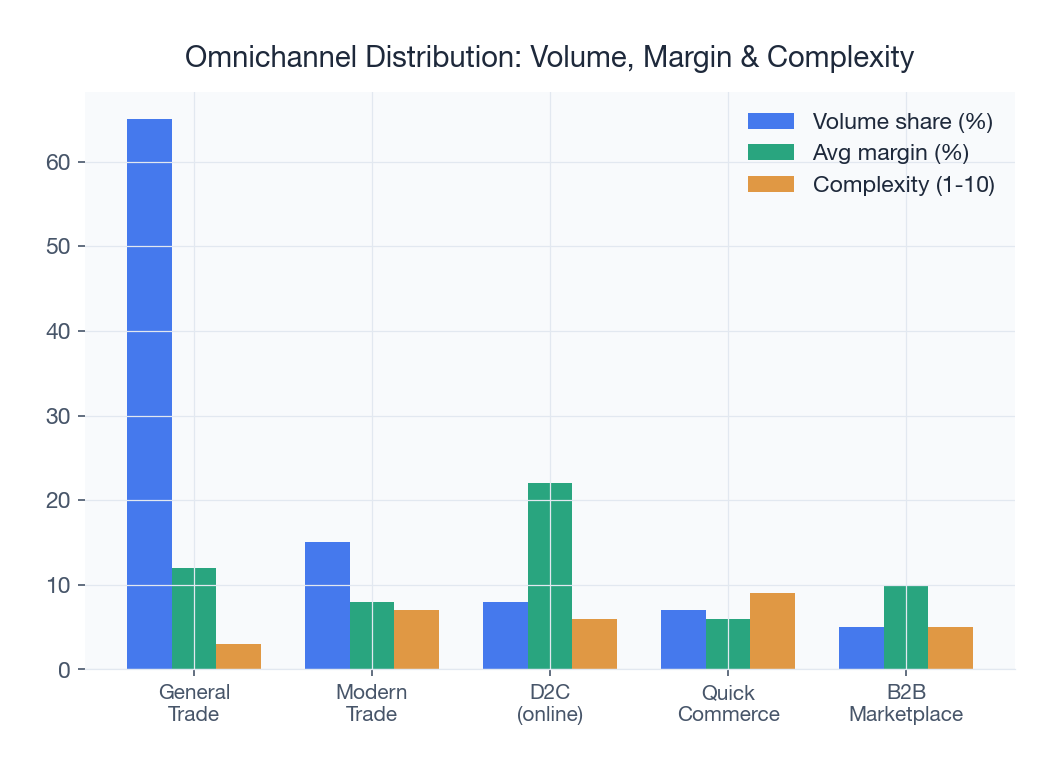
India's FMCG distribution network comprises over 7 million wholesalers and distributors serving 12 million kirana stores. Of these, an estimated 65% handle three or more brands. The trend toward multi-brand distribution is accelerating as newer D2C-origin brands seek distribution partners who already have retail reach, making the technology to manage this complexity not a luxury but an operational imperative.
The Multi-Company Billing Headache
Every brand a distributor handles requires its own set of invoices, credit notes, payment receipts, and GST filings. A distributor handling 10 brands generates 10 separate invoice series, reconciles 10 bank accounts, tracks 10 sets of outstanding payments, and files GST returns reflecting transactions with 10 supplier companies. The billing complexity scales linearly with every new brand added.
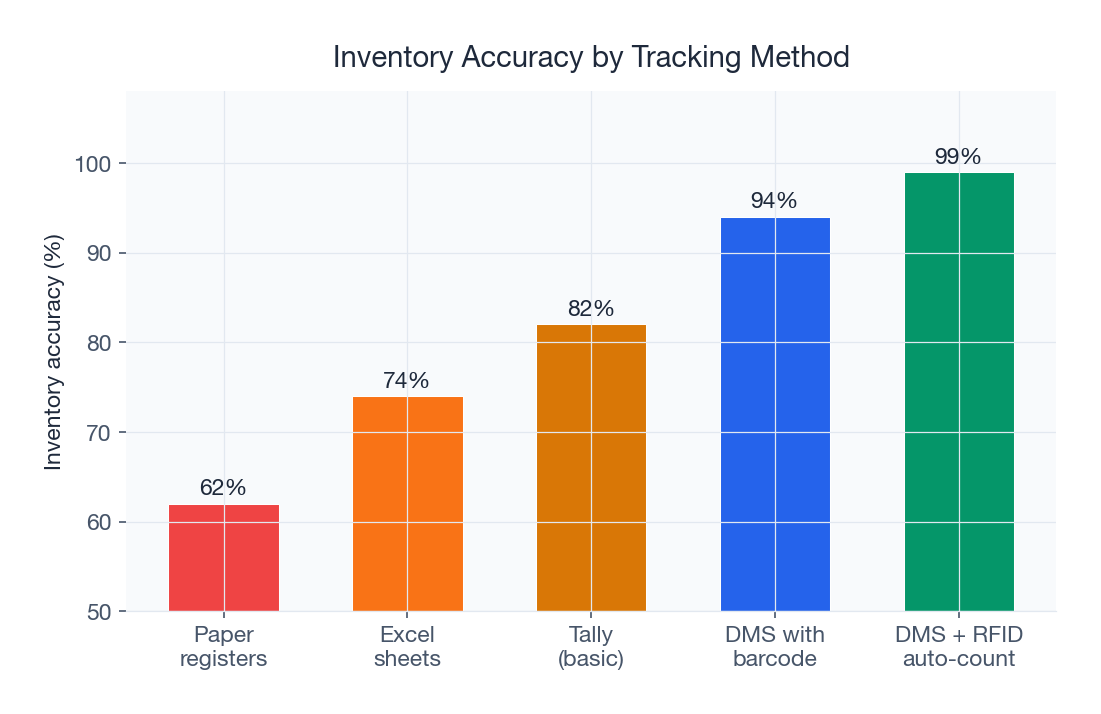
Most distributors cope by running multiple Tally instances, one per company. A 12-brand distributor in Delhi literally had 12 Tally licenses running on 4 computers, with billing staff switching between instances all day. This is the norm, not the exception. The inefficiency is staggering: the same retailer order that covers products from 3 brands requires the billing clerk to log into 3 separate Tally instances, generate 3 invoices, and print 3 challans.
The financial cost of this fragmentation is significant. Each Tally license costs Rs 18,000-54,000 depending on the edition. Running 10 licenses means Rs 1.8-5.4 lakh in licensing alone, before accounting for the hardware, the electricity, and most importantly, the 3-5 additional billing staff needed to operate the parallel instances. For a deeper look at billing automation, read our distributor billing software guide.
Why Tally Falls Short for Multi-Brand Distribution
| Capability | Multiple Tally Instances | Multi-Tenant DMS |
|---|---|---|
| Unified retailer view | No, separate per company | Yes, single retailer master across brands |
| Consolidated delivery planning | No, separate dispatches | Yes, multi-brand orders in single trip |
| Cross-brand scheme comparison | Not possible | Side-by-side scheme dashboard |
| Combined outstanding view | Manual aggregation | Real-time consolidated + company-wise |
| Single login for staff | No, multiple logins | Yes, role-based access across brands |
| Mobile ordering | Not available | Retailers order any brand from one app |
| Consolidated P&L | Manual in Excel | Auto-generated dashboard |
| Route optimization | Not available | Multi-brand delivery route optimization |
| Scheme automation | Manual per company | Automated across all brands |
| Salesman productivity tracking | Not possible cross-brand | Unified field force tracking |
For a comprehensive comparison of distribution software options, read our 2024 buyer's guide to distribution management software.
What Multi-Tenant Workspaces Enable
A multi-tenant workspace architecture means one software installation with logically separated company environments. Each brand's data (products, pricing, schemes, invoices, outstanding) remains isolated and secure, but the distributor gets a unified operational layer on top. This is fundamentally different from running parallel software instances, it is one system that understands the multi-company reality of Indian distribution.
Company-Wise Billing with Unified Operations
When a salesman takes an order from a kirana store that wants dairy butter, branded biscuits, and a local detergent brand, the system creates separate company-wise invoices automatically. The delivery boy carries one consolidated challan but the accounting is perfectly separated per brand. GST e-invoicing generates separate IRNs per company. The retailer sees one delivery, the distributor manages one trip, but the books are pristine per company.
This consolidation translates directly to savings. A distributor who previously made 3-4 separate delivery trips to the same retailer for different brands can now fulfill everything in one trip. Across 200 retailers, this eliminates 600-800 redundant deliveries per month. At Rs 150-250 per delivery trip, the savings on logistics alone can reach Rs 1-2 lakh monthly.
Consolidated Dashboard with Company Drill-Down
The distributor owner sees a single analytics dashboard showing total sales, total outstanding, total deliveries across all brands. One click drills down to any specific brand's metrics. This consolidated view is impossible with separate Tally instances without hours of manual Excel work. For the first time, a distributor can answer questions like: "Which brand gives me the best return on working capital?" or "Which brand has the highest return rate?" in seconds rather than days.
Unified Delivery Planning
Instead of separate delivery runs for each brand, route optimization consolidates multi-brand orders into efficient delivery routes. A delivery vehicle serving 40 retailers carries products from all 10 brands in a single trip instead of making 3-4 separate trips for different brands. This typically reduces delivery trips by 30-40% and fuel costs by Rs 50,000-1.5 lakh monthly depending on the fleet size and city. Distributors in congested metros like Mumbai and Kolkata see the most dramatic delivery cost reductions.
Brand-Specific Scheme Management
The scheme engine manages schemes per company with zero cross-contamination. A dairy quantity discount and a biscuit brand seasonal offer are tracked, applied, and reported separately. When a sub-stockist places an order that qualifies for schemes from 3 different brands, the system applies each brand's scheme independently with full traceability. Read more about preventing scheme leakage in our FMCG scheme management guide.
Inventory Segregation and Tracking
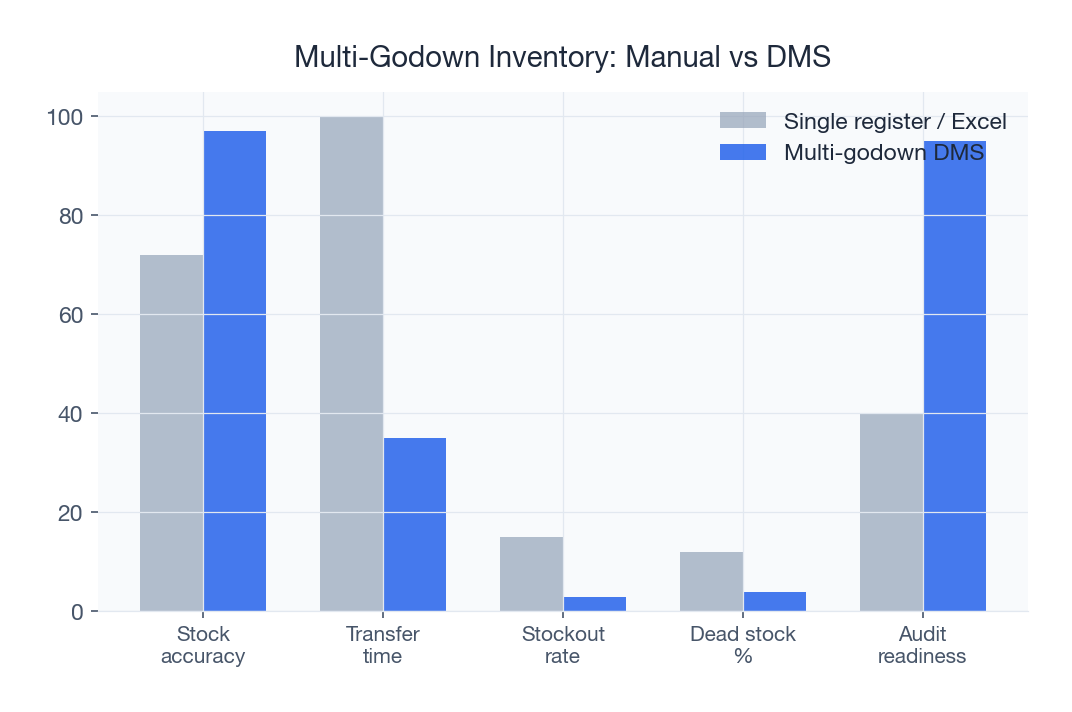
Multi-brand inventory management requires tracking stock by company, product, batch, expiry date, and physical location within the godown. A well-organized godown has designated areas for each brand, but the software must track this digitally. When one brand's stock runs low, the system should alert the distributor to reorder from that brand's C&F agent without affecting other brands' stock levels or reorder calculations.
For distributors managing perishable products alongside shelf-stable goods, the crate management module adds another layer of tracking for returnable assets per brand. Dairy crates, beverage crates, and bakery trays are all tracked separately by company, preventing the inter-brand crate mix-ups that cause disputes and losses. Our guide on inventory management software for distributors covers this in depth.
A critical inventory challenge for multi-brand distributors is space allocation. When godown space is limited, which it almost always is in cities like Pune and Bangalore where commercial rents are high, the distributor must optimize space allocation across brands based on turnover velocity, margin contribution, and seasonal patterns. The distribution tracking module provides the data needed to make these space allocation decisions objectively.
Company-Wise P&L vs Consolidated Reporting
Understanding profitability per brand is essential for distributors to decide which brands to prioritize, which to negotiate better terms with, and which to potentially drop. A multi-tenant DMS generates:
- Company-wise P&L: Revenue, cost of goods, scheme benefits, operational cost allocation, and net margin per brand
- Consolidated P&L: Total business profitability across all brands
- Contribution analysis: Which brands contribute most to fixed cost recovery
- Working capital per brand: How much capital is locked in each brand's inventory and receivables
- Return on capital employed (ROCE): The most important metric, showing which brands generate the best returns for the capital invested
This data transforms the distributor from a passive channel partner into a strategic business operator. When a brand's ROCE drops below the cost of capital (typically 12-15% for Indian distributors), the distributor has data to either negotiate better terms or reallocate resources to higher-return brands.
Common Multi-Brand Distributor Setups
| Setup Type | Brands | Monthly Turnover | Staff | Typical City Tier |
|---|---|---|---|---|
| Small multi-brand | 3-5 | Rs 15-40 lakh | 5-8 | Tier-3/4 |
| Medium multi-brand | 6-10 | Rs 40 lakh-1.5 crore | 10-20 | Tier-2/3 |
| Large multi-brand | 11-15+ | Rs 1.5-5 crore | 20-40 | Tier-1/2 |
| Super-stockist | 8-15 | Rs 2-8 crore | 15-30 | Tier-2/3 hub |
For super-stockists handling even more complexity, read our dedicated guide on superstockist and sub-stockist management.
Credit and Outstanding Management Per Brand
Each brand sets different credit terms for the distributor: Brand A might offer 21-day credit, Brand B insists on 7-day credit, and Brand C operates on advance payment. The distributor must track outstanding separately per company while managing their own cash flow across all brands. When one brand's outstanding spikes, it should not affect the distributor's ability to order from other brands.
A multi-tenant DMS maintains separate credit ledgers per company with automated aging reports. The distributor sees a consolidated outstanding view for internal management but can drill down to any brand for payment planning. Automated reminders trigger at brand-specific intervals: Brand A's reminder fires at day 18, Brand B's at day 5. This per-brand credit intelligence is impossible to maintain manually across 10+ brands. For detailed credit management strategies, read our credit limit management guide.
The working capital implications are significant. A distributor with Rs 1.5 crore monthly turnover across 10 brands might have Rs 40-60 lakh locked in outstanding at any time. Knowing exactly how much capital each brand consumes, and whether that brand's margin justifies the capital lock-up, is essential for business health. The payment collection module integrates UPI, NEFT, and cheque tracking to provide real-time outstanding positions per brand.
GST and Compliance Across Multiple Companies
Multi-brand distributors face a unique GST compliance challenge. Each brand's transactions must be invoiced with the correct tax rates, HSN codes, and company details. E-invoicing requirements (mandatory above Rs 5 crore turnover) mean generating separate IRNs per company. Monthly GSTR-1 filing must accurately reflect transactions with all supplier companies, and ITC reconciliation must match purchase invoices from 10+ suppliers against the distributor's GSTR-2B.
Common GST errors in multi-brand operations include applying the wrong tax rate when billing a retailer for mixed-category products, failing to generate e-invoices for one company while doing it correctly for others, and mismatching company GSTIN on invoices when switching between brands. These errors attract penalties and create ITC reversal risks during audits. A multi-tenant DMS eliminates these errors by auto-applying the correct tax treatment per company at the invoice level. For detailed GST guidance, see our GST billing guide and e-way bill compliance guide.
Field Force Management Across Brands
Multi-brand distributors deploy salesmen who cover beats carrying order books for all brands. Without a unified system, a salesman visiting 30 retailers per day must mentally juggle separate price lists, scheme structures, and stock availability for each brand. This leads to errors, missed schemes, and lost sales opportunities.
With a mobile app connected to the multi-tenant DMS, the salesman sees all brands on one screen. When taking an order from a retailer, the app shows available stock, applicable schemes, and the retailer's outstanding per brand. Attendance tracking and beat compliance are tracked uniformly regardless of which brands the salesman sells. Our field force tracking guide explains how to maximize salesman productivity across brands.
Onboarding New Brands: Speed as Competitive Advantage
For multi-brand distributors, the ability to quickly onboard a new brand is a competitive differentiator. When an FMCG company enters a new city or switches distributors, they evaluate potential partners on infrastructure, reach, and operational readiness. A distributor running a multi-tenant DMS can onboard a new brand in 1-2 days: configure the company workspace, upload the product catalog, set up pricing and scheme structures, assign the brand to existing routes, and start billing. A distributor running multiple Tally instances needs 2-3 weeks for the same process: purchase a new Tally license, set up a new instance, manually configure the chart of accounts, train billing staff on the new company's requirements, and create parallel delivery schedules.
This speed advantage becomes a real revenue driver. In competitive markets like Hyderabad and Chennai, where multiple distributors compete for brand appointments, the ability to demonstrate digital readiness and promise a 48-hour go-live timeline can tip the decision in your favor. Each new brand added represents Rs 15-50 lakh in additional monthly turnover and Rs 50,000-2 lakh in monthly margin contribution.
Case Study: Delhi Distributor with 12 Brands
A multi-brand distributor in East Delhi handling 12 FMCG brands (including dairy, snacks, beverages, and homecare) migrated from 12 Tally instances to SpireStock's multi-tenant platform. Results after 8 months:
| Metric | Before (12 Tallys) | After (SpireStock) | Impact |
|---|---|---|---|
| Daily billing time | 6 hours | 90 minutes | 75% reduction |
| Delivery trips per day | 14 trips | 9 trips | 35% reduction |
| Scheme leakage (monthly) | Rs 1.8 lakh | Near zero | Eliminated |
| Total outstanding | Rs 85 lakh | Rs 52 lakh | 39% reduction |
| Monthly closing time | 5-7 days | 1 day | 80% faster |
| New brand onboarding | 2-3 weeks | 1-2 days | 90% faster |
The distributor's annual savings exceeded Rs 28 lakh (billing staff reduction: Rs 7.2 lakh, scheme leakage elimination: Rs 21.6 lakh) against a platform cost of Rs 5.4 lakh, delivering 5.2x ROI in the first year. Learn more about calculating returns in our ROI calculation guide.
Migration Path from Tally
Moving from multiple Tally instances to a unified platform does not happen overnight. The recommended approach:
- Phase 1 (Week 1-2): Master data migration, retailer database, product catalogs, opening balances per company
- Phase 2 (Week 3-4): Start billing on the new platform for 2-3 brands while keeping Tally running in parallel
- Phase 3 (Week 5-8): Migrate remaining brands one by one, each brand running parallel for 1 week
- Phase 4 (Week 9-10): Full cutover, Tally retained as read-only archive for historical data
Critical success factors include getting buy-in from billing staff early (they may resist change), ensuring the first 2-3 brands migrated are the simplest ones to build confidence, and maintaining Tally access for at least 3 months post-migration for historical reference. For more on the transition from manual to digital systems, read our manual vs digital distribution comparison.
Choosing the Right Multi-Brand Platform
Not all distribution software handles multi-brand operations well. Key evaluation criteria:
- True multi-tenancy: Company data isolated but operations unified
- Scalability: Adding a new brand should take hours, not weeks
- GST compliance: Company-wise e-invoicing and filing support
- Mobile-first: Mobile app for salesmen and delivery staff across all brands
- Offline capability: Critical for distributors in tier-2/3 cities like Lucknow and Surat
- Brand reporting: Many brands require secondary sales data, ensure the platform supports secondary sales tracking
- Payment integration: UPI, NEFT, and cheque tracking through the payment collection module
Managing multiple brands from separate systems? SpireStock's multi-tenant platform consolidates all your brands into one interface with company-wise billing, unified delivery, and consolidated analytics. Explore our solutions for FMCG distribution, dairy distribution, beverage distribution, and consumer goods. Start your free trial or view pricing plans to see how consolidation can transform your multi-brand business.
Sources & References
Frequently Asked Questions
With manual or Tally-based operations, most distributors max out at 8-10 brands due to billing and operational complexity. With a multi-tenant DMS, distributors can efficiently handle 15-20+ brands because billing, inventory, and scheme management are automated per company while operations are consolidated.
A multi-tenant DMS is significantly more efficient. Separate Tally instances mean no unified delivery planning, no consolidated reporting, no cross-brand scheme management, and 3-4x more billing time. A DMS consolidates operations while keeping company-wise books perfectly separated.
A multi-tenant DMS automatically generates company-wise P&L by tracking revenue, cost of goods, scheme benefits, and allocated operational costs per brand. This lets you identify which brands are most profitable and negotiate better terms with underperforming brands.
Opening balances (outstanding, inventory) are migrated to the new system. Historical Tally data is retained as a read-only archive. Most distributors keep Tally installed for 6-12 months after migration for reference purposes. No historical data is lost.
Yes, multi-tenant DMS platforms allow you to share brand-specific secondary sales data with each company without exposing other brands' data. This is increasingly important as FMCG companies require digital secondary sales reporting from their distribution network.
For a 10-brand distributor, expect 8-10 weeks for full migration with parallel running. Phase 1 covers master data (2 weeks), Phase 2 starts billing for 2-3 brands (2 weeks), Phase 3 migrates remaining brands (4 weeks), and Phase 4 is full cutover (2 weeks). SpireStock provides dedicated migration support.
Related SpireStock Features
Isolated workspaces for each customer with custom branding and configuration.
GST-compliant invoicing with HSN codes, gate passes, and financial ledger.
Flexible incentive schemes, flat, bulk-pack, and quantitative, applied automatically.
Powerful dashboards with sales trends, MIS reports, and distribution analytics.
Related Industries
Streamline FMCG distribution with order management, beat planning, retailer tracking, and GST billing. Built for Indian FMCG supply chains.
End-to-end dairy distribution software for milk, curd, paneer, and ghee brands. Manage orders, crates, cold chain, and GST billing in one platform.
Manage beverage distribution with cold chain tracking, crate management, route optimization, and real-time delivery monitoring. Try SpireStock free.
Distribution management for consumer goods brands. Manage distributors, retailers, schemes, and sales analytics across India. Start free trial.
Related Solutions
Manage your entire distributor network digitally. Onboarding, credit limits, outstanding tracking, and performance analytics. Start free trial.
Manage distribution across multiple production units and plants. Centralized control with plant-level autonomy for dairy and FMCG brands.
Boost field sales team productivity with beat planning, GPS attendance, order capture, and performance analytics. Built for Indian FMCG teams.
Related Entities
Ready to Streamline Your Distribution?
Start your free 14-day trial and see how SpireStock can transform your dairy, FMCG or consumer-goods distribution operation, from order capture to crate recovery.

SpireStock Team
Distribution Technology Experts
SpireStock Team writes for SpireStock on distribution management, supply-chain optimisation and field operations for Indian dairy and FMCG brands.