Why Indian Distributors Cannot Afford Manual Inventory Management in 2026
India's distribution landscape spans over 13 million retail outlets, hundreds of thousands of distributors, and a supply chain that moves Rs 18 lakh crore worth of FMCG goods annually. Yet a 2025 Redseer report found that 68% of Indian distributors still track inventory using paper registers, Excel sheets, or basic Tally entries. The cost of this inefficiency is staggering: the average mid-sized distributor loses Rs 8-15 lakh per year to stockouts, overstocking, expiry-related write-offs, and pilferage that goes undetected until the annual audit.
Inventory management software for distributors is purpose-built technology that provides real-time visibility into stock levels across every location — from central godowns in Mumbai to sub-distributors in tier-3 towns — enabling data-driven purchasing, automated reorder triggers, and waste elimination. Unlike generic accounting tools, distributor-grade inventory software understands FIFO/FEFO rotation, batch-level traceability, multi-godown transfers, and the GST compliance demands of Indian trade. If you are ready to move beyond guesswork, start your free 14-day trial and experience the difference within a week.
The Real Cost of Poor Inventory Management
Before diving into features, let us quantify what poor inventory practices actually cost an Indian distributor. These numbers come from aggregated data across 500+ distributors in the FMCG and dairy sectors:
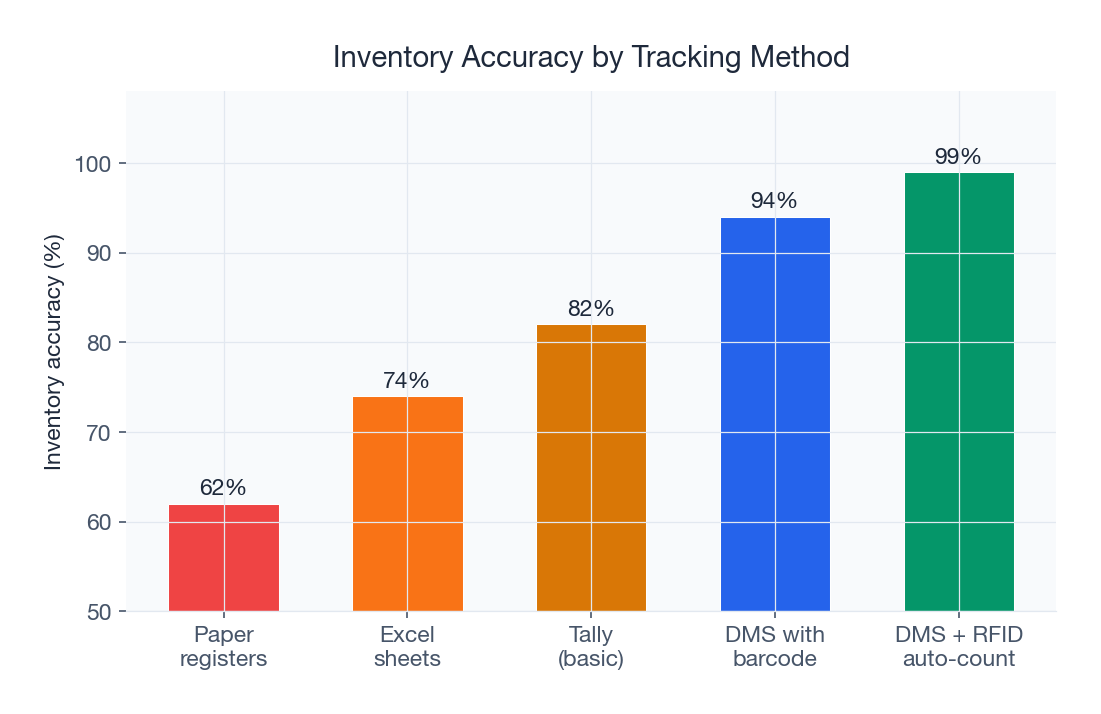
| Problem | Average Annual Cost (Mid-Size Distributor) | Root Cause |
|---|---|---|
| Stockouts leading to lost sales | Rs 4-6 lakh | No real-time stock visibility |
| Overstocking and dead inventory | Rs 2-4 lakh | No demand forecasting |
| Expiry-related write-offs | Rs 1.5-3 lakh | No FEFO enforcement |
| Pilferage and shrinkage | Rs 1-2 lakh | No digital audit trail |
| GST penalties from stock mismatches | Rs 50,000-1.5 lakh | Manual stock registers |
| Excess working capital locked in stock | Rs 5-10 lakh (opportunity cost) | No reorder optimization |
Combined, the typical FMCG distributor operating in cities like Ahmedabad or Pune bleeds Rs 12-25 lakh annually from inventory mismanagement alone. For dairy distributors handling perishable goods, these losses can be 30-40% higher. Read more about expiry-specific challenges in our guide to expiry management for dairy distribution.
Core Features of Inventory Management Software for Indian Distributors
1. Real-Time Stock Visibility Across Every Location
The foundation of effective inventory management is knowing exactly what you have, where you have it, and when it expires — in real time, not at the end of the day. Modern distribution tracking gives distributors a single dashboard showing stock levels across main godowns, branch warehouses, delivery vehicles in transit, and even at the retailer level through secondary sales data.
For a distributor managing 3 godowns in Delhi NCR, real-time visibility means your sales team in Noida can see that Godown B in Gurgaon has 400 cases of a fast-moving SKU before promising delivery to a retailer — eliminating the phone calls, WhatsApp messages, and guesswork that plague manual operations. This capability is especially valuable during festive seasons and promotional pushes when stock moves faster than usual and allocation decisions must happen in minutes, not hours.
2. FIFO and FEFO Stock Rotation
For FMCG distributors and dairy distributors, stock rotation is not a nice-to-have — it is the difference between profit and loss. FIFO (First In, First Out) ensures older stock ships first. FEFO (First Expiry, First Out) goes a step further, prioritizing dispatch based on expiry dates regardless of receipt date.
Inventory management software enforces these policies automatically during pick-pack operations. When a salesman in Bangalore creates an order, the system automatically allocates stock from the batch closest to expiry, ensuring zero manual intervention and zero rotation errors. This is especially critical for dairy products with 7-21 day shelf lives, where a single day's delay in rotation can trigger returns and write-offs. For a deeper understanding of how batch rotation connects to broader traceability requirements, see our guide on batch tracking and traceability for dairy distribution.
3. Multi-Location and Multi-Godown Management
Indian distributors rarely operate from a single warehouse. A typical mid-sized FMCG distributor manages 2-5 godowns, often spread across different areas of a city or across multiple cities. Multi-godown stock management requires the software to track inventory per location, manage inter-godown transfers with proper documentation, and maintain GST-compliant records for each location's stock movements.
SpireStock's multi-plant distribution module handles this seamlessly — each godown operates as a distinct inventory node with its own receiving, dispatch, and audit workflows, while the central dashboard gives management a consolidated view across all locations. Inter-godown stock transfers generate the required delivery challans and e-way bills automatically, keeping your compliance posture intact even as goods move between facilities.
4. Automated Reorder Points and Purchase Suggestions
Setting reorder points manually for 500-2,000 SKUs across multiple godowns is practically impossible. Intelligent inventory software calculates optimal reorder points based on historical sales velocity, lead time from the principal company, seasonal demand patterns, and safety stock requirements. When stock for a particular SKU in a particular godown drops below the calculated reorder level, the system generates a purchase suggestion automatically.
For distributors in Surat or Lucknow managing diverse FMCG portfolios, automated reorder points reduce stockouts by 60-70% while simultaneously cutting overstocking by 30-40%. Our guide on demand forecasting for dairy distribution covers the forecasting algorithms behind these calculations.
5. Batch-Level Traceability and Expiry Management
Every unit of inventory must be traceable back to its manufacturing batch — for quality control, recall management, and FSSAI compliance. Inventory management software assigns batch numbers during inward, tracks them through storage and dispatch, and records which retailer received which batch. If a quality issue arises with batch X, you can identify within minutes which retailers have that stock and initiate targeted recalls instead of market-wide panic.
Batch-level tracking also powers the expiry management workflow. The system maintains a real-time expiry calendar across all SKUs and godowns, generating alerts at configurable thresholds — for example, 30 days before expiry for packaged goods or 3 days before expiry for dairy. This early warning system gives your team time to push near-expiry stock through promotional offers, inter-godown transfers to higher-velocity locations, or return to the principal company under their take-back policy.
6. Stock Audit and Cycle Counting
Annual physical stock audits are disruptive and often reveal discrepancies that have accumulated over months. Modern inventory software supports cycle counting — a methodology where a subset of SKUs are counted daily or weekly on a rotating basis, so that every SKU gets physically verified at least once per month. Discrepancies are flagged immediately, investigated while evidence is fresh, and corrected before they compound.
The SpireStock mobile app allows warehouse staff to conduct cycle counts using their smartphone camera for barcode scanning, with automatic comparison against system quantities and exception reporting for mismatches. For distributors worried about pilferage or shrinkage — a common concern in godowns staffed by daily-wage labour in tier-2 cities — cycle counting provides continuous deterrence and early detection rather than after-the-fact discovery during annual audits.
7. Dead Stock Identification and Liquidation
Dead stock — inventory that has not moved in 60, 90, or 120+ days — silently destroys distributor margins. It ties up working capital, occupies valuable godown space, edges closer to expiry, and eventually becomes a write-off. The challenge is that dead stock hides in plain sight: across 1,500 SKUs in 3 godowns, it takes systematic analysis to identify which items are gathering dust.
Inventory management software runs automated dead stock reports on configurable thresholds. For each dead or slow-moving SKU, the system shows the quantity on hand, days since last sale, cost value locked up, and remaining shelf life. Armed with this data, you can take action: push the stock through targeted trade schemes, transfer it to a higher-velocity godown, return it to the brand under applicable policies, or write it off before it consumes more warehouse space. Distributors who run monthly dead stock reviews typically recover Rs 3-8 lakh annually in otherwise lost inventory value.
8. GST-Compliant Stock Registers and Reports
Under Indian GST law, distributors must maintain accurate stock registers per godown, with documentation for every inward, outward, and transfer transaction. Manual registers are error-prone and audit-risky. Inventory management software automatically generates GST-compliant stock registers, HSN-wise movement reports, and the documentation required for e-way bill compliance during inter-godown transfers.
The integration between inventory and billing modules ensures that every stock movement has a corresponding financial entry. When a GST officer audits your godown, every unit of inventory ties back to an inward entry, and every outward ties to an invoice or transfer challan — eliminating the reconciliation gaps that trigger notices and penalties.
How Real-Time Inventory Transforms Distribution Operations
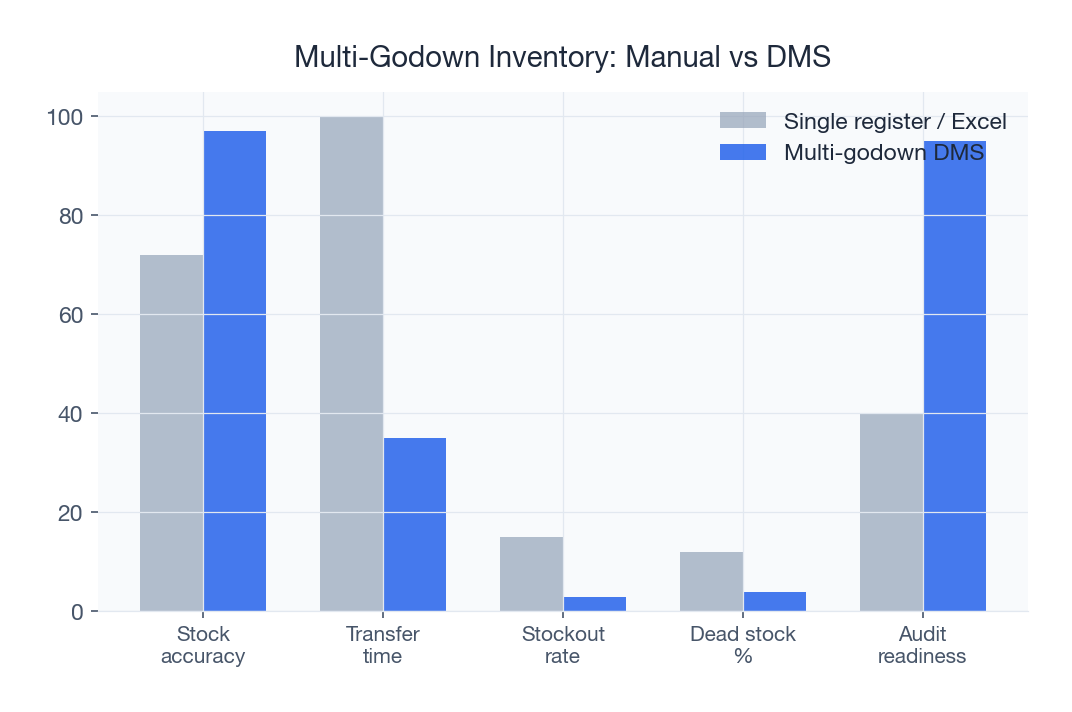
| Metric | Manual / Excel | With Inventory Software | Improvement |
|---|---|---|---|
| Stock accuracy | 70-80% | 97-99% | 25-30% improvement |
| Stockout frequency | 12-18 times/month | 2-4 times/month | 75% reduction |
| Expiry write-offs | 3-5% of turnover | 0.5-1% of turnover | 70-80% reduction |
| Order fulfilment rate | 82-88% | 95-98% | 10-15% improvement |
| Working capital locked in stock | 25-35 days of sales | 15-20 days of sales | 30-40% reduction |
| Time spent on stock reconciliation | 8-10 hours/week | 1-2 hours/week | 80% reduction |
| Dead stock as % of total inventory | 8-15% | 2-4% | 70% reduction |
Integration with Billing, Orders, and the Broader Distribution Ecosystem
Inventory management does not exist in isolation. It connects to every other distribution function, and the value of an integrated system far exceeds the sum of its parts:
- Order management — When a retailer order is confirmed through the order management system, inventory is reserved immediately, preventing overselling across multiple salesmen taking orders simultaneously
- Scheme management — Trade schemes that offer bonus stock must deduct from inventory in real time, and scheme-specific stock earmarking ensures promotional quantities are available when needed
- Billing and invoicing — Stock deductions happen at the point of dispatch or delivery confirmation, and every inventory movement auto-posts to your billing module and accounting system
- Returns processing — Returned stock re-enters inventory with proper batch tagging, quality classification, and GST credit note adjustments. See our guide on damaged goods and return management for the full workflow
- Credit management — Credit limit checks happen at the order stage using real-time stock availability data, preventing orders against out-of-stock items
- Secondary sales tracking — Secondary sales data from the field feeds back into demand planning, creating a closed loop between sell-through rates and replenishment triggers
This end-to-end integration is what separates a true distributor management system from a standalone inventory tracker.
Implementation Roadmap for Indian Distributors
Implementing inventory management software is not a single-day switch. Based on successful rollouts across distributors in Hyderabad, Chennai, and Kolkata, here is a proven 8-week roadmap:
- Week 1-2: Data cleanup and master setup — SKU master with HSN codes, godown master with storage zones, opening stock entry with batch and expiry details, vendor master for purchase orders. This is the most critical phase — clean data ensures accurate operations from day one.
- Week 3: Process configuration — Reorder points per SKU per godown, FIFO/FEFO rules per product category, approval workflows for stock transfers, user roles and permissions per godown, dead stock thresholds, and cycle count schedules.
- Week 4-5: Parallel run — Run both old and new systems simultaneously, reconcile daily to build confidence and catch configuration gaps. This phase typically uncovers 20-30 data discrepancies that would have caused issues post-go-live.
- Week 6: Training — Warehouse staff on inward/outward scanning, sales team on stock check via mobile app, management on dashboard and reports. Hands-on training in the actual godown environment is far more effective than classroom sessions.
- Week 7-8: Go-live and stabilization — Switch fully to digital, conduct daily cycle counts in the first two weeks, address exceptions immediately, and schedule daily 15-minute review calls with the implementation team.
The distributor management solution from SpireStock includes dedicated onboarding support to ensure your team is productive from day one.
Choosing the Right Inventory Management Software
When evaluating inventory management software for your distribution business, prioritize these factors specific to the Indian market:
- Offline capability — Warehouse operations should not stop when internet connectivity drops, which is common in tier-2 and tier-3 locations across India
- Barcode and QR code scanning — Using smartphone cameras, not requiring expensive handheld scanners that cost Rs 25,000-50,000 each
- Integration with billing — Inventory movements should auto-update in your invoice and billing module and accounting system (Tally, Busy, SAP)
- Multi-language support — Warehouse staff in different states need interfaces in Hindi, Marathi, Tamil, or Kannada for daily operations
- Scalability — The system should handle growth from 500 SKUs to 5,000 SKUs without degradation in search, reporting, or sync performance
- Analytics depth — Sales analytics integrated with inventory data reveals which SKUs to push, which to phase out, and where to reallocate stock across godowns
- Crate and returnable asset integration — For dairy and beverage distributors, inventory software must tie into crate management so that returnable asset balances update alongside product inventory
Read our comprehensive buyer's guide for a side-by-side evaluation: Best Distributor Management Software in India — Buyer's Guide. For an understanding of the ROI you can expect, see our ROI calculation framework for distribution software.
Manual vs. Digital Inventory Management: A Detailed Comparison
Many Indian distributors hesitate to move from their familiar manual processes. Here is a side-by-side comparison that highlights the operational differences across every dimension that matters:
| Dimension | Manual / Excel / Basic Tally | Dedicated Inventory Software |
|---|---|---|
| Stock visibility | End-of-day at best, often 2-3 days stale | Real-time across all locations |
| Reorder management | Based on gut feel or last-minute shortages | Automated alerts with demand-based calculation |
| FIFO/FEFO compliance | Depends on warehouse staff discipline | System-enforced at pick-pack stage |
| Batch traceability | Paper registers, takes hours to trace | Instant lookup by batch, SKU, or retailer |
| Inter-godown transfers | Phone calls, WhatsApp, manual challans | Digital requests, approvals, and auto-documentation |
| Dead stock identification | Discovered during annual audit | Automated monthly reports with action triggers |
| GST compliance | Manual registers, high error risk | Auto-generated registers, HSN-wise reports |
| Audit readiness | Weeks of preparation | Always audit-ready with real-time data |
For a comprehensive comparison covering the full spectrum of distribution operations beyond just inventory, read our guide on manual vs. digital distribution management.
Frequently Asked Questions
What is inventory management software for distributors?
Inventory management software for distributors is a digital platform that tracks stock levels in real time across all warehouse locations, automates reorder points, enforces FIFO/FEFO rotation, and generates GST-compliant stock reports. It replaces manual registers and Excel sheets with accurate, live inventory data accessible from any device.
How much does inventory management software cost for Indian distributors?
Cloud-based inventory management software for Indian distributors typically costs Rs 5,000-25,000 per month depending on the number of godowns, users, and SKUs. Enterprise deployments with multi-plant capabilities may range from Rs 50,000-2,00,000 per month. Most providers including SpireStock offer free trials — check our pricing page for current plans.
Can inventory software work offline in areas with poor internet?
Yes, modern distribution software is designed for Indian connectivity realities. Key operations like stock counting, barcode scanning, and dispatch recording work offline on the mobile app and sync automatically when connectivity returns. This is critical for distributors operating in tier-2 and tier-3 markets where broadband and 4G coverage remain inconsistent.
How does FEFO differ from FIFO in distribution?
FIFO (First In, First Out) dispatches stock in the order it was received. FEFO (First Expiry, First Out) dispatches stock based on which batch expires soonest, regardless of when it was received. FEFO is essential for perishable goods like dairy, bakery, and fresh produce where minimizing expiry waste is the top priority. In practice, most Indian dairy and FMCG distributors should use FEFO as their primary rotation policy.
How long does it take to implement inventory management software?
A typical implementation for a mid-sized Indian distributor takes 6-8 weeks, including data migration, configuration, parallel run, and training. Distributors with clean master data and defined processes can go live in as little as 4 weeks. The key bottleneck is usually SKU master cleanup — ensuring every product has the correct HSN code, batch format, and unit of measure.
Does inventory software integrate with Tally and GST filing?
Yes, all modern inventory management platforms offer integration with Tally, Busy, and other Indian accounting software. Stock movements, purchase entries, and sales entries sync automatically, ensuring your books always match your physical inventory. GST returns data including HSN-wise summaries can be exported directly for filing. SpireStock offers real-time API-based Tally sync that eliminates manual voucher entry entirely.
What is the ROI timeline for inventory management software?
Most Indian distributors see full payback within 8-12 weeks of go-live. The immediate savings come from reduced stockouts (recovered lost sales), lower expiry write-offs (FEFO enforcement), and reduced pilferage (digital audit trails). Working capital benefits — from optimized stock levels freeing up cash — often exceed the direct cost savings. A distributor with Rs 2 crore monthly sales typically saves Rs 15-25 lakh in the first year.
This guide covers one part of the picture. For the category as a whole — what a DMS does, the modules that matter, how it differs from ERP and SFA, and what it costs in India — see our distributor management system guide.
Sources & References
- Redseer Strategy Consultants, India FMCG Distribution Digitization Report 2025
- CRISIL Research, Indian Dairy Industry Outlook 2025-26
- National Dairy Development Board, Annual Report 2024-25
Frequently Asked Questions
Inventory management software for distributors is a digital platform that tracks stock levels in real time across all warehouse locations, automates reorder points, enforces FIFO/FEFO rotation, and generates GST-compliant stock reports. It replaces manual registers and Excel sheets with accurate, live inventory data accessible from any device.
Cloud-based inventory management software for Indian distributors typically costs Rs 5,000-25,000 per month depending on the number of godowns, users, and SKUs. Enterprise deployments with multi-plant capabilities may range from Rs 50,000-2,00,000 per month. Most providers offer free trials.
Yes, modern distribution software is designed for Indian connectivity realities. Key operations like stock counting, barcode scanning, and dispatch recording work offline on the mobile app and sync automatically when connectivity returns.
FIFO (First In, First Out) dispatches stock in the order it was received. FEFO (First Expiry, First Out) dispatches based on which batch expires soonest, regardless of receipt date. FEFO is essential for perishable goods like dairy and bakery where minimizing expiry waste is the priority.
A typical implementation for a mid-sized Indian distributor takes 6-8 weeks including data migration, configuration, parallel run, and training. Distributors with clean master data can go live in as little as 4 weeks.
Yes, all modern inventory management platforms offer integration with Tally, Busy, and other Indian accounting software. Stock movements sync automatically, and GST returns data including HSN-wise summaries can be exported directly for filing.
Related SpireStock Features
End-to-end order lifecycle from placement to delivery with multi-level approval workflows.
Real-time GPS tracking of vehicles and drivers with route optimization for faster deliveries.
Powerful dashboards with sales trends, MIS reports, and distribution analytics.
Related Industries
Streamline FMCG distribution with order management, beat planning, retailer tracking, and GST billing. Built for Indian FMCG supply chains.
End-to-end dairy distribution software for milk, curd, paneer, and ghee brands. Manage orders, crates, cold chain, and GST billing in one platform.
Related Solutions
Manage your entire distributor network digitally. Onboarding, credit limits, outstanding tracking, and performance analytics. Start free trial.
Manage distribution across multiple production units and plants. Centralized control with plant-level autonomy for dairy and FMCG brands.
Related Entities
Ready to Streamline Your Distribution?
Start your free 14-day trial and see how SpireStock can transform your dairy, FMCG or consumer-goods distribution operation, from order capture to crate recovery.

SpireStock Team
Distribution Technology Experts
SpireStock Team writes for SpireStock on distribution management, supply-chain optimisation and field operations for Indian dairy and FMCG brands.