What Is a Superstockist in Indian FMCG Distribution?
In India's massive FMCG supply chain, the superstockist occupies a critical position between the C&F (Carrying & Forwarding) agent and the sub-stockist or retailer. The standard chain runs: Manufacturer → C&F Agent → Superstockist → Sub-Stockist → Retailer → Consumer. While the C&F agent is essentially a warehousing arm of the manufacturer, the superstockist is an independent businessman who handles bulk redistribution for multiple brands across a defined geography.
India has an estimated 80,000-100,000 superstockists operating across tier-2 and tier-3 cities, according to IBEF and industry estimates. These operators are the unsung heroes of Indian FMCG distribution, handling anywhere from 5 to 15 brands simultaneously, each with its own billing requirements, scheme structures, credit terms, and GST rules. If you are a superstockist looking to modernize, get in touch with SpireStock to see how our distributor management solution can streamline your multi-brand operations.
Why Superstockists Are the Backbone of Tier-2/Tier-3 Distribution
Major FMCG brands cannot operate direct distribution in every small town and semi-urban market across India. Instead, they rely on superstockists to handle last-mile redistribution. A single superstockist in a city like Indore, Rajkot, or Coimbatore might handle distribution for a dairy brand, a biscuit company, a local edible oil brand, two detergent brands, and several personal care companies, all from the same warehouse.
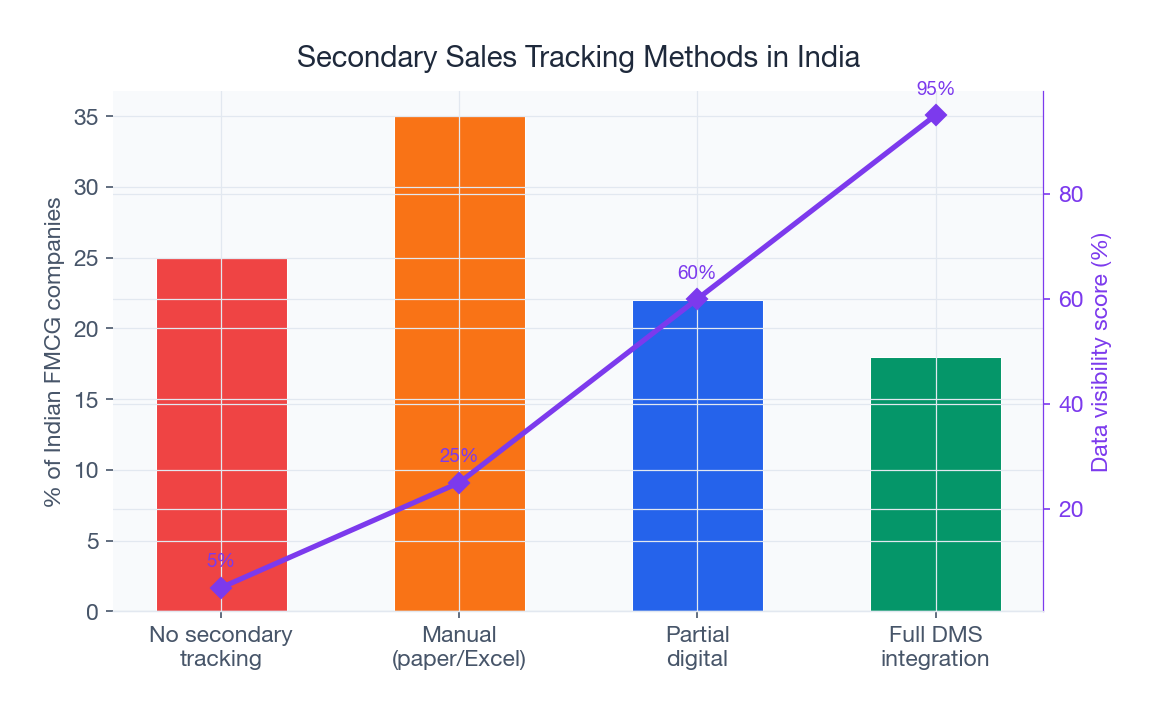
This model works because it leverages the superstockist's local market knowledge, existing sub-stockist network, and warehousing infrastructure. However, the complexity of managing multiple brands with vastly different operational requirements makes the superstockist's job enormously challenging. Most superstockists in cities like Delhi, Mumbai, Ahmedabad, and Pune still rely on multiple Tally instances or paper ledgers to manage this complexity.
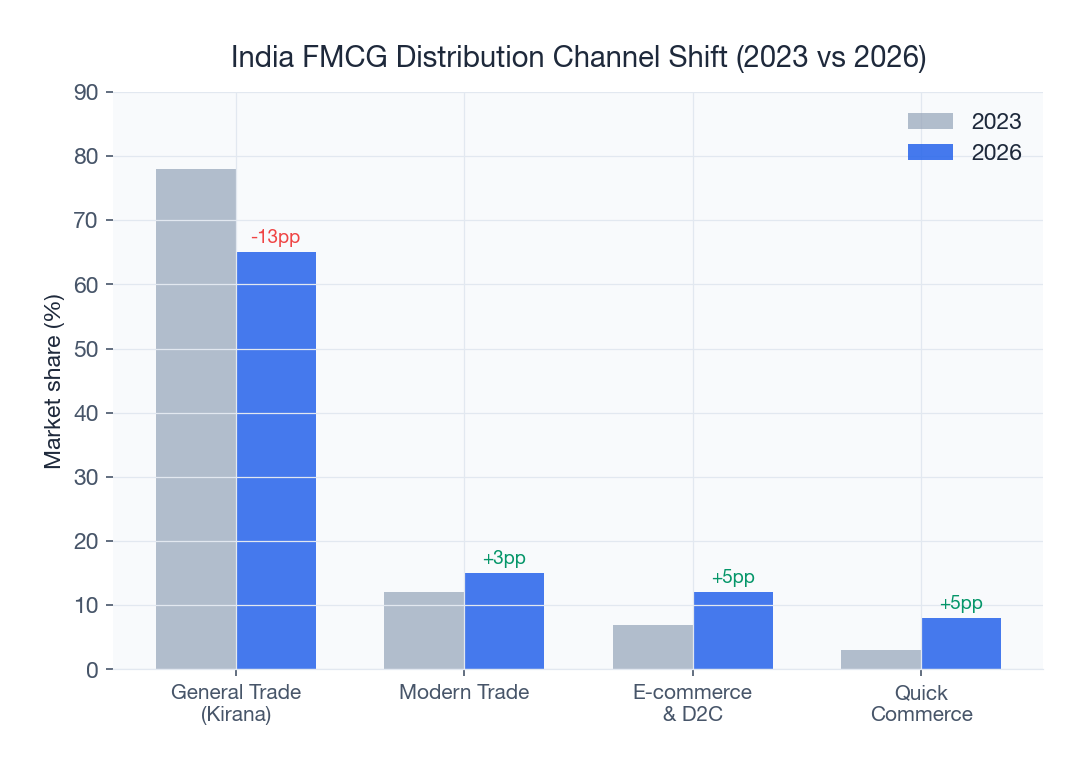
The Indian FMCG market, valued at over Rs 6 lakh crore in 2026, depends on this redistribution layer to reach 12 million kirana stores across the country. Without superstockists, brands would need to appoint thousands of additional direct distributors in small towns, an economically unviable proposition. For this reason, the superstockist model is not going away; it is evolving, and the operators who digitize first will capture a disproportionate share of brand appointments and margin growth.
Superstockist vs Distributor: Key Differences
Understanding the distinction is critical before evaluating technology solutions. While both operate in the FMCG supply chain, their roles, risks, and operational complexities differ significantly. Here is a detailed comparison:
| Parameter | Superstockist | Distributor |
|---|---|---|
| Position in chain | Between C&F and sub-stockist | Between company and retailer |
| Brands handled | 5-15 brands | 1-3 brands typically |
| Geography | District or multi-district | Specific beat/route |
| Typical margin | 2-4% on MRP | 4-8% on MRP |
| Billing complexity | Multi-company billing, separate per brand | Single or dual company billing |
| Credit exposure | Rs 50 lakh-2 crore across brands | Rs 5-25 lakh per brand |
| Sales team | Typically none (redistribution only) | Own salesmen covering beats |
| Scheme management | Pass-through from multiple companies | Single company schemes |
| Working capital requirement | Rs 30 lakh-3 crore | Rs 5-50 lakh |
| Godown size | 3,000-10,000 sq ft | 500-3,000 sq ft |
For a deeper understanding of distributor management fundamentals, read our complete guide to DMS.
The Multi-Company Billing Challenge
Multi-company billing is the single biggest operational bottleneck for superstockists. When you handle 5-15 brands, each brand has its own product catalog, pricing structure, GST rates, scheme definitions, credit terms, and invoice formatting requirements. A superstockist in Bangalore might need to generate dairy invoices at 5% GST on packaged products, processed food invoices at 12% GST, and detergent brand invoices at 18% GST, all for the same sub-stockist, on the same day.
Without a proper billing system, most superstockists run 5-8 separate Tally instances or maintain parallel manual ledgers. This leads to billing staff working 10-12 hour days, frequent invoicing errors, delayed dispatch, and GST filing nightmares. Our research shows that superstockists handling 10+ brands typically employ 4-6 dedicated billing staff, a cost of Rs 8-12 lakh per year just for data entry.
The e-invoicing mandate, now applicable to all businesses with annual turnover above Rs 5 crore, has made this problem even more acute. Each company's invoices must carry a unique IRN (Invoice Reference Number) generated from the GST portal. Doing this manually across 10+ companies is a compliance risk that can attract penalties of up to Rs 25,000 per invoice under Section 122 of the CGST Act. For guidance on GST compliance, see our GST billing guide for dairy distribution.
How DMS Handles Multi-Company Workflows
A modern distribution management system designed for Indian FMCG addresses multi-company billing through a unified multi-tenant architecture. Here is how it works:
- Single interface, multiple company books: All brands managed from one login with company-wise separation of billing, inventory, and receivables through multi-tenant workspaces
- Automated tax calculation: GST rates, HSN codes, and e-invoicing handled per company automatically
- Unified delivery planning: Orders across brands consolidated into single delivery runs to sub-stockists via route optimization
- Company-wise receivables: Outstanding tracked separately per brand with automated aging and follow-up
- Consolidated reporting: View P&L per company or across all companies from a single analytics dashboard
Sub-Stockist Appointment and Management
A superstockist's success depends heavily on the quality and coverage of their sub-stockist network. Appointing sub-stockists in the right locations, with the right credit terms, and with proper documentation is a strategic process that most superstockists handle informally. In a typical district, a superstockist may manage 40-150 sub-stockists, each covering a specific cluster of kirana stores.
Effective sub-stockist management requires tracking several parameters per sub-stockist: territory covered, brands carried, monthly purchase volume per brand, outstanding payment per company, scheme eligibility, return history, and growth trajectory. With retailer tracking solutions, superstockists can digitize the entire sub-stockist lifecycle from appointment to performance evaluation.
Key challenges in sub-stockist management include:
- Credit assessment: Evaluating creditworthiness of new sub-stockists in semi-urban areas where formal credit scores do not exist. Read our detailed guide on credit limit management.
- Territory overlap: Preventing conflicts when two sub-stockists serve overlapping areas for the same brand
- Multi-brand adoption: Encouraging sub-stockists to carry all the brands the superstockist handles, not just the fast-moving ones
- Return management: Processing returns from sub-stockists against the correct brand, batch, and scheme. Our expiry management guide covers return workflows in detail.
- Performance benchmarking: Comparing sub-stockist performance across geographies and identifying underperformers
Scheme Pass-Through Complexity
Each brand runs its own trade promotion schemes, and superstockists must pass these through accurately to sub-stockists. A single brand might have 8-12 active schemes at any time: slab-based quantity discounts, seasonal promotions, new product launch offers, and retailer-specific deals. Multiply that across 10 brands, and you have 80-120 active schemes to track simultaneously.
Without a digital scheme engine, scheme pass-through becomes a major source of leakage. Our data shows that superstockists lose Rs 2-3 lakh per month on average due to scheme miscalculation, missed pass-throughs, and duplicate claims. Read our detailed guide on scheme management in FMCG distribution for strategies to prevent leakage.
Common scheme pass-through errors include applying Brand A's discount slab to Brand B's products, failing to pass through time-limited offers because the scheme notification arrived via WhatsApp and was missed, and double-counting benefits when a sub-stockist qualifies under multiple overlapping schemes. Each of these errors either costs the superstockist money or damages trust with sub-stockists who expect accurate scheme benefits.
Margin Tracking Across Brands
Superstockists earn thin margins of 2-4% on MRP, making accurate margin tracking across brands essential. Without visibility into per-brand profitability, superstockists cannot make informed decisions about which brands deserve more godown space, more working capital allocation, or active push to sub-stockists.
A comprehensive margin analysis for a superstockist includes:
| Revenue Component | Typical Range | How to Track |
|---|---|---|
| Base trade margin | 2-4% on MRP | Invoice-level calculation |
| Scheme benefits (retained) | 0.5-1.5% additional | Scheme engine reporting |
| Cash discount from brand | 0.5-1% for timely payment | Payment tracking |
| Quantity bonus | Variable per brand | Slab achievement tracking |
| Display and visibility income | Rs 5,000-25,000/month | Claims module |
The real margin picture only emerges when you subtract operating costs allocated per brand: godown rent (by space occupied), staff cost (by billing effort), vehicle cost (by delivery frequency), and working capital interest (by average outstanding). The sales analytics module in a DMS automates this margin analysis, giving superstockists visibility that Excel spreadsheets cannot provide.
Inventory Management Across Brands
A superstockist's godown contains inventory from multiple companies, each with different shelf-life requirements, batch tracking needs, and return policies. Dairy products need FEFO (First Expiry First Out) management with 15-45 day shelf life. Biscuits have 6-9 month shelf life. Detergents might have 2-year shelf life but take up significant space.
Managing this diversity requires inventory systems that can track stock company-wise, batch-wise, and location-wise simultaneously. The order management module ensures that when a sub-stockist places an order, the system picks the right batch from the right company's allocated stock area. For distributors managing stock across multiple locations, our guide on multi-godown stock management provides actionable strategies.
Credit Control Per Company
Each brand sets its own credit terms for the superstockist: 7-day credit, 15-day credit, COD, or advance payment. The superstockist, in turn, extends credit to sub-stockists. Managing credit limits and outstanding per company is critical because overdue payments to one brand can affect supply from that brand while other brands continue unaffected.
Digital credit management through a modern DMS enforces company-wise credit limits, generates aging reports per brand, and automates collection follow-ups. This is especially critical for dairy distribution where daily ordering cycles mean credit exposure changes every 24 hours. Learn more about payment collection workflows that keep outstanding under control.
Delivery and Fleet Optimization for Superstockists
Unlike direct distributors who run fixed daily routes to retailers, superstockists serve sub-stockists who place orders less frequently but in larger quantities. A superstockist might fulfill 20-40 sub-stockist orders per day across a district-wide geography, with each order containing products from 3-8 different brands. This creates a unique fleet management challenge: routes change daily based on which sub-stockists ordered, and each delivery carries a mix of brands with different handling requirements.
The route optimization module handles this by consolidating multi-brand orders destined for the same sub-stockist into single delivery runs, sequencing deliveries by geography rather than by brand, and factoring in vehicle capacity constraints. A superstockist in Kolkata covering a 60 km radius can reduce daily kilometres driven by 20-30% through optimized sequencing, saving Rs 4-7 lakh annually on fuel and vehicle maintenance for a 5-vehicle fleet. Explore our fleet management solution for more on delivery optimization.
GST Implications for Superstockists
Superstockists face unique GST challenges because they handle multiple tax rates across brands. E-invoicing mandates (now applicable to businesses with turnover above Rs 5 crore) require automated invoice generation with proper IRN numbers. ITC (Input Tax Credit) reconciliation across 10+ supplier companies is a monthly nightmare without digital tools.
Superstockists must also manage reverse charge scenarios, TDS under GST for larger transactions, and credit note reconciliation when processing returns for multiple brands. A single month's GSTR-1 filing for a 12-brand superstockist can involve 3,000-5,000 invoice entries. Our guide on e-way bill compliance covers the logistics documentation requirements in detail.
Case Study: Superstockist in Indore Handling 11 Brands
A superstockist in Indore handling 11 FMCG brands (including dairy, biscuits, edible oil, and personal care) implemented SpireStock's multi-tenant distribution platform. Here are the before and after results after 6 months:
| Metric | Before (Manual/Tally) | After (SpireStock) | Improvement |
|---|---|---|---|
| Billing staff required | 5 persons | 2 persons | 60% reduction |
| Per-invoice generation time | 4-5 minutes | 45 seconds | 85% faster |
| Total overdue outstanding | Rs 15-18 lakh | Rs 4-5 lakh | 72% reduction |
| Stock discrepancy (monthly) | Rs 1.2 lakh | Rs 18,000 | 85% reduction |
| Scheme leakage (monthly) | Rs 2.5 lakh | Rs 12,000 | 95% reduction |
| GST filing time | 3-4 days | 4 hours | 90% faster |
| Brands manageable | 11 (at capacity) | 15+ (with headroom) | 36% more capacity |
The superstockist achieved full ROI within 4 months of implementation, primarily through billing staff reduction and scheme leakage elimination. Annual savings exceeded Rs 22 lakh against a software investment of Rs 4.8 lakh.
How to Choose Superstockist Management Software
When evaluating software for superstockist operations, prioritize these capabilities:
- True multi-tenant architecture: Not just multiple Tally instances behind a dashboard, but genuine company-wise data separation with unified operations via multi-tenant workspaces
- Scheme engine: Ability to configure and auto-apply 100+ concurrent schemes across brands
- GST compliance: E-invoicing, multi-rate handling, and ITC reconciliation built in
- Mobile accessibility: Mobile app for sub-stockist order placement and delivery tracking
- Company-wise reporting: Analytics that show P&L per brand and consolidated
- Scalability: Adding a new brand should take hours, not weeks
- Offline capability: Essential for tier-2/3 operations where connectivity is unreliable
- Credit management: Per-company credit limits with auto-hold capabilities
For a comprehensive evaluation framework, refer to our DMS buyer's guide and learn how to calculate ROI on distribution software.
Technology Adoption: Where Indian Superstockists Stand Today
Despite the clear business case for digitization, most Indian superstockists remain on legacy systems. A 2025 industry survey across 500 superstockists in tier-2 cities revealed the following technology adoption levels:
| Technology Level | % of Superstockists | Typical Challenges |
|---|---|---|
| Fully manual (paper ledgers) | 25% | No visibility, high error rate, cannot scale beyond 5-6 brands |
| Multiple Tally instances | 45% | Fragmented data, high billing staff cost, no mobile access |
| Single generic ERP | 15% | Expensive customization, poor scheme handling, no multi-tenant support |
| Distribution-specific DMS | 12% | Limited to 1-2 company support in older platforms |
| Modern multi-tenant DMS | 3% | Early adopters seeing competitive advantage |
The 3% of superstockists using modern multi-tenant platforms report significant competitive advantages: they can onboard new brands faster, their billing accuracy attracts brand confidence, and their real-time secondary sales data makes them preferred partners for brands that demand visibility. As brands increasingly mandate digital reporting from their channel partners, the remaining 97% will need to adopt or risk losing brand appointments. For a comparison of approaches, read our manual vs digital distribution guide.
Connecting the Redistribution Layer
Superstockists do not operate in isolation. Their efficiency directly impacts the performance of the entire FMCG supply chain. When superstockists are digitized, brands get real-time secondary sales visibility, sub-stockists get faster deliveries with accurate schemes, and the entire distribution ecosystem improves.
For brands looking to improve their distribution network performance, enabling superstockist digitization through multi-plant distribution solutions is one of the highest-ROI investments available. Explore how SpireStock supports FMCG distribution, consumer goods, and dairy distribution industries across cities including Delhi, Mumbai, Ahmedabad, Hyderabad, and Chennai.
Ready to digitize your superstockist operations? SpireStock's multi-tenant platform lets you manage 15+ brands from a single interface with automated billing, scheme tracking, and GST compliance. Start your free trial or view pricing plans to find the right fit for your business.
Sources & References
- Nielsen India, Nielsen India FMCG Distribution Report
- IBEF, India Brand Equity Foundation, FMCG Sector
- GST Council, GST Council Official Portal
Frequently Asked Questions
A C&F (Carrying & Forwarding) agent is essentially a warehousing extension of the manufacturer, earning a commission of 3-5% for storage and dispatch. A superstockist is an independent businessman who purchases stock from the C&F agent and redistributes it to sub-stockists and retailers in their territory, earning a margin of 2-4%. The superstockist bears inventory risk and credit risk, while the C&F agent does not.
With manual or Tally-based operations, most superstockists max out at 8-11 brands due to billing complexity. With a proper multi-tenant DMS like SpireStock, superstockists can efficiently handle 15-20+ brands from a single platform, as billing, inventory, and scheme management are automated per company.
Superstockist margins typically range from 2-4% on MRP depending on the category. Dairy products offer 2-3%, packaged foods 2.5-3.5%, and personal care 3-4%. While individual margins are thin, superstockists make money through volume across multiple brands, with monthly turnovers ranging from Rs 50 lakh to Rs 5 crore.
Yes, GST registration is mandatory for superstockists as they are independent businesses involved in the supply of goods. Most superstockists have turnovers well above the Rs 40 lakh threshold. E-invoicing is also mandatory for superstockists with turnover above Rs 5 crore. Proper GST compliance across multiple brands requires automated billing software.
Product returns from sub-stockists (damaged, expired, or unsold) are handled through credit notes. Each brand has its own return policy, and the superstockist must generate company-wise credit notes, update inventory, and claim reimbursement from the respective C&F agent or brand. A DMS automates this entire workflow with digital return documentation.
Absolutely. SpireStock is used by independent superstockists and distributors to manage their own operations. You do not need brand mandate to use the software. Many superstockists adopt SpireStock independently and later share data with brands that request secondary sales visibility. Contact us for a free trial.
Related SpireStock Features
GST-compliant invoicing with HSN codes, gate passes, and financial ledger.
Flexible incentive schemes, flat, bulk-pack, and quantitative, applied automatically.
End-to-end order lifecycle from placement to delivery with multi-level approval workflows.
Powerful dashboards with sales trends, MIS reports, and distribution analytics.
Related Industries
Streamline FMCG distribution with order management, beat planning, retailer tracking, and GST billing. Built for Indian FMCG supply chains.
Distribution management for consumer goods brands. Manage distributors, retailers, schemes, and sales analytics across India. Start free trial.
End-to-end dairy distribution software for milk, curd, paneer, and ghee brands. Manage orders, crates, cold chain, and GST billing in one platform.
Related Solutions
Manage your entire distributor network digitally. Onboarding, credit limits, outstanding tracking, and performance analytics. Start free trial.
Manage distribution across multiple production units and plants. Centralized control with plant-level autonomy for dairy and FMCG brands.
Track and manage your retail network. Geo-tag outlets, capture secondary sales, manage beats, and monitor retailer performance. Try SpireStock.
Related Entities
Ready to Streamline Your Distribution?
Start your free 14-day trial and see how SpireStock can transform your dairy, FMCG or consumer-goods distribution operation, from order capture to crate recovery.

SpireStock Team
Distribution Technology Experts
SpireStock Team writes for SpireStock on distribution management, supply-chain optimisation and field operations for Indian dairy and FMCG brands.