The Critical Role of Schemes in FMCG Distribution
Trade schemes are the fuel that drives FMCG distribution. From flat discounts and quantity incentives to seasonal promotions and display allowances, schemes motivate distributors and retailers to push your products over competitors. In India's fiercely competitive FMCG market, scheme management can make or break your market share, and at any given time, most FMCG distribution operators are running 15-40 active schemes across their network without any system to verify that they are being applied correctly. The result is a slow bleed of margin that nobody tracks until the annual audit reveals the damage.
The scale is staggering. A mid-sized dairy in Mumbai or Delhi spends 4-8% of its gross revenue on trade schemes, which translates to Rs 8-20 crore per year for a Rs 200-crore brand. Yet most companies manage this massive spend through Excel spreadsheets, manual calculations, and verbal communications, leading to errors, disputes, and an inability to measure which schemes actually drive profitable growth. Every rupee of scheme budget that gets miscalculated, duplicated, or claimed against the wrong invoice is a rupee lost forever.
The same discipline applies whether you are in dairy distribution, beverage distribution, bakery and confectionery, or consumer goods. The scheme structures differ, but the management challenge is identical: too many rules, too many exceptions, too little visibility, and too much manual work.
Types of Trade Schemes in FMCG
Flat Discount Schemes
A fixed percentage or amount off the base price. Simple to understand but difficult to control profitability across different products and territories without automated tracking. Flat discounts are the default go-to for new brands, but they also train distributors to expect them permanently, which is why mature brands typically migrate to more targeted scheme structures over time.
Quantity-Based (Slab) Schemes
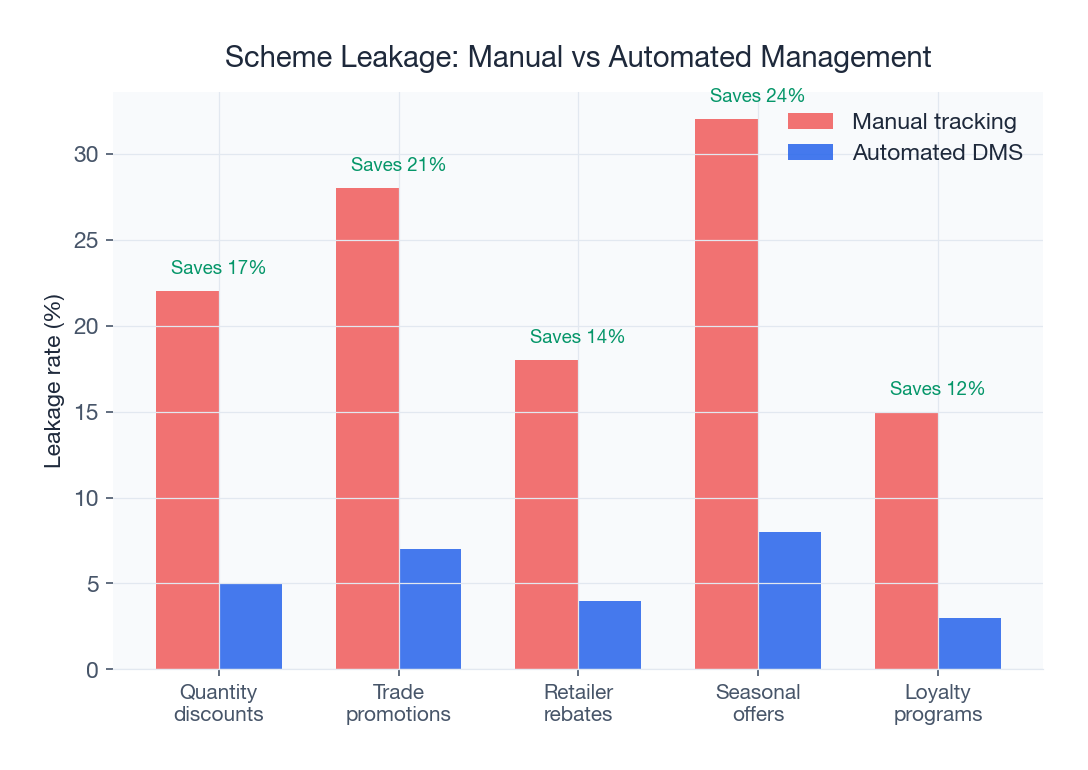
Incentives increase with order volume, buy 100 cases, get 5% off; buy 200, get 8%. These schemes drive volume but require accurate calculation at order time to ensure correct application. The risk with slab schemes is channel loading, where distributors over-order to hit a slab and then struggle to sell through before expiry.
Buy-X-Get-Y (Bulk Pack) Schemes
Free goods incentives, buy 10 cases, get 1 free. Extremely popular in Indian FMCG distribution but complex to manage across product combinations and distributor tiers. The free units also create accounting and GST complexity that paper-based systems handle poorly and that trip up most manual reconciliation processes.
Seasonal and Time-Bound Schemes
Festival-specific, seasonal, or product-launch promotions with defined start and end dates. Managing scheme activation and deactivation manually across a large distributor network is error-prone, and missing a deactivation by a few days can bleed lakhs of rupees in unauthorized discounts.
Performance-Based Rebates
Quarterly or annual rebates tied to achievement of growth targets, new outlet activation, or category expansion. These are the highest-leverage schemes but also the most complex to administer without automation, because they require continuous tracking of the underlying performance metrics.
Scheme Economics at a Glance
| Scheme Type | Typical Spend % | Volume Lift | Manual Admin Risk | Automation Priority |
|---|---|---|---|---|
| Flat discount | 2-4% | Low-medium | Low | Medium |
| Quantity slab | 3-6% | Medium-high | High | High |
| Buy X get Y | 4-8% | High | Very high | Critical |
| Seasonal | 5-12% | Very high | Very high | Critical |
| Performance rebate | 1-3% | Medium (sustained) | Medium | High |
How Automated Scheme Management Works
SpireStock's scheme engine automates the entire lifecycle of trade schemes:
- Configuration, define scheme rules with product applicability, distributor eligibility, quantity thresholds, time periods, and stacking rules
- Automatic application, when an order is placed through the order management system, applicable schemes are evaluated and applied in real time
- Transparent visibility, distributors see exactly which schemes are being applied and the resulting benefit before confirming their order
- Accurate billing, scheme deductions flow into invoicing with correct GST treatment
- ROI tracking, analytics show the volume impact and cost of each scheme, enabling data-driven decisions
- Approval workflows, higher-value schemes route through approval chains so finance and marketing see what sales is committing to
Benefits of Automated Scheme Management
- 100% application accuracy, no more over-billing or under-billing due to calculation errors
- Instant scheme deployment, launch new schemes across your network in minutes, not days
- Zero distributor disputes, transparent, system-applied schemes eliminate disagreements
- Measurable ROI per scheme, know exactly which schemes drive incremental volume vs. pantry loading
- Reduced scheme abuse, system controls prevent unauthorized discounting or scheme manipulation
- Scheme stacking clarity, system handles complex stacking rules (e.g. flat discount plus buy-X-get-Y) without human confusion
- Faster month-end close, scheme-related claim reconciliation drops from days to hours
A Britannia regional distributor in Pune reported saving Rs 48 lakh in its first year of scheme automation, not from new revenue but purely from eliminating duplicate and miscalculated claims. That is money that went straight to the bottom line without a single extra order being placed.
Scheme Strategy Best Practices
Target Specific Behaviors
Design schemes to drive specific outcomes, new product trial, volume growth in weak territories, wider retail distribution, or better payment compliance. Blanket discounts that do not target specific behaviors waste budget and train your distributors to wait for the next scheme before placing orders, eroding your price anchor over time.
Set Clear Objectives and Measure Results
Every scheme should have a defined objective, target metric, budget, and timeline. After the scheme period, analyze actual results against objectives to determine whether to repeat, modify, or retire the scheme. Schemes that cannot prove incremental ROI should be killed, regardless of how much internal politics favours them.
Avoid Scheme Fatigue
Running too many concurrent schemes confuses distributors and dilutes impact. Limit active schemes to 3-5 per product category and ensure each one is well-communicated and understood. More is not better; focus drives results.
Guard Against Channel Loading
Aggressive quantity-based schemes can cause distributors to overstock, followed by a sales trough when the scheme ends. Monitor sell-through rates during and after schemes to detect loading behavior, and cap scheme benefits at sustainable volume levels. A dashboard that shows volume pre-scheme, during-scheme, and post-scheme is the fastest way to spot unsustainable spikes.
Tie Schemes to Scheme Management Governance
Treat scheme approval like budget approval: require sign-off from sales, finance, and marketing before any scheme goes live, and review every active scheme monthly against its ROI target. Our scheme management solution automates this governance layer so the process does not collapse under busy-month pressure.
Scheme Management for Dairy Distribution
Dairy distribution has unique scheme requirements. Products are perishable, so schemes must drive sell-through, not loading. Daily ordering cycles mean schemes need to be applied daily, not monthly. Multiple product categories (milk, curd, buttermilk, ghee, ice cream) may have different scheme structures running simultaneously. Amul and Mother Dairy manage hundreds of concurrent scheme combinations through highly automated systems precisely because manual management at their scale is impossible.
For regional players running smaller networks in cities like Jaipur or Lucknow, the benefit is arguably even greater because the percentage of scheme spend relative to margin is higher. A Rs 80-crore regional dairy running 20+ concurrent schemes across 120 distributors simply cannot manage them accurately without automation, no matter how diligent the accounts team is.
Integration with Wider Distribution Operations
Scheme management does not exist in isolation. It must integrate with order management, billing, credit control, and analytics. When a distributor places an order, the scheme engine should apply applicable discounts, the billing system should reflect them correctly with proper GST treatment, the credit system should update outstanding balances, and the analytics dashboard should log the incremental volume for later ROI measurement. Any missing link in this chain creates reconciliation pain downstream.
This is why standalone scheme tools rarely work well. The scheme engine needs to live inside the same platform that handles orders, invoices, and payments. Attempts to bolt scheme management onto accounting-first tools like Tally consistently fail because the daily transaction volume and rule complexity overwhelm systems that were not designed for real-time scheme evaluation. Read more on integrated distribution in our full scheme management guide and our FMCG distribution challenges analysis.
Measuring Scheme ROI Properly
The single biggest mistake in scheme management is failing to measure incremental lift. Companies know how much they spent on a scheme but have no idea whether the resulting volume would have happened anyway. Proper ROI measurement requires tracking three things: pre-scheme baseline volume for the same product-territory combination, during-scheme actual volume, and post-scheme trailing volume to see how much of the lift was genuine incremental demand versus pantry loading. Schemes with strong incremental lift but poor post-scheme retention are worse than schemes with modest lift that sustains.
Start Turning Scheme Spend Into Measurable Returns
For companies in dairy distribution and FMCG distribution sectors, an automated scheme engine is not just a nice-to-have, it is the only way to manage the complexity of modern trade incentive programs at scale. Talk to our team about a scheme audit that can quantify exactly how much you are losing to manual mismanagement, review SpireStock pricing for transparent plans, or book a demo to see the scheme engine in action against your current scheme structures. The audit alone is typically eye-opening and will inform your budget conversations for the next fiscal year.
Scheme Communication and Distributor Education
A well-designed scheme is only as effective as your distributors' understanding of it. Even with automation, you need clear communication: scheme announcements via WhatsApp or in-app notifications, training sessions for new scheme structures, visual one-pagers summarizing key terms, and a scheme FAQ that sales reps can reference in the field. Brands that invest in education typically see 25-35% higher scheme participation rates than brands that just announce and hope for the best.
The best communication practice is to show the expected benefit in rupee terms at the distributor's typical order size. A scheme that promises "5% off on 200+ cases" means very different things to a Tier 1 distributor doing 500 cases a day versus a Tier 3 distributor doing 40. Personalized projections at onboarding drive much stronger engagement than generic messaging.
Audit and Fraud Prevention
Manual scheme management is a common vector for fraud, collusion between sales reps and distributors, ghost scheme claims, backdated applications, and other creative workarounds. Automation eliminates most of these risks because the system applies scheme rules deterministically and logs every decision with a timestamp and user ID. For internal audit teams, this transformation is often the single biggest reason to advocate for scheme automation, independent of the productivity or accuracy benefits. Operators in Delhi and Ahmedabad have both reported eliminating specific fraud patterns entirely within weeks of deploying a scheme engine.
Seasonal Scheme Planning
Indian dairy has strong seasonality: higher demand during festivals, summer peaks for ice cream and cold beverages, and winter peaks for certain curd and ghee categories. Your scheme calendar should anticipate these peaks six to eight weeks in advance, with schemes designed to pull distributor orders forward during the build-up and schemes designed to push sell-through during the peak itself. A flat scheme strategy that ignores seasonality leaves significant volume on the table and gives competitors an opening to steal market share during the moments that matter most.
Plan your full scheme calendar at the start of each financial year with the full marketing, sales, and finance teams in the room. Review it monthly and adjust based on performance data. This annual planning rhythm is how large bakery brands and mature dairy companies drive predictable, profitable growth.
The Three Questions Every Scheme Must Answer
Before approving any new scheme, require the sponsor to answer three questions in writing. First: what specific behaviour are we trying to drive? Second: what is the target metric and how will we measure it? Third: what is the expected incremental ROI versus the scheme cost? If the sponsor cannot answer all three clearly, the scheme is not ready to go live. Enforcing this simple discipline kills 30-40% of proposed schemes and saves lakhs of rupees in wasted budget every year.
For the complete picture, see our scheme management guide.
Sources & References
Frequently Asked Questions
Scheme management refers to the creation, deployment, application, and analysis of trade incentive programs offered to distributors and retailers, including flat discounts, quantity-based slabs, buy-X-get-Y offers, seasonal promotions, and performance-based rebates.
Manual scheme management leads to calculation errors (over-billing or under-billing), delayed deployment across the network, inability to handle complex scheme combinations, frequent distributor disputes, and zero visibility into scheme ROI. These issues are amplified in dairy's daily order cycle.
SpireStock's scheme engine can handle unlimited concurrent schemes with complex rules, including product-specific applicability, distributor-tier-based eligibility, quantity thresholds, time windows, and scheme stacking/exclusion rules.
Yes, schemes can be targeted based on distributor tier, territory, volume history, or any custom attribute. A premium distributor may get a different incentive structure than a new or smaller distributor.
Different scheme types have different GST treatments. Trade discounts reduce the taxable value, while post-sale incentives may be treated as separate transactions. SpireStock's scheme engine ensures correct GST treatment for each scheme type, automatically reflected in invoices.
Yes, the distributor app shows all currently active schemes, their terms, and the benefit the distributor will receive for their current order. This transparency builds trust and motivates distributors to take advantage of available incentives.
The analytics dashboard tracks incremental volume generated during the scheme period vs. pre-scheme baseline, cost of the scheme (total discount/free goods value), and net profit impact. Compare this across schemes to identify your highest-ROI incentive structures.
Yes, once configured in the system, a scheme becomes active immediately for all eligible distributors at the next order cycle. No phone calls, no circulars, no training needed, the system applies it automatically during order processing.
Related SpireStock Features
Flexible incentive schemes, flat, bulk-pack, and quantitative, applied automatically.
Powerful dashboards with sales trends, MIS reports, and distribution analytics.
End-to-end order lifecycle from placement to delivery with multi-level approval workflows.
Related Industries
Streamline FMCG distribution with order management, beat planning, retailer tracking, and GST billing. Built for Indian FMCG supply chains.
End-to-end dairy distribution software for milk, curd, paneer, and ghee brands. Manage orders, crates, cold chain, and GST billing in one platform.
Related Solutions
Automate trade schemes, incentives, and promotional offers. Flat, bulk-pack, quantitative, and FOC schemes with ROI tracking. Try SpireStock.
Manage your entire distributor network digitally. Onboarding, credit limits, outstanding tracking, and performance analytics. Start free trial.
Related Entities
Ready to Streamline Your Distribution?
Start your free 14-day trial and see how SpireStock can transform your dairy, FMCG or consumer-goods distribution operation, from order capture to crate recovery.

SpireStock Team
Product & Industry Insights
SpireStock Team leads product at SpireStock, where the team ships distribution management software for India's dairy, FMCG and consumer-goods brands.