Why Expiry Wastage Is the #1 Cost Leak in Dairy Distribution
Indian dairy distributors lose 2-8% of revenue to expired or near-expired products every year, according to the Indian Dairy Association. For a distributor doing Rs 1 crore monthly turnover, that translates to Rs 2-8 lakh per month vanishing into the waste bin. Unlike non-perishable FMCG products where shelf life is measured in months or years, dairy products operate on razor-thin expiry windows: fresh milk lasts 2-5 days, curd and buttermilk 7-15 days, paneer 10-20 days, and cheese 3-6 months.
The challenge is compounded by India's ambient temperatures, which routinely exceed 35 degrees Celsius across most of the country for 6-8 months a year. A temperature breach during transit or storage can halve the remaining shelf life of dairy products. Distributors in cities like Pune, Ahmedabad, and Hyderabad face particularly acute challenges during summer months when even a 30-minute delay in cold chain can render an entire batch unsaleable.
The National Dairy Development Board (NDDB) estimates that India wastes approximately 3-4% of its total dairy output due to distribution inefficiencies, amounting to over Rs 8,000 crore annually across the value chain. For individual distributors, this wastage often represents the difference between profitability and loss. If you are a dairy distributor losing money to expiry wastage, contact SpireStock to learn how our distributor management solution can cut your wastage by 60-80%.
Understanding Dairy Product Shelf Life in Indian Conditions
Effective expiry management starts with understanding the shelf-life characteristics of different dairy products under Indian storage conditions. This knowledge is essential for configuring alert thresholds and dispatch priorities in your distribution software.
| Product Category | Shelf Life (Refrigerated) | Shelf Life (Ambient) | Alert Trigger Point |
|---|---|---|---|
| Fresh milk (pouch) | 2-5 days | 4-6 hours | 50% life remaining |
| Curd/Dahi | 7-15 days | 12-24 hours | 40% life remaining |
| Buttermilk/Chaas | 7-12 days | 8-12 hours | 40% life remaining |
| Paneer | 10-20 days | 4-8 hours | 35% life remaining |
| Flavoured milk | 15-30 days | 2-4 hours | 30% life remaining |
| UHT milk (tetra) | 90-180 days | 90-180 days | 25% life remaining |
| Butter | 60-90 days | 3-7 days | 25% life remaining |
| Cheese (processed) | 90-180 days | 7-14 days | 25% life remaining |
| Ice cream | 180-365 days (frozen) | 30-60 minutes | 30% life remaining |
These shelf-life windows vary significantly based on packaging quality, cold chain integrity during transport, and ambient conditions at the distributor's godown. Distributors handling products from multiple dairy brands must configure product-specific FEFO parameters rather than applying a blanket approach. Learn about broader dairy distribution challenges on our industry page.
FEFO vs FIFO: Why Dairy Needs First-Expiry-First-Out
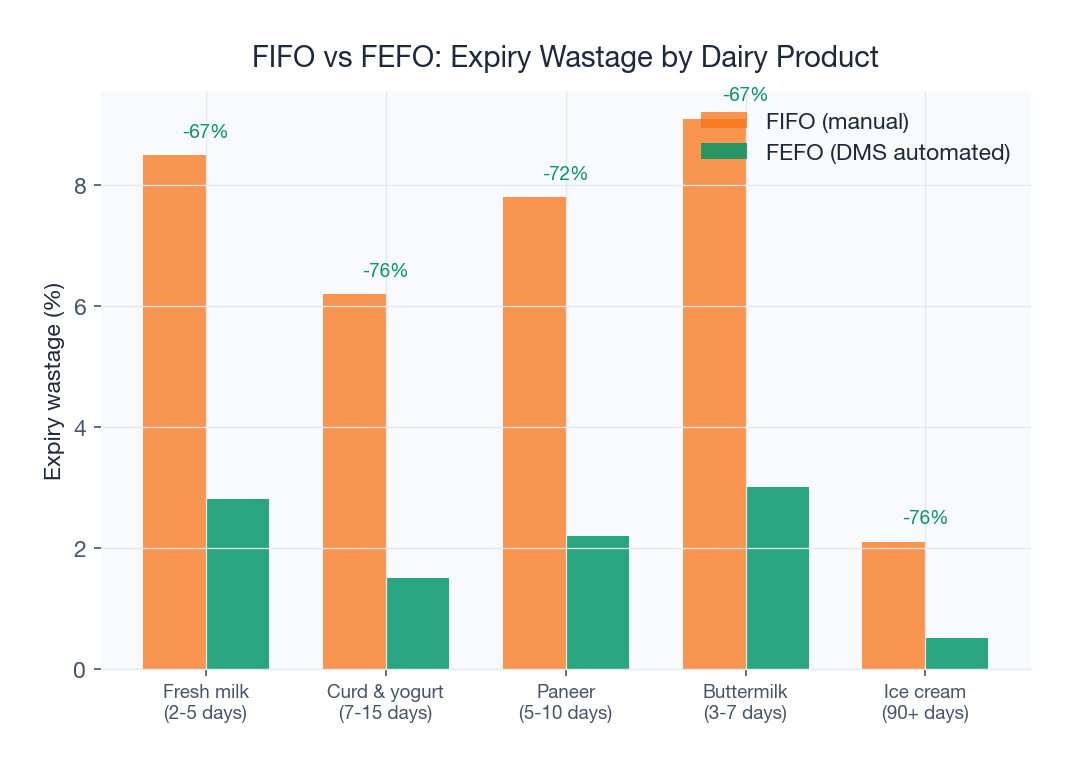
Most inventory management systems use FIFO (First In, First Out) logic, which dispatches the oldest stock first by receipt date. For dairy products, this is insufficient. You need FEFO (First Expiry, First Out), which dispatches based on expiry date regardless of when stock was received.
| Parameter | FIFO | FEFO |
|---|---|---|
| Dispatch priority | Oldest received stock first | Earliest expiry date first |
| Suitability for dairy | Inadequate | Optimal |
| Handling mixed batches | Receipt date only | Expiry date per batch |
| Wastage prevention | Moderate | High |
| FSSAI compliance | Partial | Full |
| Complexity | Simple | Requires batch tracking |
Consider this scenario: On Monday, a distributor receives Batch A of curd with a 10-day shelf life (expiry: next Thursday). On Tuesday, they receive Batch B from a different production run with a 12-day shelf life (expiry: following Saturday). Under FIFO, Batch A goes out first because it arrived first, which happens to be correct. But if Batch B had a shorter shelf life due to a different production process, FIFO would send the wrong batch first. FEFO always sends the earliest-expiring batch, regardless of receipt sequence.
This distinction becomes critical when distributors receive stock from multiple plants or multiple brands. A dairy distributor in Chennai handling products from 3 different dairy plants may receive batches with varying shelf lives for the same product category. Only FEFO logic guarantees that the batch closest to expiry always moves first.
Batch Tracking: The Foundation of Expiry Management
FEFO logic requires every unit of inventory to be tagged with a batch number and expiry date at the point of receipt. This is the foundation upon which all expiry management is built. Without batch-level tracking, you cannot implement FEFO, generate near-expiry alerts, or create an audit trail for FSSAI compliance.
The order management module in a modern DMS captures batch information at goods receipt: batch number, manufacturing date, expiry date, and quantity. Every subsequent transaction, whether it is a sale, transfer, return, or write-off, references the specific batch. This creates complete lot traceability from receipt to final disposition.
For dairy distributors who also handle non-dairy FMCG products, the same batch tracking infrastructure serves both categories, just with different shelf-life parameters. A batch of biscuits with a 9-month shelf life and a batch of curd with a 10-day shelf life are both tracked at the batch level, but with very different alert thresholds and dispatch priorities. Our guide on batch tracking and traceability covers the implementation details.
Automated Near-Expiry Alerts
The most effective way to prevent expiry wastage is to take action before products expire, not after. Automated alert systems categorize inventory into zones based on remaining shelf life:
- Green Zone (75-100% shelf life remaining): Normal distribution. No action needed.
- Yellow Zone (50-75% remaining): Priority dispatch. System prioritizes these batches for next-day delivery.
- Orange Zone (25-50% remaining): Urgent action. Push offers to retailers, consider markdowns, alert sales team.
- Red Zone (less than 25% remaining): Critical. Initiate return-to-manufacturer process or markdown authorization.
For a distributor handling dairy products, a curd batch with 3 days remaining out of a 10-day shelf life enters the Orange Zone. The system automatically alerts the dispatch team to prioritize this batch, suggests nearby retailers with high curd offtake, and if necessary, generates a return request.
The alert system integrates with multiple channels: dashboard notifications for godown managers, push notifications on the mobile app for delivery staff, SMS alerts for the distributor owner, and automated emails to the brand's supply chain team when returns become likely. This multi-channel approach ensures no near-expiry batch goes unnoticed, even during weekends and holidays when manual inspection might be skipped.
Near-Expiry Liquidation Strategies
When products enter the Orange or Red Zone, distributors need a systematic approach to liquidate stock before it expires. The most effective strategies, ranked by revenue recovery potential, include:
- Priority dispatch to high-velocity retailers: The sales analytics module identifies retailers with the highest offtake for the specific product. Routing near-expiry stock to these retailers ensures faster sell-through. A retailer who sells 50 packets of curd daily can absorb near-expiry stock that would languish at a retailer selling 5 packets daily.
- Push offers and temporary discounts: The scheme engine can create time-bound push discounts specifically for near-expiry batches. A "buy 10 get 2 free" offer on curd expiring in 4 days moves stock faster than regular pricing.
- Institutional and bulk channels: Hotels, restaurants, canteens, and catering services often accept near-expiry dairy products at a discount since they use them immediately. Maintaining a list of institutional buyers in the DMS enables quick liquidation.
- Brand-authorized markdowns: Some dairy brands authorize distributors to apply markdowns on near-expiry stock and claim the discount back. Digital claims management ensures these markdowns are documented and reimbursed promptly. See our claims settlement guide for the full workflow.
- Charitable donation with documentation: Dairy products close to expiry but still safe for consumption can be donated to food banks and charitable organizations, with proper documentation for CSR and tax benefits.
Cold Chain Integration and Temperature Monitoring
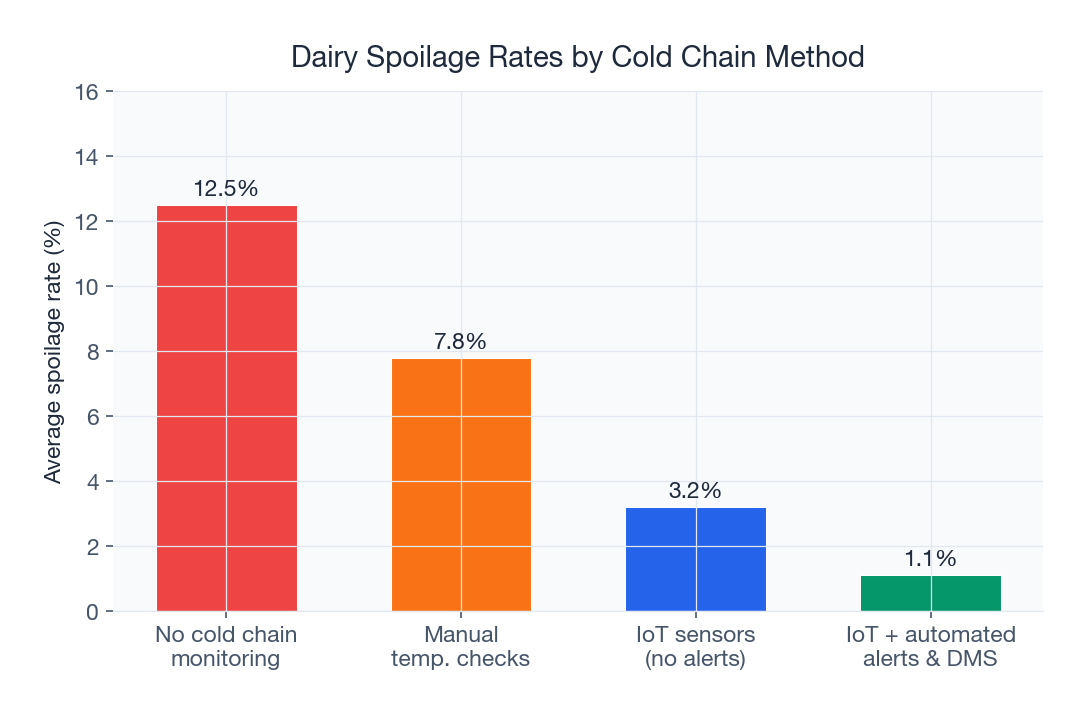
Expiry management for dairy is inseparable from cold chain management. A product's printed expiry date assumes proper cold chain maintenance at 2-8 degrees Celsius. When the cold chain breaks, whether during transit from the plant, at the distributor's godown, or during last-mile delivery, the effective shelf life drops dramatically.
Modern distribution software integrates with IoT temperature sensors to monitor cold chain conditions at the godown and in delivery vehicles. When a temperature excursion is detected (above 8 degrees Celsius for more than 30 minutes), the system can automatically reduce the effective expiry date for affected batches. A batch of curd with a printed expiry of 10 days that experienced a 2-hour temperature breach might have its effective expiry reduced to 6 days.
For distributors operating in cities like Delhi where summer temperatures exceed 45 degrees Celsius, and Kolkata where humidity accelerates spoilage, cold chain monitoring is not optional. Integrating temperature data with the distribution tracking module creates a complete picture of product condition from receipt to delivery.
Return and Credit Note Workflow
Despite best efforts, some products will reach or approach expiry before being sold. A digital return workflow handles this cleanly:
- Near-expiry identification: System flags batches entering Red Zone
- Return authorization: Distributor raises return request digitally with batch details, quantity, and reason
- Brand approval: Manufacturer or C&F agent approves/rejects with comments
- Physical return: Products picked up during next delivery/collection run
- Credit note: Automated credit note generated with proper GST adjustment
- Inventory adjustment: Returned stock removed from distributor's inventory and marked for destruction or reclamation at the plant level
Without digital workflows, return disputes between distributors and brands can drag on for weeks or months, with the distributor bearing the financial burden of expired stock sitting in the godown. Read our payment collection guide to understand how returns affect the overall settlement cycle.
FSSAI Traceability Requirements
The Food Safety and Standards Authority of India (FSSAI) mandates that dairy distributors maintain complete traceability records. This means being able to trace any product one step back (to the supplier) and one step forward (to the retailer). In case of a product recall, distributors must identify every retailer who received a specific batch within hours, not days.
Batch-level expiry tracking automatically satisfies this FSSAI requirement. The system can generate a complete batch history report showing exactly which retailers received which batches, when, and in what quantities. During an FSSAI inspection, producing this report digitally in under 2 minutes, compared to 4-8 hours of sifting through paper records, demonstrates compliance maturity that inspectors take note of. For comprehensive FSSAI compliance guidance, see our FSSAI compliance guide for dairy distributors.
FSSAI's Food Safety and Standards (Licensing and Registration of Food Businesses) Regulations also require that distributors maintain records of product temperature during storage and transit. When these records are digital and linked to batch numbers, they create a compliance package that satisfies both regular inspections and incident-based audits triggered by consumer complaints or product recalls.
Before and After: Implementing Expiry Management
| Metric | Before (Manual) | After (Digital) | Improvement |
|---|---|---|---|
| Monthly expiry wastage | Rs 3-8 lakh | Rs 0.5-1.5 lakh | 60-80% reduction |
| Batch traceability time | 4-8 hours manual search | Under 2 minutes | 99% faster |
| Near-expiry identification | Physical inspection daily | Automated real-time | Continuous monitoring |
| Return processing time | 15-30 days | 3-5 days | 80% faster |
| FSSAI audit readiness | Days of preparation | Instant report generation | Always audit-ready |
| Scheme application on near-expiry | Manual markdown | Auto-suggested push offers | Revenue recovery |
| Spoilage due to cold chain breaks | Undetected for hours | Real-time temperature alerts | Proactive intervention |
Case Study: Gujarat Dairy Distributor
A dairy distributor in Ahmedabad handling products from three major dairy brands was losing Rs 18 lakh per quarter to expiry wastage. The root causes were identified as: no batch-level tracking (stock dispatched randomly), no visibility into approaching expiry dates until physical inspection, and a manual return process that took 28 days on average, by which time products had already expired.
After implementing SpireStock's batch tracking and FEFO system:
- Quarterly wastage dropped from Rs 18 lakh to Rs 4.2 lakh (77% reduction)
- Batch traceability: Any batch traceable in under 90 seconds across the entire distribution chain
- Return settlements: Average settlement time reduced from 28 days to 6 days
- Payback period: Under 4 months (software cost recovered through wastage reduction alone)
- FSSAI inspection: Passed with zero non-conformances after implementation
- Near-expiry revenue recovery: Rs 2.8 lakh per quarter recovered through push offers on Yellow/Orange zone stock that would previously have expired
Demand Forecasting to Prevent Overstocking
While FEFO, alerts, and returns handle expiry after stock arrives, the most effective long-term strategy is preventing overstocking in the first place. Most expiry wastage results not from distribution inefficiency but from ordering more stock than the market can absorb within the shelf-life window.
A data-driven approach to demand forecasting for dairy products considers: historical sales velocity per product per outlet, day-of-week patterns (curd sells 40% more on weekends in many markets), seasonal demand shifts (lassi and buttermilk spike in summer, paneer peaks during winter and festive periods), and local events or festivals that affect consumption. The sales analytics module uses this data to generate recommended order quantities per product per route, preventing the two most common ordering errors: over-ordering popular products "just in case" and under-ordering secondary products that then need emergency replenishment.
For dairy distributors operating in multiple territories, demand patterns vary significantly by locality. A distributor covering both Mumbai suburbs and satellite towns might see 3x higher flavoured milk demand in urban routes versus rural routes, while basic curd demand is more uniform. Our guide on demand forecasting for dairy distribution covers these patterns in detail.
Spoilage Reduction Through Godown Management
Even with perfect FEFO logic in software, physical godown management determines whether batch-priority dispatch actually happens. Common godown-level failures that cause expiry wastage include: new stock placed in front of older stock (making it physically easier to pick the newer batch), batch labels obscured by stacking, and cold storage zones operating at incorrect temperatures due to overloading or equipment malfunction.
Best practices for godown management in dairy distribution include dedicated receiving and dispatch zones to prevent cross-contamination of workflows, batch-labeled shelf positions with clear visual indicators for expiry zones (green/yellow/orange/red stickers), daily opening stock audits that verify physical stock matches the DMS batch records, and temperature logging at 4-hour intervals with escalation protocols for excursions. For distributors managing inventory across multiple locations, our multi-godown stock management guide provides location-specific strategies.
Implementation Roadmap
Rolling out expiry management follows a phased approach that minimizes disruption to daily operations:
- Phase 1 (Week 1-2): Foundation - Set up batch tracking at goods receipt, configure product shelf-life parameters, define alert thresholds per product category
- Phase 2 (Week 3-4): FEFO Activation - Switch dispatch logic from FIFO to FEFO, train warehouse staff on batch-priority picking, establish godown layout for FEFO compliance
- Phase 3 (Week 4-5): Alert System - Configure zone-based alerts, set up dashboard for daily near-expiry review, train sales team on push offers and liquidation strategies
- Phase 4 (Week 5-6): Return Workflow - Digitize return requests, connect with brand portals for approval, automate credit note generation
- Phase 5 (Week 7-8): Optimization - Fine-tune alert thresholds based on actual wastage data, integrate cold chain monitoring if applicable, establish weekly expiry management review cadence
Connecting Expiry Management to Broader Operations
Expiry management does not work in isolation. It connects to every part of distribution operations: route optimization ensures near-expiry stock reaches high-velocity retailers first; the scheme engine can auto-apply push discounts on near-expiry batches; and mobile app alerts delivery staff about batch priorities during loading.
For distributors managing dairy alongside other perishable categories, the same expiry management framework extends to bakery and confectionery products and fresh produce. The principles are identical; only the shelf-life parameters differ. Explore our complete dairy distribution software guide for the broader technology landscape, and read about reducing distribution costs across all product categories.
Losing lakhs to expiry wastage every month? SpireStock's FEFO-based expiry management system with automated alerts and batch tracking can reduce your wastage by 60-80%. Start your free trial or view pricing to see how much you can save.
Sources & References
- FSSAI, Food Safety and Standards Authority of India
- NDDB, National Dairy Development Board
- Indian Dairy Association, Indian Dairy Association
Frequently Asked Questions
FIFO (First In, First Out) dispatches based on receipt date, while FEFO (First Expiry, First Out) dispatches based on expiry date. For dairy products with short and variable shelf lives, FEFO is essential because different batches received on the same day may have different expiry dates depending on production timing and temperature history.
Indian dairy distributors typically lose 2-8% of revenue to expiry wastage. For a distributor with Rs 1 crore monthly turnover, this means Rs 2-8 lakh per month. The percentage is higher during summer months when shelf life is shortened by heat exposure and during festive periods when demand prediction is harder.
Yes, batch tracking can work with manual batch number entry at goods receipt. However, barcode or QR code scanning makes the process faster and eliminates data entry errors. Most modern dairy packaging already includes batch information in machine-readable formats. Even without scanning, manual batch entry at receipt is a huge improvement over no tracking.
A phased implementation takes 4-6 weeks. Phase 1 (batch tracking setup) takes 2 weeks, Phase 2 (FEFO activation) takes 1-2 weeks, and Phase 3 (alerts and returns) takes 1-2 weeks. Most distributors see measurable wastage reduction within the first month of FEFO implementation.
Yes, FSSAI regulations require food distributors to maintain one-step-forward, one-step-back traceability. This means for any batch, you must be able to identify your supplier and all the retailers you sold it to. Digital batch tracking automatically satisfies this requirement and makes FSSAI audits stress-free.
Based on our case studies, ROI is typically 4-6x in the first year. A distributor spending Rs 18 lakh quarterly on wastage can reduce this to Rs 4-5 lakh, saving Rs 50-55 lakh annually against a software investment of Rs 2-4 lakh per year. Most distributors achieve payback within 3-4 months.
Related SpireStock Features
End-to-end order lifecycle from placement to delivery with multi-level approval workflows.
Powerful dashboards with sales trends, MIS reports, and distribution analytics.
GST-compliant invoicing with HSN codes, gate passes, and financial ledger.
Related Industries
End-to-end dairy distribution software for milk, curd, paneer, and ghee brands. Manage orders, crates, cold chain, and GST billing in one platform.
Distribution management for fruits, vegetables, and perishable goods. Cold chain tracking, wastage reduction, and daily order management. Try free.
Distribution software for bakeries and confectionery brands. Manage short-shelf-life products, daily dispatch, returns, and retailer credit efficiently.
Related Solutions
Manage your entire distributor network digitally. Onboarding, credit limits, outstanding tracking, and performance analytics. Start free trial.
Track distributor and retailer payments. Cash, UPI, cheque collection with reconciliation, ageing reports, and credit limit management.
Related Entities
Ready to Streamline Your Distribution?
Start your free 14-day trial and see how SpireStock can transform your dairy, FMCG or consumer-goods distribution operation, from order capture to crate recovery.

SpireStock Team
Distribution Technology Experts
SpireStock Team writes for SpireStock on distribution management, supply-chain optimisation and field operations for Indian dairy and FMCG brands.