Why Return Management Is a Critical Pain Point for Indian FMCG Distributors
In India's Rs 14 lakh crore FMCG market, product returns are an unavoidable reality. Damaged goods, expired stock, quality complaints, and retailer rejections collectively cost the distribution ecosystem an estimated Rs 8,000-12,000 crore every year. For an average FMCG distributor handling Rs 2-5 crore in monthly sales, return rates of 3-8% translate directly into margin erosion, working capital blockage, and strained relationships with both brands and retailers.
Yet most distributors in cities like Mumbai, Delhi, and Ahmedabad still manage returns through handwritten registers, loose challans, and verbal agreements. This manual approach leads to disputes, delayed credit notes, incorrect GST adjustments, and zero visibility into return patterns. Whether you handle FMCG distribution or dairy products, a structured return management process is essential for protecting your margins and maintaining healthy channel relationships.
Types of Returns in FMCG Distribution
Not all returns are created equal. Understanding the classification of returns is the first step toward managing them effectively. Indian FMCG distributors typically encounter five distinct categories, each requiring different handling procedures, documentation, and financial treatment:
1. Expiry Returns
Products that have crossed their best-before or use-by date are the most common type of return in perishable categories. Dairy products, bakery items, and fresh juices are particularly vulnerable. A typical dairy distributor in Pune may see 4-6% of stock returned due to expiry, especially during summer months when shelf life shortens and consumer purchase patterns shift. Proactive expiry management — including FEFO enforcement and near-expiry alerts — is the most effective way to reduce this category of returns before they occur.
2. Transit Damage Returns
Products damaged during loading, transport, or unloading account for 1-3% of total dispatches. Broken bottles, crushed packaging, leaking pouches, and dented cans are common examples. Poor vehicle conditions, improper stacking, and rough road conditions in tier-2 and tier-3 cities exacerbate this problem. Distributors operating in cities like Lucknow or Surat with mixed road quality often report higher transit damage rates than those in cities with better infrastructure.
Transit damage is the most preventable category of returns. Proper vehicle maintenance, stacking guidelines, cushioning materials, and driver training can cut transit damage by 50-70%. The key is making damage accountability data-driven: which vehicle, which route, which loading team, and which time of day see the most damage incidents.
3. Quality Complaint Returns
Retailer or consumer complaints about taste, texture, colour, or odour trigger quality-related returns. These are particularly sensitive in dairy and beverage distribution where cold chain integrity directly affects product quality. Quality returns require careful documentation — including photographs, batch numbers, and temperature logs — and often involve brand-level investigation before credit can be issued. A quality complaint return is not just a financial event; it is a signal that something in the supply chain may be compromised.
4. Recall Returns
When a brand issues a product recall due to contamination, labelling errors, or regulatory non-compliance, distributors must rapidly pull affected batches from the market. Recall returns require batch-level traceability — knowing exactly which retailers received which batches and recovering them systematically. FSSAI compliance mandates that food businesses maintain such traceability records. Our guide on batch tracking and traceability covers the systems required to execute recalls efficiently.
5. Commercial Returns (Unsold/Slow-Moving Stock)
Retailers returning unsold stock — either due to overestimated demand, scheme-related overstocking, or seasonal demand shifts — is a persistent challenge. This is especially common after festive season pushes or when trade schemes incentivize bulk buying that exceeds actual sell-through capacity. Unlike other return categories, commercial returns are often negotiable and subject to the distributor's return policy rather than automatic acceptance.
Return Rate Benchmarks by FMCG Category
| Category | Average Return Rate | Best-in-Class Rate | Primary Return Type | Financial Impact (Rs Cr Monthly Sales) |
|---|---|---|---|---|
| Dairy (milk, curd) | 4-7% | 1.5-2.5% | Expiry, quality | Rs 4-7 lakh/month losses |
| Bakery & confectionery | 3-6% | 1-2% | Expiry, transit damage | Rs 3-6 lakh/month losses |
| Beverages | 2-4% | 0.8-1.5% | Transit damage, commercial | Rs 2-4 lakh/month losses |
| Packaged foods | 1.5-3% | 0.5-1% | Expiry, commercial | Rs 1.5-3 lakh/month losses |
| Personal care | 1-2% | 0.3-0.8% | Commercial, damage | Rs 1-2 lakh/month losses |
| Home care | 0.5-1.5% | 0.2-0.5% | Transit damage | Rs 50K-1.5 lakh/month losses |
If your return rates exceed these benchmarks, there is significant room for improvement. Distributors handling bakery and confectionery products or fresh produce face the steepest challenge due to shorter shelf lives. Even a 1-percentage-point reduction in return rate for a distributor doing Rs 3 crore monthly translates to Rs 3 lakh per month — Rs 36 lakh annually — flowing directly to the bottom line.
The Credit Note Workflow: Getting It Right
Every return ultimately results in a financial adjustment, typically through a credit note. In Indian FMCG distribution, the credit note workflow is where most problems occur. Manual processes lead to delayed credits, incorrect amounts, disputed deductions, and GST complications that cascade into month-end reconciliation chaos.
A well-designed credit note workflow follows these steps:
- Return request initiation — Retailer or salesman raises a return request via the mobile app with reason code, quantity, batch number, and photographic evidence of the issue
- Verification and approval — Distributor or area manager verifies the return against delivery records and approves or rejects. The system cross-references the claimed batch with actual dispatch data to prevent fraudulent claims.
- Physical goods receipt — Returned goods are received at the godown with condition assessment, batch number verification, and quantity confirmation. The warehouse team records whether goods are resaleable, salvageable, or destined for destruction.
- Credit note generation — System auto-generates a GST-compliant credit note with correct HSN codes, tax rates, and reference to the original invoice. No manual calculation required.
- Brand claim filing — For returns covered by the brand's return policy, the distributor files a claim with the principal company, attaching supporting documentation including photos, batch details, and quantity records
- Settlement — Credit is adjusted against the retailer's outstanding balance or next invoice, and the brand claim amount is tracked until settlement
With SpireStock's invoicing and billing module, credit notes are generated automatically with the correct GST adjustments, linked to the original invoice, and reflected in real-time in the retailer's account ledger. This eliminates the 7-15 day delay that manual credit note processing typically involves.
GST Implications of Returns for FMCG Distributors
The Goods and Services Tax framework in India has specific provisions for handling returns that every distributor must understand. Getting GST wrong on returns can lead to notices, penalties, and input tax credit mismatches that trigger departmental scrutiny.
Credit Notes Under GST (Section 34)
When goods are returned, the supplier (distributor) must issue a credit note under Section 34 of the CGST Act. This credit note reduces the original tax liability. Key requirements include:
- Credit note must reference the original invoice number and date
- HSN codes and tax rates must match the original supply
- Credit notes must be declared in the GSTR-1 return for the month of issuance
- The value of credit notes cannot exceed the value of the original supply
- Time limit: credit notes must be issued before the earlier of September 30 of the following financial year or the date of filing the annual return
- Each credit note must carry a unique sequential number for audit trail purposes
Failing to issue credit notes within the prescribed time limit means the distributor absorbs the full tax cost of the returned goods — a costly oversight that manual systems frequently allow. Automated billing software enforces these deadlines through alerts and escalations.
Impact on Input Tax Credit
When a distributor receives returned goods, the corresponding ITC that was claimed on the outward supply must be reversed proportionally. For example, if a distributor in Chennai sells Rs 1,00,000 worth of FMCG products at 18% GST (Rs 18,000 tax) and receives Rs 10,000 worth of returns, the credit note must show Rs 1,800 as tax adjustment. The distributor's GSTR-3B must reflect this reversal. The buyer (retailer) correspondingly reduces their ITC claim by the credit note amount.
This ITC reversal requirement makes accurate, timely credit note generation critical. Delayed credit notes create mismatches between the distributor's GSTR-1 and the retailer's GSTR-2A, triggering reconciliation issues during GST audits. For a detailed walkthrough of GST billing compliance, read our guide on GST billing for dairy distribution.
E-Invoicing for Credit Notes
Since October 2022, businesses with turnover above Rs 10 crore must generate e-invoices for credit notes as well. This means your return management system must integrate with the e-invoicing portal (IRP) to generate IRN numbers for every credit note, not just sales invoices. The distributor billing software handles this automatically, but manual processes often miss this requirement, exposing distributors to compliance risk and potential penalties during GST audits.
The Company Claim Process: Recovering Costs from Brands
For Indian FMCG distributors, a significant portion of returns are covered under the brand principal's return policy. Expiry returns, quality issues, and recalls are typically the brand's financial responsibility — but only if the distributor files claims correctly with complete documentation. This is where most distributors leave money on the table.
The typical company claim process involves:
- Documentation assembly — Photographs of damaged or expired goods, batch numbers, manufacturing and expiry dates, original dispatch records, and the quantity being claimed
- Claim submission — Filing the claim through the brand's portal or via email within the stipulated time window (usually 30-60 days from return receipt)
- Brand verification — The brand's team verifies the claim against their dispatch records, checks whether the batch falls within their return policy, and may request physical inspection for high-value claims
- Approval and settlement — Approved claims are settled via credit note from the brand, stock replacement, or cash settlement, typically within 30-90 days
Without digital tracking, distributors recover only 40-55% of eligible brand claims. The rest are lost to missed filing deadlines, incomplete documentation, or inability to prove that the returned goods originated from that brand's dispatch. With SpireStock's distributor management solution, claim recovery rates jump to 88-95% because every return is documented from initiation with photos, batch numbers, and original dispatch references — all the evidence the brand needs to approve the claim.
Reducing Return Rates: Practical Strategies
While returns cannot be eliminated entirely, Indian FMCG distributors can realistically reduce return rates by 30-40% through systematic improvements:
Implement FEFO/FIFO at Every Level
First Expiry First Out (FEFO) discipline at the godown and during dispatch ensures that products with the earliest expiry dates are shipped first. This alone can reduce expiry returns by 40-50%. Digital distribution tracking makes FEFO compliance verifiable rather than aspirational. The system blocks dispatch of newer batches while older batches remain in stock, removing the human temptation to pick the most accessible pallet rather than the one with the earliest expiry.
Demand Forecasting to Prevent Overstocking
Overstocking at the retailer level is the root cause of most expiry and commercial returns. Accurate demand forecasting ensures that order quantities match actual sell-through rates. For a distributor in Kolkata managing 300 retailers, even a 15% improvement in forecast accuracy reduces returns by Rs 3-5 lakh annually. The order management system can flag orders that exceed a retailer's historical offtake by more than 150%, prompting a verification step before confirmation.
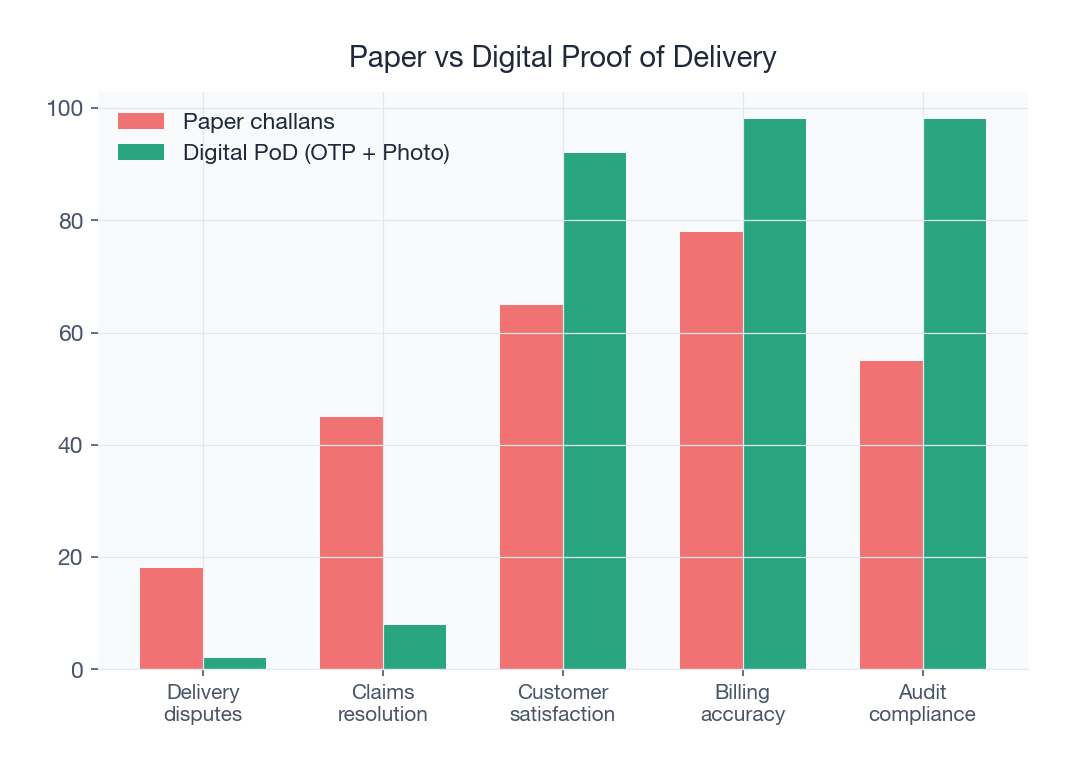
Digital Proof of Delivery
Capturing digital proof of delivery with timestamped photos, GPS coordinates, and receiver signatures creates an irrefutable record of what was delivered in what condition. This eliminates the "it arrived damaged" disputes that account for 20-30% of return claims. The delivery executive photographs the goods at the point of handover, and the retailer confirms receipt on the mobile app. If a damage claim arises later, you have photo evidence of the goods' condition at delivery time.
Scheme Design That Discourages Overstocking
Poorly designed trade schemes encourage retailers to order more than they can sell, inevitably leading to returns. The scheme engine should include guardrails — maximum order quantities relative to historical offtake, graduated incentives that reward sell-through rather than just purchases, and automatic alerts when a retailer's order exceeds 150% of their rolling average. Read more about effective scheme management for FMCG distribution.
Vehicle and Handling Audits
Transit damage is directly linked to vehicle condition and loading practices. Regular vehicle audits, proper stacking training for loading staff, and investment in appropriate vehicle modifications (padding, dividers, refrigeration for cold chain products) can reduce transit damage by 50-70%. Fleet management solutions help track vehicle maintenance schedules and condition reports systematically.
Retailer Education and FIFO Support
Even after you deliver goods in perfect condition with proper FEFO sequence, returns can still happen if the retailer stores products improperly — stacking new stock in front of old stock, storing temperature-sensitive items near heat sources, or failing to check expiry dates during shelf rotation. The best distributors in Bangalore and Hyderabad invest in retailer education: short training sessions on proper storage, FIFO shelf rotation, and storage temperature guidelines. Salesmen conducting regular store visits through the field tracking system can audit retailer storage conditions and provide real-time coaching.
Tracking Returns Digitally: What a Modern System Should Offer
Manual return tracking through registers and loose papers is the single biggest reason for return-related disputes and financial leakage. A digital return management system integrated with your order management and billing modules should provide:
- Return request workflow — Mobile-initiated return requests with reason codes, photos, and batch numbers
- Multi-level approval — Configurable approval chains based on return value and reason (e.g., returns under Rs 5,000 auto-approved, above Rs 5,000 requires manager approval)
- Automatic credit note generation — GST-compliant credit notes linked to original invoices with IRP submission for e-invoicing compliance
- Brand claim management — Track claims filed with brands, approved amounts, settlement status, and ageing of pending claims
- Return analytics — Dashboards showing return rates by product, territory, retailer, reason, and time period
- Batch-level traceability — Track which batches went to which retailers for recall management and return verification
- Crate adjustment on returns — Automatic crate balance adjustment when goods are returned with returnable assets like crates and bottles
- Disposition workflow — Track what happens to returned goods: resale, salvage, brand return, or destruction with proper documentation
Building a Return Prevention Culture
Technology alone cannot solve the return problem. Indian FMCG distributors need to build a culture of return prevention across their teams:
- Salesman accountability — Link return rates to salesman KPIs tracked through field force tracking. When salesmen know that their incentives are affected by return rates in their beats, they become more careful about recommending appropriate order quantities and checking retailer storage conditions during visits.
- Warehouse discipline — Train godown staff on proper stacking, handling, and FEFO compliance. Conduct weekly spot audits and reward teams with the lowest damage rates.
- Root cause analysis — Use sales analytics to identify patterns: Is a particular route consistently showing high damage returns? Is one product SKU always expiring? Is a specific retailer over-ordering every month? Is a particular vehicle or driver associated with higher damage rates?
- Incentivize low returns — Offer small incentives to retailers who maintain return rates below threshold levels. A Rs 500 monthly bonus for retailers with zero returns costs far less than processing and absorbing returns worth Rs 5,000-10,000.
- Monthly return review meetings — Dedicate 30 minutes each month to reviewing return data with the sales team, identifying the top 3 return causes, and assigning corrective actions with deadlines.
The Financial Impact: A Real-World Example
Consider a mid-sized FMCG distributor in Ahmedabad with Rs 3 crore monthly sales, handling dairy, beverages, and packaged snacks across 450 retail outlets. Before implementing digital return management:
| Metric | Before Digital Returns | After SpireStock Implementation |
|---|---|---|
| Average return rate | 5.2% (Rs 15.6 lakh/month) | 3.1% (Rs 9.3 lakh/month) |
| Credit note processing time | 12-18 days | Under 48 hours |
| Disputed returns | 22% of all return claims | Under 3% |
| Brand claim recovery rate | 45% of eligible returns | 92% of eligible returns |
| Annual return-related losses | Rs 42 lakh | Rs 14 lakh |
| Staff time on return processing | 15 hours/week | 3 hours/week |
The annual savings of Rs 28 lakh — against a software cost of Rs 8-10 lakh — represents a payback period of under 4 months. The working capital improvement from faster credit note processing (12 days faster) freed up approximately Rs 18 lakh in cash flow that was previously stuck in return reconciliation limbo.
Frequently Asked Questions
What are the main types of product returns in FMCG distribution?
FMCG distributors in India encounter five main types of returns: expiry returns (products past best-before date), transit damage returns (goods damaged during transport), quality complaint returns (taste, texture, or odour issues), recall returns (brand-initiated product recalls), and commercial returns (unsold or slow-moving stock returned by retailers). Each type requires different handling procedures, documentation, and GST treatment.
How should a distributor handle credit notes for returned goods under GST?
Under Section 34 of the CGST Act, a credit note must be issued referencing the original invoice number, with matching HSN codes and tax rates. The credit note must be declared in GSTR-1 for the month of issuance. Businesses above Rs 10 crore turnover must also generate e-invoices for credit notes through the IRP portal. The credit note must be issued before September 30 of the following financial year.
What is a good return rate benchmark for FMCG distributors in India?
Return rates vary by category. Best-in-class benchmarks are: dairy 1.5-2.5%, bakery 1-2%, beverages 0.8-1.5%, packaged foods 0.5-1%, and personal care 0.3-0.8%. If your rates exceed these, there is significant scope for improvement through digital return tracking, demand forecasting, and FEFO enforcement.
How can FMCG distributors reduce damaged goods returns?
Key strategies include implementing FEFO (First Expiry First Out) discipline, using demand forecasting to prevent overstocking, capturing digital proof of delivery with photos and GPS, designing schemes that discourage over-ordering, conducting regular vehicle audits, training loading staff on proper stacking techniques, and educating retailers on proper storage practices.
What percentage of brand claims do distributors typically recover?
Distributors using manual return tracking recover only 40-55% of eligible brand claims, losing the rest to missed deadlines and incomplete documentation. With digital return management, recovery rates jump to 88-95% because every return is documented with photos, batch numbers, and original dispatch references from the point of initiation.
How does digital return tracking reduce disputes between distributors and retailers?
Digital return tracking captures every return with photographic evidence, timestamps, GPS coordinates, reason codes, and batch numbers at the point of initiation. Multi-level approval workflows ensure verification before credit is issued. This creates an irrefutable audit trail that reduces disputed returns from 20-25% to under 3%, saving both parties significant time and relationship friction.
Take control of your return management. SpireStock's end-to-end return workflow — from mobile-initiated requests to automated credit notes and brand claim tracking — helps FMCG distributors across India cut return-related losses by 40-60%. Book a free demo to see how it works for your operation, or explore our pricing plans to find the right fit.
Sources & References
Frequently Asked Questions
FMCG distributors in India encounter five main types of returns: expiry returns (products past best-before date), transit damage returns (goods damaged during transport), quality complaint returns (taste, texture, or odour issues), recall returns (brand-initiated product recalls), and commercial returns (unsold or slow-moving stock returned by retailers).
Under Section 34 of the CGST Act, a credit note must be issued referencing the original invoice number, with matching HSN codes and tax rates. The credit note must be declared in GSTR-1 for the month of issuance. Businesses above Rs 10 crore turnover must also generate e-invoices for credit notes through the IRP portal.
Return rates vary by category. Best-in-class benchmarks are: dairy 1.5-2.5%, bakery 1-2%, beverages 0.8-1.5%, packaged foods 0.5-1%, and personal care 0.3-0.8%. If your rates exceed these, there is significant scope for improvement through digital return tracking and demand forecasting.
Key strategies include implementing FEFO (First Expiry First Out) discipline, using demand forecasting to prevent overstocking, capturing digital proof of delivery with photos and GPS, designing schemes that discourage over-ordering, conducting regular vehicle audits, and training loading staff on proper stacking techniques.
When expired goods are returned, the distributor issues a credit note under GST Section 34. The tax collected on the original supply is reversed proportionally. The corresponding ITC must also be adjusted. The credit note must be issued before September 30 of the following financial year or the date of filing the annual return, whichever is earlier.
Digital return tracking captures every return with photographic evidence, timestamps, GPS coordinates, reason codes, and batch numbers at the point of initiation. Multi-level approval workflows ensure verification before credit is issued. This creates an irrefutable audit trail that reduces disputed returns from 20-25% to under 3%.
Related SpireStock Features
End-to-end order lifecycle from placement to delivery with multi-level approval workflows.
GST-compliant invoicing with HSN codes, gate passes, and financial ledger.
Real-time GPS tracking of vehicles and drivers with route optimization for faster deliveries.
Related Industries
Streamline FMCG distribution with order management, beat planning, retailer tracking, and GST billing. Built for Indian FMCG supply chains.
End-to-end dairy distribution software for milk, curd, paneer, and ghee brands. Manage orders, crates, cold chain, and GST billing in one platform.
Distribution software for bakeries and confectionery brands. Manage short-shelf-life products, daily dispatch, returns, and retailer credit efficiently.
Related Solutions
Manage your entire distributor network digitally. Onboarding, credit limits, outstanding tracking, and performance analytics. Start free trial.
Track returnable crates, bottles, and kegs across your distribution network. Automated ledger, shortage alerts, and loss prevention. Try free.
Related Entities
Ready to Streamline Your Distribution?
Start your free 14-day trial and see how SpireStock can transform your dairy, FMCG or consumer-goods distribution operation, from order capture to crate recovery.

SpireStock Team
Distribution Technology Experts
SpireStock Team writes for SpireStock on distribution management, supply-chain optimisation and field operations for Indian dairy and FMCG brands.