What Is a Milk Distribution Management System?
A milk distribution management system is an integrated software platform designed to handle the complex logistics of distributing milk and dairy products from processing plants to end consumers through a network of distributors, retailers, and delivery agents. Unlike generic logistics software, it addresses dairy-specific challenges: extreme perishability, daily demand cycles, returnable assets, and temperature-sensitive handling.
In India's dairy landscape, where Mother Dairy, Amul, and hundreds of regional brands operate massive distribution networks, these systems have evolved from nice-to-have tools to operational necessities. If you are evaluating such a system for your operation, start your free 14-day trial and experience the difference firsthand.
Why Milk Distribution Demands Specialized Software
Milk is not like packaged biscuits or shampoo. It spoils within hours at room temperature, must be delivered daily in precise quantities, and circulates through returnable assets that need meticulous tracking. These realities create a set of requirements that no generic logistics or ERP platform can handle natively:
- Daily order cycles, distributors place orders every single day, not weekly or monthly
- Production-linked cutoffs, orders must reach the plant before production scheduling deadlines
- Perishable inventory, every SKU has a shelf life measured in days, not months
- Returnable assets, crates and bottles must be tracked across thousands of touchpoints
- Temperature sensitivity, cold chain breaks can render entire shipments unsaleable
- Complex pricing, GST rates vary from 0% to 18% across dairy product categories
These constraints mean that a milk distribution operation in Delhi handling 500 distributors generates more daily transactions and operational complexity than a packaged goods company ten times its size.
Core Components of a Milk Distribution Management System
Order Lifecycle Management
The heart of any milk distribution system is its order management engine. For dairy, this means handling daily standing orders, variable orders based on demand, production-unit-specific cutoff times, and multi-level approval chains. The system should automate the entire journey from order placement through picking, loading, dispatch, and OTP-verified delivery. Standing orders repeat automatically each day, and distributors only need to modify quantities when their requirements change, saving hours of repetitive order entry.
Route Planning and Delivery Optimization
Milk delivery operates within razor-thin time windows, consumers expect fresh milk by morning, and retailers need stock before their peak hours. A capable route optimization module plans delivery sequences that minimize distance while respecting time constraints, vehicle capacities, and priority deliveries. For a dairy operating 15 routes across Bangalore, intelligent route planning can reduce total daily kilometers by 20-30%, translating to Rs 5-8 lakh in annual fuel savings.
Returnable Asset Management
Milk crates, bottles, and insulated containers circulate through the distribution chain and must be tracked meticulously. Crate management functionality logs every issuance, return, and transfer, providing real-time visibility into asset positions and highlighting overdue returns before they become disputes. A mid-sized dairy loses Rs 15-40 lakh annually to crate leakage without digital tracking, making this module one of the fastest to deliver ROI.
Sales and Distribution Analytics
Analytics dashboards transform raw transaction data into actionable intelligence. Track sell-through rates by SKU, identify underperforming territories, spot demand trends before they mature, and benchmark distributor performance against targets. Real-time analytics replace the weekly or monthly reports that most dairy companies rely on, giving you the ability to act on today's data, not last week's.
Billing and Financial Management
Dairy billing involves scheme deductions, trade discounts, crate deposits, GST variations across product categories, and credit management. Automated invoicing handles all these calculations accurately, generating compliant documents in seconds rather than hours. With e-invoicing mandates now covering businesses above Rs 5 crore turnover, automated compliance is essential.
Scheme and Trade Promotion Engine
Indian dairy distribution relies heavily on trade schemes to drive distributor and retailer behavior. The scheme management engine configures and auto-applies flat discounts, slab-based incentives, seasonal promotions, and product-specific offers. Distributors see their effective pricing before confirming orders, building trust and transparency across the channel.
Benefits of Implementing a Milk Distribution System
| Operational Area | Without System | With System | Impact |
|---|---|---|---|
| Order processing | 3-5 hours daily (manual calls) | 30-45 minutes (automated) | 80% time saved |
| Billing errors | 5-12% error rate | Under 0.5% | 99%+ accuracy |
| Crate losses | Rs 15-40 lakh/year | Rs 2-5 lakh/year | 80% reduction |
| Delivery cost per stop | Rs 18-28 | Rs 12-18 | 25-35% lower |
| Payment collection cycle | 20-30 days | 12-18 days | 40% faster |
| Sales data availability | Weekly/monthly reports | Real-time dashboards | Instant decisions |
- Eliminate manual errors, automatic calculations for pricing, schemes, GST, and crate balances remove human error from critical financial processes
- Reduce spoilage and returns, better demand forecasting and route optimization ensure products reach shelves faster
- Improve distributor satisfaction, self-service order placement, transparent scheme application, and timely deliveries build stronger channel relationships
- Scale confidently, add new territories, distributors, and product lines without proportionally increasing back-office staff
- Gain competitive intelligence, real-time data on market performance helps you outmaneuver competitors in local markets
Beyond Dairy: Supporting Multi-Category Distribution
Many dairy companies also distribute beverages, bakery products, and other FMCG items through the same channel. A modern milk distribution management system should handle these adjacent categories seamlessly. Whether you are managing beverage distribution for a brand like Bisleri or handling bakery deliveries for a regional chain, the system should support different shelf-life rules, packaging types, and pricing structures across all categories.
The distributor management solution centralizes all category operations under a single platform, eliminating the data silos that plague companies running separate systems per product line.
How to Choose the Right System
The dairy distribution sector has specific requirements that generic solutions struggle to meet. Evaluate potential systems against these criteria:
- Dairy-specific workflows, does it understand daily order cycles, perishable inventory, and crate tracking natively?
- Mobile accessibility, can your distributors and delivery team operate entirely from their phones via the mobile app?
- Integration capability, will it connect with your existing ERP, accounting, and communication tools?
- Scalability, can the system grow from a single-city operation to a national network?
- Local compliance, is GST billing, e-invoicing, and FSSAI compliance built in?
- Multi-tenant architecture, does it support multi-tenant workspaces for complex organizational structures?
Review our pricing page to understand the cost structure and find a plan that fits your operation size.
Implementation Roadmap
A successful implementation follows these phases:
- Discovery (Week 1), mapping your current processes, distributor hierarchy, product catalog, and scheme structures
- Configuration (Week 2), setting up the system to match your workflows, importing master data, and configuring approval chains
- Migration (Week 3), importing existing distributor balances, crate records, and historical data
- Training (Week 3-4), getting your internal team, field force, and pilot distributors comfortable with the system
- Go-Live (Week 4-6), phased rollout starting with a pilot region of 20-30 distributors, expanding to full network
Partnering with a provider that understands the FMCG distribution landscape ensures your implementation addresses industry-specific pain points rather than forcing you into generic workflows.
Looking for more implementation insights? Read our comprehensive guide on Dairy Distribution Software in India for a deeper dive into feature evaluation and vendor selection.
Measuring Success: KPIs That Matter
After implementation, track these metrics to ensure your milk distribution management system is delivering value:
- Order fill rate, percentage of ordered quantity actually delivered (target: 95%+)
- Average order processing time, from placement to dispatch (target: under 2 hours)
- Crate return rate, percentage of issued crates returned within 7 days (target: 90%+)
- Billing accuracy, percentage of invoices generated without errors (target: 99%+)
- Collection efficiency, percentage of receivables collected within credit terms (target: 85%+)
- On-time delivery rate, percentage of deliveries within the promised window (target: 92%+)
Real-World Implementation Scenarios
Three illustrative deployments show how a milk distribution management system transforms operations for different kinds of Indian dairy businesses.
Scenario 1: Devgiri Milk Co-operative, Nagpur
Devgiri supplies 55,000 litres of milk daily to 120 distributors across Nagpur and Amravati, emulating the cooperative model pioneered by Amul. Their pre-software operation relied on paper-based standing orders and a 2-person billing cell. After implementing SpireStock's distributor management solution, standing orders auto-generate each night, invoices dispatch at 5:30 AM, and the billing cell reallocated to higher-value analytics work. Order-to-dispatch time dropped from 5 hours to 35 minutes. Annual savings: Rs 32 lakh.
Scenario 2: Shreedhar Dairy Delights, Jaipur
Shreedhar operates in Jaipur with 85 distributors, modelled on regional giants like Verka. Crate leakage was a chronic pain point, Rs 19 lakh annually disappeared into disputes. Digital crate tracking cut that to Rs 2.8 lakh in the first year and resolved 94% of distributor disputes automatically. The sales team expanded territories by 40% without hiring additional back-office staff.
Scenario 3: South Coast Fresh, Chennai
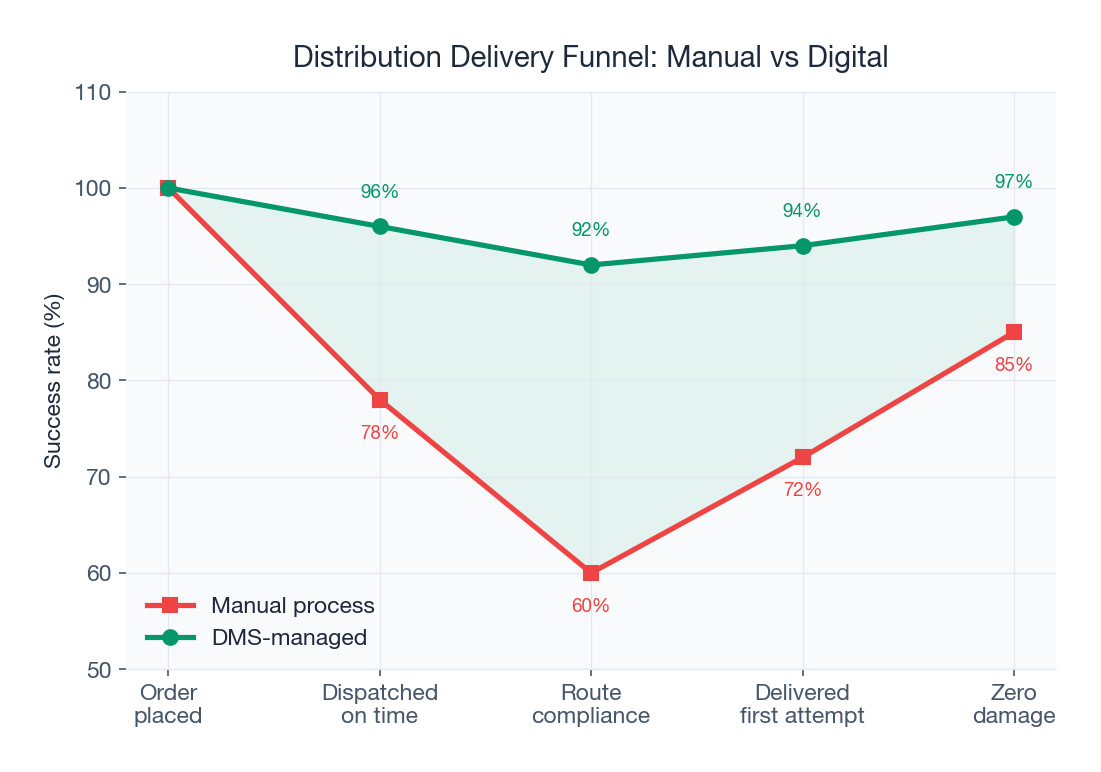
South Coast Fresh handles dairy plus beverages and bakery items through 210 distributors in Chennai, Coimbatore, and Madurai, the kind of multi-category operation where brands like Aavin and Britannia dominate. Unifying three legacy systems onto SpireStock reduced reconciliation work from 11 staff-days per month to under 1 day, while improving on-time delivery from 78% to 94%.
Cost & ROI Analysis
For a mid-sized dairy operation, 80-200 distributors, 15-30 vehicles, Rs 30-80 crore annual revenue, the cost-benefit breakdown typically looks like this:
| Line Item | Year-1 Impact (INR) | Details |
|---|---|---|
| SaaS subscription | (Rs 7-12 lakh) | Tiered by distributor count and modules |
| Onboarding & training | (Rs 1.5-3 lakh) | One-time, amortized over 3 years typically |
| Order processing savings | Rs 8-14 lakh | Reduced back-office FTE requirement |
| Crate & asset recovery | Rs 15-30 lakh | 80% reduction in leakage |
| Fuel/route optimization | Rs 18-35 lakh | 20-30% fewer km driven |
| Billing error reduction | Rs 4-9 lakh | Eliminates write-offs from errors |
| Collection acceleration | Rs 25-55 lakh unlocked | Working capital benefit |
| Net Year-1 benefit | Rs 62-132 lakh | Payback: 2-3 months |
The payback period is consistently under 4 months, with many deployments achieving full ROI inside the first quarter. This favourable economics applies equally to dairy, beverages, bakery, and fresh produce operators.
Conclusion
A milk distribution management system is not a luxury, it is the operational backbone that determines whether your dairy business can compete in India's rapidly evolving market. With the right system, you reduce costs, eliminate errors, scale faster, and build stronger relationships with your channel partners. The companies that digitize now will be the market leaders of 2030. Get in touch with our team to discuss your specific requirements and see a live demo tailored to your operation. For related insights, explore our guide on route optimization for milk delivery and our complete guide to dairy distribution software in India.
This guide covers one part of the picture. For the category as a whole — what a DMS does, the modules that matter, how it differs from ERP and SFA, and what it costs in India — see our distributor management system guide.
Sources & References
Frequently Asked Questions
A milk distribution management system is an integrated software solution that manages the entire dairy distribution lifecycle, from order placement and production scheduling through route optimization, delivery tracking, crate management, and invoicing, designed specifically for the perishable dairy supply chain.
Any dairy company distributing products through a network of distributors, agents, or retailers benefits from this system. It's especially valuable for operations handling 100+ daily orders, managing returnable assets like crates, or distributing across multiple territories.
Yes, modern systems like SpireStock handle the full range of dairy SKUs, liquid milk in pouches and bottles, curd, buttermilk, paneer, ghee, ice cream, and flavored beverages, each with their own shelf life, pricing, and distribution requirements.
Distributors can set up standing orders that automatically repeat daily. They can modify quantities before the cutoff time each day, or the system processes the standing order as-is. This eliminates the need to place fresh orders every single day.
Yes, SpireStock offers API-based integration with major ERP systems including SAP, Tally, and custom dairy plant management software. Production schedules and dispatch data can flow seamlessly between systems.
Absolutely. The system supports multiple payment modes, cash, credit, UPI, cheque, and maintains real-time credit limits and outstanding balances per distributor. Automatic alerts trigger when distributors approach their credit limits.
The mobile app is designed for simplicity. Most delivery staff become comfortable within 1-2 days of use. The interface supports vernacular languages and uses intuitive icons, making it accessible to staff with varying tech literacy levels.
By improving demand forecasting accuracy, optimizing delivery routes for speed, tracking shelf life across the chain, and providing real-time visibility into stock levels at every distribution point, the system helps reduce spoilage by 15-30%.
Related SpireStock Features
End-to-end order lifecycle from placement to delivery with multi-level approval workflows.
Real-time GPS tracking of vehicles and drivers with route optimization for faster deliveries.
Complete returnable crate tracking across plant, transporter, and retail levels.
Related Solutions
Manage your entire distributor network digitally. Onboarding, credit limits, outstanding tracking, and performance analytics. Start free trial.
GPS fleet tracking, driver management, and route optimization for dairy and FMCG delivery vehicles. Reduce fuel costs by 25%. Try SpireStock.
Related Entities
Ready to Streamline Your Distribution?
Start your free 14-day trial and see how SpireStock can transform your dairy, FMCG or consumer-goods distribution operation, from order capture to crate recovery.

SpireStock Team
Product & Industry Insights
SpireStock Team leads product at SpireStock, where the team ships distribution management software for India's dairy, FMCG and consumer-goods brands.