The State of FMCG Distribution in India, 2026
India's FMCG sector is projected to reach $220 billion by 2026, but the distribution infrastructure supporting this massive market is straining under multiple pressures. From rising fuel costs and labour shortages to the rapid shift toward digital ordering, distribution companies must evolve or risk being left behind.
This article examines the most pressing challenges and outlines practical solutions that Indian FMCG distributors, especially those in the dairy, packaged goods, and beverage segments, can implement today. If you are facing any of these challenges, start your free 14-day trial to see how technology can solve them in weeks, not months.
The Numbers Behind India's FMCG Distribution Crisis
Before diving into individual challenges, let us understand the scale of the problem. India's FMCG distribution network is among the most complex in the world, serving over 12 million kirana stores, 5 million modern trade outlets, and thousands of institutional buyers across 29 states and 8 union territories.
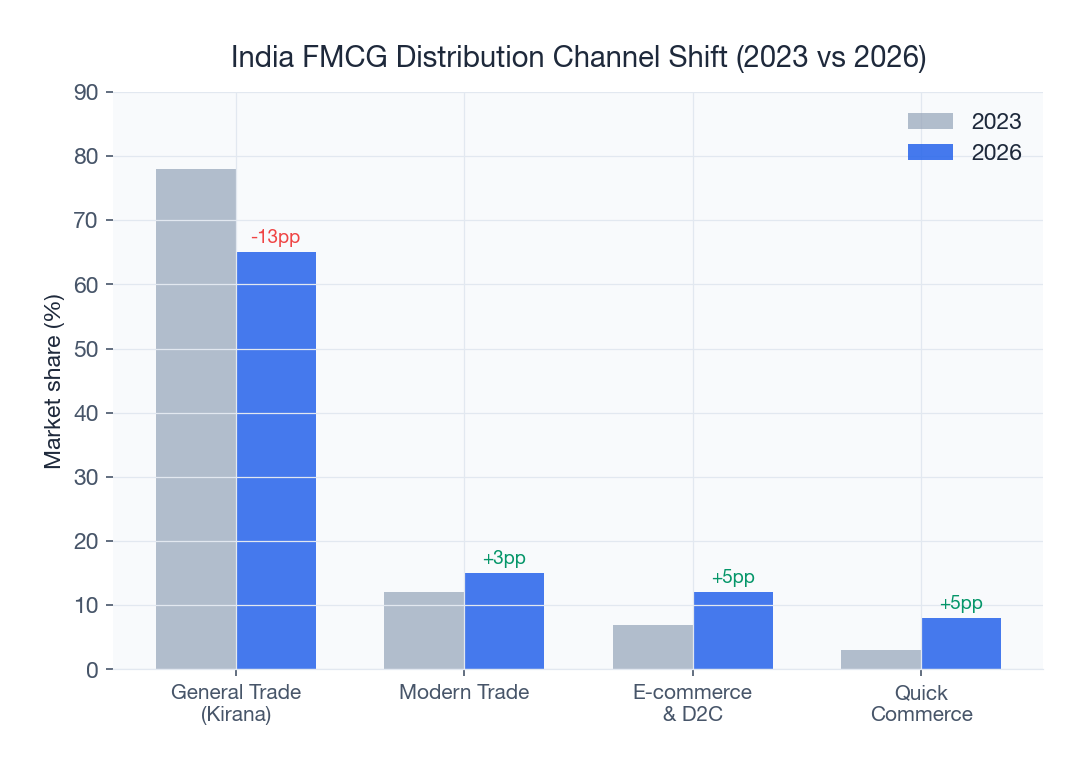
| Metric | 2023 | 2026 (Projected) | Change |
|---|---|---|---|
| Total FMCG market size | $167 billion | $220 billion | +32% |
| Average fuel cost per km | Rs 8.5 | Rs 11.2 | +32% |
| Driver wage inflation | Rs 15,000/month | Rs 21,000/month | +40% |
| Returnable asset losses (industry) | Rs 1,800 crore | Rs 2,500 crore | +39% |
| Digital order adoption | 12% | 28% | +133% |
| Quick commerce share | 1.5% | 5% | +233% |
These numbers tell a clear story: costs are rising faster than revenue, while digital-native competitors are capturing an increasing share of the market. Traditional distributors must adapt or face margin compression that makes their business unsustainable.
Challenge 1: Rising Last-Mile Delivery Costs
Fuel prices, vehicle maintenance, and driver wages have increased 20-35% over the past three years. For FMCG distributors operating on thin margins (typically 3-8%), last-mile costs can consume over half of gross profit. A distributor running 10 delivery vehicles in Hyderabad now spends Rs 4-6 lakh more annually on fuel alone compared to 2023.
Solution: Route Optimization Technology
AI-powered route optimization can reduce delivery costs by 20-30% by calculating the most efficient delivery sequences. When combined with real-time distribution tracking, managers can identify and eliminate wasteful practices like unnecessary detours, idle time, and unplanned stops. Smart route planning considers traffic patterns, delivery time windows, vehicle capacity, and customer priority, delivering more stops per kilometre and more value per rupee of fuel.
The fleet management solution goes further by tracking vehicle utilization, maintenance schedules, and driver performance, ensuring your entire delivery operation runs at peak efficiency.
Challenge 2: Returnable Asset Leakage
Crates, bottles, pallets, and containers represent significant capital investment. Indian FMCG companies lose an estimated Rs 2,500 crore annually to unreturned or damaged returnable assets. Without systematic tracking, disputes between distributors and the company become chronic. Dairy companies face this most acutely, a regional brand like Country Delight or Nandini can lose Rs 20-50 lakh annually just in crate leakage.
Solution: Digital Asset Tracking
Implementing a dedicated crate and asset management system creates an auditable trail of every asset movement. Digital issuance, return logging, and automated balance reconciliation reduce losses by up to 80% and virtually eliminate distributor disputes. Each crate transaction is recorded with timestamps, quantities, and responsible parties, providing indisputable records when questions arise.
Read our detailed guide on crate management systems for dairy for a deep dive into implementation strategies and ROI calculations.
Challenge 3: Manual Order Processing
Despite India's digital revolution, a majority of FMCG orders still come through phone calls, WhatsApp messages, and paper forms. This leads to transcription errors, missed orders, and delayed processing. For perishable categories like dairy and fresh produce, even a 2-hour delay can mean lost sales or spoiled inventory.
Solution: Digital Order Management
Migrating to a digital order management platform where distributors place orders through a mobile app eliminates errors, enforces cutoff times, and gives production teams real-time demand visibility for better planning. Standing order templates automate repetitive daily ordering, saving distributors 15-20 minutes per day and eliminating the 3-5% error rate inherent in phone-based ordering.
Challenge 4: Scheme and Discount Complexity
FMCG companies run dozens of concurrent trade schemes, flat discounts, quantity-based incentives, seasonal promotions, and retailer-specific deals. A company like Britannia might run 30-50 active schemes simultaneously across different product lines and territories. Manually applying these correctly across thousands of orders is nearly impossible, leading to either overpayment (margin erosion) or underpayment (distributor dissatisfaction).
Solution: Automated Scheme Engine
A configurable scheme management engine applies the right incentives automatically during order processing. This ensures 100% accuracy in scheme application while freeing your team from hours of manual calculations. The scheme management solution also provides ROI analytics per scheme, helping you invest your trade spend where it generates the most lift.
Challenge 5: Limited Visibility into Field Operations
Many FMCG companies have blind spots in their distribution, they don't know in real time which orders have been delivered, which distributors are underperforming, or where their delivery vehicles are. A sales manager in Chennai overseeing 80 distributors across Tamil Nadu relies on end-of-week phone reports to understand what happened on Monday. By then, the opportunity to intervene has passed.
Solution: Integrated Analytics and Tracking
Sales analytics combined with GPS-based distribution tracking provides a comprehensive, real-time view of your entire distribution network. Dashboard-driven insights help managers identify issues before they become crises. Field force attendance and activity tracking ensures your sales team is covering territories effectively and spending time on high-value activities.
Challenge 6: GST and Regulatory Compliance
India's evolving regulatory landscape, with frequent changes to GST rates, e-invoicing mandates, and FSSAI requirements, creates a constant compliance burden. Non-compliance results in penalties, disrupted operations, and strained government relationships. The automated billing system handles:
- Automated GST calculation with product-level HSN code mapping across all slabs (0%, 5%, 12%, 18%, 28%)
- E-invoice generation compliant with NIC portal requirements, mandatory for businesses above Rs 5 crore turnover
- Automated GSTR report generation for GSTR-1, GSTR-3B, and reconciliation with GSTR-2A/2B
- Product-level FSSAI license tracking and expiry alerts for food safety compliance
- Multi-state billing with automatic IGST/CGST+SGST determination based on seller and buyer locations
Challenge 7: Workforce Attrition and Training
Delivery drivers and field sales staff in India's FMCG sector face annual attrition rates of 30-50%. Every time a driver leaves, the company loses route knowledge, customer relationships, and training investment. The replacement cycle, recruiting, training, and achieving full productivity, takes 4-6 weeks per hire.
Solution: Technology-Enabled Onboarding
When routes, customer details, delivery sequences, and operational procedures are captured in software rather than in a driver's memory, new hires become productive within days instead of weeks. The mobile app provides turn-by-turn delivery guidance, customer-specific instructions, and real-time support, dramatically reducing the dependency on institutional knowledge held by individual employees.
Challenge 8: Competition from Quick Commerce and D2C
Quick commerce platforms (Blinkit, Zepto, Swiggy Instamart) and direct-to-consumer brands are reshaping Indian consumer expectations. While traditional FMCG distribution still handles 90%+ of volume, the pressure to match the speed, reliability, and data sophistication of digital-native competitors is intensifying.
Solution: Digital Transformation of Traditional Distribution
Rather than competing with quick commerce head-on, traditional FMCG distributors should digitize their inherent advantages, deep retailer relationships, last-mile reach in tier-2 and tier-3 cities, and category expertise. Digital ordering, real-time tracking, and data-driven territory management create a distribution network that combines traditional reach with modern efficiency.
Ready to solve your distribution challenges? SpireStock helps FMCG, dairy, beverage, and consumer goods companies across India digitize their distribution operations. Book a free demo to see how it works for your specific challenges.
The Path Forward: A Prioritized Action Plan
The common thread across all these challenges is clear: technology adoption is no longer optional for Indian FMCG distributors. But where should you start? Here is a prioritized roadmap based on impact and implementation speed:
- Month 1, Implement digital order management and billing automation (highest immediate impact)
- Month 2, Deploy crate and returnable asset tracking (fastest ROI)
- Month 3, Enable route optimization and distribution tracking (cost reduction)
- Month 4, Activate sales analytics and performance dashboards (strategic insights)
- Ongoing, Refine scheme management, expand coverage, and integrate with accounting systems
The good news is that modern SaaS platforms have made this transformation accessible even to mid-sized distributors, with cloud-based solutions eliminating the need for heavy upfront IT investment. Check our pricing plans to find the right fit. For more on dairy-specific challenges, read our complete guide to dairy distribution software in India.
Real-World Implementation Scenarios
The challenges above are not abstract, they play out every day across Indian distribution networks. Here are three case studies showing how technology interventions deliver measurable outcomes.
Case Study 1: Vindhya Consumer Brands, Indore
Vindhya Consumer Brands distributes biscuits, namkeen, and packaged beverages through 310 distributors across Indore, Bhopal, and Ujjain, a classic multi-category FMCG operator competing with the likes of Britannia. Scheme leakage was running at Rs 67 lakh annually because field staff couldn't keep up with 40+ simultaneous trade promotions. After deploying SpireStock's scheme management solution, scheme application accuracy jumped from 68% to 100%, eliminating Rs 65 lakh of leakage in year one against software cost of Rs 11 lakh.
Case Study 2: Kaveri Beverages, Bangalore
Kaveri Beverages handles packaged water and flavoured drinks similar to the Bisleri portfolio across 165 routes in Bangalore. Last-mile costs were cannibalising margin, Rs 2.8 crore in annual fuel spend against revenue of Rs 48 crore. SpireStock's fleet management solution with AI-driven route planning cut kilometres by 27%, saving Rs 76 lakh in year one and reducing driver overtime by 40%.
Case Study 3: Punjab Premium Dairy, Chandigarh
Punjab Premium Dairy, with 140 distributors across Chandigarh, Mohali, and Ludhiana, models itself on regional giants like Verka. Returnable crate losses were Rs 42 lakh annually, a devastating figure on Rs 85 crore revenue. Digital crate tracking through SpireStock's crate asset management solution cut losses to Rs 6.5 lakh in year one, recovering Rs 35.5 lakh that previously vanished into disputes.
Cost & ROI Analysis
For FMCG distributors in India facing the challenges described above, here is a consolidated view of investment and payback:
| Challenge Area | Annual Cost of Inaction | Solution Investment | Net Year-1 Savings |
|---|---|---|---|
| Last-mile delivery inefficiency | Rs 40-90 lakh | Rs 3-5 lakh | Rs 25-65 lakh |
| Returnable asset leakage | Rs 20-50 lakh | Rs 2-3 lakh | Rs 15-42 lakh |
| Manual order processing errors | Rs 8-18 lakh | Rs 2-4 lakh | Rs 5-13 lakh |
| Scheme leakage | Rs 25-75 lakh | Rs 2-4 lakh | Rs 20-65 lakh |
| GST compliance penalties | Rs 3-15 lakh | Rs 1-2 lakh | Rs 2-13 lakh |
| Workforce attrition costs | Rs 10-22 lakh | Rs 1-2 lakh | Rs 6-15 lakh |
| Total Year-1 Impact | Rs 106-270 lakh | Rs 11-20 lakh | Rs 73-213 lakh |
Payback period for a typical FMCG distributor deploying a comprehensive solution is between 8 and 14 weeks. For multi-category operations covering dairy, beverages, bakery, fresh produce, and packaged consumer goods, the consolidated savings compound significantly. For related reading, see our milk distribution management system guide.
Sources & References
Frequently Asked Questions
The top challenges include rising last-mile delivery costs, returnable asset leakage, manual order processing errors, scheme management complexity, limited visibility into field operations, and evolving GST/regulatory compliance requirements.
Cloud-based SaaS platforms offer route optimization, digital order management, automated billing, crate tracking, and real-time analytics, all accessible via mobile devices. These tools are reducing costs by 20-30% and improving operational accuracy to near 99%.
Last-mile delivery typically costs Rs 8-15 per delivery point in urban areas and Rs 15-30 in semi-urban/rural areas. For dairy products specifically, cold chain requirements can add another Rs 3-5 per point.
Industry estimates suggest Indian FMCG companies lose Rs 2,000-3,000 crore annually to unreturned, damaged, or misplaced returnable assets. Individual companies report crate loss rates of 5-15% annually without digital tracking systems.
Yes, modern SaaS platforms offer subscription-based pricing starting from Rs 5,000-10,000 per month, making them accessible to distributors of all sizes. The ROI typically pays for the subscription within the first 2-3 months.
Mobile technology is transforming FMCG distribution by enabling distributors to place orders, delivery staff to confirm drops via OTP, and managers to monitor operations, all from smartphones. This is especially impactful in India where smartphone penetration exceeds 70%.
Leading dairy companies are adopting IoT temperature sensors, GPS-tracked refrigerated vehicles, and real-time monitoring dashboards. Software platforms integrate cold chain data with delivery tracking to ensure products maintain proper temperature throughout distribution.
Quick commerce is growing fast but currently represents only 3-5% of India's FMCG volume. Traditional distribution through general trade and modern trade will remain dominant for the foreseeable future, but distributors must improve efficiency to stay competitive.
Related SpireStock Features
Real-time GPS tracking of vehicles and drivers with route optimization for faster deliveries.
Powerful dashboards with sales trends, MIS reports, and distribution analytics.
Zone, town, and route-based delivery management with optimization.
Related Industries
Related Solutions
Manage your entire distributor network digitally. Onboarding, credit limits, outstanding tracking, and performance analytics. Start free trial.
Track and manage your retail network. Geo-tag outlets, capture secondary sales, manage beats, and monitor retailer performance. Try SpireStock.
Related Entities
Ready to Streamline Your Distribution?
Start your free 14-day trial and see how SpireStock can transform your dairy, FMCG or consumer-goods distribution operation, from order capture to crate recovery.

SpireStock Team
Product & Industry Insights
SpireStock Team leads product at SpireStock, where the team ships distribution management software for India's dairy, FMCG and consumer-goods brands.