Why Distributor Appointment Is the Most Critical Decision a Brand Manager Makes
In the Indian FMCG ecosystem — valued at over ₹6.5 lakh crore in 2026 — distributors are the backbone of market execution. A single distributor in a mid-sized Indian city like Jaipur or Indore typically services 800-1,500 retail outlets across 15-25 beats. Get this appointment wrong, and you lose an entire territory for months.
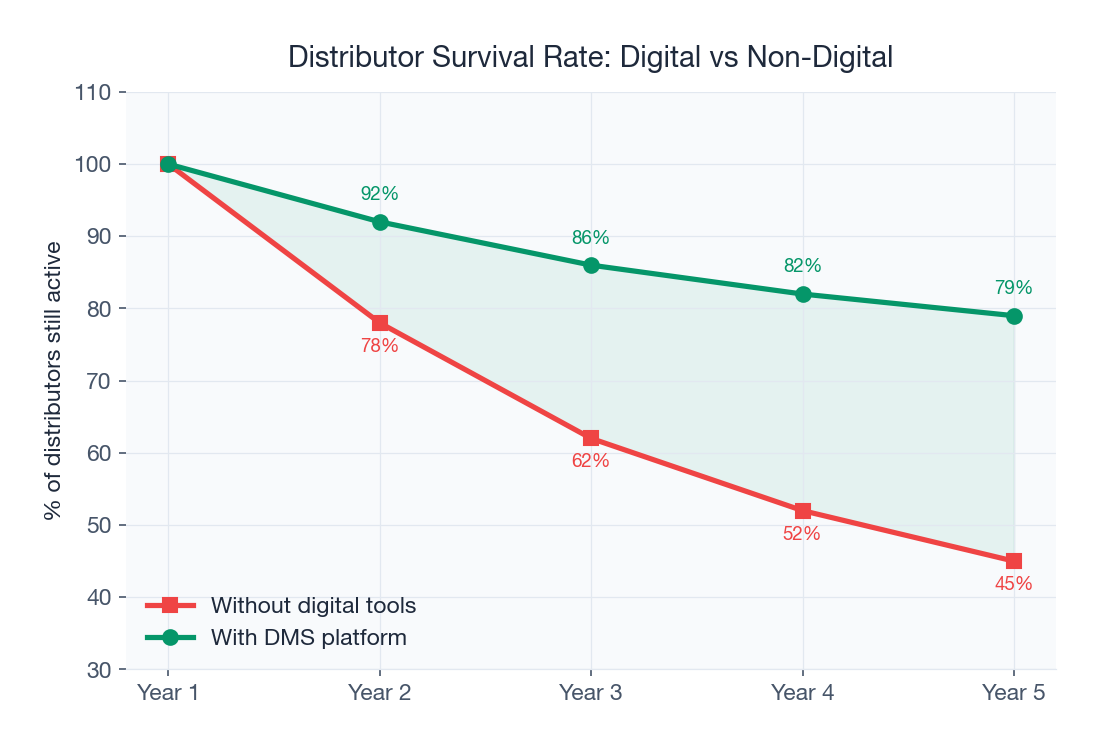
Yet most FMCG companies still rely on informal referrals and gut instinct when appointing distributors. According to a 2025 survey by the Federation of Indian Distributors Association (FIDA), 42% of distributor terminations happen within the first 18 months — almost always because the selection criteria were inadequate from the start.
This guide provides a rigorous, data-backed framework for appointing FMCG distributors in India. Whether you manage a national brand like Britannia or Dabur, or you are building distribution for a D2C-turned-offline brand, this process will help you avoid costly mistakes.
The Five Pillars of Distributor Evaluation
Every distributor appointment decision should be evaluated across five core pillars. Each pillar carries a different weightage depending on your product category, territory type (urban vs. rural), and distribution model (direct vs. super-stockist).
1. Financial Strength and Creditworthiness
Financial capacity is the single biggest predictor of distributor success. A distributor who is undercapitalized will fail to maintain adequate stock levels, delay payments to the company, and struggle during peak seasons like Diwali or the summer beverage rush.
- Minimum Net Worth: For a Tier-1 city like Mumbai or Delhi, expect a net worth of ₹50 lakh to ₹2 crore depending on the brand's billing volume. For Tier-2/3 cities, ₹15-50 lakh is typical.
- Working Capital Availability: The distributor should have liquid working capital equivalent to at least 1.5x their expected monthly billing. If your projected monthly primary billing is ₹20 lakh, the distributor needs ₹30 lakh in accessible working capital.
- Banking Track Record: Request 12 months of bank statements. Look for consistent balance maintenance above ₹5 lakh, regular business transactions, and no bounce history on cheques or NACH mandates.
- Existing Credit Lines: Distributors who already have CC/OD limits from scheduled banks (typically ₹10-50 lakh) demonstrate banking credibility and have a financial cushion for scaling.
- Tax Compliance: Verify active GST registration, filed returns for 12+ months, and PAN-linked ITR filings. Non-compliant distributors create legal and tax risks for your brand.
Key insight: In perishable categories like dairy and bakery, working capital needs are 2x higher than shelf-stable FMCG because stock rotation happens every 2-5 days instead of 15-30 days.
2. Infrastructure and Logistics Capability
Your distributor's physical infrastructure directly impacts product availability, freshness, and delivery speed to retailers. The requirements vary significantly by category.
- Godown/Warehouse Size: A general FMCG distributor needs 1,500-3,000 sq ft of warehousing for a mid-sized territory. For beverage distribution, expect 2,500-5,000 sq ft due to bulky packaging. Ensure the godown has pucca flooring, ventilation, and pest control.
- Cold Storage (Category-Specific): Dairy, frozen foods, and chocolate categories require dedicated cold rooms (minimum 200 sq ft) with temperature monitoring. Walk-in coolers with 2-8°C range for dairy, and -18°C freezer capacity for frozen categories.
- Vehicle Fleet: The distributor should own or have dedicated access to delivery vehicles. For urban territories, 3-wheelers (Piaggio Ape, Mahindra Treo) work well. For wider coverage, Tata Ace or Ashok Leyland Dost mini-trucks are standard. Minimum 2-3 vehicles for a single-brand territory.
- Loading/Unloading Facilities: Proper dock space, weighing scales, and material handling equipment (hand trolleys at minimum) reduce damage and improve turnaround.
- Office and IT Setup: Basic office infrastructure with computer systems, internet connectivity (minimum broadband), printer for invoicing, and smartphones for delivery staff.
3. Market Knowledge and Retailer Relationships
This is where many brand managers make mistakes — they prioritize financial muscle over market intelligence. A wealthy distributor with no relationships in the territory will underperform a moderately financed distributor who knows every kirana store owner by name.
- Existing Retailer Network: The ideal distributor already services 500-1,000+ retail outlets in the target territory. Verify this by cross-referencing their claimed outlet list with a field check on 20-30 randomly selected retailers.
- Category Experience: A distributor handling Parle Agro beverages has transferable skills for any beverage brand. Category-adjacent experience (e.g., snacks distributor taking on confectionery) is also valuable.
- Territory Expertise: They should know the geography intimately — which markets are wholesale hubs, which localities have high footfall, where new residential colonies are developing, and which areas have seasonal demand spikes.
- Competing Brand Relationships: This is a double-edged sword. A distributor handling 6-8 brands has proven capability, but check for direct competitors in your category. Handling both Brand A chips and Brand B chips creates conflict of interest.
4. Operational Team and Salesforce
Distribution is a people business. The distributor's team quality determines whether your schemes reach retailers and your products get shelf visibility.
- Dedicated Salesmen: For a meaningful territory, the distributor should deploy 3-6 order bookers/salesmen who cover designated beats daily. Each salesman typically covers 25-35 outlets per day in urban areas.
- Delivery Staff: Separate delivery boys (minimum 2-3) who handle physical distribution. Combining order booking and delivery in the same person reduces efficiency by 40%.
- Supervisor/Manager: For distributors billing above ₹25 lakh/month, a dedicated operations manager who handles claims, returns, expiry management, and coordination with your area sales manager (ASM).
- Staff Retention History: High attrition among delivery staff is a red flag. Ask about average tenure — anything below 6 months indicates management issues.
5. Technology Readiness and DMS Adoption Willingness
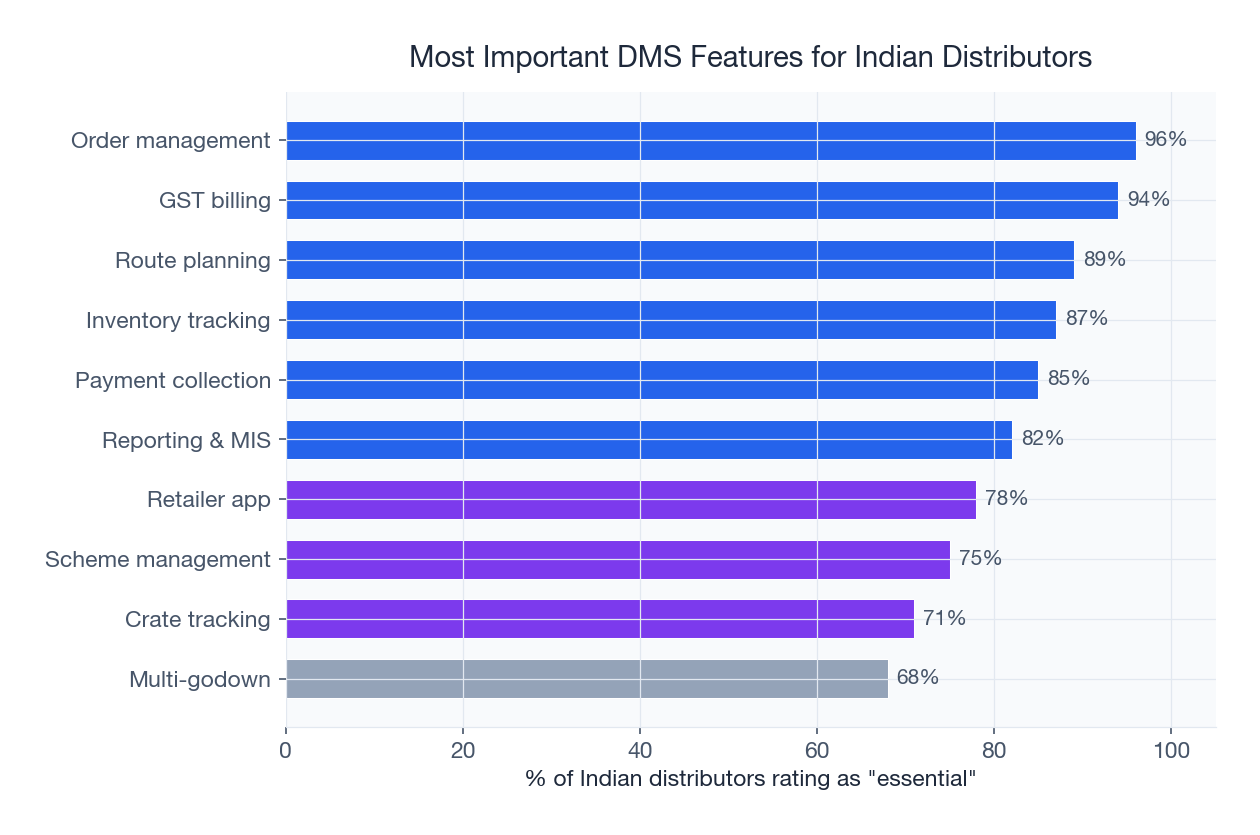
In 2026, a distributor unwilling to adopt distributor management software (DMS) is a liability, not an asset. Digital operations are no longer optional — they are essential for secondary sales visibility, scheme execution, and real-time inventory tracking.
- Current Tech Usage: Is the distributor already using any billing software (even Tally or Busy)? Are their delivery staff comfortable with smartphones? Do they track inventory digitally or manually in registers?
- Willingness to Invest: DMS solutions like SpireStock's distribution tracking require the distributor to ensure their team uses the platform daily. Gauge their openness during initial meetings.
- Data Sharing Comfort: Modern DMS requires the distributor to share real-time secondary sales data, stock levels, and retailer-wise billing. Some traditional distributors resist this transparency.
- Mobile Readiness: Their salesmen and delivery boys need Android smartphones (minimum 2GB RAM, 4G connectivity). If the distributor is unwilling to equip their team, it signals resistance to change.
Distributor Evaluation Scorecard: Weighted Criteria
Use this scorecard to objectively compare distributor candidates. Rate each criterion on a scale of 1-5, multiply by the weightage, and calculate a total weighted score. A minimum score of 65 out of 100 is recommended for appointment.
| Evaluation Criteria | Weightage (%) | Rating Scale (1-5) | What 5/5 Looks Like |
|---|---|---|---|
| Net Worth & Working Capital | 20% | 1 = Below ₹10L, 5 = Above ₹1Cr | Net worth ₹1Cr+, CC limit ₹25L+, clean banking |
| Warehouse & Cold Storage | 15% | 1 = No dedicated godown, 5 = 3000+ sq ft with cold chain | Owned godown, temperature-controlled, FSSAI-compliant |
| Vehicle Fleet & Delivery Capacity | 10% | 1 = No vehicles, 5 = 5+ dedicated vehicles | Owned fleet with GPS, insulated vehicles for perishables |
| Existing Retailer Network | 20% | 1 = Below 200 outlets, 5 = 1000+ active outlets | 1000+ billed outlets in target territory with 80%+ billing efficiency |
| Category & Territory Experience | 10% | 1 = No FMCG experience, 5 = 5+ years same category | 10+ years in same category, deep territory knowledge |
| Salesforce Strength | 10% | 1 = Owner-operated only, 5 = 6+ trained salesmen | Dedicated sales team with supervisor, low attrition |
| Tech Readiness & DMS Adoption | 10% | 1 = No digital tools, 5 = Already using DMS | Uses billing software, team has smartphones, open to DMS |
| Reputation & Market Standing | 5% | 1 = Unknown/negative, 5 = Highly respected | Known for timely payments, good retailer relationships |
Key insight: Many brands like ITC and Haldiram's use weighted scorecards during their annual distributor review process. Adopting this at the appointment stage itself prevents costly course-corrections later.
Step-by-Step Distributor Appointment Process
A structured appointment process typically takes 4-8 weeks from initial identification to operational go-live. Rushing this process is one of the top reasons distributors fail in India. Here is the recommended workflow.
Step 1: Territory Analysis and Requirement Definition (Week 1)
Before you even begin looking for distributor candidates, define what the territory needs. Use your sales analytics data to determine: monthly billing potential (in ₹ lakh), number of retail outlets in the territory, product mix and storage requirements, and the delivery frequency needed (daily for dairy, 2-3x weekly for packaged FMCG).
Step 2: Candidate Sourcing (Week 1-2)
Source candidates from multiple channels to avoid single-source bias:
- ASM/RSM Recommendations: Your area sales managers typically know 2-3 potential distributors in every territory. But validate independently — ASMs sometimes recommend based on personal relationships.
- Existing Distributor Referrals: Your best distributors in adjacent territories often know capable businessmen in the target market.
- Market Surveys: Send your field team to the territory to identify who is distributing competing or complementary brands effectively. Visit wholesale markets and ask retailers who their best-serviced distributor is.
- Industry Associations: Local chamber of commerce, FMCG distributor associations, and trade bodies maintain databases.
- Digital Platforms: IndiaMart, TradeIndia, and LinkedIn are increasingly used for distributor discovery, especially for D2C brands expanding offline.
Step 3: Preliminary Screening and Document Collection (Week 2-3)
Shortlist 3-5 candidates and collect the following documents: GST registration certificate, PAN card and Aadhaar of proprietor/partners, 12-month bank statements, ITR for last 2 years, godown ownership/lease agreement, vehicle RC books, existing distributor agreements with other brands (to check conflicts), and trade references from 3-5 retailers.
Step 4: Physical Verification and Field Visit (Week 3-4)
This is non-negotiable — never appoint a distributor without a physical visit. During the visit, inspect the godown (cleanliness, racking, pest control, cold storage functionality), verify vehicle count and condition, meet the sales team, check existing stock management practices, and randomly visit 10-15 retailers to verify claimed relationships.
Step 5: Evaluation, Scoring, and Negotiation (Week 4-5)
Apply the evaluation scorecard from the previous section. For candidates scoring above 65, proceed to commercial discussions: margin structure (typically 3-8% for FMCG, 8-12% for dairy/perishables), credit period (7-21 days is standard, cash-and-carry for new distributors), target-linked incentives, scheme pass-through percentages, and return/expiry handling terms.
Step 6: Agreement Execution and Legal Formalities (Week 5-6)
The distributor appointment letter and agreement should clearly specify: territory boundaries (pin code level or beat level), product categories covered, minimum monthly lifting commitment, margin and incentive structure, credit limit and payment terms, performance review frequency (quarterly recommended), termination clauses (typically 30-90 day notice), and dispute resolution mechanism.
Step 7: DMS Onboarding and Training (Week 6-7)
This is where technology transforms the onboarding experience. With a platform like SpireStock, the distributor onboarding process includes: creating the distributor profile in multi-tenant workspaces, uploading the retailer master list and mapping beats, configuring margin and scheme rules in the system, training the distributor's billing operator on order and invoice management, setting up mobile app access for salesmen and delivery staff, and conducting a pilot run with 2-3 beats before full territory launch.
Step 8: Go-Live with Supervised Launch (Week 7-8)
Deploy your ASM on-ground for the first 2 weeks of operation. Monitor daily order volumes, retailer coverage percentage, delivery fulfilment rates, and return percentages. Any metric below expectation needs immediate course correction.
Red Flags: When to Walk Away from a Distributor Candidate
Even if a candidate scores well on paper, these warning signs should trigger immediate disqualification:
- Multiple Brand Terminations: If the candidate has been terminated by 2 or more FMCG brands in the last 3 years, there is a systemic issue regardless of their explanation.
- Reluctance to Share Financial Documents: A distributor who will not share bank statements or ITRs is either hiding financial weakness or has compliance issues. Either way, it is a dealbreaker.
- Godown in Residential Area: Operating from a residential property creates legal risks (municipal violations), limits scalability, and often means the distributor is not serious about the business.
- Owner Not Involved in Daily Operations: If the owner treats distribution as a passive investment and has no daily involvement, operational quality will suffer. Distribution requires hands-on management.
- Existing Portfolio Conflicts: A distributor already handling a direct competitor's products will never give your brand 100% focus. Some brands allow complementary portfolios, but direct category overlap is risky.
- Resistance to Technology: In 2026, a distributor who insists on manual billing and paper-based tracking will be unable to provide the secondary sales visibility that modern FMCG brands require. This DMS resistance becomes a long-term liability.
- High Existing Debt: If the candidate is heavily leveraged with loans for non-business purposes (real estate speculation, personal expenses), their financial stability is questionable.
- Poor Retailer Feedback: During your field verification, if more than 30% of retailers give negative feedback about delivery reliability, product freshness, or claim settlement, move on.
Typical Distributor Agreement Terms in Indian FMCG
Understanding market-standard terms helps you negotiate fairly while protecting your brand's interests. Here is what the 2026 landscape looks like across major FMCG categories.
| Agreement Term | Packaged FMCG | Dairy & Perishables | Beverages |
|---|---|---|---|
| Distributor Margin | 3-6% on MRP | 8-12% on MRP | 5-8% on MRP |
| Credit Period | 15-21 days | 7-10 days or COD | 14-21 days |
| Security Deposit | ₹1-5 lakh | ₹50K-2 lakh | ₹1-3 lakh (+ crate deposit) |
| Minimum Monthly Lifting | ₹5-15 lakh | ₹3-10 lakh | ₹5-20 lakh (seasonal) |
| Agreement Tenure | 1 year (renewable) | 1 year (renewable) | 1 year (renewable) |
| Termination Notice | 60-90 days | 30-60 days | 60-90 days |
| Performance Review | Quarterly | Monthly | Quarterly |
| Return/Expiry Handling | Credit note within 15 days | Same-day replacement | Credit note within 7 days |
How DMS Software Transforms the Distributor Appointment Process
Modern distribution management software does not just help after appointment — it fundamentally improves how you evaluate, select, and onboard distributors.
Data-Driven Candidate Evaluation
With sales analytics from your existing distribution network, you can benchmark what a top-performing distributor looks like in similar territories. When a new candidate claims they can achieve ₹15 lakh monthly billing, you can validate this against actual performance data from comparable markets in Pune, Ahmedabad, or Chennai.
Faster Onboarding with Digital Tools
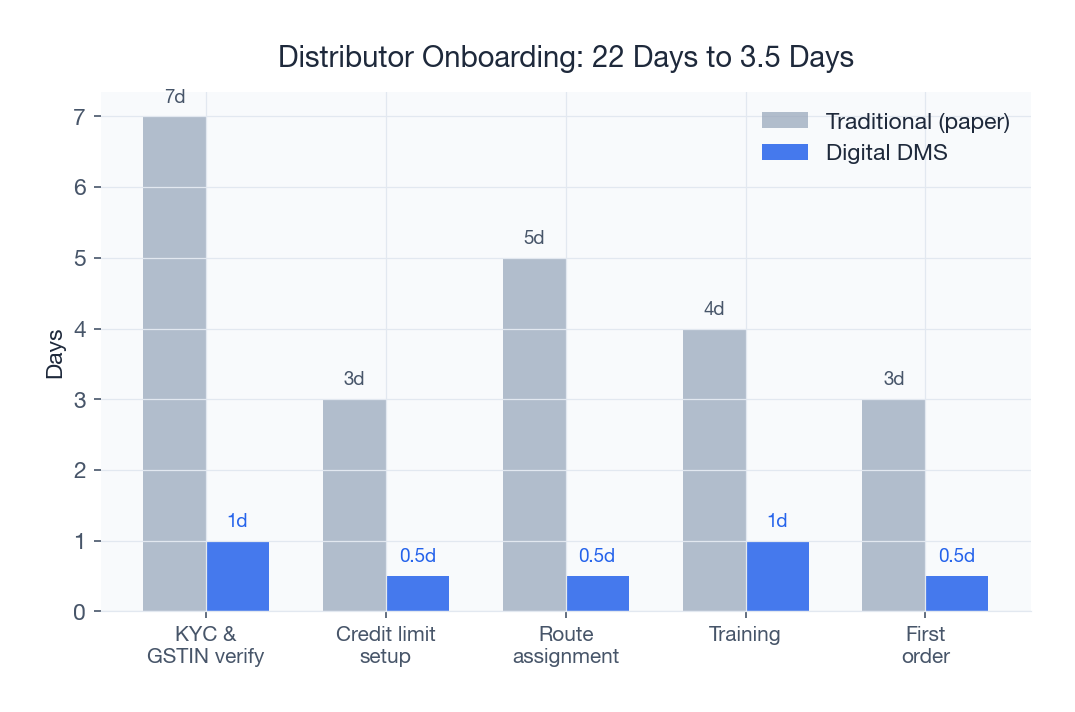
Traditional onboarding takes 3-4 weeks of manual setup. With a DMS platform, you can onboard a distributor in 5-7 days: auto-generate retailer masters from territory mapping, pre-configure scheme rules and pricing tiers, deploy mobile apps to the sales team with pre-loaded beat plans using distributor management solutions, and enable real-time distribution tracking from day one.
Performance Monitoring from Day One
Instead of waiting 3 months for a quarterly review to discover problems, DMS gives you daily visibility into: order booking per beat, retailer coverage percentage, average bill value, scheme utilization rates, and delivery fulfilment percentage. This early visibility lets you intervene and coach the distributor before small issues become territory-level failures.
Multi-Territory Comparison
When managing distributors across cities — from Kolkata to Bangalore — multi-tenant workspaces let you compare distributor performance across territories on a single dashboard. This makes it obvious which distributors are outperforming and which need attention or replacement.
Special Considerations for Different Distribution Models
Super-Stockist to Sub-Distributor Model
In this model, common in FMCG distribution across Tier-2/3 India, the super-stockist breaks bulk and supplies to multiple sub-distributors. When appointing a super-stockist, financial criteria are 3-5x higher (net worth ₹1-5 crore), but infrastructure and retailer network requirements shift — they need large warehousing (5,000-10,000 sq ft) but do not need last-mile delivery capability.
Exclusive vs. Multi-Brand Distribution
Brands like Amul and Mother Dairy often require exclusive distributors for their dairy portfolio. Exclusive distribution guarantees focus but requires the brand to ensure the distributor's economics work — typically through higher margins (10-15%), volume incentives, and infrastructure support (branded vehicles, cooler subsidy). For multi-brand distribution networks, ensure your agreement allows for complementary but not competing brands.
Rural Distribution Appointments
Appointing distributors for rural India requires relaxing some urban-centric criteria. Net worth thresholds drop to ₹5-15 lakh, godown sizes can be 500-1,000 sq ft, and two-wheeler-based delivery (bike + carrier) replaces mini-truck fleets. However, place higher weight on market knowledge — a rural distributor's value is their relationships with village-level retailers and haats.
Post-Appointment: The First 90 Days Framework
Appointing the right distributor is only half the battle. The first 90 days determine long-term success.
- Days 1-30 (Foundation Phase): Complete DMS onboarding, validate retailer master, execute first 4 weeks of beat plans, establish daily reporting rhythms. Target: 40% outlet coverage.
- Days 31-60 (Acceleration Phase): Launch introductory schemes, achieve target billing levels, identify and fix delivery bottlenecks, begin secondary sales tracking. Target: 60% outlet coverage, ₹X lakh billing milestone.
- Days 61-90 (Stabilization Phase): Full territory coverage operational, scheme management running smoothly, distributor independently managing daily operations, ASM shifts from daily to weekly check-ins. Target: 75%+ outlet coverage, consistent billing growth.
Common Mistakes Brand Managers Make During Distributor Appointment
After studying distributor appointment patterns across hundreds of FMCG brands operating in India, these are the most frequent errors:
- Over-indexing on financial strength: A distributor with ₹2 crore net worth but zero market relationships will underperform one with ₹30 lakh but 800 active retailers.
- Ignoring infrastructure verification: Accepting photos instead of physical visits. In one documented case in Lucknow, a distributor sent photos of a rented godown they planned to vacate within 3 months.
- Skipping retailer reference checks: The 30 minutes spent calling 5-10 retailers in the territory can save you 6 months of pain.
- Unclear territory boundaries: Vague territory definitions like "East Hyderabad" cause channel conflict. Define boundaries at pin code or landmark level using territory management best practices.
- No performance milestones: An appointment letter without 30/60/90-day targets gives the distributor no urgency and gives you no contractual basis for course correction.
Take the Guesswork Out of Distributor Appointments
The distributor appointment process does not have to be a gamble. With a structured evaluation scorecard, rigorous field verification, clear agreement terms, and DMS-powered onboarding, you can dramatically improve your hit rate on distributor selection.
SpireStock's distributor management platform gives you the tools to evaluate candidates against data-driven benchmarks, onboard them in days instead of weeks, and monitor performance from day one. Brands using SpireStock report 60% faster distributor onboarding and 35% lower first-year termination rates.
Ready to build a stronger distribution network? Talk to our distribution experts for a personalized assessment of your territory needs, or explore our pricing plans to see how SpireStock fits your scale.
Sources & References
Frequently Asked Questions
For Tier-1 cities like Mumbai or Delhi, brands typically require ₹50 lakh to ₹2 crore net worth. For Tier-2 and Tier-3 cities, ₹15-50 lakh is standard. Perishable categories like dairy require higher working capital due to faster stock rotation cycles.
A structured distributor appointment process takes 4-8 weeks from initial candidate identification to operational go-live. This includes territory analysis, candidate sourcing, document verification, physical inspection, commercial negotiation, agreement execution, and DMS onboarding.
Key documents include GST registration certificate, PAN card, Aadhaar of proprietor, 12-month bank statements, ITR for last 2 years, godown ownership or lease agreement, vehicle RC books, existing brand agreements, and trade references from retailers.
Margins vary by category: packaged FMCG offers 3-6% on MRP, dairy and perishables offer 8-12%, and beverages offer 5-8%. Additional income comes from target-linked incentives, scheme commissions, and volume rebates that can add 1-3% to base margins.
Most FMCG companies prohibit distributors from handling direct competitors in the same category. However, complementary brand portfolios are usually allowed. Some brands like Amul require exclusive distribution, especially for dairy products.
Major red flags include multiple brand terminations in 3 years, reluctance to share financial documents, godown in residential area, owner not involved in daily operations, direct competitor portfolio conflicts, resistance to DMS technology, and poor retailer feedback.
DMS software helps benchmark candidates against data from similar territories, accelerates onboarding from 3-4 weeks to 5-7 days, enables real-time performance monitoring from day one, and allows multi-territory comparison to quickly identify underperformers.
Days 1-30 focus on DMS onboarding and achieving 40% outlet coverage. Days 31-60 target 60% coverage with active scheme execution. Days 61-90 aim for 75%+ coverage with the distributor independently managing operations and consistent billing growth.
Related SpireStock Features
Powerful dashboards with sales trends, MIS reports, and distribution analytics.
Real-time GPS tracking of vehicles and drivers with route optimization for faster deliveries.
Isolated workspaces for each customer with custom branding and configuration.
Related Industries
Streamline FMCG distribution with order management, beat planning, retailer tracking, and GST billing. Built for Indian FMCG supply chains.
End-to-end dairy distribution software for milk, curd, paneer, and ghee brands. Manage orders, crates, cold chain, and GST billing in one platform.
Distribution management for consumer goods brands. Manage distributors, retailers, schemes, and sales analytics across India. Start free trial.
Related Entities
Ready to Streamline Your Distribution?
Start your free 14-day trial and see how SpireStock can transform your dairy, FMCG or consumer-goods distribution operation, from order capture to crate recovery.

SpireStock Team
Distribution Technology Experts
SpireStock Team writes for SpireStock on distribution management, supply-chain optimisation and field operations for Indian dairy and FMCG brands.