The Shift from Salesman-Dependent to Retailer-Driven Ordering
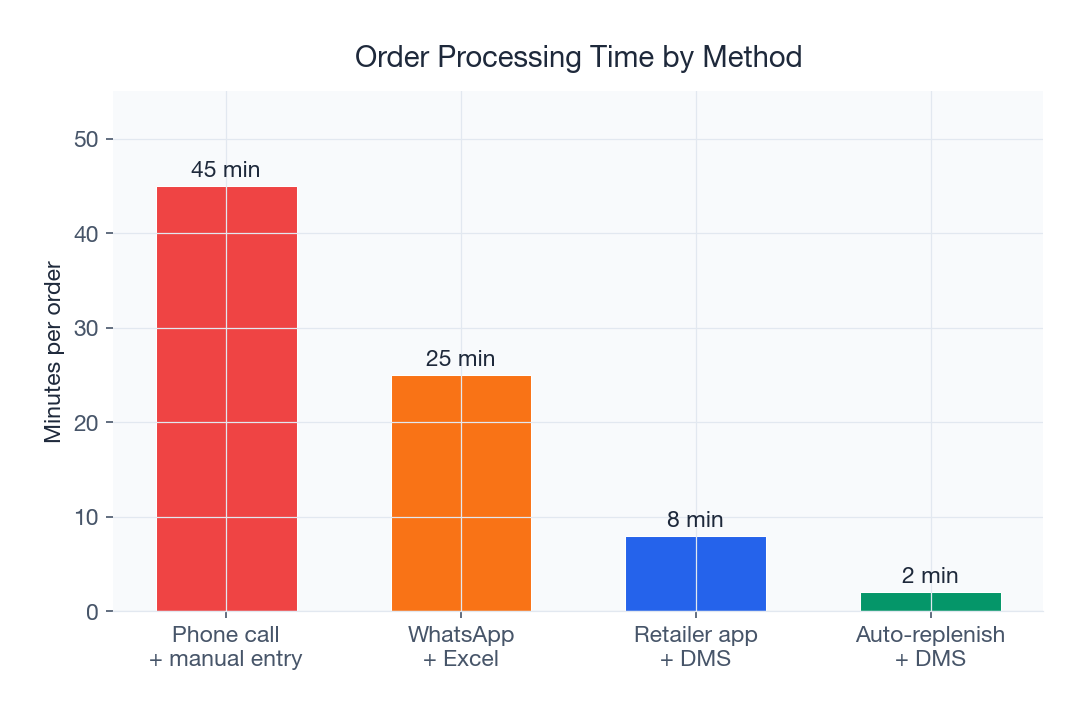
For decades, FMCG distribution in India has followed a fixed pattern: a salesman visits a retailer on a scheduled beat day, takes a handwritten order, and relays it back to the distributor's office via phone call or paper slip. This model — while deeply entrenched — creates systemic inefficiencies. Orders can only be placed during the salesman's visit. Urgent restock needs between visits go unmet. The salesman becomes a bottleneck, handling 30-40 retailers per day and spending as much time on logistics as on selling.
Retailer self-ordering apps break this dependency by giving kirana store owners and modern trade retailers a direct digital channel to place orders with their distributor — anytime, from anywhere. Whether through a dedicated mobile app or a simple WhatsApp-based interface, self-ordering transforms the distributor-retailer relationship from periodic salesman visits to always-on, on-demand supply.
The shift is already underway. Major FMCG companies operating in Mumbai, Delhi, and Bangalore report that 30-40% of retailer orders now come through digital channels. But in tier-2 and tier-3 markets — where 70% of India's retail volume sits — adoption is still below 10%. This guide covers everything distributors need to know about implementing retailer ordering apps, from the technology to the ground-level adoption challenges that determine success or failure.
How Retailer Ordering Apps Work
Modern retailer ordering systems offer multiple interfaces to accommodate India's diverse retail landscape:
Dedicated Mobile App
A branded mobile application installed on the retailer's smartphone. The retailer logs in, browses the product catalog with real-time pricing and stock availability, adds items to cart, applies available trade schemes automatically, and places the order. The order flows directly into the distributor's order management system for processing and dispatch.
SpireStock's mobile app includes a retailer-facing portal where shop owners see their order history, outstanding payments, scheme eligibility, and delivery status — creating a self-service experience that reduces inbound calls to your office by 60-70%.
WhatsApp-Based Ordering
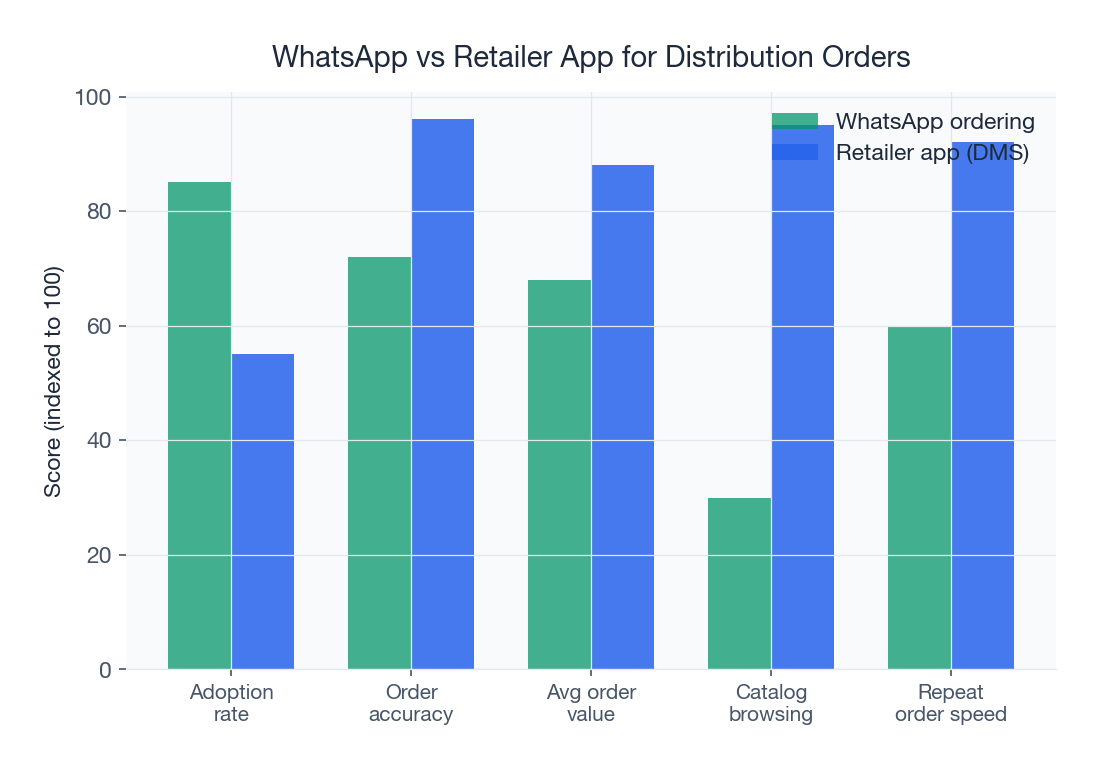
For retailers in Lucknow, Surat, and other tier-2/3 markets who are uncomfortable with new apps, WhatsApp-based ordering provides a familiar interface. The retailer sends a message (or selects from a pre-built catalog) on WhatsApp, and the system parses the order, confirms pricing, and routes it into the distributor's order pipeline. This approach achieves 3-4x higher adoption rates in non-metro markets compared to app-only strategies.
USSD and Missed-Call Ordering
For the long tail of retailers using feature phones — still 15-20% of India's kirana universe — USSD menus and missed-call-triggered IVR ordering provide a digital path. While less sophisticated, these channels ensure no retailer is excluded from the self-ordering ecosystem due to device limitations.
Benefits for Distributors
| Benefit | Manual Ordering | Self-Ordering App | Impact |
|---|---|---|---|
| Order capture window | Only during salesman visit | 24/7 | 40-60% more orders captured |
| Order accuracy | 85-90% (handwritten errors) | 99%+ (digital catalog) | Near-zero errors |
| Time from order to dispatch | 12-24 hours | 2-4 hours | 70-80% faster |
| Average order value | Baseline | 15-25% higher | Scheme visibility drives upselling |
| Order frequency | 1-2x per week | 2-4x per week | Smaller, more frequent orders |
| Salesman time on selling vs. order-taking | 40% selling / 60% order-taking | 80% selling / 20% order-taking | 2x selling time |
The most transformative benefit is freeing your salesmen from routine order-taking. When retailers place their own replenishment orders, the salesman's visit shifts from order collection to relationship building, merchandising, scheme promotion, and new product introduction — activities that drive real growth. Read our guide on secondary sales tracking to understand how self-ordering data feeds into sell-through analytics.
Benefits for Retailers
Adoption only happens when retailers see clear value. Here is what drives retailer engagement:
- Order anytime — A kirana store owner in Ahmedabad can reorder fast-moving SKUs at 10 PM after closing shop, instead of waiting for Monday's salesman visit
- See live schemes and discounts — The app surfaces all eligible trade schemes automatically, so retailers never miss a promotion they qualify for
- Track order and delivery status — Real-time visibility into when their order will arrive, eliminating uncertainty and follow-up calls
- View order history and payment ledger — Complete digital record of past orders, invoices, credit notes, and outstanding balances
- Reduce dependency on salesman — No more missed orders because the salesman didn't visit or was in a hurry
- Access to full product catalog — Salesmen often push high-margin or incentivized SKUs. The app shows the complete catalog, letting retailers order what they actually need
The Tier-2/3 Adoption Challenge
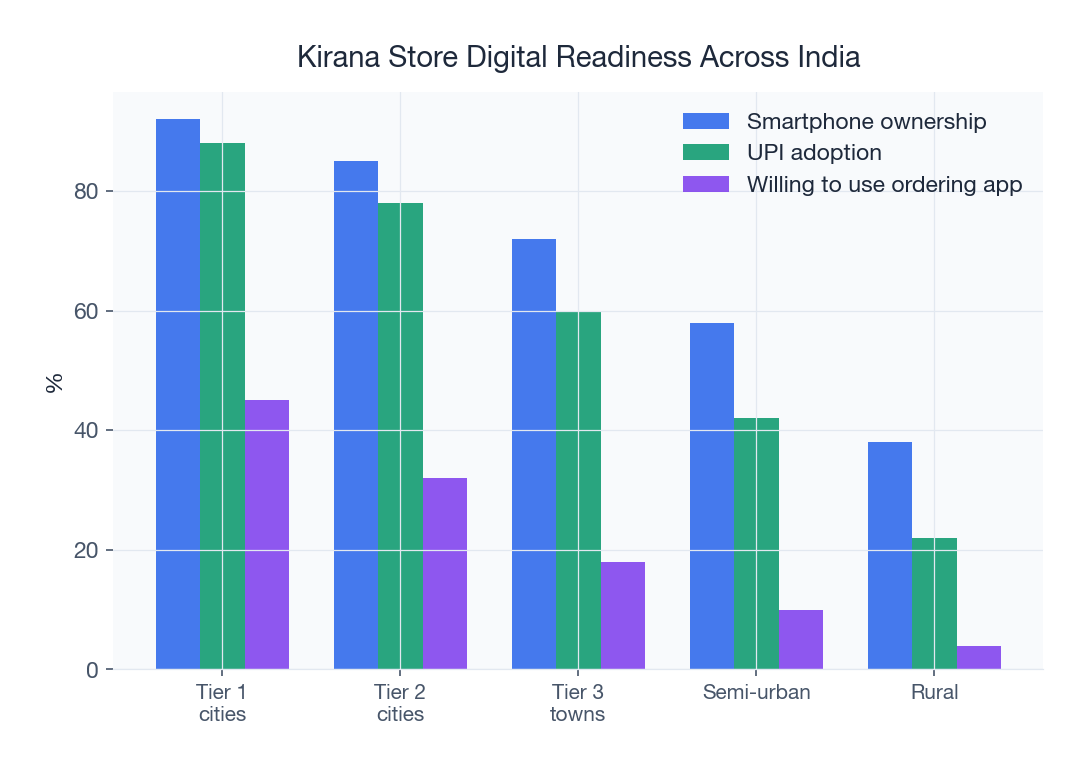
Here is the hard truth: retailer self-ordering works brilliantly in metros but faces significant adoption friction in India's tier-2, tier-3, and rural markets. Understanding and solving these challenges is the difference between a successful rollout and an expensive flop.
Challenge 1: Smartphone Literacy
While smartphone penetration in India exceeds 75%, many kirana store owners — especially those aged 45+ in smaller towns — use their phones primarily for calls and WhatsApp. Asking them to install, navigate, and regularly use a new ordering app is a bigger ask than metro-centric product teams realize.
Solution: Offer WhatsApp ordering as the primary channel in tier-2/3 markets. Use the dedicated app as an upgrade path for tech-comfortable retailers. In Chennai and Kolkata, distributors who led with WhatsApp achieved 45-55% adoption in 6 months, versus 15-20% for app-only approaches.
Challenge 2: Trust and Relationship Dynamics
In smaller markets, the relationship between retailer and salesman is deeply personal. Many retailers worry that self-ordering means the salesman will stop visiting, which they value for credit negotiations, complaint resolution, and market information. Some salesmen actively discourage app adoption, fearing their role will be eliminated.
Solution: Position the app as supplementary to the salesman, not a replacement. The salesman continues scheduled visits but focuses on relationship building, merchandising, and problem-solving instead of routine order-taking. Incentivize salesmen on retailer app adoption — make it their KPI, not their threat.
Challenge 3: Connectivity in Smaller Markets
4G coverage is inconsistent in many tier-3 locations. An ordering app that requires constant connectivity will frustrate retailers and drive abandonment.
Solution: The app must support offline browsing and order drafting, with auto-submission when connectivity returns. WhatsApp ordering inherently handles intermittent connectivity better than custom apps.
Challenge 4: Vernacular Language Needs
An English-only or even Hindi-only app excludes large portions of India's retail universe. A kirana owner in Tamil Nadu or Kerala needs the interface in their local language.
Solution: Support at least Hindi, English, Marathi, Tamil, Telugu, Kannada, and Bengali. SpireStock's retailer app supports 8 Indian languages with auto-detection based on the device's language setting.
Implementation Playbook for Distributors
Based on 150+ successful retailer app deployments across India, here is a proven 12-week playbook:
- Week 1-2: Configure the platform — Set up product catalog with images, pricing tiers per retailer segment, scheme rules, and minimum order values. Ensure the order management backend is processing orders correctly.
- Week 3-4: Train your salesmen first — Every salesman must be an expert on the retailer app before they promote it. Run 2-hour training sessions per territory. Align incentives: salesmen earn a bonus for every retailer they onboard.
- Week 5-8: Retailer onboarding in waves — Start with your top 20% of retailers by order volume. The salesman personally installs the app or registers the retailer on WhatsApp during their visit, places the first order together, and explains the value proposition. Move to the next tier of retailers every 2 weeks.
- Week 9-10: Drive repeat usage — First-time installation means nothing without repeat usage. Send push notifications for new schemes, back-in-stock alerts for popular SKUs, and payment reminders. Offer a first-order discount exclusively through the app.
- Week 11-12: Measure and optimize — Track adoption rate, repeat order rate, average order value through app vs. salesman, and retailer feedback. Identify and address drop-off points.
For retailers who need additional support, the retailer tracking solution provides engagement analytics that show which retailers are active, dormant, or at risk of dropping off.
How Self-Ordering Integrates with Your Distribution System
A retailer ordering app is not a standalone tool — it must integrate tightly with your entire distribution workflow:
- Inventory — The catalog shows only in-stock items with real-time availability, preventing orders for out-of-stock SKUs. Read our guide on inventory management software for distributors for full coverage.
- Pricing and schemes — Retailer-specific pricing tiers, volume discounts, and trade schemes apply automatically based on the retailer's profile
- Credit limits — Orders are checked against the retailer's credit limit before confirmation, preventing overdue situations
- Route planning — Self-service orders feed into route optimization for next-day delivery planning
- Billing — Confirmed orders auto-generate GST-compliant invoices, eliminating manual billing
- Analytics — Order patterns feed into sales analytics for demand forecasting, SKU rationalization, and territory performance analysis
The distributor management solution from SpireStock brings all of these touchpoints together in a single platform, ensuring that retailer-placed orders flow seamlessly from placement to delivery to payment.
Measuring Success: Key Metrics to Track
After launching a retailer ordering app, track these metrics monthly to gauge success:
| Metric | Target (6 Months Post-Launch) | Why It Matters |
|---|---|---|
| Retailer activation rate | 50-60% of active retailers | Measures adoption breadth |
| Repeat order rate | 70%+ of activated retailers order monthly | True adoption vs. one-time trial |
| Digital order share | 30-40% of total orders via app/WhatsApp | Channel shift progress |
| Average order value (app) | 15-25% higher than salesman orders | Scheme visibility drives upselling |
| Order-to-delivery time | Under 6 hours for same-day orders | Speed reinforces app usage |
| Salesman time on selling activities | 70%+ (vs. 40% baseline) | The real productivity dividend |
The Future: From Ordering to Full Retailer Engagement
Retailer ordering apps are just the starting point. Leading FMCG distributors and consumer goods companies are evolving these platforms into full retailer engagement ecosystems that include loyalty programs, digital lending (buy-now-pay-later for kirana), merchandising compliance checks, and market intelligence gathering. The distributor who builds the strongest digital relationship with retailers today will own the channel tomorrow.
Explore our pricing plans to find the right fit for your distribution network, or start a free 14-day trial to see retailer self-ordering in action.
Frequently Asked Questions
What is a retailer ordering app for FMCG distribution?
A retailer ordering app is a digital platform that allows kirana stores and modern trade retailers to place orders directly with their distributor via a mobile app or WhatsApp, without waiting for a salesman's visit. Orders flow into the distributor's management system for automatic processing, invoicing, and dispatch.
How is WhatsApp ordering different from a dedicated app?
WhatsApp ordering uses the retailer's existing WhatsApp to interact with a business catalog or chatbot. It requires no new app installation, making adoption easier in tier-2/3 markets. A dedicated app offers richer features — full catalog browsing, scheme calculators, order tracking, payment ledger — but requires the retailer to install and learn a new application.
Will a retailer app replace my salesmen?
No. The app replaces routine order-taking, which currently consumes 60% of a salesman's time. Salesmen shift to higher-value activities: relationship building, merchandising, scheme promotion, new product introduction, and competitive intelligence. Companies that deploy retailer apps typically retain their field force but see 25-35% higher productivity per salesman.
What adoption rate can I expect in tier-2 and tier-3 markets?
With a WhatsApp-first approach and active salesman-driven onboarding, expect 30-40% retailer activation within 6 months in tier-2 markets and 15-25% in tier-3 markets. Dedicated app-only approaches typically achieve half these numbers. The key is meeting retailers where they are comfortable.
How do I handle retailers who refuse to use the app?
Always maintain the salesman order channel for retailers who prefer it. Forcing adoption creates resentment. Instead, create natural incentives: app-exclusive schemes, faster delivery for digital orders, and visibility into promotions. Most holdouts convert within 6-12 months as they see peers benefiting.
Does the retailer ordering app work for perishable goods like dairy?
Yes, and it is particularly valuable for dairy distribution where ordering windows are tight and daily replenishment is standard. Retailers place orders by the evening cutoff, and the system aggregates demand for next-morning production and dispatch. This is far more reliable than phone-based ordering where calls get missed or misheard.
Sources & References
- Redseer Strategy Consultants, Digitization of India's Kirana Ecosystem 2025
- Nielsen India, India Retail Channel Evolution Report 2025
- CAIT (Confederation of All India Traders), Indian Retail Trade Survey 2024-25
Frequently Asked Questions
A retailer ordering app is a digital platform that allows kirana stores and modern trade retailers to place orders directly with their distributor via a mobile app or WhatsApp, without waiting for a salesman's visit. Orders flow into the distributor's management system for automatic processing, invoicing, and dispatch.
WhatsApp ordering uses the retailer's existing WhatsApp to interact with a business catalog or chatbot, requiring no new app installation. A dedicated app offers richer features like full catalog browsing, scheme calculators, and order tracking but requires installation and learning.
No. The app replaces routine order-taking, freeing salesmen for higher-value activities like relationship building, merchandising, and scheme promotion. Companies typically see 25-35% higher productivity per salesman.
With a WhatsApp-first approach, expect 30-40% retailer activation within 6 months in tier-2 markets and 15-25% in tier-3 markets. Dedicated app-only approaches achieve roughly half these numbers.
Always maintain the salesman order channel. Create natural incentives like app-exclusive schemes, faster delivery for digital orders, and scheme visibility. Most holdouts convert within 6-12 months.
Yes, it is particularly valuable for dairy distribution where ordering windows are tight. Retailers place orders by evening cutoff, and the system aggregates demand for next-morning production and dispatch.
Related SpireStock Features
Related Industries
Streamline FMCG distribution with order management, beat planning, retailer tracking, and GST billing. Built for Indian FMCG supply chains.
Distribution management for consumer goods brands. Manage distributors, retailers, schemes, and sales analytics across India. Start free trial.
Related Solutions
Track and manage your retail network. Geo-tag outlets, capture secondary sales, manage beats, and monitor retailer performance. Try SpireStock.
Manage your entire distributor network digitally. Onboarding, credit limits, outstanding tracking, and performance analytics. Start free trial.
Related Entities
Ready to Streamline Your Distribution?
Start your free 14-day trial and see how SpireStock can transform your dairy, FMCG or consumer-goods distribution operation, from order capture to crate recovery.

SpireStock Team
Distribution Technology Experts
SpireStock Team writes for SpireStock on distribution management, supply-chain optimisation and field operations for Indian dairy and FMCG brands.