Why Rural India Demands a Different Distribution Software Approach
India's rural economy is not a smaller version of its urban counterpart — it is a fundamentally different operating environment. With over 650,000 villages spread across 28 states, rural India contributes approximately 45% of the country's total FMCG consumption, valued at over ₹4.5 lakh crore annually. Yet, the vast majority of distribution management software on the market today was designed for urban supply chains — reliable 4G connectivity, smartphone-literate salespeople, and dense outlet networks within a few square kilometres.
The result? Distributors serving rural territories are stuck with paper registers, WhatsApp groups, and Excel sheets — or worse, they have paid for software that simply does not work once their salesmen step outside taluka headquarters. According to TRAI data from early 2026, only about 60% of rural India has consistent 3G or 4G coverage. In states like Jharkhand, Chhattisgarh, and parts of Odisha, connectivity drops to under 40% in interior villages.
This is not a minor inconvenience. When a salesman covering a beat of 25 villages across 80 km cannot sync orders because there is no network, the entire supply chain breaks down — orders are missed, invoices are delayed, and sales analytics become unreliable. Rural distribution software must be built from the ground up for these realities, not retrofitted as an afterthought.
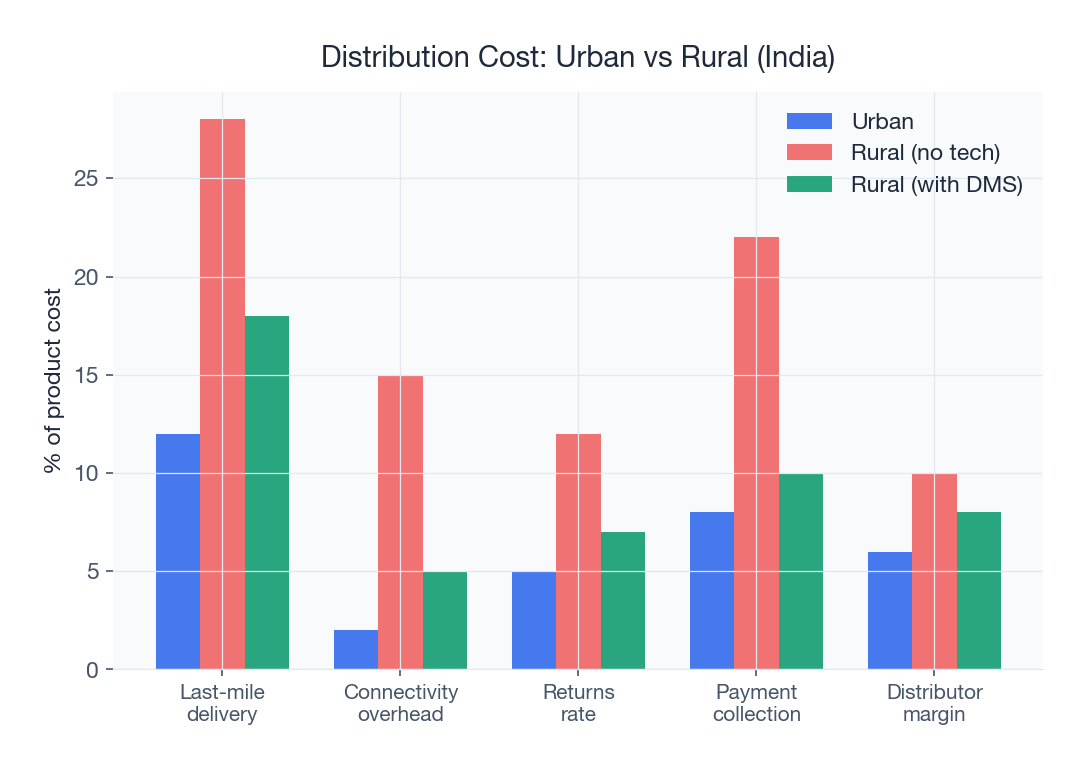
Urban vs Rural Distribution: A Comparison of Challenges
Before selecting any distribution management software, it is essential to understand how rural and urban distribution differ across every critical dimension.
| Parameter | Urban Distribution | Rural Distribution |
|---|---|---|
| Outlet density | 150-300 outlets per sq km | 5-15 outlets per sq km |
| Average beat distance | 8-15 km per day | 60-120 km per day |
| Network connectivity | 4G/5G available 95%+ of time | 3G/4G available 40-60% of time |
| Salesman education | Graduate or above | Often 10th/12th pass or below |
| Average order value | ₹3,000-₹15,000 per retailer | ₹500-₹3,000 per retailer |
| Payment method | UPI, cheque, NEFT common | Cash dominant (70%+ transactions) |
| Language preference | English/Hindi acceptable | Regional language essential |
| Road infrastructure | Paved roads, GPS-accurate maps | Kachha roads, GPS often inaccurate |
| Delivery frequency | Daily or alternate day | Weekly or fortnightly |
| Smartphone quality | Mid-range to flagship devices | Entry-level phones (2-3 GB RAM) |
This table makes one thing clear: a software solution designed for urban parameters will fail catastrophically in rural India. The challenges are not incremental — they are structural. Any serious mobile app for distribution must address each of these gaps.
The Offline-First Architecture: How It Actually Works
The single most important feature of rural distribution software is offline-first capability. But what does "offline-first" actually mean from a technical standpoint?
Local Database with Intelligent Sync
An offline-first app stores a complete local database on the salesman's device. This includes the retailer master list, product catalogue with current pricing, outstanding balances, scheme details, and recent order history. When the salesman visits a village with no connectivity, every operation — placing orders, recording payments, marking attendance, capturing retailer feedback — happens against this local database.
When connectivity is restored — even briefly, such as passing through a town — the app automatically syncs all pending transactions to the central server. Modern sync engines use conflict resolution algorithms to handle scenarios where the same data was modified on multiple devices. For example, if a distributor updated a product price while the salesman was offline, the system applies the newer price and flags affected orders for review.
Low-Data-Mode Operations
Even when network is available, rural areas often have extremely slow connections — sometimes as low as 50-100 Kbps on congested 3G towers. Effective rural distribution software operates in a low-data mode where:
- Compressed data packets: Order sync uses 2-5 KB per transaction instead of 50-100 KB in standard mode
- Image compression: Retail visit photos are compressed to under 100 KB before upload, with full-resolution versions synced during WiFi availability
- Delta sync: Only changed records are transferred, not entire databases — reducing daily data usage to 5-10 MB even for active salesmen
- Priority queuing: Critical data like orders and payments sync first; lower-priority items like visit photos sync later
SpireStock's distribution tracking system is built on this exact architecture, ensuring that rural distributors in cities like Lucknow, Jaipur, and Indore — and their vast surrounding rural belts — get the same data accuracy as urban operations.
Vernacular UI: Speaking the Language of Rural India
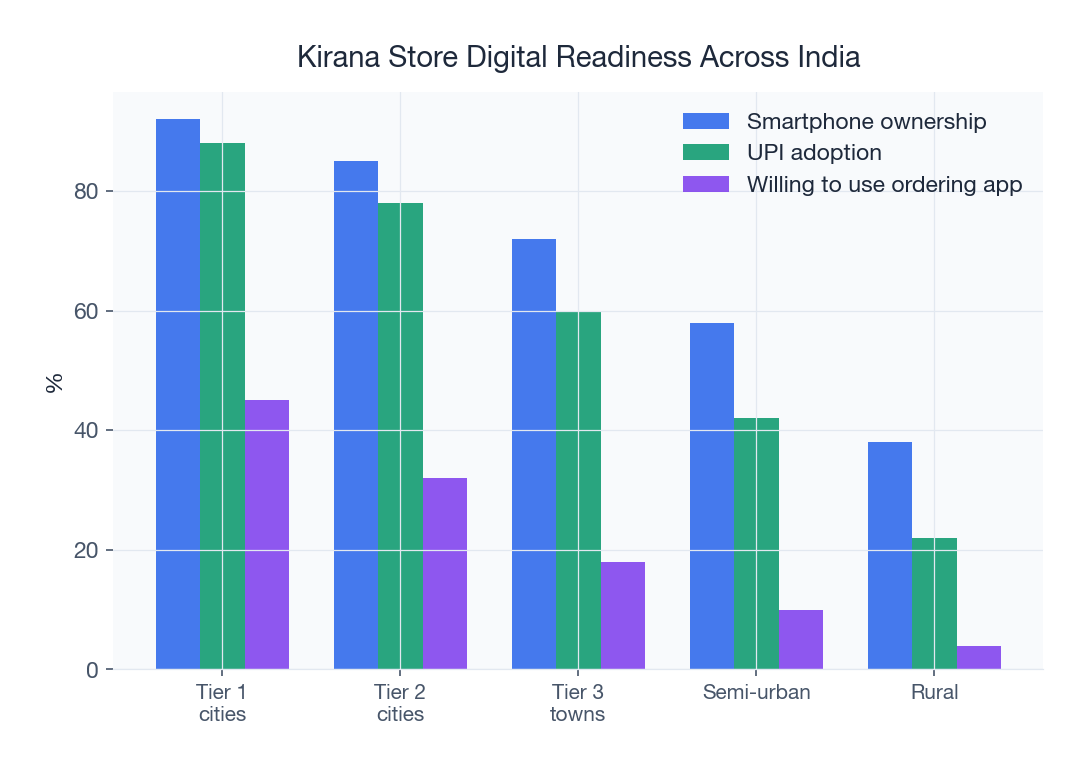
India has 22 officially recognised languages and over 19,500 dialects. In rural areas, expecting a salesman who completed schooling in Marathi-medium to navigate an English-only app is unrealistic and counterproductive. Yet, most distribution software offers only English or basic Hindi interfaces.
Languages That Matter for Rural FMCG
Based on FMCG distribution volumes across states, the critical languages for rural distribution software include:
- Hindi: Uttar Pradesh, Madhya Pradesh, Rajasthan, Bihar, Jharkhand — covering over 40% of rural FMCG volume
- Marathi: Maharashtra's rural districts including Vidarbha, Marathwada, and Western Maharashtra
- Tamil: Tamil Nadu's extensive rural kirana network — over 180,000 rural outlets
- Telugu: Andhra Pradesh and Telangana, with a combined rural population exceeding 5 crore
- Kannada: Karnataka's North Karnataka and Malnad regions
- Bengali: West Bengal's rural districts, critical for dairy and FMCG distribution
- Gujarati: Gujarat's rural cooperative networks, especially dairy distribution
The interface must go beyond simple translation. Icons, colour coding, and visual workflows become essential. A well-designed mobile distribution app uses large buttons, pictorial product selection (showing the actual product image rather than just text), and voice-assisted data entry for salesmen who are more comfortable speaking than typing.
Simplified Workflows for Semi-Literate Staff
In rural distribution, the field force often includes delivery drivers and sales helpers who may have limited formal education. Software designed for this workforce must offer:
- Three-tap ordering: Select retailer (from photos/icons), select products (from images), confirm quantity — order placed
- Voice notes instead of typed remarks: A salesman can record "dukaan bandh thi, kal aaunga" instead of typing it
- Visual dashboards: Green/red colour coding for targets instead of numerical tables
- Auto-populated fields: Previous order quantities pre-filled, reducing data entry by 60-70%
Rural Beat Planning: Covering Large Territories Efficiently
Urban beat planning is relatively straightforward — a salesman covers 25-40 outlets within a 10 km radius. Rural beat planning is an entirely different challenge. A single rural beat might cover 15-25 villages spread across 80-120 km, with road quality varying from national highways to unpaved tracks that become impassable during monsoons.
Territory Mapping and Route Optimisation
Effective route optimisation for rural distribution must account for factors that urban algorithms ignore:
- Seasonal road conditions: Routes that work in October may be flooded in July. The system must maintain monsoon-specific alternate routes
- Market day scheduling: Many rural outlets operate primarily on weekly haat (market) days. Beat plans must align with these local schedules
- Fuel cost optimisation: With diesel at ₹92-95 per litre and rural beats covering 80+ km daily, route efficiency directly impacts distribution cost per case
- Vehicle constraints: Rural delivery often uses three-wheelers or mini trucks that cannot navigate all roads. Route planning must consider vehicle type
A well-optimised rural route can reduce daily travel distance by 15-25%, saving ₹300-500 per salesman per day in fuel and time costs alone. For a distributor with 10 rural salesmen, that translates to annual savings of ₹9-15 lakh.
Attendance and Field Force Tracking in Low-Connectivity Zones
Attendance tracking in rural areas cannot rely solely on GPS check-ins that require real-time connectivity. Offline-capable attendance systems use:
- GPS coordinate capture with local storage: Location is recorded on-device and synced later
- Photo-based verification: Geo-tagged selfies at retailer locations, stored locally
- Cell tower triangulation: Approximate location using cell tower data, which works even on 2G networks
- Beat compliance scoring: Automated calculation of how closely the salesman followed the planned route, computed after sync
Case Study: How a Chhattisgarh Dairy Distributor Transformed Rural Operations
Consider the experience of a mid-size dairy distributor operating across 12 districts in Chhattisgarh — a state where rural connectivity remains among the lowest in India. Before adopting offline-first distribution software, the operation faced severe challenges.
Key insight: The distributor was losing an estimated 12-15% of potential daily orders because salesmen could not place orders digitally in areas with no connectivity, reverting to paper slips that were often lost or illegible by the time they reached the depot.
The Before Picture
- Order capture: Paper-based in 70% of villages, with 8-12% order entry errors
- Daily sync failures: 35-40% of salesmen could not upload orders before the evening cut-off
- Route deviation: No visibility into actual routes taken; estimated 25% excess fuel spending
- Scheme compliance: Rural retailers received incorrect scheme benefits in 20%+ of orders because the salesman manually calculated discounts
- Collection tracking: Cash collections from rural beats took 2-3 days to reconcile with the accounts team
The Transformation
After implementing offline-first distribution software with vernacular Chhattisgarhi-Hindi interface, the results over 6 months were substantial:
- Order capture accuracy: Improved from 88% to 99.2%, with all orders captured digitally regardless of connectivity
- Daily order completion: 100% of orders synced within 24 hours, with 85% syncing within 4 hours
- Route optimisation savings: ₹4.2 lakh per month in fuel costs across the fleet, a 22% reduction
- Revenue uplift: 18% increase in rural secondary sales within two quarters, attributed to zero missed orders and better scheme execution
- Salesman productivity: Average daily outlet coverage increased from 18 to 26 outlets per salesman
This transformation mirrors what brands like Amul and ITC have achieved at scale across their rural distribution networks.
How Leading Brands Solved Rural Distribution with Technology
Amul's Rural Distribution Model
Amul operates one of the world's most extensive rural distribution networks, collecting milk from over 36 lakh dairy farmers across 18,600+ village-level cooperative societies. Their distribution model succeeds because of:
- Decentralised data capture: Each village society operates with local data storage that syncs to district-level servers
- Vernacular interfaces: Systems operate in Gujarati, Hindi, Marathi, and other regional languages depending on the state
- Simplified workflows: Milk collection data entry requires only quantity and fat percentage — two fields, not twenty
- SMS-based fallback: In areas with no data connectivity, critical updates are sent via SMS, ensuring minimum viable communication
ITC's e-Choupal to Distribution Integration
ITC's rural strategy leverages its e-Choupal network of 6,100 installations across 35,000 villages. The company's distribution software integrates:
- Village-level demand forecasting: Using historical purchase data from each cluster to predict demand for products ranging from Aashirvaad atta to Bingo chips
- Hub-and-spoke delivery: Large trucks deliver to taluka-level hubs; smaller vehicles complete last-mile delivery to villages
- Sanchalak-assisted ordering: Village-level coordinators (sanchalaks) aggregate demand, reducing per-outlet distribution cost
Both models demonstrate that rural distribution at scale is achievable — but only with purpose-built technology that respects the constraints of rural India.
Key Features to Evaluate in Rural Distribution Software
When selecting distribution software for rural operations, distributors should evaluate these critical capabilities:
1. Offline Capability Depth
Not all "offline modes" are equal. Test whether the app supports full order creation, payment recording, new retailer onboarding, and scheme application without any connectivity — not just viewing cached data.
2. Device Compatibility
Rural salesmen typically carry entry-level smartphones — devices like Redmi 9A or Realme C-series with 2-3 GB RAM. The app must run smoothly on Android 10 and above with less than 100 MB of installed size. Heavy apps that consume 500 MB or more are unsuitable for rural deployment.
3. Battery Efficiency
Rural beats mean 8-10 hours away from charging points. Distribution apps that aggressively use GPS and data sync can drain a budget phone's 5,000 mAh battery by early afternoon. Look for apps with intelligent location sampling — capturing GPS every 5 minutes instead of continuously — and background sync that activates only when the phone is charging or connected to WiFi.
4. Multi-Language Support
Verify that the app supports the specific languages your field force needs. Ensure that product names, scheme descriptions, and alert messages are all translated — not just menu labels. A half-translated app creates more confusion than an English-only one.
5. Integration with Rural Payment Methods
Rural transactions are predominantly cash-based. The software must support robust cash collection tracking, denomination recording, and integration with basic UPI for the growing number of rural retailers who accept digital payments. For cost-effective rural distribution, accurate payment tracking is non-negotiable.
Implementation Best Practices for Rural Distribution Software
Rolling out distribution software in rural territories requires a different playbook than urban deployment.
Phased Rollout by Connectivity Zones
Classify your rural territory into three zones:
- Zone A (Good connectivity): Taluka headquarters and large villages along national highways — deploy standard features
- Zone B (Intermittent connectivity): Villages with patchy 3G/4G — deploy with offline-first mode and scheduled sync windows
- Zone C (Minimal connectivity): Remote villages with 2G or no coverage — deploy with full offline mode, SMS fallback, and weekly manual sync at the nearest town
Training in the Local Language
Conduct training sessions in the regional language, not in English or corporate Hindi. Use video tutorials that salesmen can replay on their phones. Pair each new user with a "tech buddy" — an existing salesman who has already mastered the app. This peer-learning approach achieves 3x faster adoption than classroom training.
Incentivise Digital Adoption
Offer small monetary incentives (₹50-100 per day) for the first month to salesmen who achieve 100% digital order capture. This offset addresses the initial friction of switching from paper-based habits and typically pays for itself within weeks through improved order accuracy and faster processing.
The ROI of Rural Distribution Software
For a distributor covering 500 rural outlets across 100+ villages, the typical ROI calculation looks like this:
| Cost/Benefit Item | Monthly Impact (₹) |
|---|---|
| Software subscription cost | -₹8,000 to -₹15,000 |
| Fuel savings from route optimisation | +₹25,000 to +₹40,000 |
| Revenue from recovered missed orders | +₹50,000 to +₹1,20,000 |
| Reduced order entry errors | +₹10,000 to +₹20,000 |
| Faster payment collection | +₹15,000 to +₹30,000 |
| Reduced paper/printing costs | +₹3,000 to +₹5,000 |
| Net monthly benefit | +₹95,000 to +₹2,00,000 |
Most rural distributors achieve full ROI within 2-3 months of deployment, making this one of the highest-return technology investments available to Indian distributors.
Future Trends: What's Next for Rural Distribution Technology
Several emerging trends will shape rural distribution software over the next 2-3 years:
- AI-powered demand prediction: Machine learning models trained on rural purchase patterns, accounting for seasonality (harvest cycles, festival periods) and local events (weekly haats, melas)
- Satellite connectivity: Jio's satellite broadband initiative and Starlink's India entry (expected 2027) could bring reliable internet to remote villages, though offline capability will remain essential as a fallback
- Voice-first interfaces: Natural language processing in Indian languages enabling salesmen to place orders by simply speaking — "Sharma ji ki dukaan pe 5 case Parle-G aur 2 case Good Day bhejo
- Drone-assisted last mile: Pilot programmes in Telangana and Uttarakhand are testing drone delivery for high-value, low-weight FMCG products to inaccessible villages
Getting Started: Choosing the Right Solution
If you are a distributor serving rural India — or an FMCG brand building rural distribution capabilities — the time to adopt offline-first distribution software is now. The gap between digitised urban distribution and paper-based rural operations is widening, and distributors who do not bridge this gap will lose competitiveness as FMCG distribution evolves in 2026 and beyond.
SpireStock is purpose-built for Indian distribution realities, including the unique challenges of rural operations. With offline-first architecture, vernacular language support, and workflows designed for real field conditions, it helps distributors across fleet management and sales productivity in even the most connectivity-challenged territories.
Ready to transform your rural distribution operations? Talk to our team for a personalised demo, or explore our pricing plans designed for distributors of every size.
This guide covers one part of the picture. For the category as a whole — what a DMS does, the modules that matter, how it differs from ERP and SFA, and what it costs in India — see our distributor management system guide.
Sources & References
- TRAI Telecom Subscription Data Reports 2025-2026
- Nielsen India Rural FMCG Consumption Report 2025
- National Dairy Development Board Annual Report 2025-26
Frequently Asked Questions
Yes, offline-first distribution software stores all essential data locally on the device. Orders, payments, attendance, and retailer data are captured without connectivity and automatically sync when network is available — even briefly while passing through a town.
At minimum, Hindi, Marathi, Tamil, Telugu, Kannada, Bengali, and Gujarati. The interface should go beyond menu translation to include product names, scheme descriptions, and alerts in the local language for effective adoption by semi-literate field staff.
Well-optimised offline-first software uses only 5-10 MB per day through compressed data packets and delta sync. This is critical in rural areas where salesmen may have limited mobile data plans of 1-1.5 GB per day.
Typical monthly costs range from ₹8,000 to ₹15,000 depending on the number of users and features. Most rural distributors achieve full ROI within 2-3 months through fuel savings, recovered missed orders, and reduced errors.
Offline-capable systems capture GPS coordinates locally and sync later. Supplementary methods include geo-tagged photos at retailer locations, cell tower triangulation for approximate location, and automated beat compliance scoring computed after data sync.
A good rural distribution app runs on entry-level devices with 2-3 GB RAM and Android 10 or above. The app should be under 100 MB in size and battery-efficient, using intelligent GPS sampling to last through a full 8-10 hour rural beat.
Rural beats cover 60-120 km daily across 15-25 villages, compared to 8-15 km in cities. Planning must account for seasonal road conditions, weekly market days, vehicle constraints on unpaved roads, and fewer outlets per kilometre requiring larger territories.
Yes, most modern distribution software offers API-based integration with Tally, Busy, and other popular ERP systems used by Indian distributors. Data syncs automatically once connectivity is available, maintaining accurate records across both systems.
Related SpireStock Features
Mobile app for distributors, retailers, and delivery teams.
Real-time GPS tracking of vehicles and drivers with route optimization for faster deliveries.
Zone, town, and route-based delivery management with optimization.
Geo-tagged attendance with location verification and travel analytics.
Related Industries
Streamline FMCG distribution with order management, beat planning, retailer tracking, and GST billing. Built for Indian FMCG supply chains.
End-to-end dairy distribution software for milk, curd, paneer, and ghee brands. Manage orders, crates, cold chain, and GST billing in one platform.
Distribution management for consumer goods brands. Manage distributors, retailers, schemes, and sales analytics across India. Start free trial.
Related Solutions
Manage your entire distributor network digitally. Onboarding, credit limits, outstanding tracking, and performance analytics. Start free trial.
GPS fleet tracking, driver management, and route optimization for dairy and FMCG delivery vehicles. Reduce fuel costs by 25%. Try SpireStock.
Boost field sales team productivity with beat planning, GPS attendance, order capture, and performance analytics. Built for Indian FMCG teams.
Ready to Streamline Your Distribution?
Start your free 14-day trial and see how SpireStock can transform your dairy, FMCG or consumer-goods distribution operation, from order capture to crate recovery.

SpireStock Team
Distribution Technology Experts
SpireStock Team writes for SpireStock on distribution management, supply-chain optimisation and field operations for Indian dairy and FMCG brands.