
Why Milk Route Management Is the Backbone of Dairy Distribution in India
India's dairy distribution network is unlike any other supply chain on Earth. Over 230 million tonnes of milk move through an intricate web of processing plants, distributors, retailers, and doorstep delivery agents every single year — not in weekly batches, but in daily, time-critical cycles. A single missed morning route in Mumbai can mean thousands of litres of unsold milk, unhappy retailers, and margin erosion that compounds fast.
Yet the reality on the ground is staggering: more than 65% of Indian dairy distributors still plan routes manually — using paper registers, phone calls to drivers, and gut instinct built over decades. This approach worked when a dairy served 50 outlets across one neighbourhood. It breaks down completely when you scale to 500+ outlets across a city like Bangalore or Hyderabad.
Milk route management software brings science and automation to this critical function. It plans optimal delivery sequences, assigns vehicles based on capacity and temperature requirements, schedules morning and evening dispatch windows, and tracks real-time route execution — all while calculating route-wise profitability down to the last rupee.
The Unique Challenges of Dairy Route Planning in India
Daily Recurring Routes with Zero Tolerance for Delay
Unlike FMCG products that ship weekly, dairy operates on a daily rhythm. Fresh milk, curd, and paneer must reach retailers before 7:00 AM for morning demand and again by 4:00 PM for evening sales. This creates enormous pressure on route planning — every route runs 365 days a year, and a 15-minute delay can cascade across the entire delivery network. Manual planning simply cannot handle this precision at scale.
Morning and Evening Split Deliveries
Many Indian dairy brands operate dual-shift deliveries. Morning routes carry fresh milk, curd, and buttermilk with ultra-short shelf lives, while evening routes handle paneer, cheese, flavoured drinks, and restocking. Each shift has different product mixes, different outlet priorities, and different vehicle requirements. A robust route optimization engine must handle both shifts independently while maximizing shared vehicle utilisation across the day.
Vehicle Capacity and Cold Chain Constraints
A typical dairy delivery vehicle in India — whether a Tata Ace, Mahindra Bolero, or refrigerated mini-truck — has a fixed volumetric and weight capacity. Overloading causes product damage and compliance issues; underloading wastes fuel and driver time. Add temperature requirements to the mix (milk must stay below 4°C during transit), and route planning becomes a multi-variable optimization problem that manual methods cannot solve. The fleet management solution ensures every vehicle is loaded optimally and temperature-compliant throughout its route.
Urban Congestion and Tier-2/3 City Road Challenges
A delivery route through Chennai's T. Nagar market at 8:00 AM looks nothing like the same route at 6:00 AM. Traffic patterns, one-way restrictions, market loading zones, and seasonal road conditions all affect actual delivery times. In tier-2 cities like Lucknow or Surat, poor road infrastructure in certain wards can double the time needed for a 5-kilometre stretch. Software that accounts for these real-world conditions produces dramatically better routes than static manual plans.
Core Features of Milk Route Management Software
1. Intelligent Route Sequencing
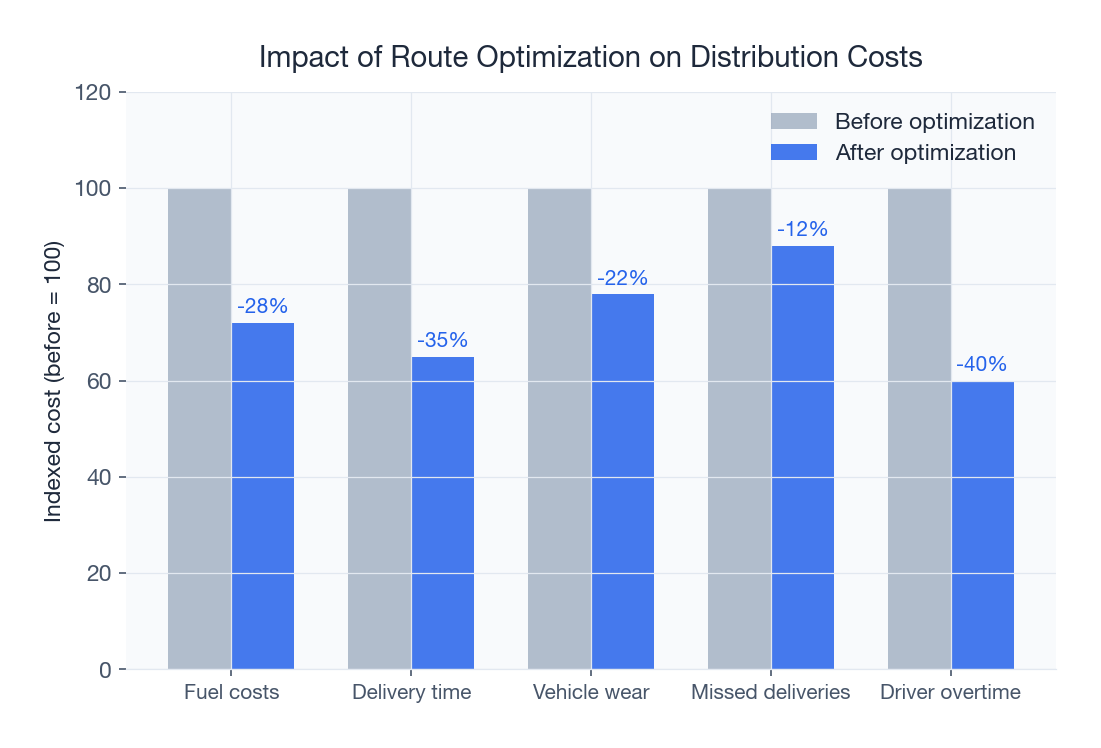
The foundation of any route management system is its sequencing algorithm. For dairy distribution, this means optimizing delivery order based on outlet priority (high-volume retailers first), time windows (schools and hospitals need early delivery), geographic clustering, and road conditions. SpireStock's route optimization calculates the most efficient sequence for each route, reducing total kilometres driven by 20-30% compared to manually planned routes.
For a dairy operating 25 routes in Pune, this translates to saving 150-200 km daily — equivalent to Rs 10-15 lakh in annual fuel costs alone.
2. Morning/Evening Delivery Scheduling
The software allows you to configure separate route templates for AM and PM delivery shifts. Each template carries its own product mix, vehicle assignment, outlet list, and cutoff time. Dispatchers see a unified dashboard showing both shifts, with real-time tracking of which routes have departed, which are in progress, and which are completed. This dual-shift visibility is critical for dairy operations where the same vehicle may serve different routes in morning and evening.
3. Vehicle Capacity Planning
Every route assignment considers the vehicle's weight capacity, volumetric capacity, and refrigeration capability. The system prevents overloading by flagging routes where order volume exceeds vehicle capacity, and suggests splits or vehicle upgrades when needed. For mixed loads — say, 200 litres of pouched milk plus 50 crates of curd plus 30 cartons of paneer — the software calculates optimal loading sequences to maximize space utilisation and minimize handling at each stop.
4. Route-Wise Profitability Analysis
Not all routes are equally profitable. A route serving 40 small kirana stores in a congested area may generate less margin than a route serving 15 large modern trade outlets in a well-connected suburb. Sales analytics integrated with route data lets you calculate true route-wise profitability by factoring in fuel cost, driver salary, vehicle depreciation, delivery time, returns, and revenue per stop. Armed with this data, you can restructure unprofitable routes, merge low-volume runs, or reprioritise high-value outlets.
5. Temperature Compliance Monitoring
FSSAI mandates that milk and dairy products maintain cold chain integrity throughout transit. Route management software integrates with vehicle-mounted temperature sensors to log temperatures at configurable intervals. If the temperature breaches the threshold at any point during the route, the system generates real-time alerts to the dispatcher and driver. This audit trail is essential for FSSAI compliance and for defending against quality complaints from retailers.
6. Real-Time GPS Tracking and Deviation Alerts
Once a vehicle departs the depot, the distribution tracking module provides live GPS visibility. Dispatchers can see exact vehicle positions, compare actual routes against planned routes, and receive alerts for unplanned stops, excessive idling, or route deviations. This transparency discourages pilferage and unauthorised detours — a persistent problem in Indian dairy distribution where driver accountability has traditionally relied on trust alone.
7. Mobile App for Drivers and Delivery Staff
The SpireStock mobile app gives delivery staff their optimised route sequence, turn-by-turn navigation, outlet details, and order quantities on their smartphones. At each stop, they record delivery confirmation with OTP verification, capture returns, and log any issues. This digital proof-of-delivery replaces paper challans and eliminates he-said-she-said disputes. Read more about digital proof of delivery in our detailed guide on digital POD for dairy and FMCG distribution.
How Route Optimization Impacts the Bottom Line
| Metric | Manual Route Planning | Software-Optimized Routes | Improvement |
|---|---|---|---|
| Average km per route | 85-110 km | 60-80 km | 25-30% reduction |
| Fuel cost per vehicle/month | Rs 28,000-35,000 | Rs 18,000-24,000 | Rs 10,000+ saved |
| Deliveries per route | 25-30 stops | 35-45 stops | 30-40% more drops |
| On-time delivery rate | 65-75% | 92-97% | Near-perfect reliability |
| Returns due to late delivery | 4-8% of dispatched value | Under 1.5% | 70% fewer returns |
| Driver overtime hours | 15-20 hrs/month | 3-6 hrs/month | 70% reduction |
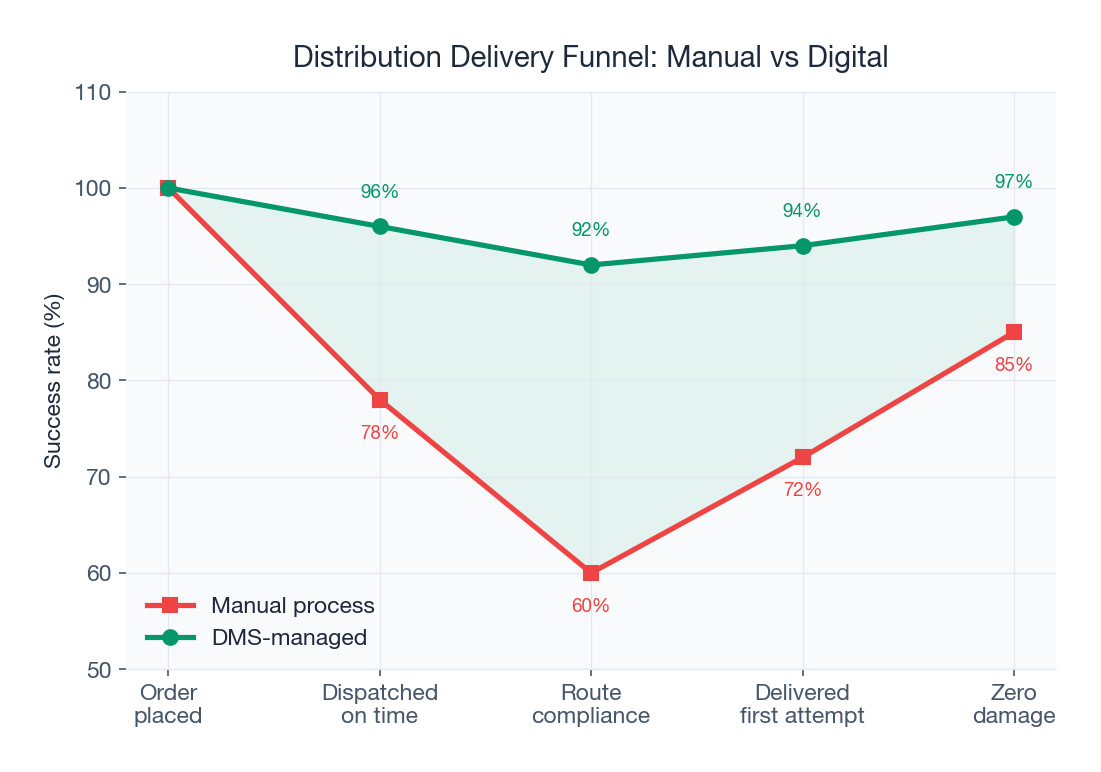
For a dairy company running 30 vehicles across Ahmedabad and nearby districts, these improvements translate to annual savings of Rs 36-48 lakh in fuel, Rs 8-12 lakh in overtime costs, and Rs 15-25 lakh in reduced returns — a combined impact of Rs 60-85 lakh against a typical software investment of Rs 8-14 lakh per year.
Route Planning for Different Dairy Operation Sizes
Small Dairies: 5-15 Routes
A local dairy serving a single city with 5-15 routes can see immediate benefits from basic route sequencing and GPS tracking. At this scale, the biggest wins come from eliminating overlapping routes (where two vehicles serve outlets in the same area on different days) and standardising delivery sequences so that new drivers can follow established patterns without a learning curve. Even small operations save Rs 8-15 lakh annually.
Mid-Sized Dairies: 15-50 Routes
At this scale, route management complexity grows exponentially. You are likely handling morning and evening shifts, multiple vehicle types, and outlets spread across urban and semi-urban areas. The distributor management solution becomes essential for coordinating between depots, managing driver rosters, and ensuring that vehicle maintenance schedules do not disrupt route coverage. Savings at this scale typically run Rs 30-60 lakh annually.
Large Dairy Networks: 50+ Routes
Multi-city dairy operations with 50+ routes need enterprise-grade route management with multi-tenant workspace capabilities. Each city or region operates as a semi-independent unit with its own routes, vehicles, and drivers, but corporate headquarters needs consolidated visibility into fleet utilisation, cost benchmarks, and service levels across all locations. Read our guide on multi-plant dairy distribution for strategies on managing this complexity.
Implementation: Getting Started with Route Management Software
Transitioning from manual to software-driven route management does not need to be disruptive. A phased approach works best for Indian dairy operations:
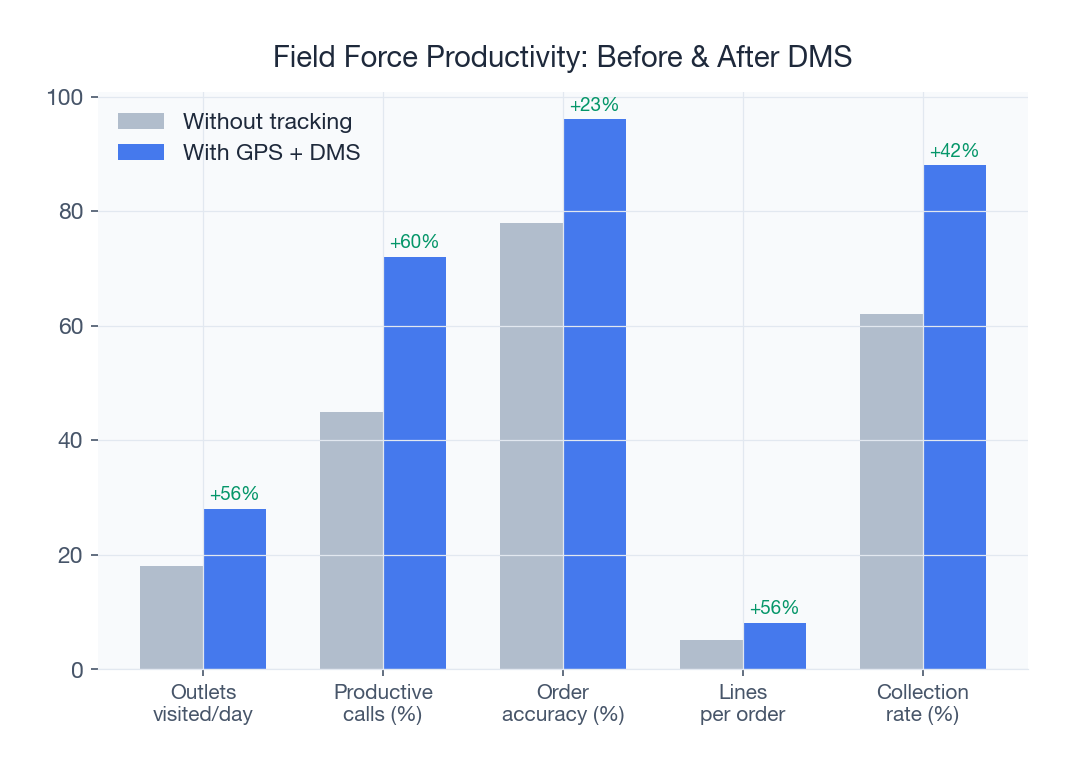
- Week 1-2: Map all existing routes, outlets, and vehicles into the system. Import historical order data to establish baseline volumes per outlet.
- Week 3-4: Run the optimization engine in shadow mode — generating recommended routes alongside your existing manual routes so dispatchers can compare and build confidence.
- Week 5-6: Go live with optimized routes for a pilot set of 5-10 routes. Measure fuel savings, on-time rates, and driver feedback.
- Week 7-8: Roll out to all routes based on pilot learnings. Fine-tune parameters for outlet priorities, time windows, and vehicle assignments.
Most dairy companies complete the full rollout within 8 weeks and see measurable ROI by week 6. For details on calculating your specific payback, read our ROI calculation guide for distribution software.
Integration with the Broader Distribution Stack
Route management does not operate in isolation. It connects with order management (routes are planned based on confirmed orders), billing (invoices are generated per route/vehicle for dispatch), crate tracking (crate issuance and returns are logged per route stop), and attendance tracking (driver check-in/check-out timestamps). This integration eliminates data silos and ensures that every team — sales, dispatch, finance, and operations — works from a single source of truth.
Frequently Asked Questions
What is milk route management software?
Milk route management software is a specialised platform that plans, schedules, and optimizes daily delivery routes for dairy distribution. It handles vehicle capacity planning, morning/evening shift scheduling, GPS tracking, temperature compliance monitoring, and route-wise profitability analysis — all tailored for the unique demands of perishable dairy logistics in India.
How much can dairy businesses save with route optimization software?
Indian dairy businesses typically save 20-30% on fuel costs, reduce delivery returns by 70%, and improve on-time delivery rates from 65-75% to over 92%. For a mid-sized operation with 20-30 vehicles, this translates to Rs 40-70 lakh in annual savings against a software investment of Rs 8-14 lakh.
Can the software handle morning and evening delivery shifts?
Yes. Purpose-built dairy route software like SpireStock supports separate route templates for AM and PM shifts, each with its own product mix, outlet list, vehicle assignment, and dispatch cutoff. Both shifts are visible from a unified dispatcher dashboard for complete operational control.
Does route management software work in tier-2 and tier-3 Indian cities?
Absolutely. The software accounts for local road conditions, market timings, and connectivity challenges common in smaller cities. SpireStock's mobile app works offline, so drivers in areas with patchy internet can still follow optimized routes and sync delivery data when connectivity returns.
How does the software ensure cold chain compliance during delivery?
The system integrates with vehicle-mounted temperature sensors to log readings at configurable intervals throughout the route. Real-time alerts notify dispatchers and drivers if temperatures breach FSSAI-mandated thresholds, creating a complete audit trail for regulatory compliance and quality assurance.
Can I see which routes are profitable and which are losing money?
Yes. Route-wise profitability analysis factors in revenue per stop, fuel cost, driver salary, vehicle depreciation, returns, and delivery time to calculate true margin for each route. This data helps you restructure unprofitable routes, merge low-volume runs, or reassign high-value outlets for better economics.
Ready to optimize your dairy delivery routes? SpireStock's route management module has helped dairy companies across India reduce fuel costs by 25% and improve on-time delivery to 95%+. Book a free demo to see it in action for your operation.
Sources & References
Frequently Asked Questions
Milk route management software is a specialised platform that plans, schedules, and optimizes daily delivery routes for dairy distribution. It handles vehicle capacity planning, morning/evening shift scheduling, GPS tracking, temperature compliance monitoring, and route-wise profitability analysis tailored for perishable dairy logistics.
Indian dairy businesses typically save 20-30% on fuel costs, reduce delivery returns by 70%, and improve on-time delivery rates from 65-75% to over 92%. For a mid-sized operation with 20-30 vehicles, this translates to Rs 40-70 lakh in annual savings.
Yes. Purpose-built dairy route software supports separate route templates for AM and PM shifts, each with its own product mix, outlet list, vehicle assignment, and dispatch cutoff time. Both shifts are visible from a unified dispatcher dashboard.
Absolutely. The software accounts for local road conditions, market timings, and connectivity challenges. The mobile app works offline so drivers in areas with patchy internet can still follow optimized routes and sync data when connectivity returns.
The system integrates with vehicle-mounted temperature sensors to log readings throughout the route. Real-time alerts notify dispatchers if temperatures breach FSSAI-mandated thresholds, creating a complete audit trail for regulatory compliance.
Yes. Route-wise profitability analysis factors in revenue per stop, fuel cost, driver salary, vehicle depreciation, returns, and delivery time to calculate true margin for each route, helping you restructure unprofitable runs.
Related SpireStock Features
Related Industries
End-to-end dairy distribution software for milk, curd, paneer, and ghee brands. Manage orders, crates, cold chain, and GST billing in one platform.
Manage beverage distribution with cold chain tracking, crate management, route optimization, and real-time delivery monitoring. Try SpireStock free.
Related Solutions
GPS fleet tracking, driver management, and route optimization for dairy and FMCG delivery vehicles. Reduce fuel costs by 25%. Try SpireStock.
Manage your entire distributor network digitally. Onboarding, credit limits, outstanding tracking, and performance analytics. Start free trial.
Related Entities
Ready to Streamline Your Distribution?
Start your free 14-day trial and see how SpireStock can transform your dairy, FMCG or consumer-goods distribution operation, from order capture to crate recovery.

SpireStock Team
Distribution Technology Experts
SpireStock Team writes for SpireStock on distribution management, supply-chain optimisation and field operations for Indian dairy and FMCG brands.


